Invisibility cloak: From ancient legends to scientific experiments (11 photos)
Since childhood, we've heard about a magic cap that, when worn, allows one to disappear—as if dissolving into thin air. This image has long been a part of fairy tales, legends, and films, but where did it come from? Who first invented the invisibility cap and when? How was it perceived in different eras—as a magical artifact, an object of faith, or a metaphor for human nature? 
The first invisibility caps were made of metal.
Many consider the invisibility cap to be a folkloric image. It's indeed a common occurrence in folk tales. The cap helps heroes defeat enemies, escape disaster, or rescue their fiancée. But the very image of a magical object granting invisibility appeared long before fairy tales—in the myths of Ancient Greece.
The prototype for the cap of invisibility was the Helmet of Hades, the headdress of the god of the underworld. According to legend, it was forged by the Cyclopes in gratitude for their release from Tartarus. At the same time, Zeus received lightning bolts, and Poseidon a trident. The helmet made its wearer completely invisible and passed from god to god according to need.
The helmet featured in several key myths. Perseus donned it to kill the Gorgon Medusa—otherwise, he couldn't get close to the monster. Athena donned the helmet during the Trojan War—she assisted Diomedes in his battle with Ares and didn't want to be recognized. Hermes wore it when he fought the giant Hippolytus in the Battle of the Giants. The very name Hades, translated from ancient Greek, means "invisible"—which is not coincidentally associated with his main attribute. 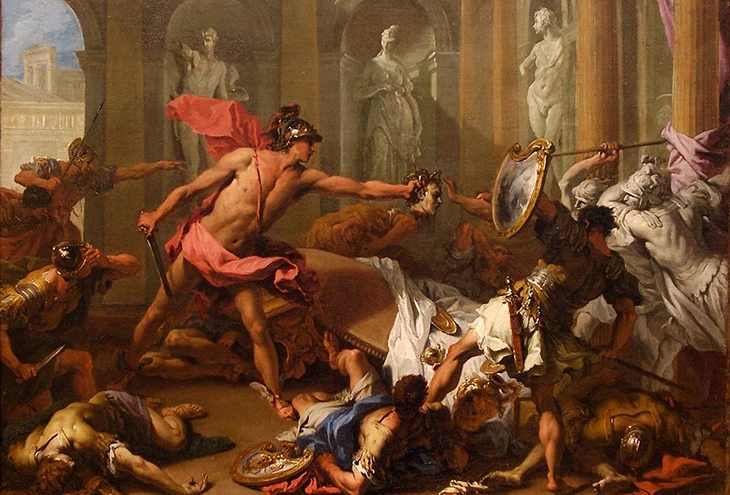
Perseus, wearing Hades' helmet, slays Medusa—a scene from ancient Greek myth.
Later, the magical helmet also appeared in the Scandinavian sagas. Gods and heroes wore it during battles and secret expeditions. In skaldic poetry—the verses of Scandinavian poets—the invisibility helmet appears beginning in the 9th century AD.
Invisibility in Plato's Philosophy
The ancient Greek philosopher Plato, in the 4th century BC, included a story about an invisibility ring in his work "The Republic"—but not for the sake of a fairy tale. This story is told by Glaucon, Plato's brother, who appears as Socrates' opponent in the dialogue.
According to Glaucon, a shepherd named Gyges served the king of Lydia. One day, after heavy rains and an earthquake, the earth opened up, and he descended into the resulting crevice. Inside, he discovered a tomb containing a copper horse. Inside the horse lay a corpse of inhuman size, and on his finger was a gold ring. 
"The Ring of Gyges" — painting by an unknown artist, Ferrara, 16th century
Gyges took the ring and soon discovered that turning the stone inward made him invisible. He infiltrated the palace, seduced the queen, killed the king, and became the ruler of Lydia. Glaucon asks: would anyone else have acted differently? Socrates himself ultimately counters: the one who misused the ring enslaved himself to his own desires. But the man who resisted temptation retained control over himself—and therefore is happy.
Later, Cicero retold this same story in his treatise "On Duties." Most ancient philosophers agreed on one thing: a truly good person will not betray themselves, even with absolute impunity.
Magic Rings from the Middle Ages to Tolkien
In the Middle Ages, a ring granting invisibility became more popular than a helmet. The Italian poet Matteo Boiardo began writing the chivalric poem "Orlando Innamorato" (Orlando Innamorato) in 1476. The heroine Angelica's magic ring could do two things at once: put it in your mouth to become invisible, and put it on your finger to dispel evil spells. 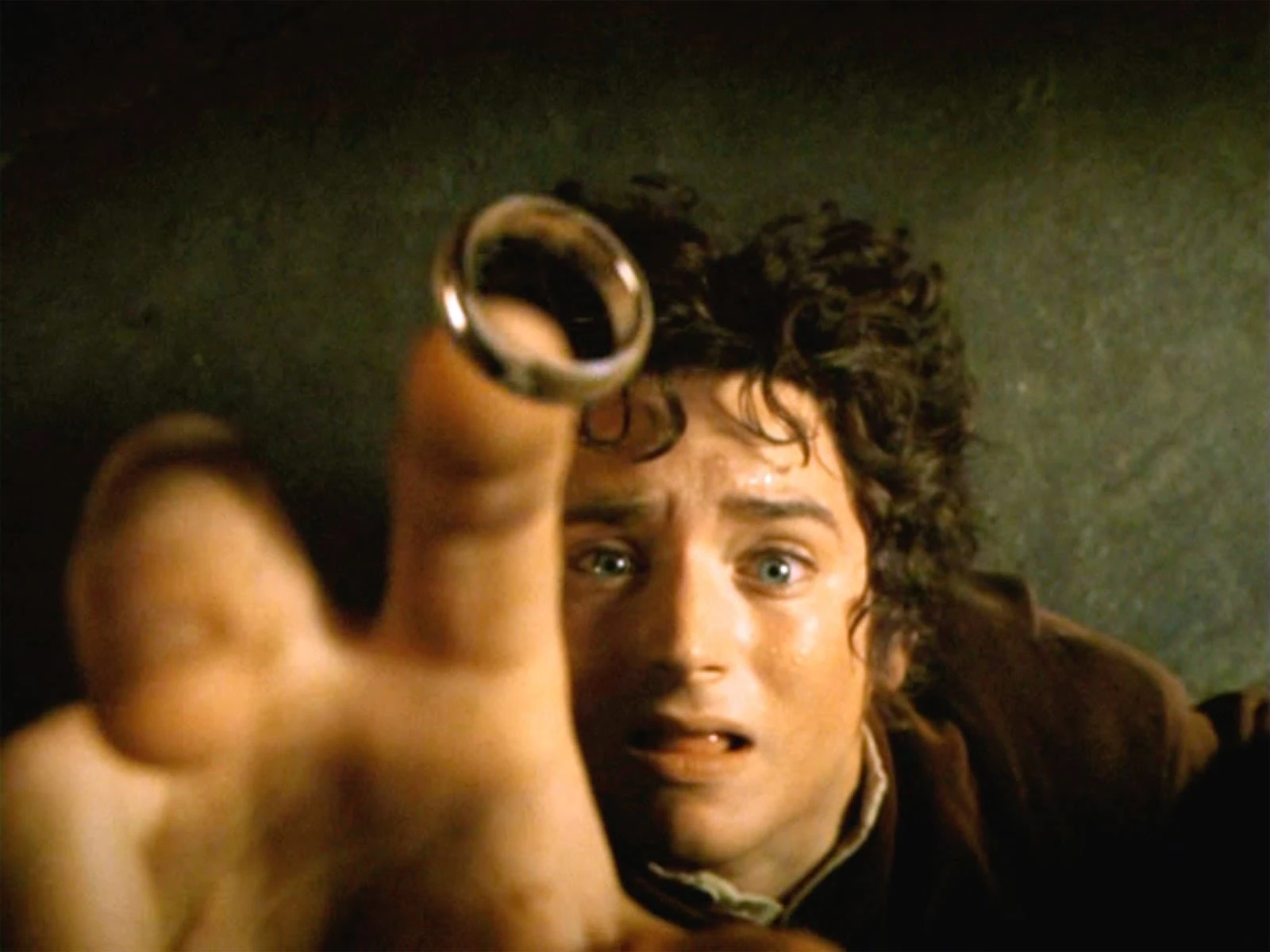
Frodo Baggins (actor Elijah Wood) at the Prancing Pony tavern — still from the film "The Lord of the Rings"
In the 20th century, the magic ring found new life in the novels of J.R.R. Tolkien. His One Ring made the hobbit Frodo invisible to everyone except Sauron. Researchers have long debated where Tolkien got this idea. Professor Mark Horton and Tolkien Society researcher Lynn Forest-Hill have suggested that it was inspired by a real gold ring from the Roman era. 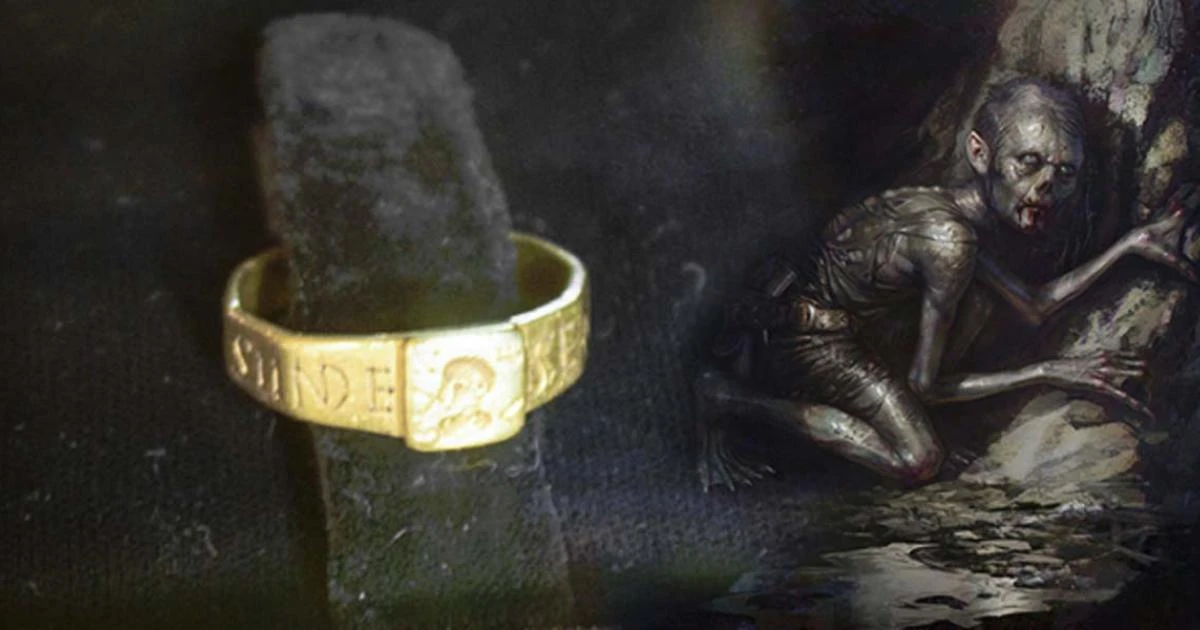
A 4th-century Roman ring found in England. Tolkien knew about it—and it could have inspired him to create the One Ring.
The story goes like this. In 1785, a gold ring bearing the inscription "Senicianus, live in peace with God" was found near the village of Silchester. In 1928, during excavations of a Celtic temple to the god Nodens in Lydney Park (Gloucestershire), a lead tablet was found. On it, a certain Silvianus cursed a man named Senicianus, who supposedly stole the ring. The coincidence of the names led researchers to believe they were referring to the same object. Tolkien consulted on these excavations as an expert on the Anglo-Saxon language. He completed his report on the name of the god Nodens in 1932—the same year he completed the manuscript of The Hobbit.
Robes, Cloaks, and Other Ways to Disappear
Besides helmets and rings, there were many other ways to become invisible. Cloaks and capes with such properties are found in Welsh and Germanic mythology. The cloak of invisibility was one of the thirteen treasures of the British Isles—legendary magical objects from Arthurian legend. 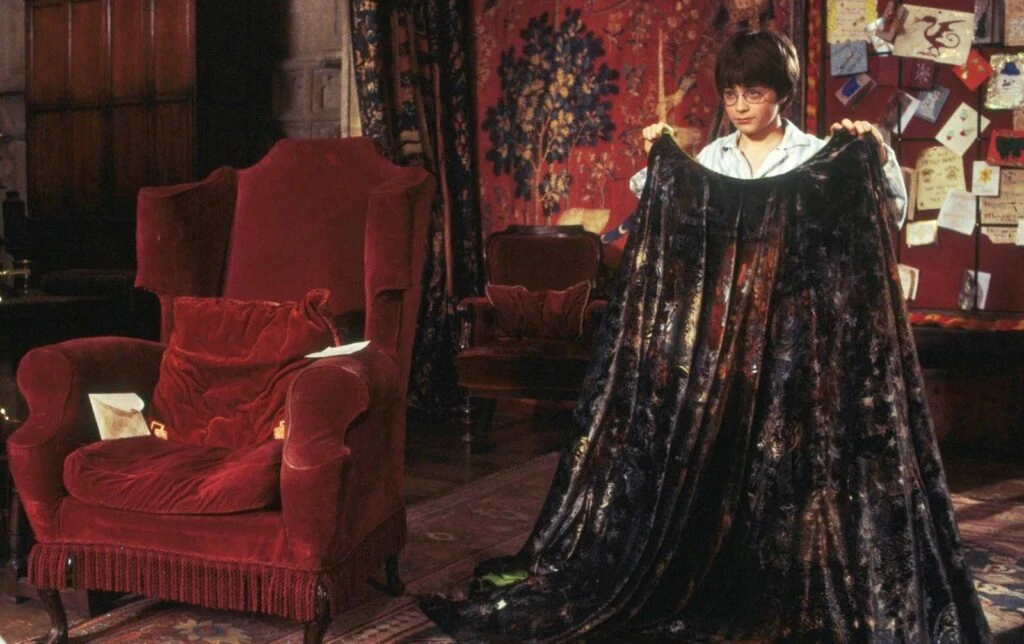
Harry Potter's invisibility cloak is one of the most recognizable magical objects in modern culture.
In the Norse sagas, the cloak of invisibility appears almost as often as a helmet. In the Germanic epic "The Nibelungenlied," the hero Siegfried uses it to secretly defeat Brunhild. After a long period of oblivion, the image of the magical cloak was revived by the Brothers Grimm. And in their fairy tale "The Twelve Dancing Princesses," recorded in the early 19th century, it is with its help that the detective unravels the mystery of the enchanted palace. 
In Chinese mythology, it wasn't people who could disappear, but rather the creatures themselves—for example, the Futzanlong dragons, guardians of underground treasures.
In Japanese folklore, the invisibility cloak is called "kakuremino" (literally, "hiding cloak of reeds"). Chinese myths ascribed the ability to disappear to creatures themselves—for example, the Futzanlong dragons, guardians of underground treasures. Irish leprechauns disappear without any objects—simply by their very nature. Across the world, from Siberia to South America, potions and spells that grant invisibility were believed.
Wells, Science, and Modern Technology
At the end of the 19th century, invisibility moved from the world of magic to the world of science. In 1897, H.G. Wells' novel "The Invisible Man" was published: its hero becomes transparent using a chemical substance and special radiation. The book instantly became a bestseller and has been adapted into numerous films in the 20th and 21st centuries. 
The classic image of the invisible man from the film adaptation of H.G. Wells' 1933 novel
What seemed like pure science fiction a hundred years ago has now partially become reality. The simplest path to invisibility is camouflage clothing, allowing one to blend into the background. But scientists have gone further.
Since 2010, the Canadian company Hyperstealth Biotechnology has been developing a material called Quantum Stealth. This is a thin plastic made of many microscopic lenses. Light rays striking these lenses are dispersed, making everything behind the material at a certain distance indistinguishable. 
Quantum Stealth material from the Canadian company Hyperstealth – lenses scatter light and hide objects behind it
Developer and company president Guy Kramer has filed four patent applications describing 13 material variants for use in various conditions. The fabric requires no batteries or cameras and, according to its creators, hides objects in the visible, ultraviolet, and infrared ranges. The US, UK, Canadian, and several other militaries have already expressed interest in the development.
Physics on the Edge of Magic
At the same time, physicists are working with metamaterials – substances that do not occur in nature. Their structure causes electromagnetic waves to bend around an object, making it invisible to devices. In 2006, British physicist John Pendry of Imperial College London achieved this effect for the first time. However, only in the infrared range—the object was still visible to the human eye. 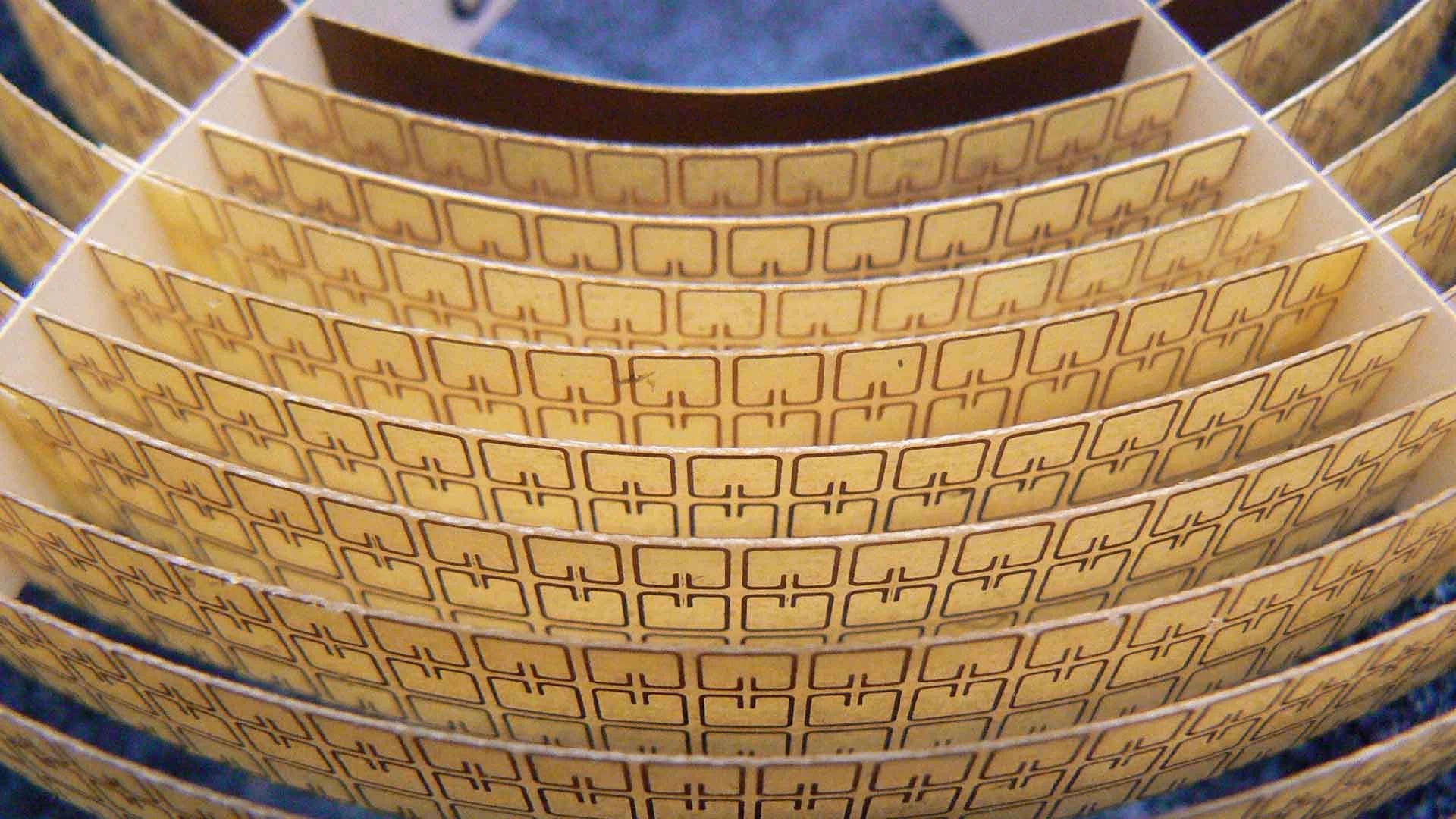
A microwave "invisibility cloak" is the world's first working prototype of an invisibility device, created by scientists from Duke University in 2006.
Many experts are skeptical about the prospects of such developments. It's impossible to completely circumvent the laws of physics: under certain conditions, a person will still be visible. But steps have already been taken. The dream of invisibility has accompanied humanity for several thousand years—from Greek myths to modern laboratories. And it is gradually becoming more than just a dream.
If such technology were ever available to everyone, how would it change society? Would we become freer—or, conversely, more vulnerable? What do you think?