Ever Walked Into a Room and Forgot Why? Science Explains What's Happening (6 photos)
You walk into a room—and instantly forget why you came in. A moment later, embarrassment sets in: is your memory failing you already? But there's no need to blame yourself. Almost everyone experiences these momentary memory lapses, and they happen for a very specific reason that psychologists have been studying for nearly two decades. Here is how the "doorway effect" works, how scientists discovered it, and how to keep your train of thought when stepping across the threshold. 
What Happens When You Forget Your Intentions at the Door
It’s a scenario nearly everyone knows: you step into a room and suddenly draw a complete blank. When it happens in front of others, a simple brain freeze can feel downright embarrassing. But cognitive psychologists reassure us that a failing memory isn't to blame. Instead, the culprit is a specific brain mechanism known as the doorway effect.
Throughout the day, the human brain operates across different levels of mental focus. It can concentrate on an overarching goal, a specific plan, or a single physical action. This shift in perspective is neatly illustrated by the classic parable of the three bricklayers. When asked what they were doing, the first replied, "I’m laying bricks." The second said, "I’m building a wall." The third proclaimed, "I’m building a cathedral." All three were doing the exact same task, but each framed their work at a different level of abstraction. 
Forgetting why you walked into a room isn't a sign of absent-mindedness—it's just how the brain operates
In much the same way, our minds constantly shift between levels of focus—moving back and forth between big-picture goals and minor details. It is precisely during these shifts that the doorway effect tends to strike. This mental pivot happens seamlessly in the background as the brain manages dozens of processes at once, making an occasional slip at the boundary between tasks a normal occurrence rather than a cause for concern.
It's Not Just About Misplaced Thoughts at the Door
A physical doorway isn't the only trigger. A similar mental hitch often happens in conversation. While someone else is speaking, a thought or question pops into your head. Out of politeness, you wait for a pause to chime in—only to realize when your turn comes that the thought has completely vanished. The underlying mechanism is identical, just without an actual door involved. 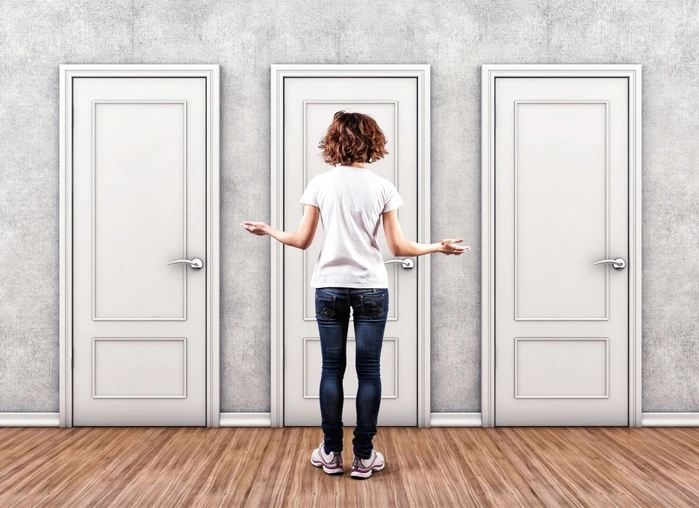
Every new decision acts like a doorway: the brain opens one mental door and closes the previous one
Everyday routines offer a clear example of this. Imagine you're getting ready for work, holding several sequential goals in mind: leave the bedroom, get in the car, arrive at the office. If halfway out the door you remember your keys and turn back, the sub-task of "grab keys" instantly displaces the broader goal of "drive to work." Because each plan competes for conscious attention, introducing a new task disrupts the established chain of events. With the brain toggling between such mental models dozens of times a day, a brief pause at the threshold is just a minor glitch in a complex system.
How Scientists Discovered the Doorway Effect
The doorway effect was first documented in 2006 by psychologists Gabriel Radvansky and David Copeland at the University of Notre Dame. They coined the term "location-updating effect," observing that memory performance degrades whenever a person transitions from one environment to another. 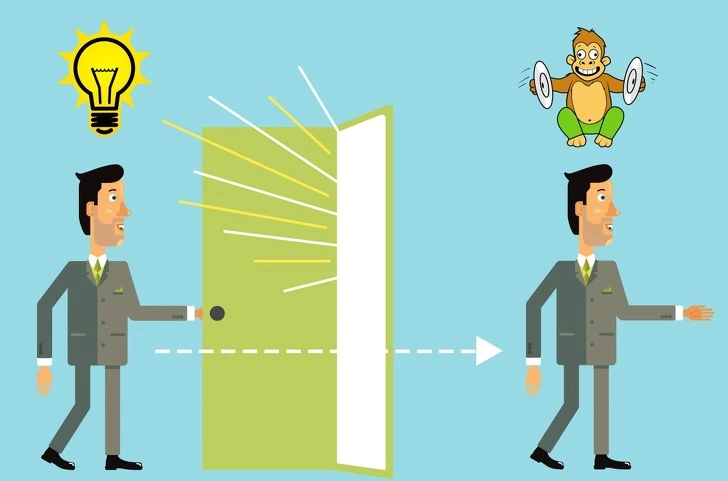
Study participants carried objects between virtual and real rooms, testing their memory of what they held
In 2011, Radvansky expanded on the research alongside colleagues Sabina Kravitz and Andrea Tamplin. Participants navigated a virtual environment, moving objects from room to room while keeping track of what they were carrying. Passing through a doorway consistently lowered recall accuracy—regardless of the size of the room or the distance walked. When the researchers repeated the experiment in a physical space using actual objects inside boxes, the results were identical. The researchers concluded that the surroundings themselves weren't the issue; it was the act of crossing a boundary between rooms.
Why the Brain "Closes the Door" on Previous Spaces
Radvansky explains this phenomenon using the concept of an "event boundary." The brain interprets passing through a doorway as a cue that one mental episode has ended and another has begun. Information associated with the previous room gets filed away into a separate memory folder, making it harder to retrieve than details relevant to your immediate environment. 
Getting confused at the doorway is the brain's reaction to a new "episode," not a memory failure
It seems logical that simply walking back into the original room would restore your memory. Researchers tested this theory in a separate experiment by having participants re-enter the room where they had first picked up the objects. However, recall did not improve. This proved that retrieval isn't tied to physical surroundings, but rather to the boundary crossing itself. Later, psychologists Zachary Lawrence and Daniel Peterson of Knox College demonstrated that the effect occurs even when people merely imagine walking through a door. Just visualizing a change of scenery is enough for the brain to "close" the previous memory episode.
How to Outsmart the Doorway Effect
Understanding how this cognitive glitch works makes it easier to prevent. If a stray thought strikes while someone is talking, rather than trying to hold onto it until you can speak, quickly jot down a keyword on paper or in your phone's notes app. This prevents your mind from discarding the thought during the next mental shift. 
A simple habit—saying your goal out loud before leaving the room—helps prevent memory lapses
A similar trick works when hunting for misplaced items. If you head back into your apartment for your keys, say your objective out loud before stepping through the door: "I'm getting my keys." Verbalizing your intent keeps it at the front of your mind, preventing external distractions—a stain on the rug, a hungry cat, or a neighbor in the hallway—from pushing it out. While none of these strategies can eliminate the doorway effect entirely—since it's baked into how human memory is structured—forming these habits reduces awkward lapses and helps you quickly recall what brought you there in the first place.
How does the doorway effect usually catch you off guard? Do you forget why you walked into a room, lose your train of thought during a conversation, or get distracted along the way? Share your experiences in the comments below.