In Hubble's view, a pillar of cosmic dust resembles a cat sitting with its back to the viewer. Its head is turned to the right, marked by a glowing red spot right where an eye would be. Located in the Carina Nebula about 7,500 light-years from Earth, this striking region was featured in new images released by NASA on October 29. 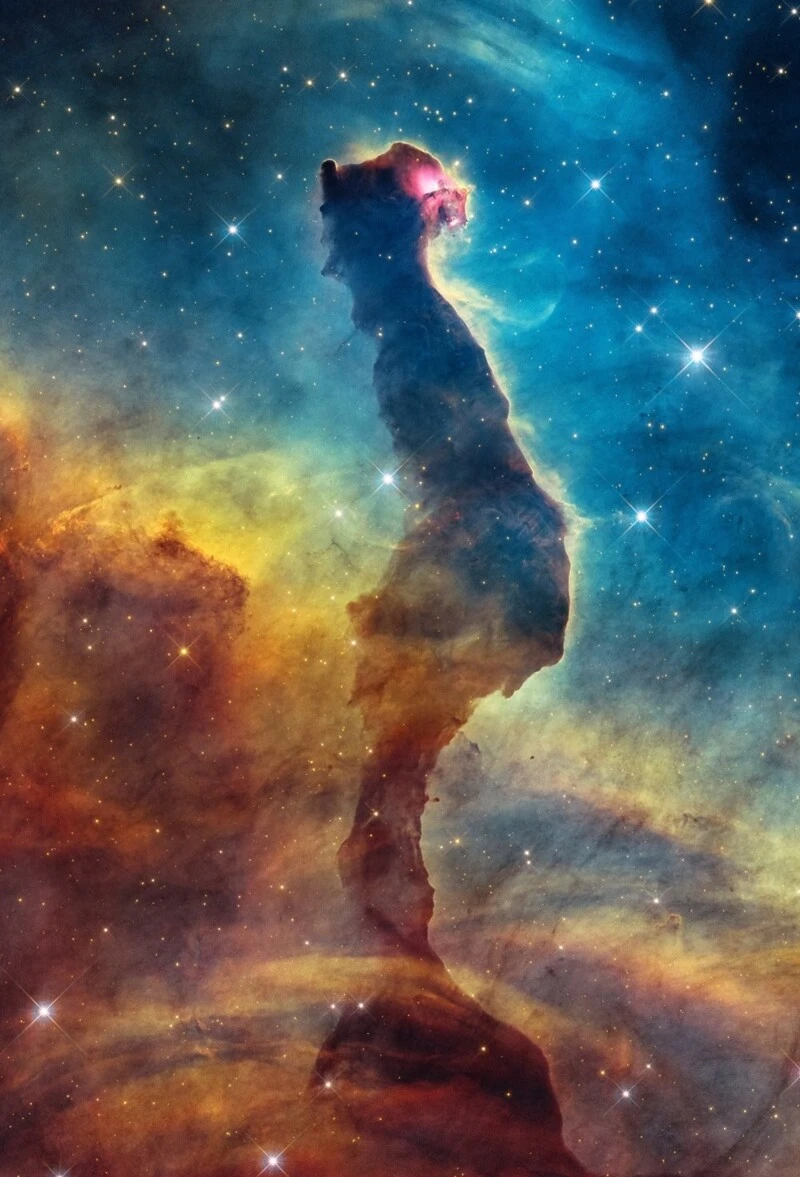
Hubble, visible light. NASA, ESA, STScI; Joseph DePasquale.
Visible light leaves much of the cloud's inner structure hidden behind dense dust. James Webb’s near-infrared view, however, pierces through to reveal a sea of stars and complex cloud features. The glowing "eye" is likely tied to a young star still embedded within the dust. 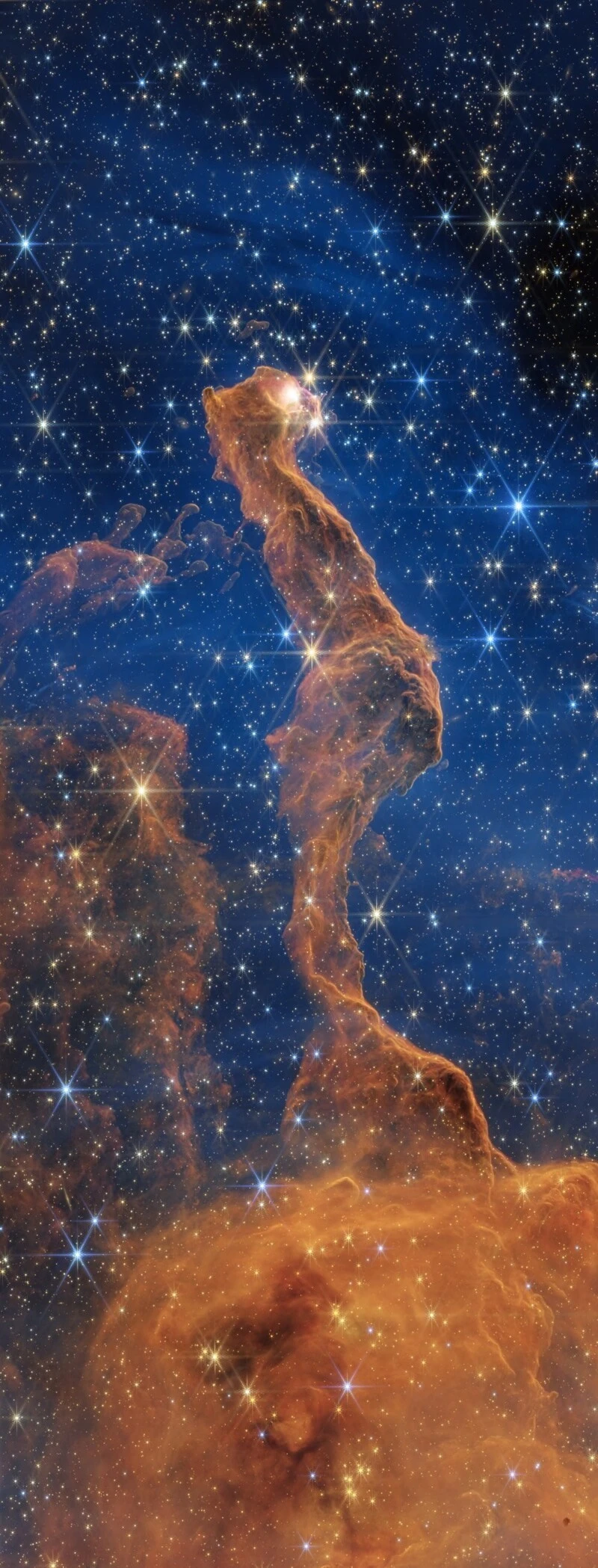
James Webb, NIRCam. NASA, ESA, CSA, STScI; Joseph DePasquale.
A third perspective, captured in mid-infrared wavelengths, showcases radiation emitted by warm dust and carbon-bearing molecules—giving the exact same region a dramatically different look. 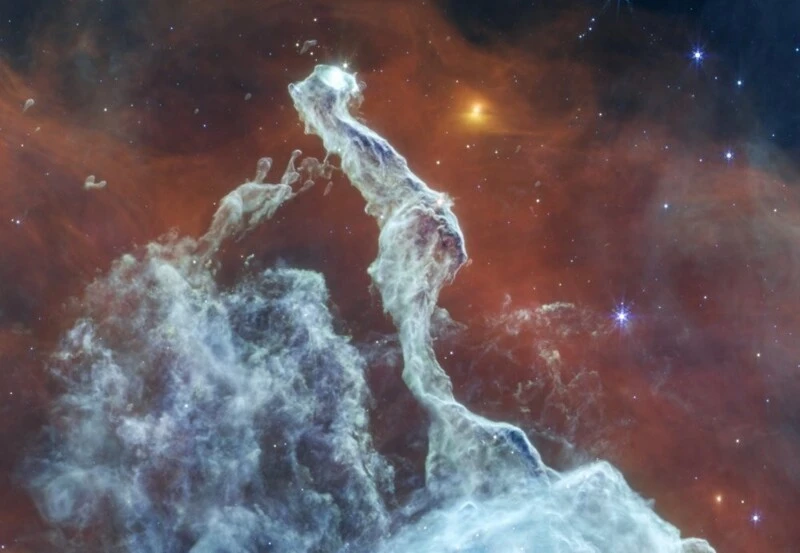
James Webb, MIRI. NASA, ESA, CSA, STScI; Joseph DePasquale.
Intense radiation and stellar winds from nearby massive stars likely sculpted the pillar's distinct shape. While its dense pockets of dust have so far resisted destruction, this cosmic silhouette is ultimately living on borrowed time.
Add your comment
You might be interested in:




Stars Carve Out a Cavity Hundreds of Light-Years Wide in a
The Hubble telescope took a picture of the
NASA posted footage of a rare “ring-shaped” solar eclipse
NASA's Curiosity rover showed what the night sky looks like
NASA Universe: There are black holes larger than our entire

Ancient Star Cluster Moves Against the Galactic Tide (1
A NASA astronaut shows how they train upside down on the ISS

A welder from Poland didn't believe in NASA's

NASA presented an impressive map of the seabed

A single gesture that made someone’s day: a man gives a

How Rowan Atkinson transforms into Mr. Bean

A clear demonstration of the difference between a $1, $5,

Top 10 Foods That Lower Blood Pressure (11 photos)

An American man reveals a bunker he spent 3 years preparing
Witches on roller skates—brooms included

An orchestra plays a prank on their conductor during his

A dad made a realistic WALL-E costume for his daughter

17 Photos of Famous People Goofing Off Like Kids (18 photos)
