A Millisecond of a Nuclear Explosion: The Story Behind One Photo (3 Photos)
The human eye is physically incapable of perceiving what is captured in this photograph. Resembling an alien jellyfish, this terrifying fireball existed for less than a thousandth of a second. 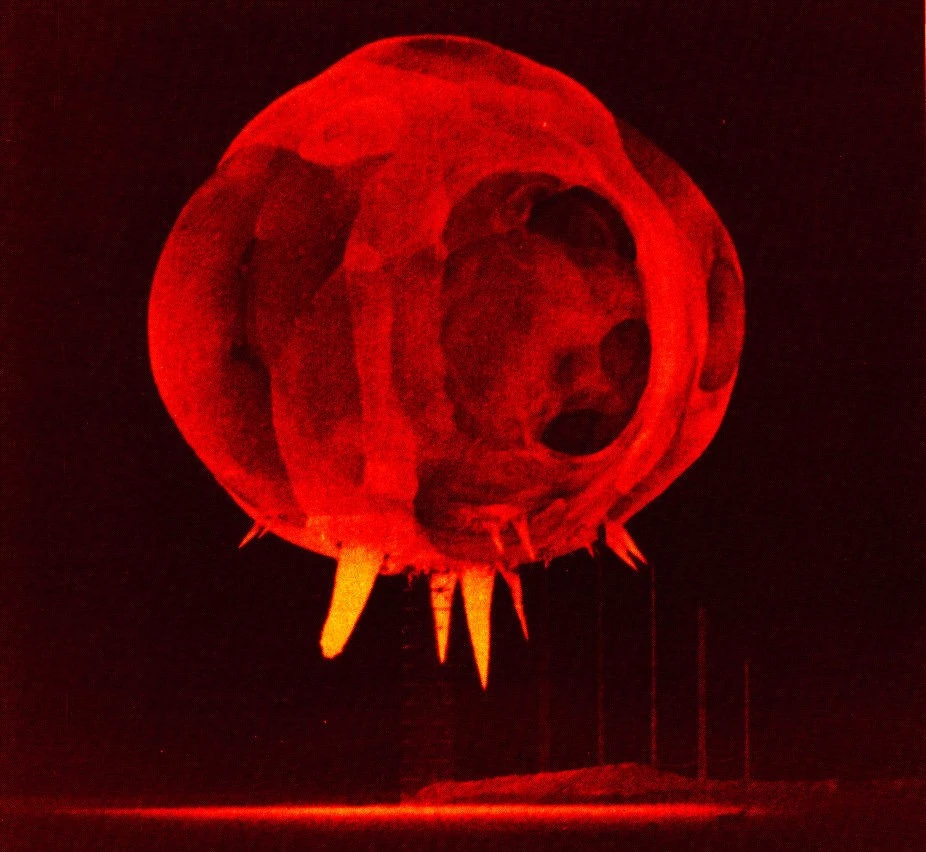
Yet the photograph exists—and the technology required to capture it had to be invented entirely from scratch.
What Are We Looking At?
This image captures a nuclear explosion less than one millisecond after detonation. Taken in 1952 during Operation Tumbler-Snapper at the Nevada Proving Grounds, it shows a fireball roughly 20 meters across, expanding exponentially with each passing microsecond.
The strange spikes protruding from the bottom of the sphere are not part of the bomb itself. They are the vanishing steel guy-wires that anchored the shot tower. In the first instant of detonation, intense thermal radiation vaporized the metal into plasma. For a fraction of a second, the superheated vapor retaining the shape of the cables glowed brighter than the fireball itself.
Why Conventional Cameras Were Useless
Even the fastest mechanical shutter of the era could not physically open and close in time; scientists were dealing with fractions of a microsecond.
Yet the researchers engineering weapons capable of devastating planetary life needed to capture these precise early moments: how the fireball expanded, and how the shockwave formed and propagated. Without this data, evaluating the true yield and efficiency of a specific weapon design was impossible.
Solving the problem demanded a radical engineering solution: a camera operating without any moving mechanical parts.
The breakthrough came from MIT engineer Harold Edgerton, who invented a device known as the Rapatronic camera. 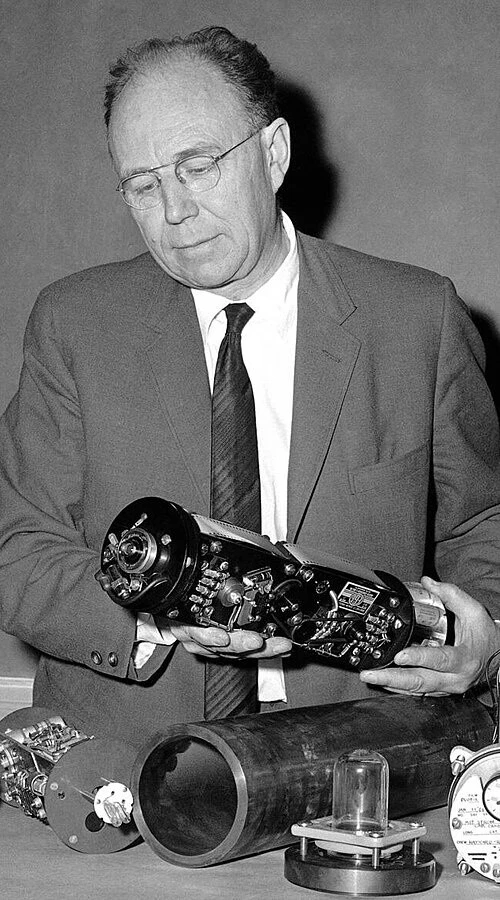
Harold Edgerton with his cameras
Instead of a conventional mechanical shutter, the camera relied on two polarizing filters oriented at a 90-degree angle to each other. Positioned this way, they blocked light completely—not a single photon could pass through.
Placed between them was a Kerr cell—a container filled with a specialized liquid capable of briefly rotating the polarization of light when triggered by an electrical pulse. This electrical pulse, rather than mechanical movement, "opened" the camera for a tiny fraction of time: roughly 10 nanoseconds. An exposure of just ten billionths of a second is an interval almost impossible for the human mind to comprehend.
One Frame, One Camera
The Rapatronic technique had one major limitation: film could not advance quickly enough to record a sequence of frames on a single camera. To capture the detonation's evolution, arrays of up to ten separate cameras were set up, each timed to fire with a precisely calibrated delay after the last. Only by combining single exposures from multiple units could researchers reconstruct a frame-by-frame sequence of the explosion's initial microseconds. 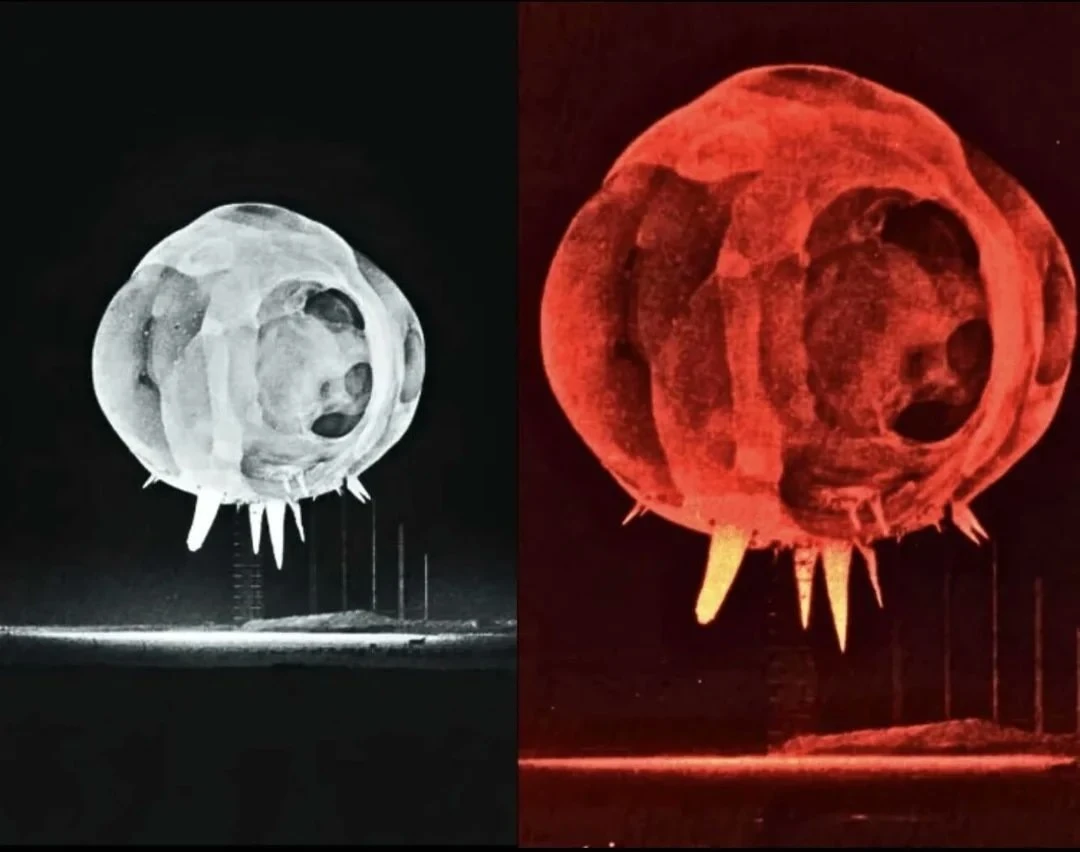
This photograph is a haunting effort to peer into the heart of a process that could vaporize a human being in the blink of an eye. Humanity sought to measure, dissect, and comprehend the physics of forces engineered to erase entire cities.
Yet despite being born of pure destructive power, the image possesses an eerie, organic beauty—resembling not a test of a weapon of mass destruction, but some surreal organism from the deep ocean or outer space.