How a disqualification made an Italian baker the Olympic king (6 photos + 1 video)
Throughout the history of the Olympic Games, gold goes to the best – the strongest, the most resilient, the fastest. But sometimes the hero finishes last, or doesn't finish at all. 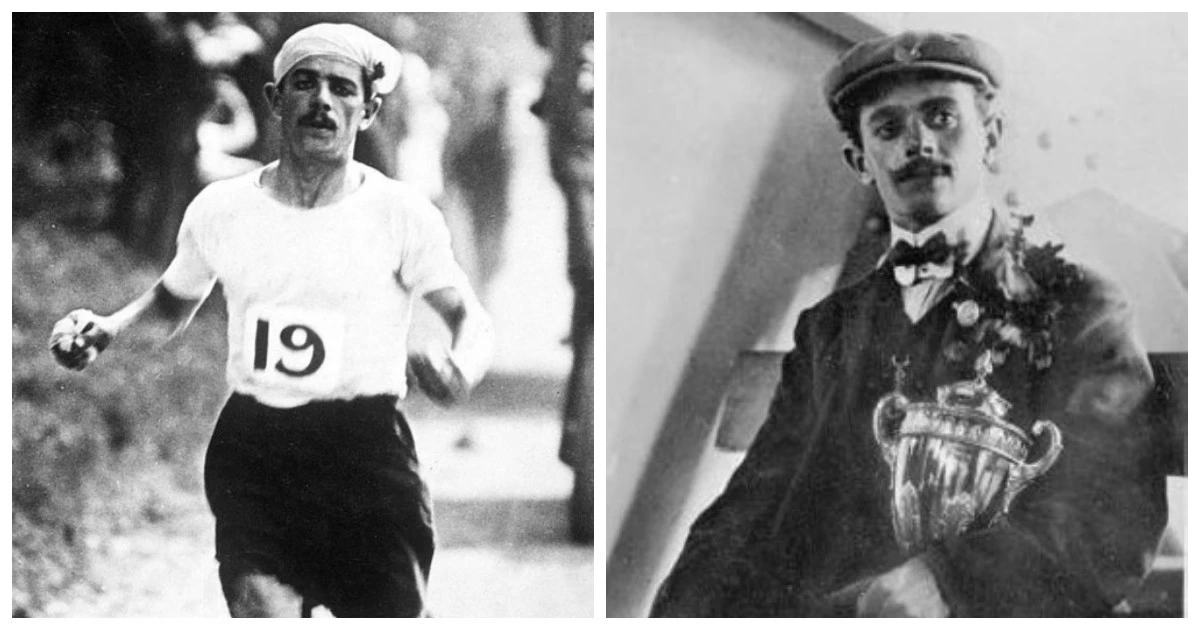
London in 1908 gave the world not just a marathon, but a tragicomic spectacle starring a diminutive Italian runner with an iron lung and an unusual fate. 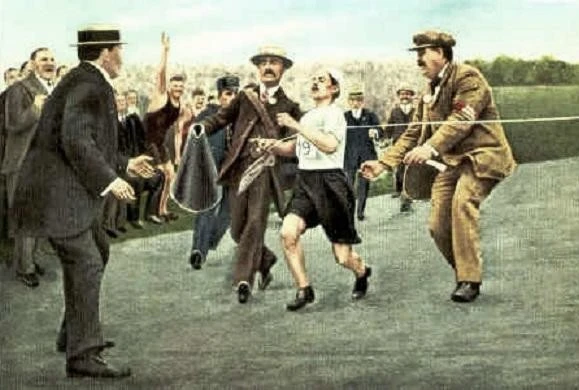
Dorando Pietri stood just 157 cm tall. His short legs didn't stop him from breaking into the elite at the age of 19, still in his work clothes. Legend has it that he showed up at an amateur race in Carpi after his shift, put on the first pair of shoes he could find, and left behind even Pericle Pagliani, the star of Italian running. His debut in Bologna (3 kilometers) brought him silver, and a year later, he won the 30 kilometers in Paris.
At the unofficial 1906 Games in Athens, Pietri withdrew from the marathon due to an intestinal infection. However, in 1907, he won the Italian Championship. By London 1908, he had become the country's undisputed leader in all long-distance events, from 5 kilometers to the marathon.
So, it was a hot July day at Windsor Castle. The start was given at the gates of the royal residence so the monarch's children could wave to the runners. The 42 kilometers 195 meters distance—not yet a standard at the time, but a temporary measure—became torture that day. The heat, dirt roads, and lack of proper refreshment stations turned the race into a race for survival. 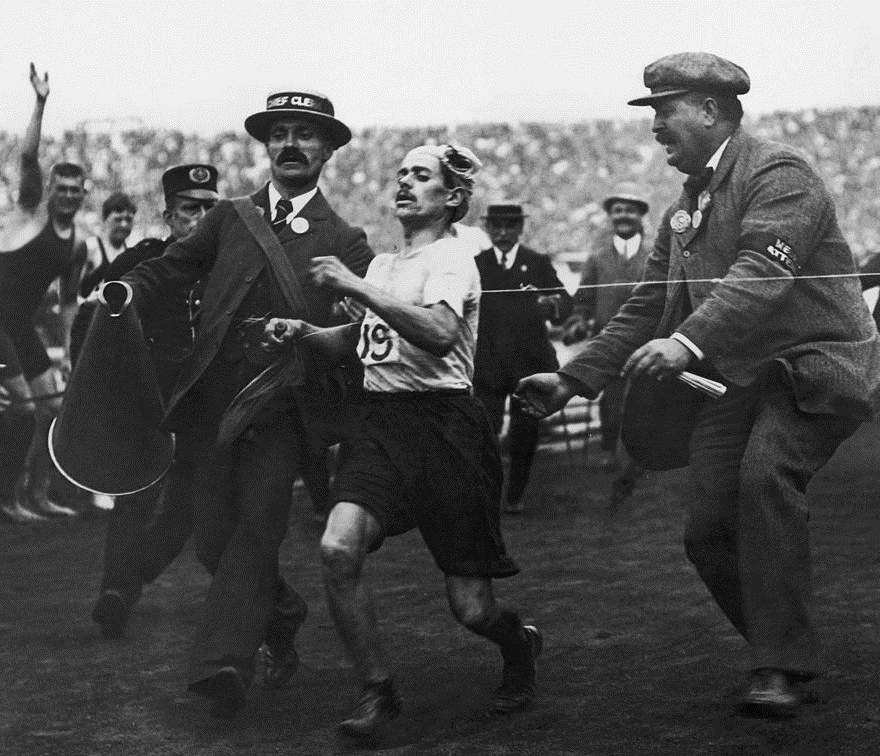
Dorando Pietri arrives at the finish line of the 1908 Olympic Marathon, accompanied by Dr. Michael Joseph Bulger (right)
Pietri started slowly, but by kilometer 32 he had moved into second place, four minutes behind South African Charles Hefferon. When the leader gave up, the Italian surged forward and overtook him at kilometer 39.
And then all hell broke loose. Running into White City Stadium, Pietri lost his bearings: he took a wrong turn instead of the finish line, and the judges had to turn him around. After taking a few steps, he collapsed as if struck dead.
"The little red feet moved incoherently, but drummed on the ground, driven by a higher will," wrote eyewitness Arthur Conan Doyle, who was working as a reporter for the Daily Mail at that race. 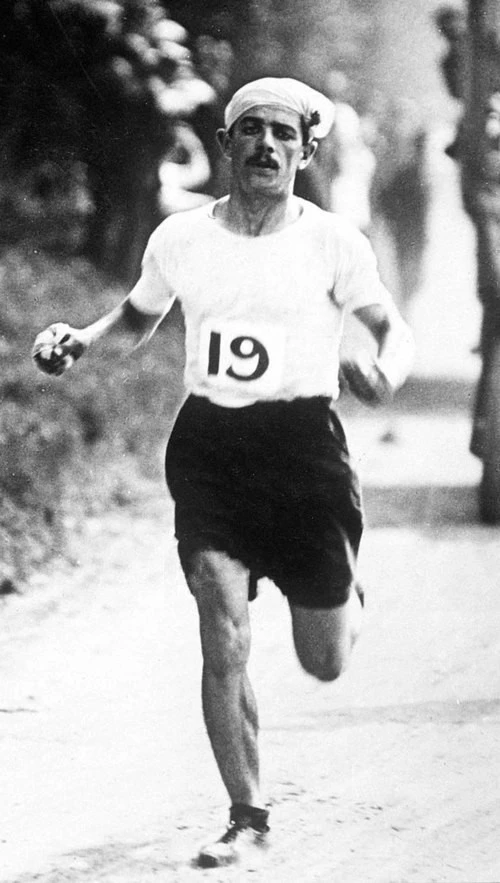
Pietri fell again and again. Ten times in the final minutes. The judges and volunteers lifted him up, almost carrying him to the coveted tape. The crowd first gasped, then sobbed, and then erupted in applause when the Italian finally crossed the finish line.
Time: 2:54:46. He looked like the winner. But 32 seconds later, American Johnny Hayes ran into the stadium. His team immediately protested: according to the rules, a runner is not allowed outside assistance. Pietri had been assisted repeatedly, in full view of everyone. The jury annulled his result. The gold was awarded to Hayes.
(It was later discovered that Pietri had been given microdoses of strychnine during the race. Back then, it was a legal endurance drug. The runner himself attributed his collapse to a heavy meal before the start.) 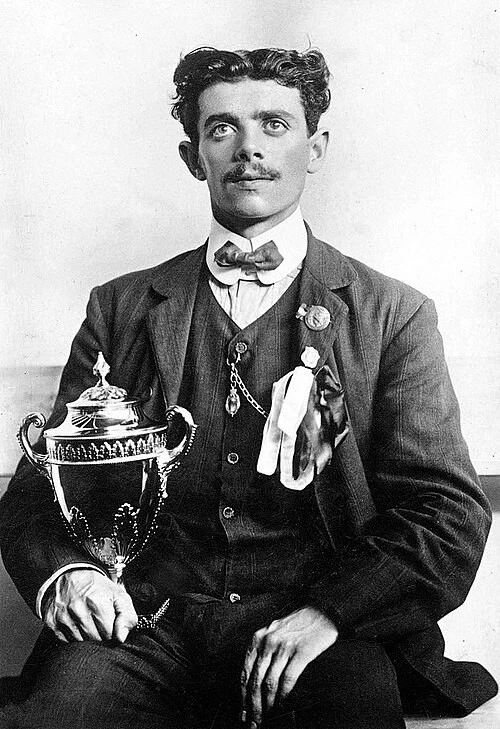
Pietri holds a silver-gilt cup presented by Queen Alexandra in 1908.
But the crowd had already chosen its champion. Even Queen Alexandra, touched by the Italian's tenacity, presented him with a silver-gilt cup. Conan Doyle launched a subscription to help Pietri open a bakery in his homeland. They raised 300 pounds—a huge sum at the time. Sir Arthur himself contributed the first five.
That same year, a rematch between Pietri and Hayes was held in New York. The Italian won by half a lap. This race inspired Irving Berlin's first hit, the song "Dorando." On his American tour, Pietri won 17 of 22 races. Returning to Italy, he ran for another two years. His final marathon, in Buenos Aires, in 1910, set a personal best: 2:38:48. 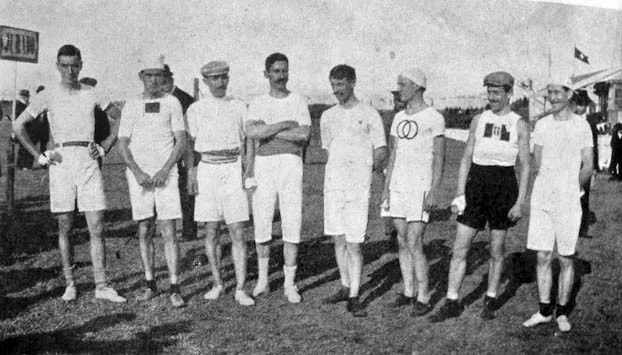
Pietri (second from right) with his entrants in the 1910 Argentine Marathon, which he won.
He also won the final race of his career (Gothenburg, October 1911). He was 26. In three years of professional racing, Pietri earned 200,000 lire in prize money alone—a fortune at the time.
But he proved a lousy businessman. The hotel he opened with his brother failed. Pietri moved to San Remo, where he ran an auto repair shop. He died there at 56—forgotten by businessmen, but forever etched in history as the man who lost the race but won immortality.