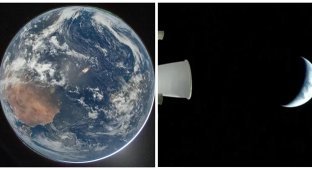
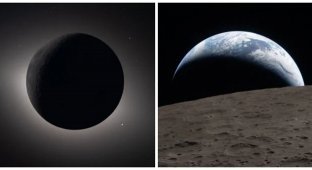
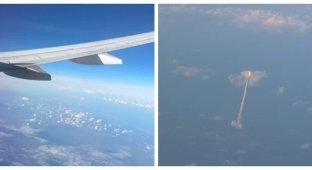
The Orion spacecraft carrying the Artemis 2 lunar mission astronauts has returned to Earth, NASA reports. (6 photos + 2 videos)
On the night of April 11, the American Orion spacecraft, carrying four astronauts, entered Earth's atmosphere and splashed down in the Pacific Ocean off the coast of California a few minutes later. This marked the end of the Artemis 2 mission, the first time humans had landed on the moon since the Apollo 17 crew in December 1972. 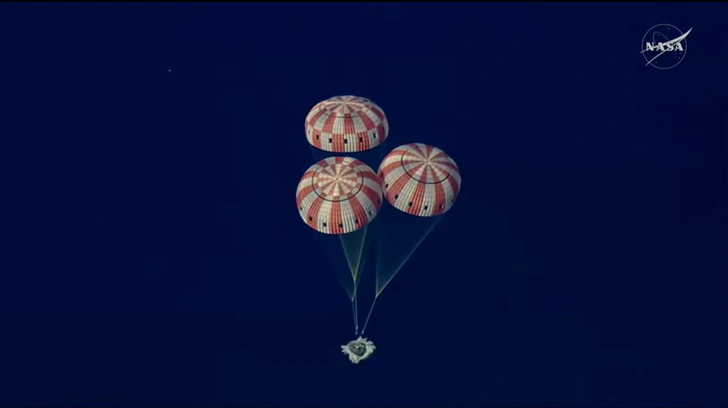
Artemis 2 also became the first manned mission in the history of the American Artemis lunar program, whose goal is not only to land humans on the Moon after more than half a century (currently scheduled for 2028), but also to gradually establish a habitable base near the Moon's South Pole.
The Artemis 2 crew included American astronauts Reid Wiseman, Victor Glover, and Christina Koch, as well as Canadian Space Agency (CSA) astronaut Jeremy Hansen. The plan for the nearly 10-day mission called for the Orion spacecraft, launched on the night of April 2nd aboard the Space Launch System (SLS) rocket, to enter an elliptical orbit around the Earth, then fly to the Moon, then circle the natural satellite on a free-return trajectory and return to Earth. 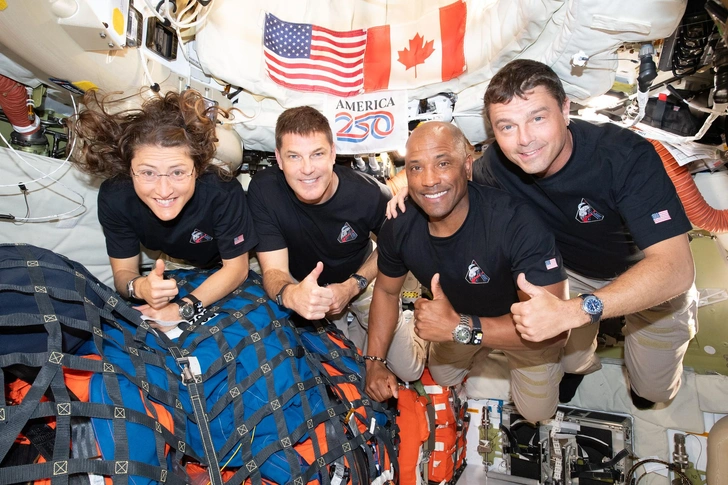
Group photo of the Artemis 2 crew from aboard Orion. Left to right: Christina Koch, Jeremy Hansen, Reid Wiseman, and Victor Glover
Ultimately, the mission proceeded entirely according to plan, with no significant issues on board the spacecraft, the testing of which in crewed flight mode was one of the primary objectives of Artemis 2. However, there were some hiccups: intermittent problems with the Orion toilet caused inconvenience to the crew, and on the penultimate day of the flight, NASA reported a helium leak in the pressurization system of the fuel oxidizer tank in the spacecraft's service module.
The leak was within acceptable limits and did not impact the mission, but several modifications to the pressurization system design are planned for future Artemis missions to address this issue.
As for other Artemis 2 achievements, the mission was marked by several achievements and records. Thus, Christina Koch became the first woman to travel into interplanetary space, Victor Glover the first African-American astronaut, and Jeremy Hansen the first person from outside the United States. On the day of the lunar flyby, Orion broke the record for the longest human flight from Earth (400,171 kilometers), set in 1970 by Apollo 13, reaching a distance of 406,779 kilometers.
During the flight, the astronauts tested various Orion systems, including the spacecraft's manual control system, tested various equipment, and took numerous photographs of the Moon, Earth, and stars—many of the images published so far will surely become part of the golden age of space photography. It is also worth mentioning that during the lunar flyby, Wiseman, Glover, Cook, and Hansen witnessed a solar eclipse—the Sun disappeared behind the Moon for almost 54 minutes.
Perhaps the most important result of Artemis 2 to date is the surge of interest in space and cosmonautics—the first human flight to the Moon in over 53 years attracted enormous public attention worldwide. It's possible that it was during these days that hundreds of teenagers decided to dedicate their lives to space in one way or another.
How the Orion Landing Went 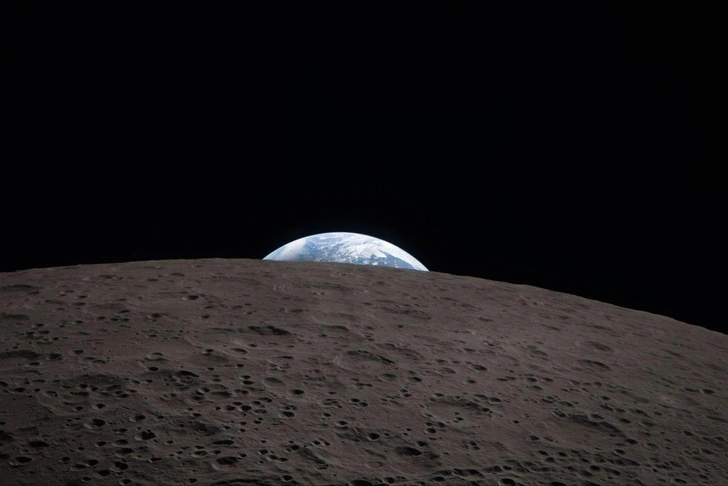
As with the Apollo missions, the Orion mission plan did not include entering low Earth orbit before landing. On April 10, at 9:53 PM Moscow time, the spacecraft completed the third and final trajectory adjustment planned en route to Earth. Meanwhile, the astronauts donned emergency spacesuits and completed all necessary checks to prepare the spacecraft for reentry.
At 2:33 AM Moscow time on April 11, the spacecraft's command and service modules separated. Three and a half minutes later, the command module performed a 19-second burn of its attitude control thrusters to distance itself from the service module (which soon burned up in the atmosphere) and adjust the reentry angle.
Service module separation
At 2:53 a.m., the command module entered the atmosphere at an altitude of approximately 122 kilometers above Earth, southeast of Hawaii. According to calculations adjusted in the last few hours, its velocity at this point was 39,688 km/h (11.02 km/s versus the previously announced 10.66 km/s). Here, Orion's heat shield took the brunt of the impact—the shock wave that formed ahead of it could have heated it to a maximum of 2,760°C. At this point, the spacecraft resembled a fireball, and the cocoon of plasma that enveloped it completely blocked communications with Mission Control for six minutes.
Having reached an altitude of approximately 60 kilometers, Orion bounced slightly, like a flat pebble thrown along the water, and then began its descent along a relatively flat trajectory. Previously, the maximum G-force the astronauts would experience during descent was estimated at 3.9G, comparable to the G-force experienced during return from the International Space Station (ISS).
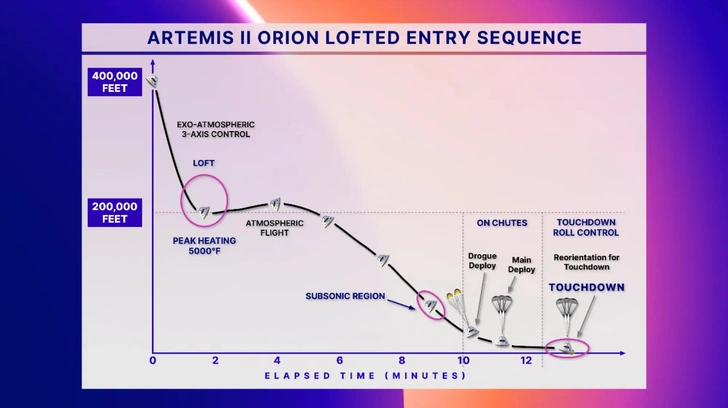
Orion reentry and splashdown diagram
At an altitude of approximately 8 kilometers, when the spacecraft slowed to approximately 523 km/h (325 mph), Orion's complex parachute system took over.
First, pyrotechnics ejected the nose cone cover, which began to descend into the ocean on three small parachutes. At an altitude of 7.6 kilometers, two 7-meter-diameter drag parachutes deployed. They stabilized Orion and detached. Then, at an altitude of 2.9 kilometers, three pilot chutes pulled out the spacecraft's three 35-meter-long main parachutes. These parachutes propelled Orion into the Pacific Ocean southwest of San Diego at 30.5 kilometers per hour (19.5 mph) at 3:07 a.m. Moscow time—right on schedule.
The entire landing process went perfectly. Commander Reed Wiseman reported that all crew members were feeling well. By the time of splashdown, Orion had traveled 1,118,624 kilometers (6,800,000 miles) in 9 days, 1 hour, and 32 minutes.
The US Navy landing dock USS John P. Murtha, carrying NASA specialists and US space agency Administrator Jared Isaacman, was waiting for Orion at the splashdown site.
Shortly after Orion touched down, the crew began shutting down various systems on the spacecraft, which had become their home for nearly 10 days. Meanwhile, rescue helicopters and boats were dispatched. However, the evacuation procedure was delayed due to communication issues between the astronauts and rescuers: the satellite phone on Orion, which was intended for communication, malfunctioned.
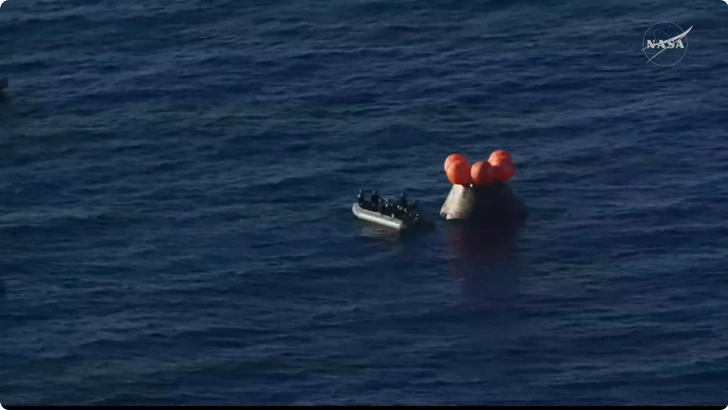
The command module's side hatch was opened 50 minutes after splashdown. Approximately 40 minutes later, the recovery team, having verified the capsule's integrity, the absence of any potentially hazardous gas leaks, and the crew's normal condition, stabilized the Orion in the water and helped the astronauts transfer to an inflatable raft moored to it.
Soon, Reed Wiseman, Victor Glover, Christina Koch, and Jeremy Hansen were flown one by one by helicopter to the John P. Murtha, which was located 3 kilometers from the capsule. According to procedure, they will be examined by doctors there, and then the astronauts will be transported to San Diego by helicopter.
Meanwhile, John P. Murtha's team began preparing to load Orion into the ship's dock. NASA engineers will conduct a thorough examination of all its systems after the command module is delivered to shore.
The Artemis 2 mission can now be considered complete – the first human flight to the Moon since 1972 was successful and certainly made history.