The History of the German Heavy Tank Destroyer Panzerjäger Tiger (P), Also Known as the Ferdnand and Elefant 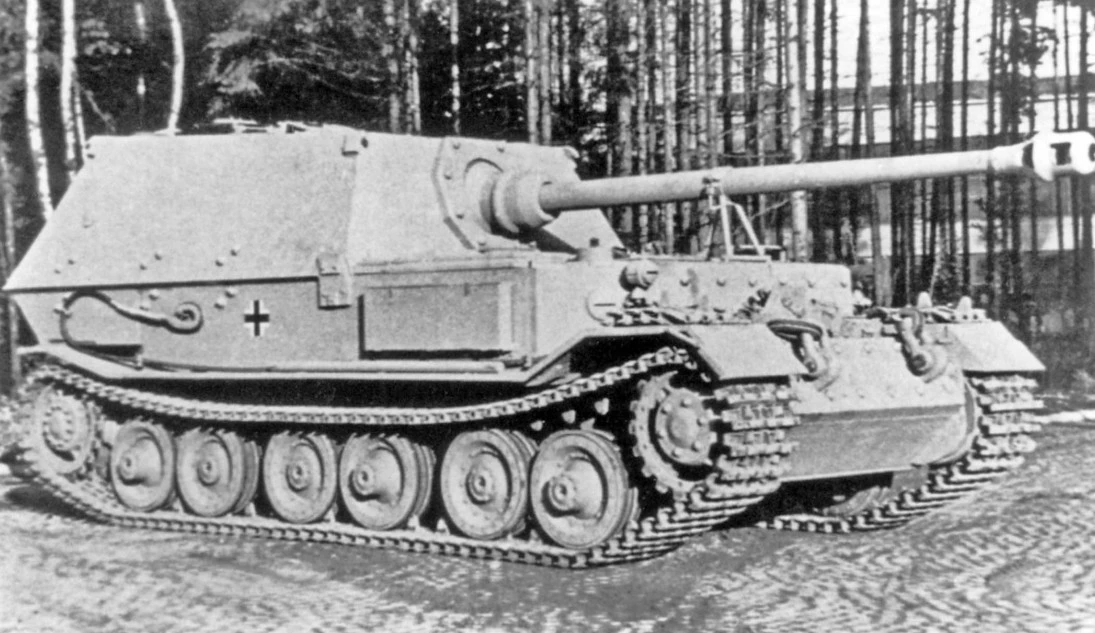
While the end of the Pz.Kpfw.Tiger (P) story itself was not very pretty, the obvious must be acknowledged. The twin air-cooled engines looked clearly inferior to the Maybach HL 210 engine. Moreover, the idea for a third chassis variant, designated Typ 130, first surfaced in the spring of 1942. It envisioned a twin water-cooled Maybach HL 120 engine, the most widely produced German engine during World War II. Importantly, this was a tank, not a conversion, which appeared in the plans on September 22, 1942.
The appearance of such a variant on the horizon was a sure sign of the future cancellation of the Pz.Kpfw.Tiger (P). So it wasn't a big surprise. In the Porsche K.G. development list, the future tank destroyer was initially designated Typ 101D, or Sturmgeschütz ohne turm. The final decision on the fate of 90 Pz.Kpfw.Tiger (P) chassis was made on November 16, 1942. They were converted into tank destroyers, with the engine compartment moved to the center of the hull and the engines replaced with Maybach HL 120s. This project, developed jointly with Alkett, was designated Typ 130.
The original design, developed by Alkett, was designated the Sturmgeschütz Tiger 8.8 cm L/71. According to calculations, the combat weight of the vehicle was 65 tons. The frontal hull received additional armor protection of 100 mm, and the casemate had a total thickness of 200 mm. The upper frontal hull plate was sloped appropriately, and the twin machine gun mount was decided to be moved to the front of the casemate. However, for an unknown reason, this was abandoned, a move later greatly appreciated by self-propelled gun crews. It must be said that the Sturmgeschütz Tiger 8.8 cm L/71 wasn't particularly roomy. However, 55 rounds of ammunition is quite a decent amount.
The last chassis being reassembled, Nibelungenwerke, April 23, 1943. 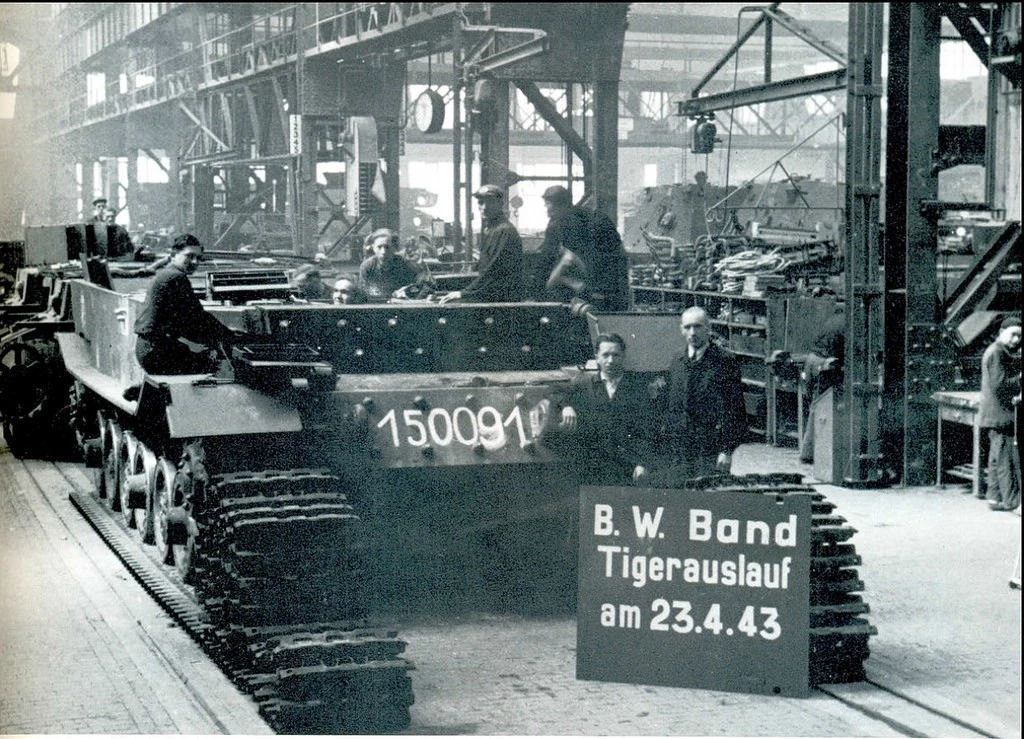
The last chassis being reassembled, Nibelungenwerke, April 23, 1943.
Alkett, however, acted as the engineering firm, while the production of the self-propelled guns fell to Nibelungenwerke. According to the approved plan, the first 15 self-propelled guns were to be delivered in February 1943, another 35 in March, and the final 40 in April. The Sankt Valentin factory served as the assembly site. The hulls were rebuilt at Eisenwerke Oberdonau in Linz, and the casemates were manufactured at the Krupp plant in Essen. However, there was some deviation from the original concept. Additional hull plates were bolted flush to the main plates, and the bow machine gun mount was eliminated. Other changes compared to the preliminary design were also made, such as on the casemate roof. The casemate itself was made removable to allow access to the transmission components.
It must be said that Nibelungerwerke approached the task with great responsibility. Assembly of the first Sturmgeschütz Tiger 8.8 cm L/71 chassis began on April 16, 1943, and the first casemate arrived that same day. The last chassis, 150091, was assembled on April 23, 1943, and the last SPG was shipped from the factory on May 12. By that time, testing had been completed, including a demonstration to Hitler. Following the testing, it was decided to add armor plating to protect the gun mount. These were manufactured at Alkett in May 1943, and the bolted armor plating was then sent to the units that received these SPGs.
At that time, the SPG was officially designated the Panzerjäger Tiger (P), but it became better known as the Ferdinand in the field. The number of SPGs produced proved sufficient to arm two heavy tank destroyer battalions – the 653rd and 654th. Previously, the 653rd Battalion was the 197th Assault Gun Battalion, and the 654th fought with Marder II tank destroyers. Both battalions were structurally composed of 45 self-propelled guns each; the TO&E for them was introduced on March 31, 1943. Both battalions operated alongside a number of units, including tank companies with radio-controlled vehicles. The Ferdinands were intended to act as a battering ram, breaking through Soviet defensive lines. 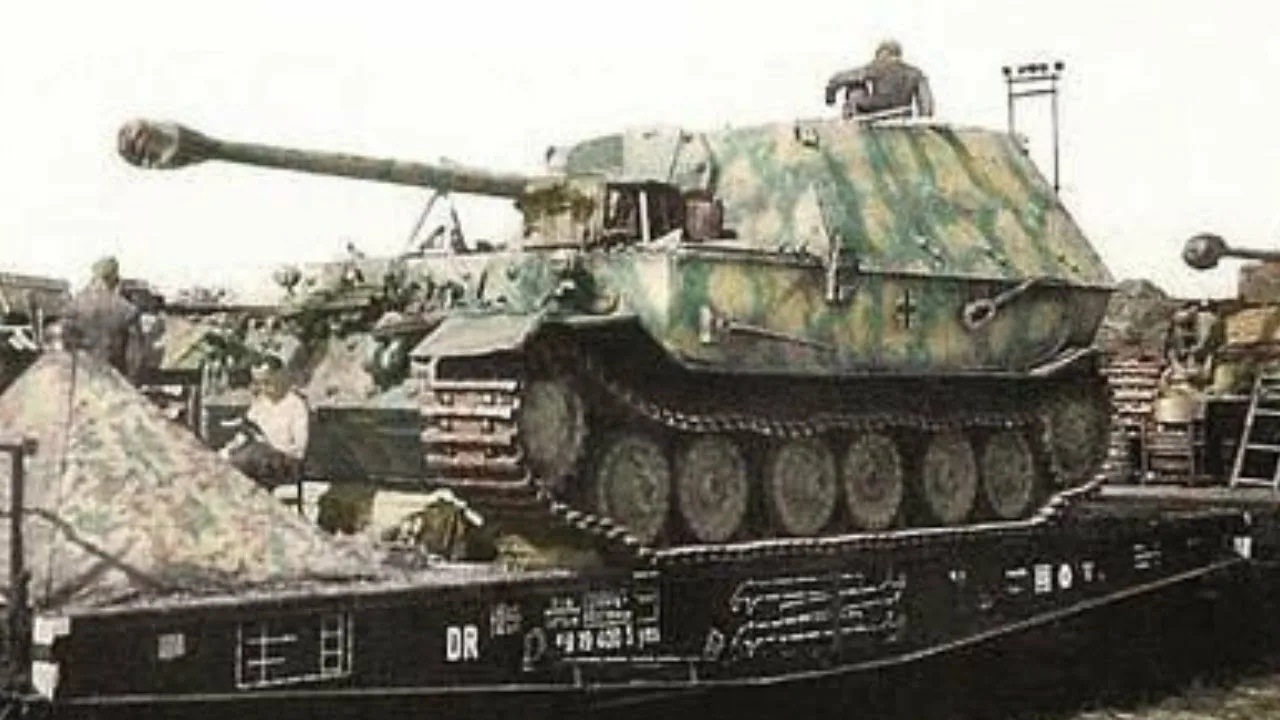
Departure to the Front
This is precisely how both Ferdinand-equipped battalions operated during Operation Citadel. They fought on the northern face of the Kursk Salient, breaking through to the Ponyri railway station. It must be said that German superiority at Kursk was extreme, but they were met by an army that already had two years of combat experience. The Ferdinand's most formidable enemy was the Soviet sappers. At least 10 vehicles were blown up by planted mines and explosive charges. The total number of Ferdinand SPGs lost was 39, almost the entire battalion. This led to the consolidation of all SPGs of this type into the 653rd Battalion on August 26, 1943.
The appearance of the Ferdinand had a direct impact on the development of Soviet tank design. The first reports on the new German combat vehicle appeared as early as July 1943, and a more detailed study followed. This self-propelled gun was the main reason why Soviet medium tanks received 85mm guns, while the 122mm D-25 became the preferred weapon for the IS tank. This was because the 85mm gun could confidently penetrate 80mm of side armor, while the D-25 could penetrate the frontal hull and cabin armor at medium ranges. The appearance of the Ferdinand also influenced the development of the "K" tank project, later known as Object 701. It was built as a counter-tank to the Ferdinand. 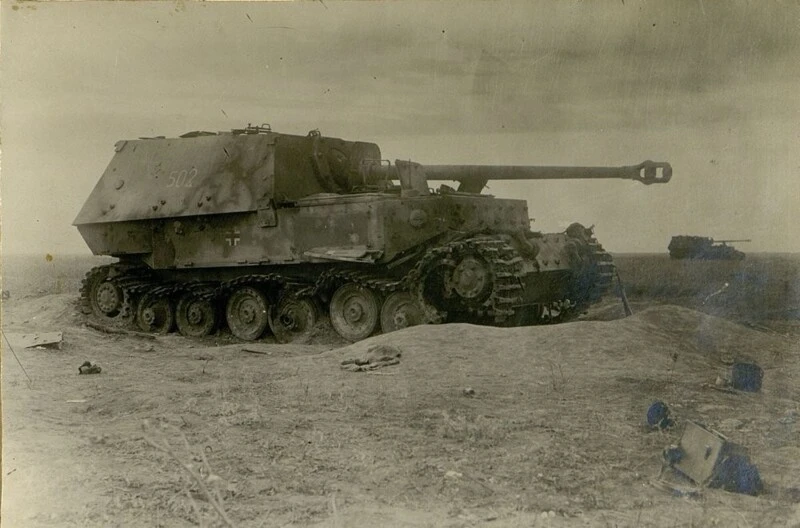
Their main opponents were Soviet engineers.
At the same time, statistics on the use of these self-propelled guns indicated that the vehicles, weighing 70 tons, were not without problems in combat. For example, as of August 26, 1943, only 12 of the 50 self-propelled guns were operational. Subsequently, the number of combat-ready vehicles rarely exceeded 10. There were cases of vehicles burning out while marching. It might seem like a chassis issue. But no, it was a chassis overload issue. And, to be fair, it's worth noting that Porsche's creation coped more or less well with the abuse inflicted on it. The Pz.Kpfw.Tiger Ausf.E. would never have achieved anything similar.
The Ferdinand was a very dangerous combat vehicle, but it was a mixed bag. The history of this self-propelled gun often mentions an episode in which the 653rd Division destroyed 54 Soviet tanks in two days of fighting, 21 of which were crewed by Franz Kretschmer. However, the 28th Army lost 33 tanks to destruction or damage during those days, including nine KV-85s and four Su-152s that were irretrievably lost. Moreover, the "Zveroboys" (Beast Hunters) destroyed five or six Ferdinands, which supposedly suffered no losses. And here's the surprising thing: six self-propelled guns "disappeared" during those days. Apparently, they vanished. "No losses." 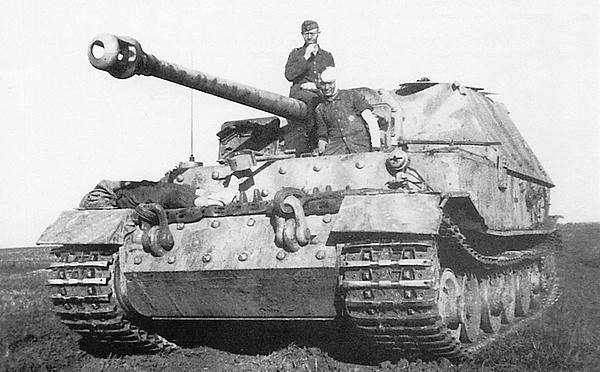
with two dummy tanks
On December 22, 1943, the 653rd Tank Destroyer Battalion was recalled from the front. The vehicles were sent to the Nibelungenwerk factory, where they underwent modernization. The roof of the cabin was redesigned, improving visibility. Based on experience at the Kursk Bulge, where machine gun fire was sometimes required directly through the gun barrel, the machine gun mount was reinstated. Zimmerit was also applied, and various modifications were made to the bodywork. The self-propelled gun remained known as the Ferdinand, meaning the redesign did not automatically mean a renaming. The Elefant designation was introduced in April 1944.
Even before the renaming, in March 1944, the division's first battery (11 self-propelled guns) departed for Italy. The idea of sending these combat vehicles to mountainous terrain was far from ideal. The vehicles suffered from having to fight in terrain that was clearly unsuitable for them. Some self-propelled guns were lost due to mechanical failures, while others were destroyed by Allied aircraft. The first two self-propelled guns were lost by the end of March 1944, and a total of seven were lost. Moreover, in June 1944, only one or two self-propelled guns of this type were usually combat-ready.
The remaining self-propelled guns (31 vehicles) were sent to Ternopil in April 1944. They operated quite successfully; by July 1944, they had 33 of these self-propelled guns, plus the only operational Pz.Kpfw. Tiger (P), as well as a Bergepanzer VI ARV. Then came the Lvov-Sandomierz Operation. Troubles reached the 653rd Division by July 20, 1944. And it seems they went unnoticed. In a matter of days, 19 self-propelled guns, a Pz.Kpfw. Tiger (P), and all Bergepanzer VI ARVs were lost. By August 1, only 12 Elefants were operational, all requiring repairs. 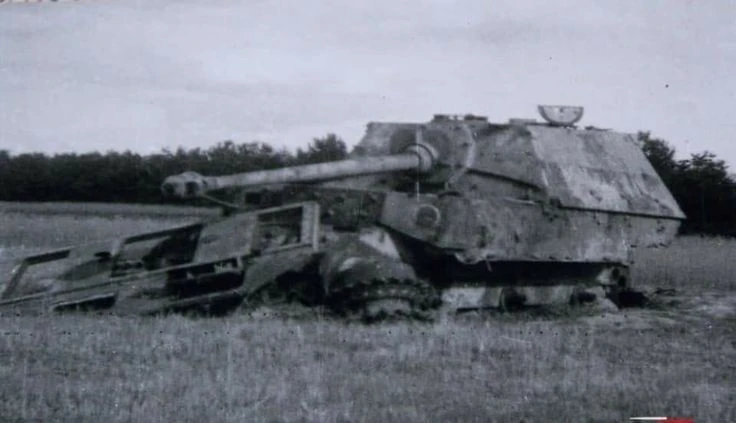
After the fighting in Poland
Fourteen Elefants were consolidated into the 614th Heavy Tank Destroyer Battery. Ten of them were lost in the fighting of mid-January 1945, and the remaining self-propelled guns saw sporadic service until the end of the war. However, the fighting of the summer of 1944 already showed that nothing remained of their former glory. It couldn't have been otherwise: by that time, the Red Army was widely using tanks and self-propelled guns developed, in part, based on the lessons learned from the battles at Kursk. Regardless, the Ferdinand/Elefant became arguably the most successful German heavy tank destroyer. At the very least, no other German self-propelled gun in its class had such a significant impact. The fact that we "saw" Ferdinands in so many different sectors of the front speaks volumes.
1 comment
Add your comment
You might be interested in:





V8 Engine Designer
Graphics or reality: the impressive capabilities of Unreal

A tiger from the zoo pressed against the belly of a

The Chinese showed their flagship SUV Tank 700 (7 photos)

Mercedes-Maybach Vision 6 is just a candy

A luxurious Maybach electric crossover was brought to
Toyota is preparing to release a new 2-liter engine with
1967 Porsche 910 racing car sold for a record $2.5 million

Armored smartphone Unihertz 8849 Tank 2 is a serious
How to start a 102-liter engine
Protective film Removing it with a power screwdriver
How metal buckets are made in Pakistan
When a child plays hide-and-seek at a professional level

Man sets up bedroom camera and discovers the reason for his
Super dads who swoop in to save the day
Athlete in Bavarian dress flies over a lake on a hydrofoil
Precision carpentry

Looks like it's time to buy WinRAR
