What Is Couvade? Why Men "Got Pregnant" and "Gave Birth" (8 photos)
In modern anthropology, the term "couvade" refers to a set of ritualistic behaviors performed by a man when his partner is pregnant or giving birth. During a couvade, men drastically alter their lifestyle and sometimes even simulate pregnancy itself. Today, this phenomenon is rare, primarily surviving among cultures that have preserved pagan beliefs. In ancient times, however, the ritual was widespread, including across Europe. 
The word "couvade" originates from the French language, where it literally means "brooding" or "hatching eggs." In France, this custom existed for centuries, predominantly among the Basques living in the southwest. Today, the people of the Pyrenees have largely forgotten it, and mentions of the couvade can only be found in ancient Basque folk tales and songs. 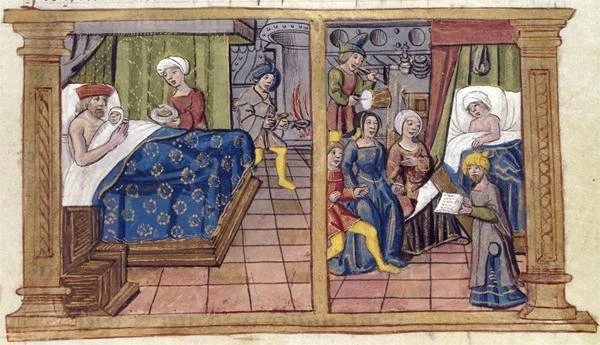
So if you want to get a closer look at men practicing couvade today, you will have to travel to South America or Southeast Asia, where several tribes continue to follow the traditions of their ancestors. Although ritual pregnancy is fading around the globe, some curious customs associated with it linger in various corners of the world—including among the native peoples of Siberia and the Pomor region.
The Many Forms of Couvade
Couvade takes many forms, ranging from mild, purely symbolic gestures to extreme and grueling rites. The simplest and most common variation involves dietary taboos imposed on the expectant father during his wife's pregnancy. In some cultures, husbands of pregnant women are also banned from participating in certain agricultural labor. 
This type of couvade can still be found in India's Travancore region. There, for seven days after their wives give birth, men are barred from farm work and live exclusively on fruit. A century ago, among Greenlandic Inuit, men were forbidden from hunting or fishing from a boat for several weeks when expecting a newborn.
Both Indians and Inuit believed that failing to follow these rules put the mother and child at grave risk, even threatening their lives. In other cultures, the husband had to take a more active role in labor. For instance, in traditional Russian culture, a husband would untie every knot on his clothing before the birth to magically assist his wife in a safe delivery.
Perhaps the least burdensome version of the ritual for men was the custom of feigning labor pains while demanding comfort, gifts, and treats from those around them. Young men in certain African and South American tribes used this approach to "help" their wives give birth. 
Men living along the northern coast of the Black Sea during antiquity exhibited similar behavior. In his epic poem
Argonautica
, Apollonius of Rhodes wrote of the Tibareni:
The heroes sped past the neighboring land of the Tibareni.
There, whenever a wife bears a child to her husband,
The men themselves lie groaning on their couches with covered
Heads, while their wives tend to them, feeding them food
And preparing baths for them just as for women in labor.
In the Smolensk Governorate, locals went even further. During labor, the husband would climb onto the raised sleeping platform while the midwife tied a string around his genitals. As labor contractions hit, she would tug on the string, inflicting real pain on the expectant father. Among the Bespopovtsy (priestless Old Believers) of the upper Kama River, an early 20th-century custom required the husband to wear an item of the laboring woman's clothing to magically transfer part of her agony to him. 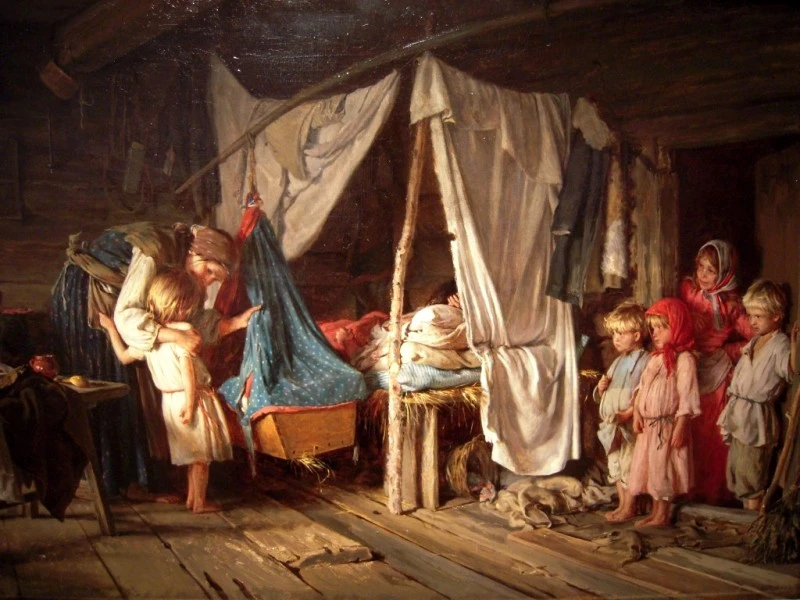
Childbirth in a village
Those same Old Believers sometimes roped unsuspecting guests into the ritual—whether the visitors liked it or not. In 2000, ethnographers recorded a story from a man who was forced to stay overnight in a house where a woman was about to give birth.
To transfer a share of her labor pains to the traveler, the hosts slipped a laxative into his food. As a result, he spent the next day squatting behind bushes rather than continuing his journey. Because the laboring mother had no husband, an outsider had to step in to fulfill the couvade. Remarkably, this took place in the 20th century, not the Dark Ages. Old Believers referred to this custom as "childbirth agony."
The Nursing Father
The most extreme form of couvade involved men fully mimicking the behavior of a pregnant woman, laboring mother, and new mom. Men would complain of feeling ill, take to bed alongside the newborn, and feign breastfeeding. 
A similar ritual was practiced by the indigenous peoples of the Caribbean. For five days after his wife gave birth, the man would lie beside the infant, completely abstaining from food and drink. For the next five days, he sustained himself solely on
mabi
—a local beverage made from fermented
colubrina
bark. This was followed by 30 days during which cassava fruit could be added to the
mabi
, and on the 41st day, the couvade concluded with a painful ordeal.
To mark the end of this period of fasting, relatives and friends slashed the new father's skin with sharp animal fangs and rubbed burning hot peppers into the wounds. Washing off the ritual mixture was strictly forbidden, so one can only imagine what the father endured.
Yet couvade was not everywhere associated with torment and starvation. The famous medieval traveler Marco Polo described the custom among families in southern China after a child was born:
"When a woman gives birth, they wash the child, wrap it in swaddling clothes, and the husband takes to bed with the newborn beside him. He remains in bed for 40 days, rising only out of necessity. Friends and relatives visit him, stay with him, and keep him entertained. They say this is done because the wife suffered while carrying the child in her womb, so she should not suffer for another 40 days. As soon as she gives birth, the wife gets up, manages the household, and serves her husband in bed."
How Scholars Explain Couvade
Scholarly interest in couvade began relatively late, in the second half of the 19th century. Ethnographers proposed numerous hypotheses regarding the origins of the tradition, yet failed to reach a consensus. Early theories viewed the ritual as a relic of matriarchy that arose during the transition to a patriarchal society. 
Scholars posited that by simulating pregnancy and childbirth, men mirrored the matrilineal system typical of matriarchal societies. In earlier times, when promiscuity was common, establishing paternity was nearly impossible, so lineage was traced through the mother. Couvade was thought to be a leftover from an era when children had known mothers, but fatherhood was irrelevant. Later, this theory was dismissed as contrived and unscientific.
More recently, couvade has been reinterpreted as a mechanism for rebalancing power. In patriarchal societies, childbirth can be seen as diminishing for men who are accustomed to dominance. By participating in ritual pregnancy, men attempt to restore the status quo and demonstrate that they are no less important than mothers.
Contemporary research goes a step further, casting doubt on any direct link between the various manifestations of couvade across different eras and regions. Ethnographers view the practice as far too diverse, with distinct local roots in every culture. Forcing it into a single framework, they argue, is academically shortsighted. 
Be that as it may, couvade—having endured for millennia—still resurfaces in surprising ways in modern families. In the Western world, up to 40% of men experience discomfort or even sympathetic pain while their partners are in labor. Distance seems to offer no protection: a husband and wife can be on opposite sides of the globe and still share this uncanny connection. Male postpartum depression presents a similar puzzle, proving equally difficult to explain.