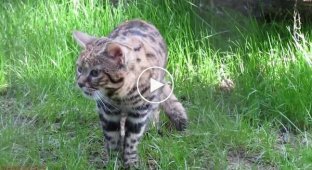
A Monster the Size of a Mug: The World's Deadliest Cat (11 photos)
Ask anyone which cat is the most dangerous on the planet, and they'll probably say a lion. Or a tiger.
These are 100% associations, like a poet and Pushkin, or a fruit and an apple (yes, according to linguists, these associations are the first thing that come to mind for 93% of respondents). 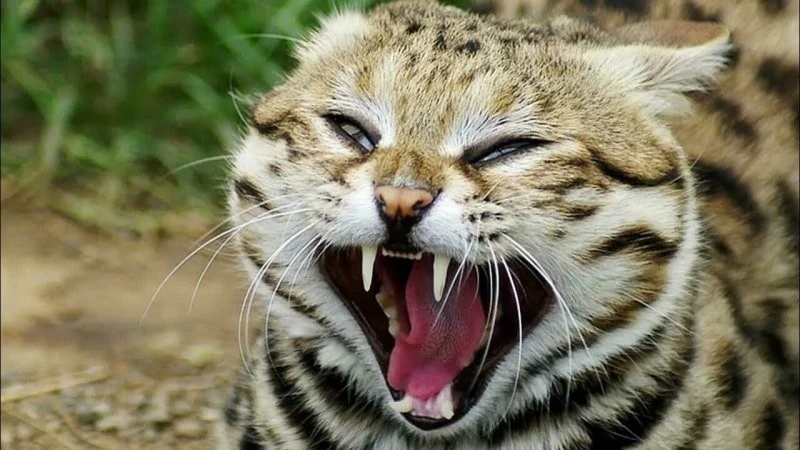
Well, a tiger or a lion is banal and seems logical. A large predator, powerful paws, fangs like daggers—that's what comes to mind when you hear the word "deadly." But mathematics and evolution fundamentally disagree, and nature, as always, came up with something unexpected.
Evolution spent 5 million years developing the lion.
And the black-footed cat, too.
It was simply rehearsing on a lion.
Who is this anyway?
The African black-footed cat (Felis nigripes) weighs about two kilograms. Lighter than the average house cat. But it kills with an efficiency that neither lions nor tigers could ever dream of. A new victim every 50 minutes. Up to 14 kills per night. Its hunting success rate is over 60%. For the lion, that figure barely reaches 25%.
Get to know it. This isn't just a "small wildcat." It's the perfect killing machine, honed by evolution for 4-5 million years. 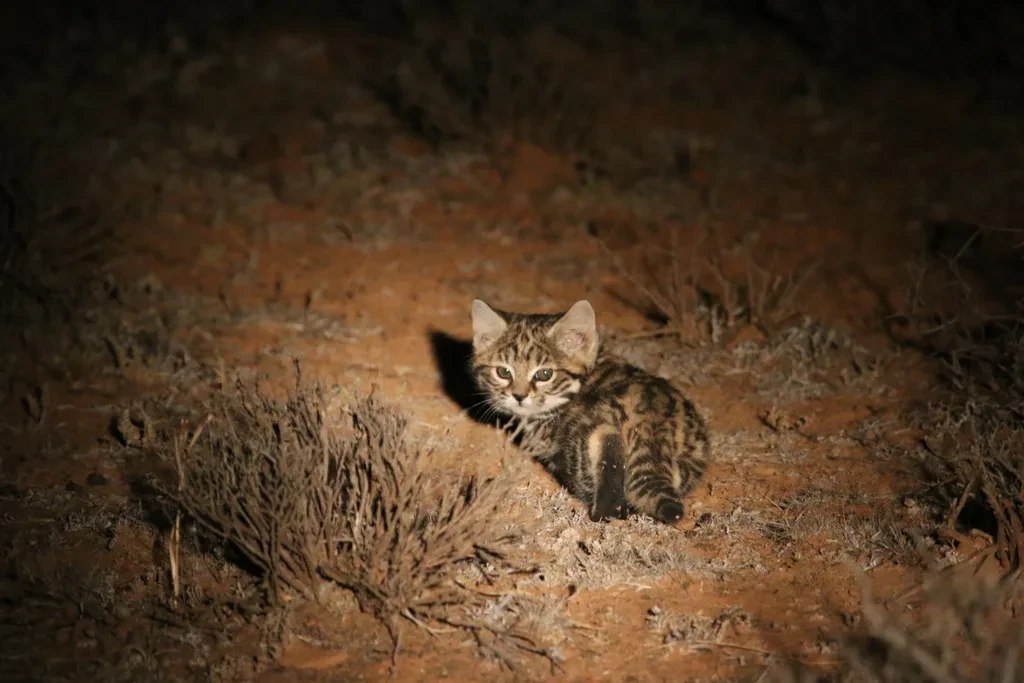
The black-footed cat is Africa's smallest wild cat. Males weigh an average of 1.9 kg, while females weigh around 1.3 kg. Their body length ranges from 35 to 52 centimeters. On the outside, they're a cute, reddish-sand-colored creature with dark spots, somewhat reminiscent of a domestic Bengal cat. Only wild. Totally wild.
It gets its name from its black paw pads and the undersides of its paws. This feature is no accident: black pigmented skin protects against hot sand during the day and cold ground at night. Evolution even took care of the soles. 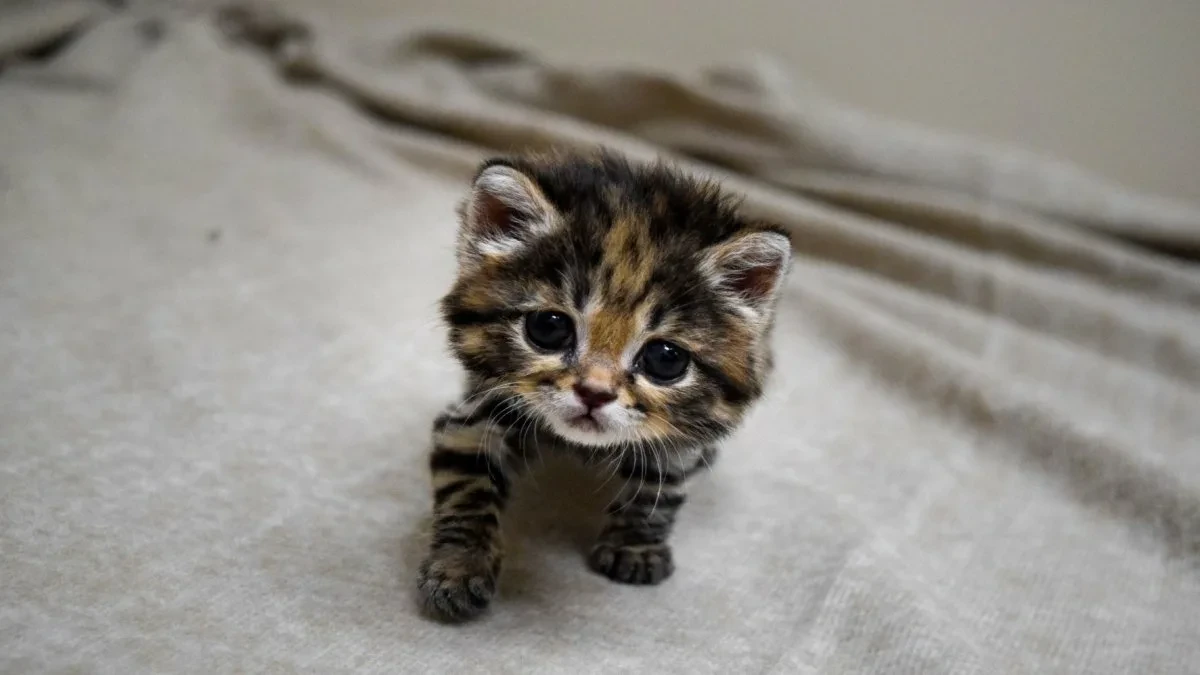
Her eyes are huge – disproportionately large for such a small head. If human eyes were the same proportions relative to the size of the skull, each one would be the size of a grapefruit. But more on that later.
Imagine a date:
— You have beautiful eyes.
— Thank you, I use them to track rabbits at night.
Where does this beast hide? 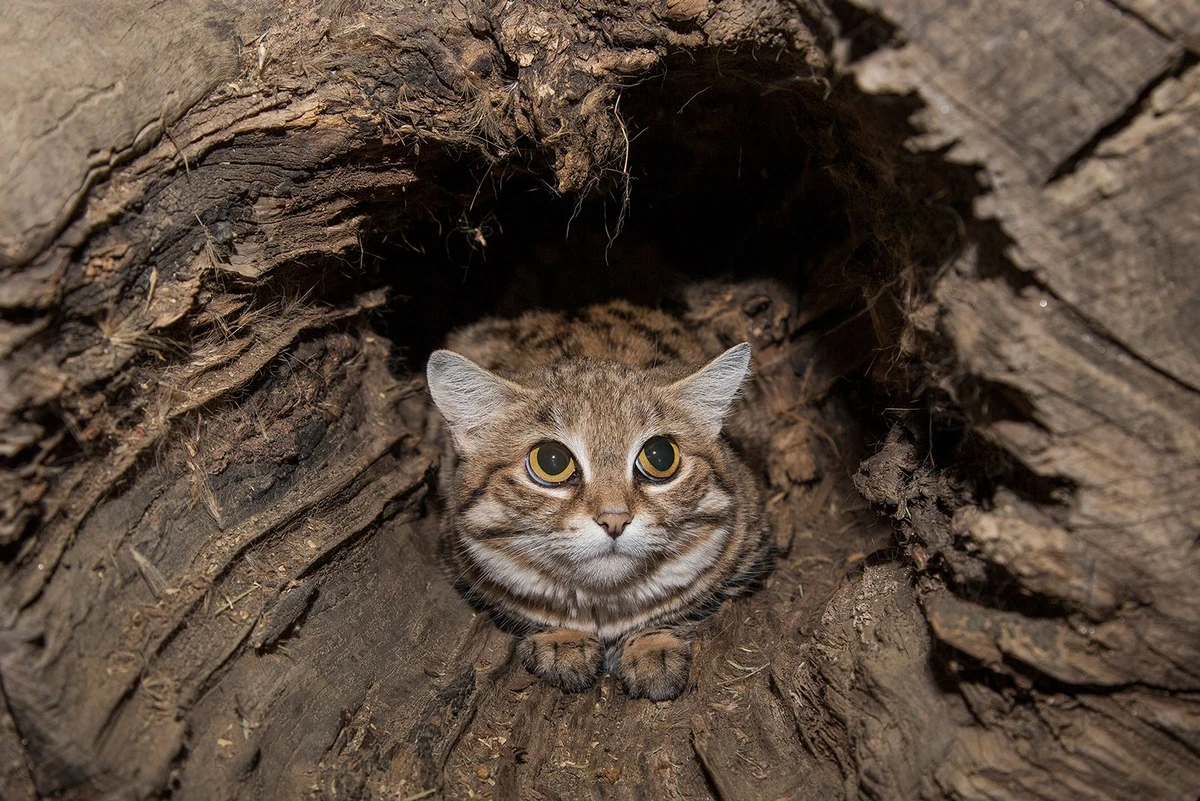
The black-footed cat is endemic to southern Africa. It has been spotted in South Africa, Namibia, and Botswana. Occasionally, it has been spotted in Zimbabwe and Angola, but its main habitat is concentrated in this triangle.
It chooses the harshest environments: dry savannas with low grass, the Kalahari semi-desert, and the Karoo steppes. There, water is scarce, food is scattered over vast areas, and competition among predators is fierce. In such conditions, you either become a master hunter or die.
She avoids forests and mountains. Open spaces are her element: there, her hearing and sight work at full capacity. 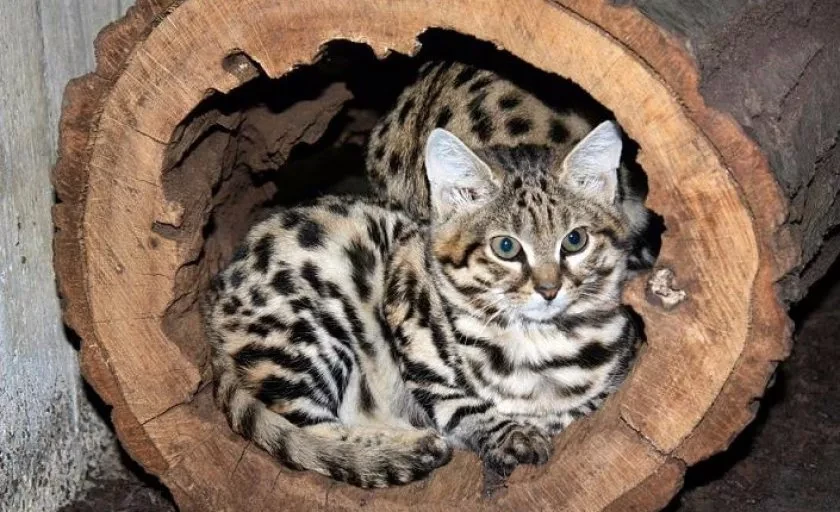
During the day, the black-footed cat hides. She doesn't dig her own burrows; she takes over others'. Abandoned termite mounds, aardvark and porcupine burrows, dense thickets. The heat of the African day is not her forte. Her time comes with darkness.
Supersenses: She perceives the night differently than we do
Imagine standing in a quiet room and being able to pinpoint a mouse crawling behind that wall, a meter under the floor. Hear its footsteps. You know exactly where it is. This is how the black-footed cat "sees" its prey in pitch darkness.
Its ears are parabolic antennas. The bony structure of the inner ear (bulla) is disproportionately large. It detects the low-frequency vibrations emitted by rodents as they move underground. It can hear the squeak of a mouse from over 20 meters away in complete darkness and pinpoint its location to within a few centimeters. Each ear rotates almost 180 degrees independently of the other, creating a living surround-sound system. 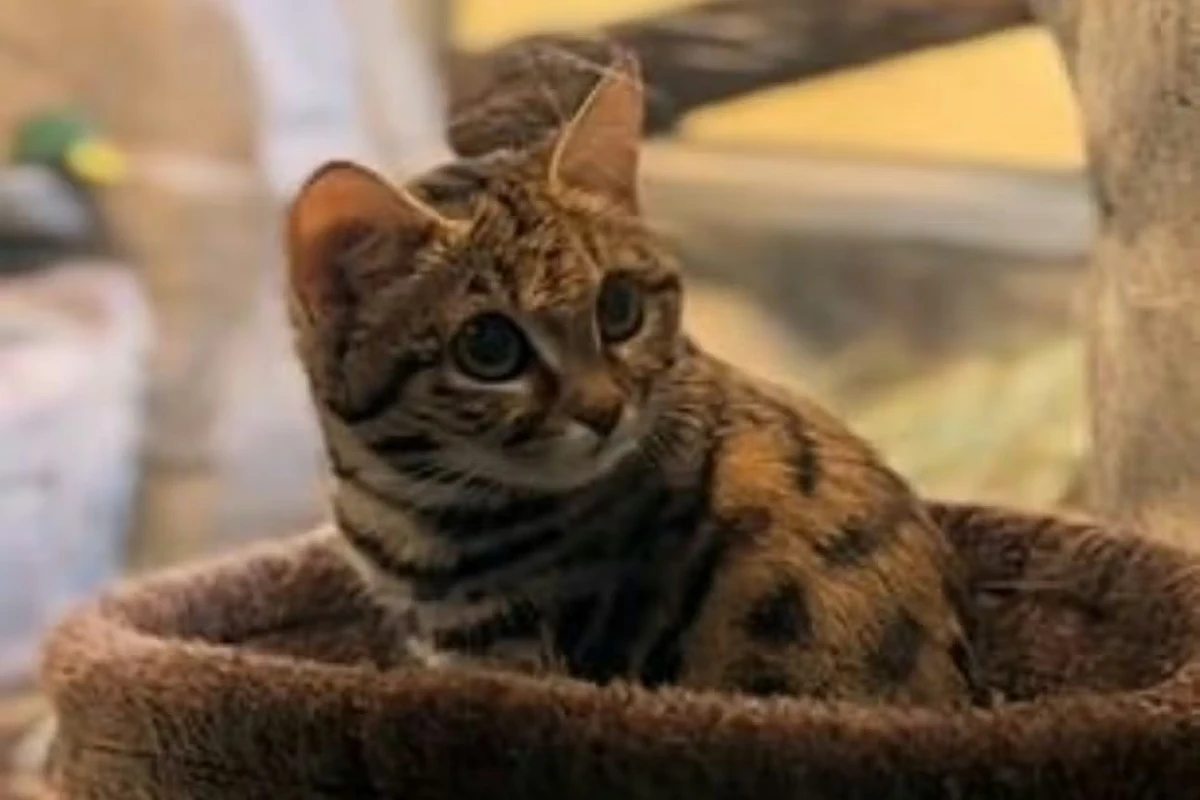
The story of the eyes is no less fantastic. Behind the retina, the black-footed cat has a tapetum lucidum—a reflective layer that acts like a mirror. Light passes through the retina, is reflected back, and then passes through again. This increases light sensitivity by 6-8 times compared to the human eye. This is why its eyes glow in the dark—like those of all cats, only brighter. The retina is dominated by rods—receptors for black-and-white vision in low light. Its night world is a world of shadows and movement, but it sees every movement flawlessly.
Hunting: Three Strategies of One Killer 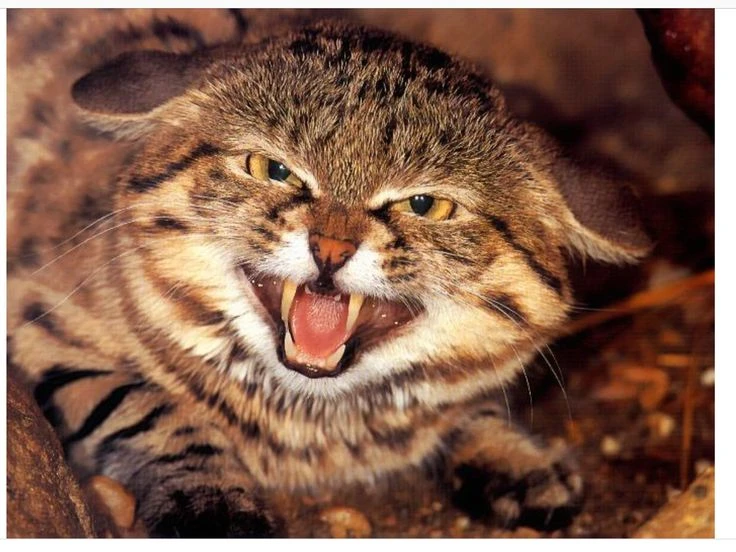
A black-footed cat covers 8 to 16 kilometers per night. For a small creature, that's equivalent to a human walking 40 to 80 kilometers per night—not on a stroll, but in "find, run, kill" mode.
She covers 16 kilometers per night.
My fitness tracker shows 16 steps per night.
And that's only after the cat walked on me.
She uses three tactics depending on the situation.
The first is a quick search. The cat practically runs through the area, pouncing on anything that moves. No long pursuits—a lightning-fast attack and a fatal bite to the base of the skull or cervical vertebrae. 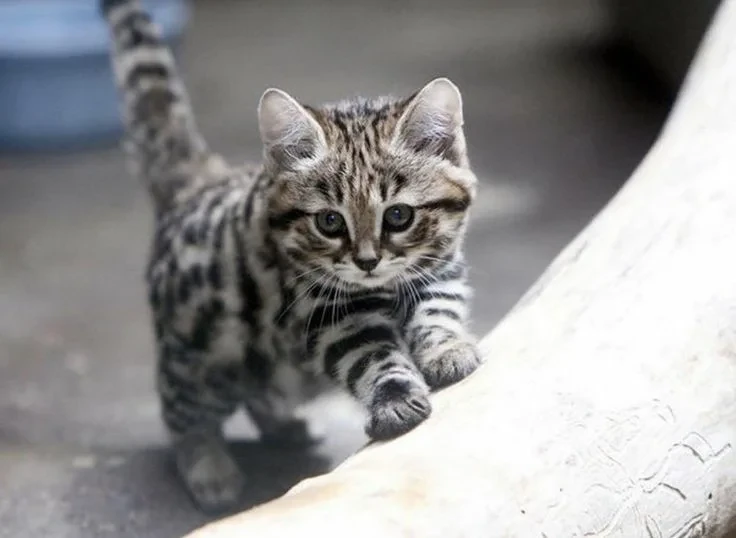
The second method is slow hunting. The cat sneaks through the grass, listening, and sniffing. This method is for more cautious prey—birds and large rodents.
The third method is ambush hunting. The most patient method. The cat sits near a rodent's burrow and waits. Sometimes for up to two hours. It doesn't move. The prey pokes its head out—and that's the last thing it does.
The cat's diet includes small rodents (about 55%), birds (about 20%), insects, solifug spiders, scorpions, and lizards. Sometimes, the black-footed cat will take on prey larger than itself—a Cape hare or a baby antelope. One naturalist observed a female weighing 1.5 kg attack a hare almost twice her weight. She grabbed its neck and held it in a death grip while the hare thrashed across the savannah, trying to shake her off. She wouldn't let go. It was these observations that gave rise to a local Khoisan legend that the black-footed cat is capable of killing even a giraffe by severing its jugular vein. The giraffe is, of course, a myth. But the essence of its character is accurately conveyed.
Life on the Edge: Energy Balance
The cat didn't become such an effective hunter because of a good life. It needs a lot of food. The black-footed cat is a hostage to its own metabolism.
Because of its small size, its metabolism runs at breakneck speed. It needs to consume 250-300 grams of food per night—15-20% of its body weight. That's equivalent to a 75-kilogram human eating 15 kilograms of food per night. Without it, it's dead. Not in a week, not in three days. After 24-36 hours of starvation, the black-footed cat is on the brink of death.
A lion has several days to digest a buffalo and lie in the sun. The black-footed cat has a few hours before its next hunt.
Water is almost nonexistent in the Kalahari. Therefore, it gets most of its necessary moisture from the bodies of its prey. Hunting is both eating and drinking.
Researchers observed a female who caught 12 rodents and one lark in a single night. She practically never stopped. It's not appetite - it's survival.
Scientist Oddities: The Story of Digga the Marauder
When researchers first began studying black-footed cats using radio collars, they were in for quite a few surprises. 
One of their subjects, a male named Digga, led the scientists to a sheep pen one night. The researchers froze: was this two-kilogram beast really planning to attack a sheep? As they approached, they saw Digga dragging a lamb carcass weighing about 4 kg. The lamb died of natural causes, but Digga decided not to miss the chance. He dragged prey twice his own weight for several hundred meters, hoping to hide it in a secluded spot and eat it in silence.
Another remarkable case involved camouflage. Researcher Luke Hunter shone a flashlight on a cat at night. Instead of running away, it instantly crouched low and froze. Hunter looked away for a second—and was practically unable to find it again. Its spotted coat against the dry grass and rocks makes it virtually invisible.
And its voice? The black-footed cat doesn't meow in the traditional sense. Its cry is a cross between a growl and a deep bark, surprisingly low and loud for such a creature. Alex Sliua, a leading expert on this species, described the situation: you hear this sound from a termite mound, expecting to see something large—and then an animal the size of a house cat emerges.
Her cry is like that of a huge animal.
So you're walking through the savannah at night...
you hear a roar...
and there's a cat the size of a mug.
Where it came from: 5 million years of evolution
The black-footed cat is one of the most ancient members of the cat family. Its evolutionary lineage diverged from a common ancestor about 5 million years ago. It is part of the "caracal lineage" along with the caracal and the African golden cat, but has long since gone its own way. 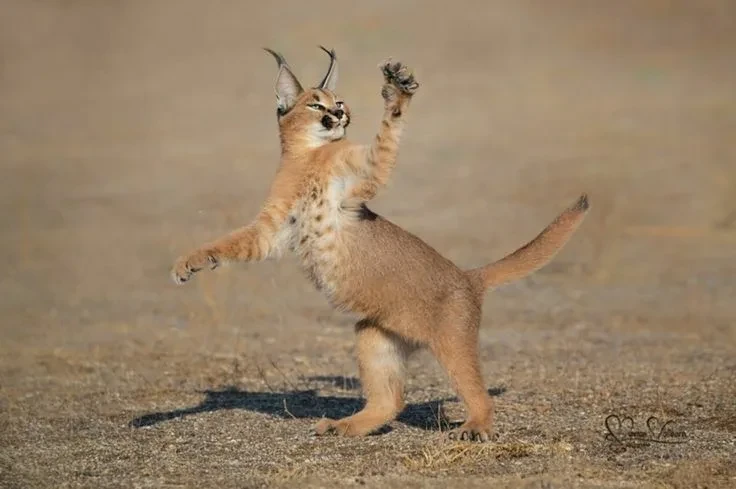
Caracal
The black-footed cat's ancestors faced severe shortages: arid landscapes, rare and scattered prey, and large competitors all around. Only those who could hunt with maximum efficiency, remain stealthy, and remain constantly active at night survived. 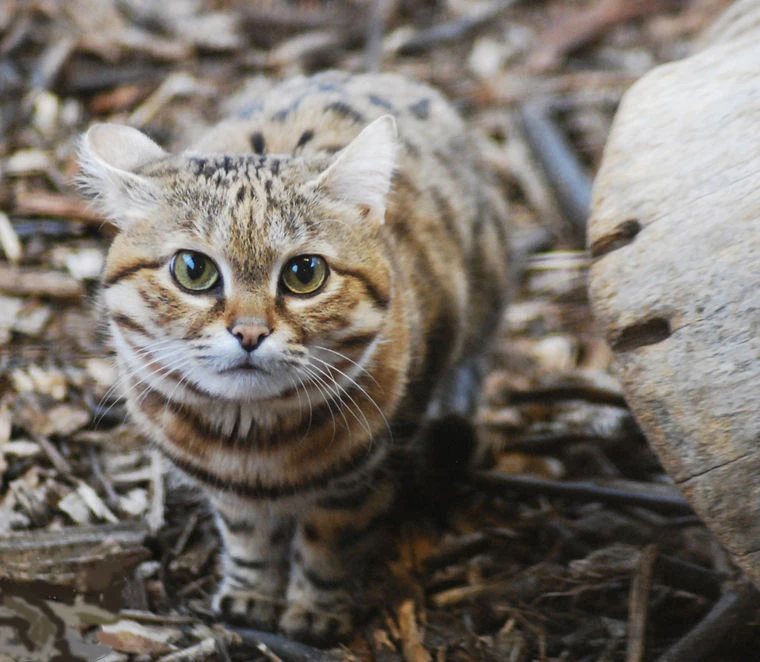
Most predators evolved to become larger—to take on larger prey. The black-footed cat took the opposite approach. Its small size became an advantage: less energy spent on movement, better camouflage, and access to burrows and termite mounds that larger predators simply couldn't penetrate. It became a specialist in small but abundant prey—and it worked.
5 million years—and as a result, a creature weighing two kilograms kills with 60% efficiency.