Dione is Saturn's fourth-largest moon, with an average diameter of 1,123 kilometers, composed primarily of water ice. This image was taken on June 21, 2015, by NASA's Cassini spacecraft. 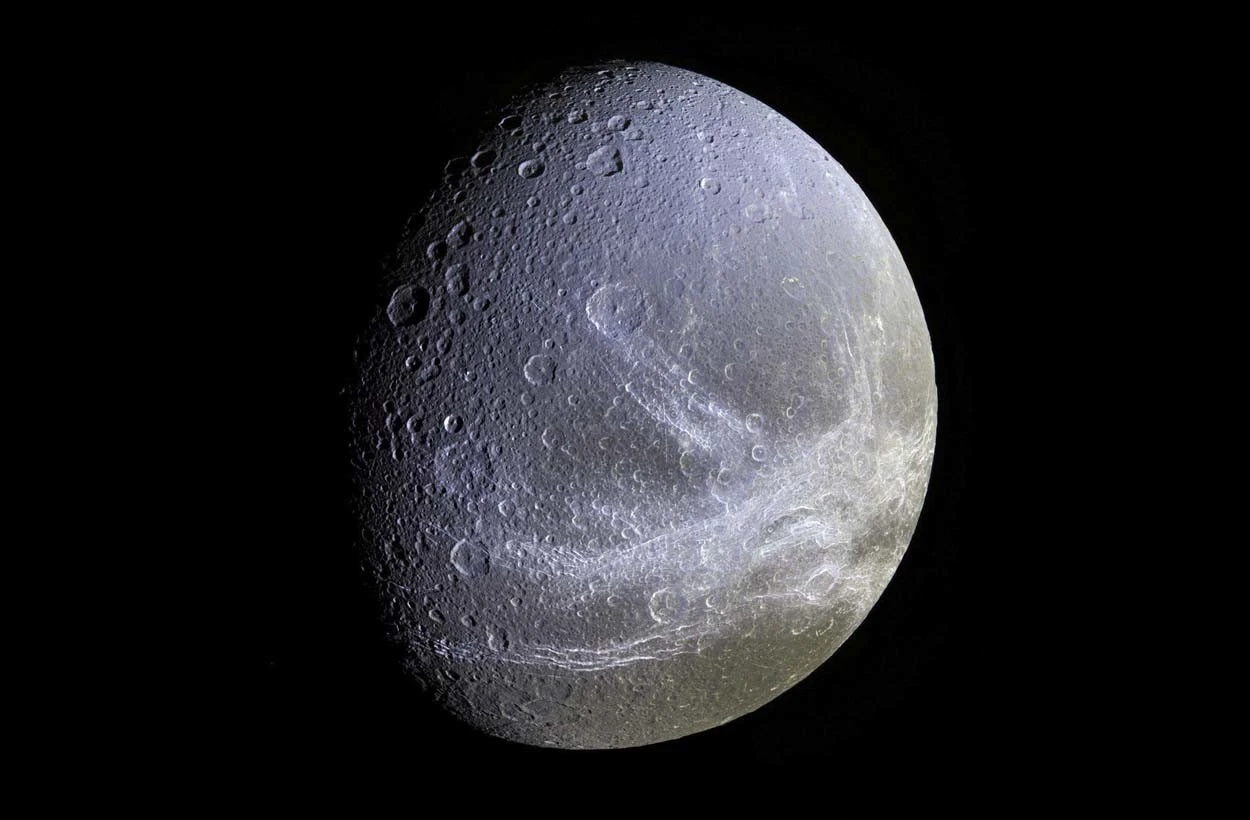
The contrast between the light leading hemisphere and the darker trailing hemisphere is clearly visible—this is where the famous "white strands" (lat. "Wispy Terrain") are located: bright, fresh ice walls of tectonic faults stretching for hundreds of kilometers.
The surface is covered with countless craters of varying sizes, but in some areas, traces of tectonic activity are visible—mountains and scarps up to 1.5 kilometers high.
Analysis of Cassini data revealed that beneath Dione's icy crust, at a depth of approximately 100 kilometers, lies an ocean of liquid water. Its depth is estimated at 40-50 kilometers. Gravity measurements and analysis of the moon's libration (slow wobble) confirm that the icy crust "floats" on the liquid water surrounding the rocky core.
Thus, Dione is another member of the club of "worlds with subsurface oceans" in the Solar System and a promising target for the search for possible traces of life.
Add your comment
You might be interested in:











Space Chronicle 3: A Review of Astronomical Images (6
Enceladus and Titan: Two Potentially Habitable Worlds in
Iapetus: Mesmerizing Photos of Saturn's Most Mysterious
Charon is Pluto's largest moon (1 photo)
Saturn's rings as you've never seen them before (3 photos)
Enceladus — a Leading Candidate for Home for
Mount Wright on Pluto: A Cryovolcano That May Be Hiding an
Ariel: Uranus's moon with a 170-kilometer-deep ocean (4

Margaret Hamilton Dies at 90: The Story of the Moon

Persistence in achieving a goal

Who Is the Woman Standing Next to Trump — and What's Going

"What Is This Thing?": 20+ Bizarre Objects That
25 Incredibly Beautiful and Rare Stones (26 Photos)

Soldiers in Lace, a Bowling Geisha, and 20 More Rare Photos

13 "Healthy" Habits You Should Actually Quit (14

16 Fascinating and Surprising Facts About Life in Sweden

30 Everyday Details That Will Change How You See the World
