Space Chronicle 3: A Review of Astronomical Images (6 photos)
Space Chronicle is a fascinating journey through space and time through astronomical images. This section features reviews of legendary photographs from the early space missions, as well as the latest images from modern space telescopes, ground-based observatories, and talented amateur astronomers. 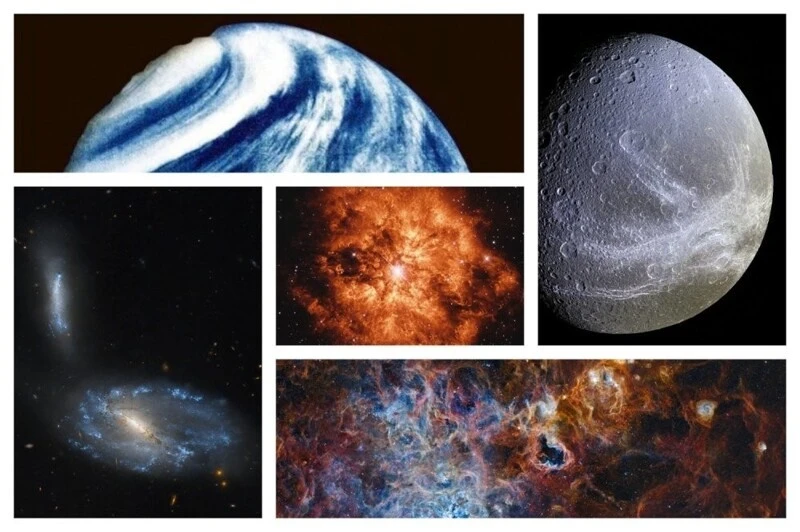
Venus in Ultraviolet Light
Here is one of the first close-up images of Venus, taken by NASA's Mariner 10 spacecraft on February 5, 1974, from a distance of just 5,768 kilometers. In optical light (the wavelength visible to our eyes), Venus appears as a featureless white ball, but ultraviolet filters reveal fascinating details. 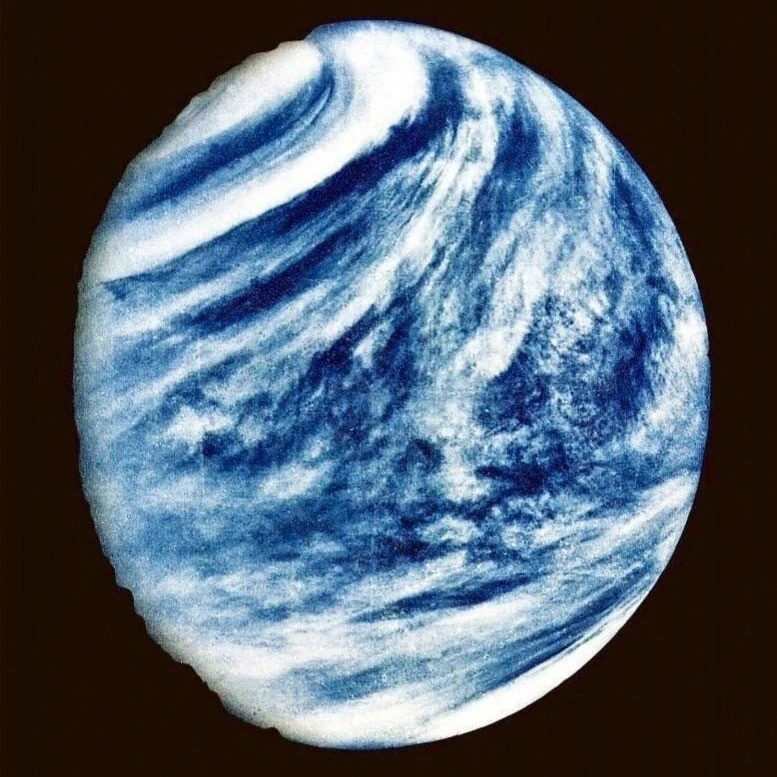
White clouds located in the upper atmosphere, composed of droplets of concentrated sulfuric acid, exhibit superrotation—they complete a full rotation in just four days, while Venus itself rotates extremely slowly: a day lasts 243 Earth days. Scientists are still debating what substance creates the dark patterns by absorbing ultraviolet light—it is likely sulfur compounds.
Mariner 10 was the first mission to intentionally use a gravity assist maneuver*, which allowed the spacecraft to slow down and redirect it toward Mercury.
*The spacecraft approached Venus from behind, following its orbital motion—the planet "stole" some of its energy. As a result, Mariner 10's orbit changed.
Star Formation Hotbed
The Tarantula Nebula (NGC 2070) is one of the largest and most efficient star factories in our cosmic neighborhood. It is located approximately 170,000 light-years from Earth in the constellation Dorado, in the Large Magellanic Cloud, a dwarf satellite galaxy of the Milky Way. 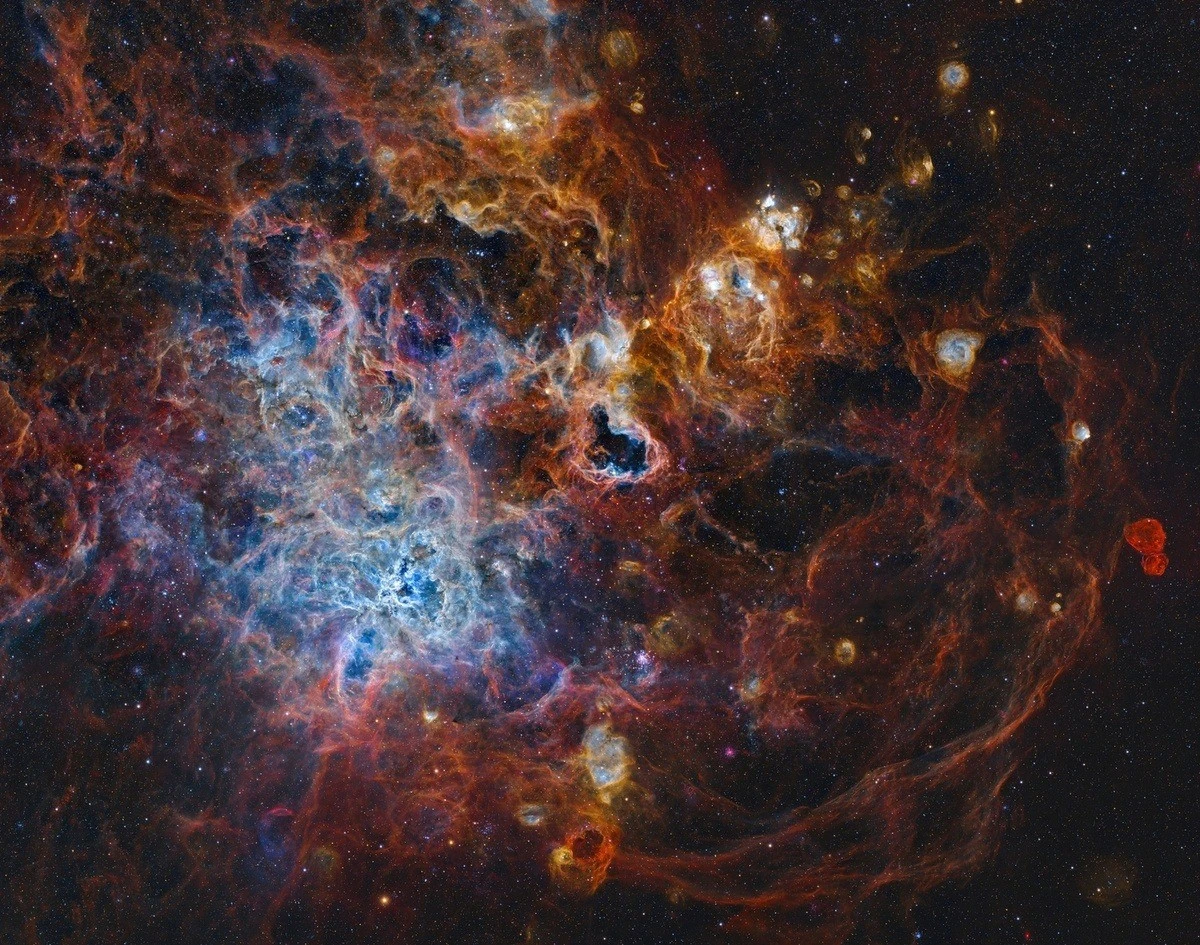
This is the most active star-forming region in the Local Group of galaxies. Just left of center is the R 136 cluster, a dense core of hundreds of young, massive stars, some of which are 200–300 times the mass of the Sun. The radiation from these giants is so powerful that it tears apart the surrounding gas and dust clouds, forming distinctive filaments and filaments.
If the Tarantula Nebula were to replace the famous Orion Nebula in the Milky Way (just 1,300 light-years away), it would occupy an area on the sky 60 times larger than the full Moon and cast shadows on Earth.
Studying NGC 2070 helps astronomers understand the formation of massive stars and the evolution of galaxies in the early Universe.
This image was taken by Australian astrophotographer Andy Astro in October 2021.
Saturn's Dione
Dione is Saturn's fourth-largest moon, with an average diameter of 1,123 kilometers (680 mi), composed primarily of water ice. This image was taken on June 21, 2015, by NASA's Cassini spacecraft. 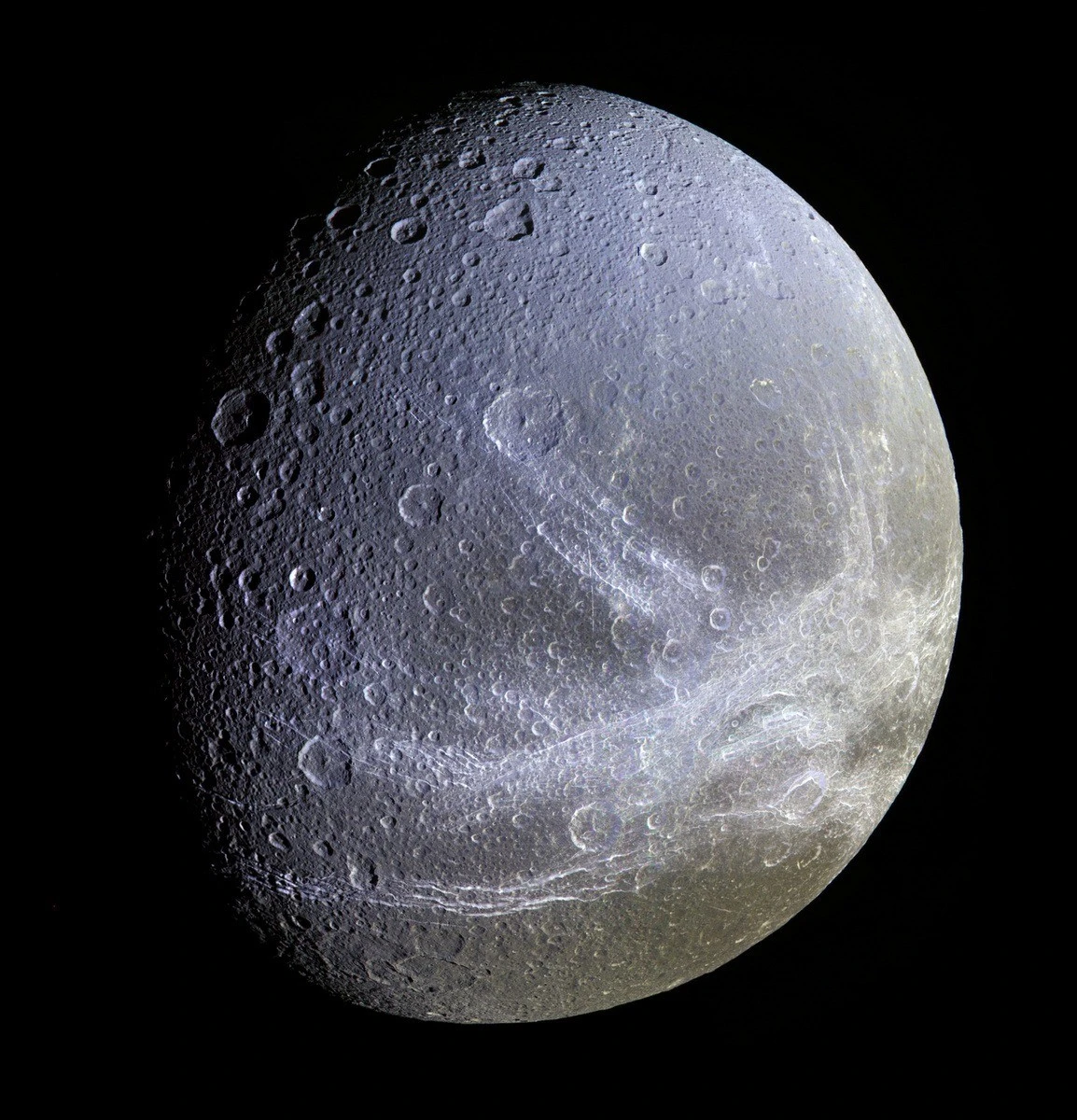
The contrast between the light leading hemisphere and the darker trailing hemisphere is clearly visible—this is where the famous "white strands" (lat. Wispy Terrain) are located: bright, fresh ice walls of tectonic faults stretching for hundreds of kilometers.
The surface is covered with countless craters of various sizes, but in some areas, traces of tectonic activity are visible—mountains and scarps up to 1.5 kilometers high.
Analysis of Cassini data revealed that beneath Dione's icy crust, at a depth of about 100 kilometers, lies an ocean of liquid water. Its depth is estimated at 40-50 kilometers. Gravitational measurements and analysis of the moon's libration (slow wobble) confirm that the icy crust "floats" on liquid water surrounding the rocky core.
Thus, Dione is another member of the club of "worlds with subsurface oceans" in the Solar System and a promising target for searching for possible traces of life.
The Wild Temper of Wolf-Rayet
A composite image of the M1-67 nebula around the star WR 124, obtained by combining data from the NASA/ESA Hubble Space Telescope from September 9, 2013. 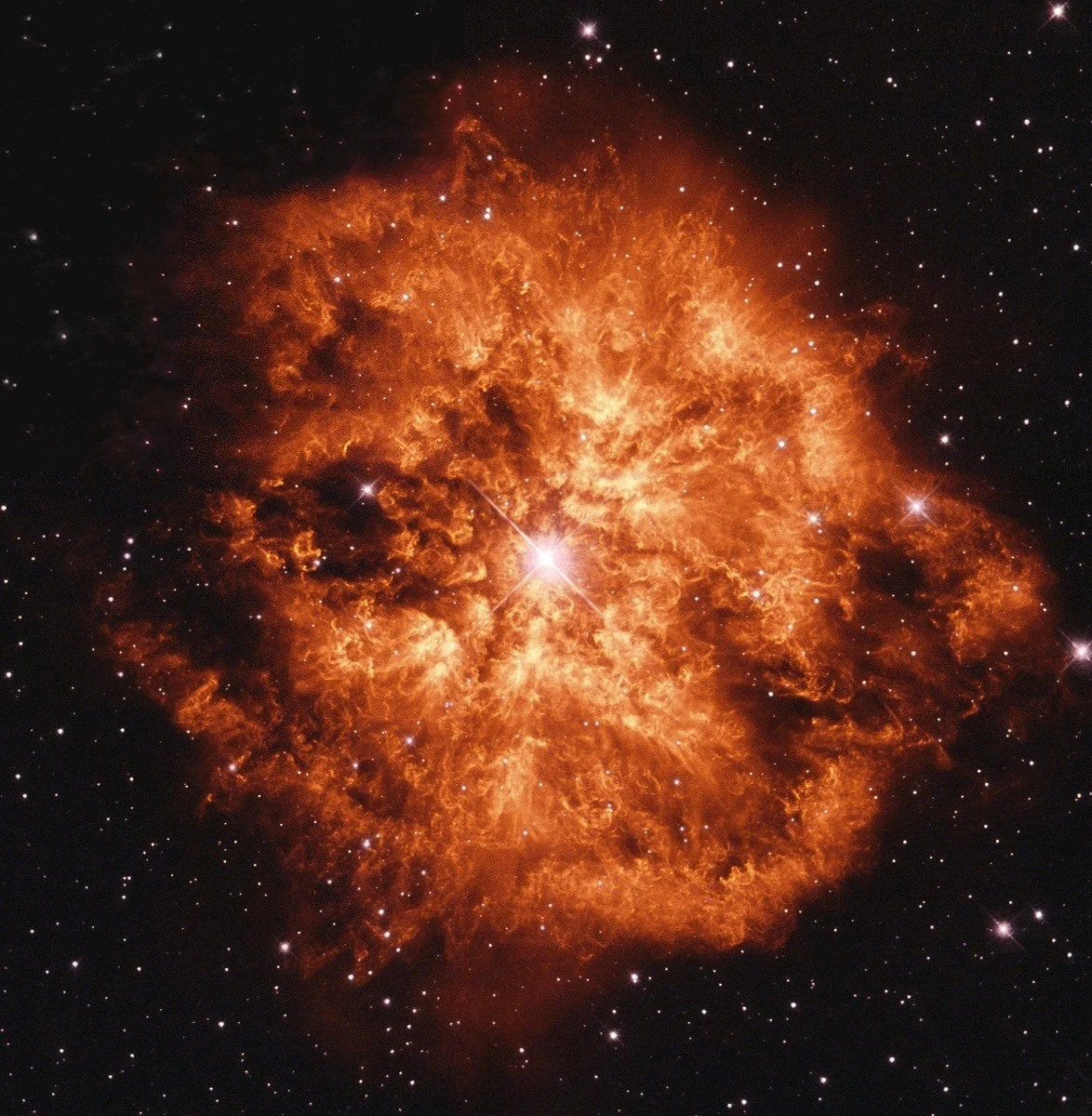
The object, with a mass of approximately 20 solar masses, is located in the constellation Sagittarius at a distance of 21,000 ± 2,000 light-years and is ejecting material at a speed of 1,400–2,000 km/s. WR 124 is 150,000 times more luminous than the Sun, and its surface temperature is 44,700 degrees Celsius, almost 7.7 times hotter than the Sun.
Stars with such high temperatures and luminosities are classified as Wolf-Rayet stars, named after the astronomers Charles Wolf and Georges Rayet, who first noticed and described the spectral features of such stars in 1867.
The orange-brown wisps are gas clumps with masses tens of times that of Earth, illuminated by ultraviolet radiation from their parent star. WR 124 is approximately 8.6 million years old, meaning it could explode as a supernova at any moment.
Galactic Cannibalism
The spiral giant NGC 5410 (89,000 light-years in diameter) is devouring its companion PGC 49896 (60,000 light-years in diameter), located at the top of the image. The event is taking place at a distance of approximately 190 million light-years from Earth. 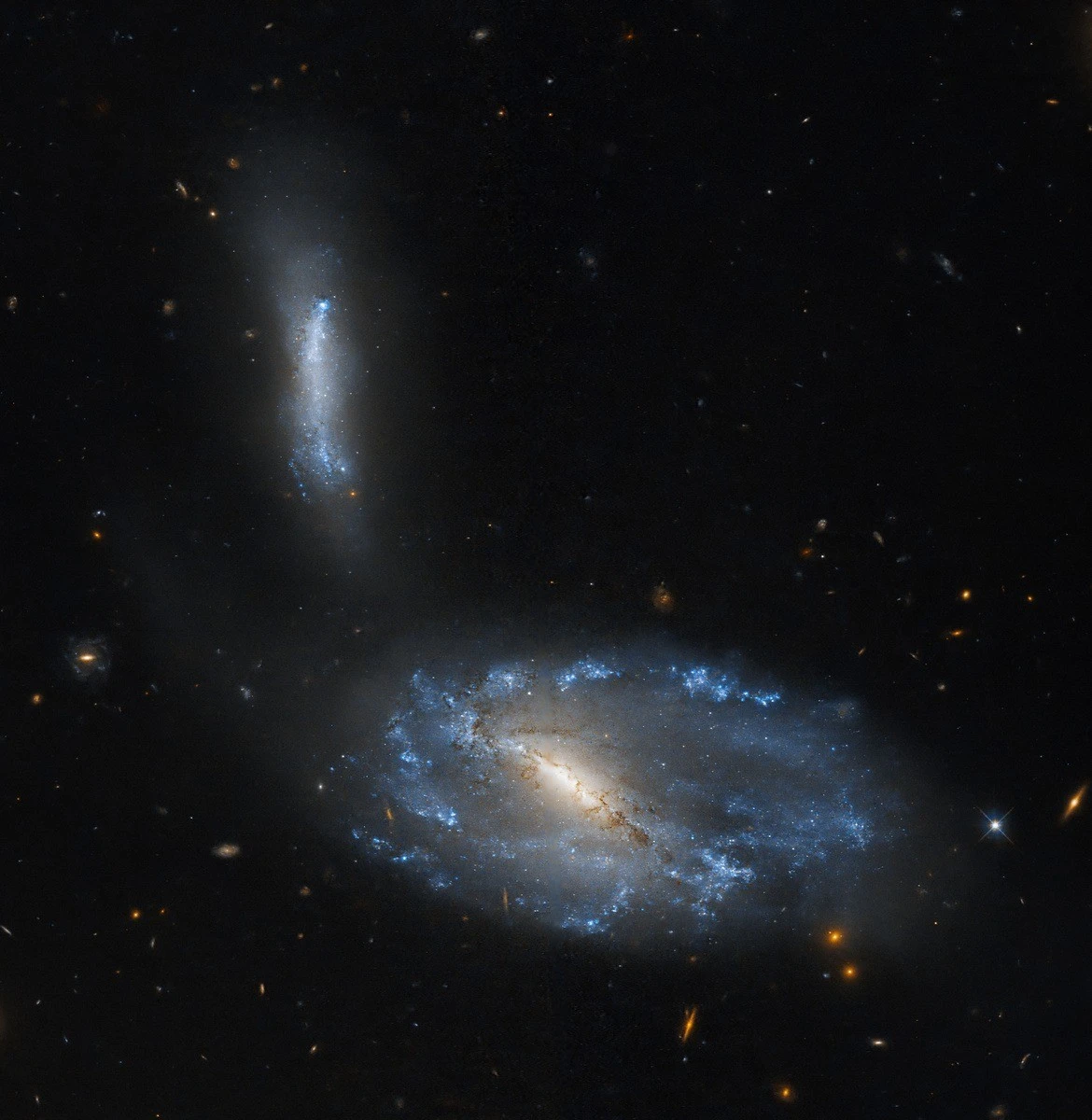
The gravitational interaction between the two galaxies caused them to exchange stars and gas, and star formation (bright blue-white spots) erupted in the arms of NGC 5410.
This image was taken by the Hubble Space Telescope on February 12, 2024.