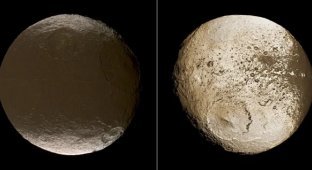
Enceladus — a Leading Candidate for Home for Extraterrestrial Life (3 photos)
Saturn's 504-kilometer-long moon Enceladus is home to geysers—not of hot water, but of icy water. The jets shoot hundreds of kilometers into space, forming the giant planet's E-ring. 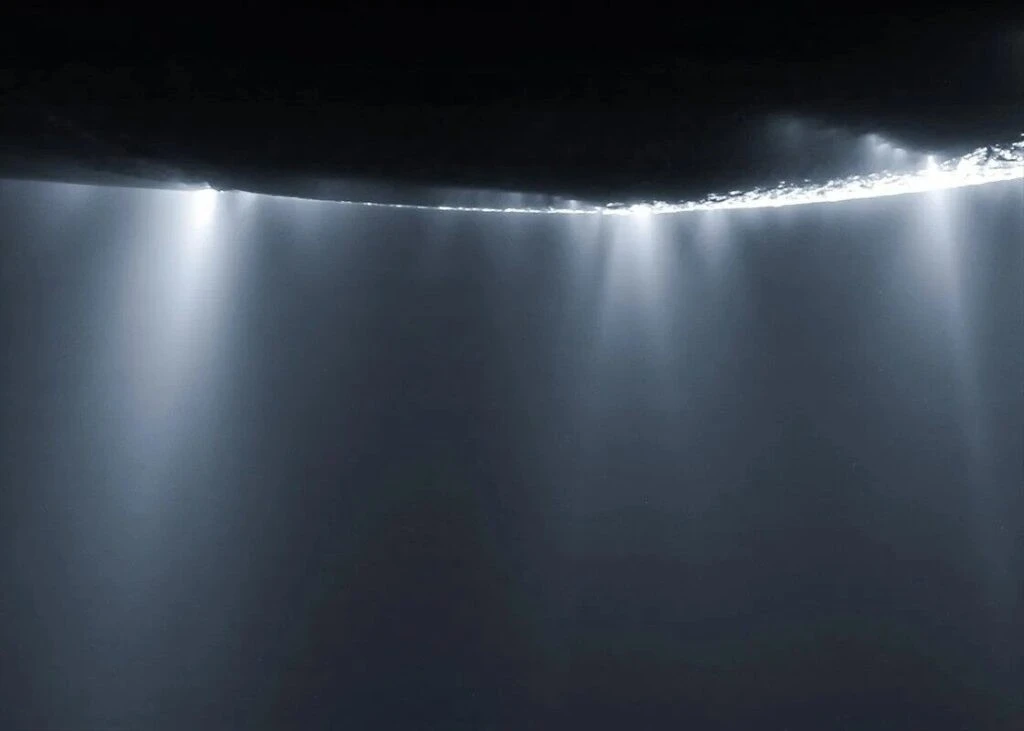
Geysers at Enceladus's south pole, as seen by the Cassini spacecraft
This activity is linked to the presence of a global ocean beneath the 20-kilometer-thick icy crust. NASA's Cassini probe, which studied the ringed giant system from July 1, 2004, to September 15, 2017, discovered complex organic molecules, hydrogen, and salts in the ejecta—everything needed for the origin and maintenance of life.
Why is the detection of hydrogen, the most abundant element in the universe, so intriguing? Its presence indicates hydrothermal processes at the ocean floor—where hot water interacts with rock. Similar processes exist at the bottom of Earth's oceans—hydrothermal vents known as "black smokers," which are "oases of life" thriving in the deep sea without access to sunlight.
Where does the energy come from?
Where does such a tiny world get the energy for its eruptions? Saturn's tidal forces heat the moon's interior from within. Enceladus's orbit is slightly eccentric, and the giant's gravity alternately compresses and stretches it. These continuous processes generate heat. Friction turns ice into water, and pressure produces geysers. 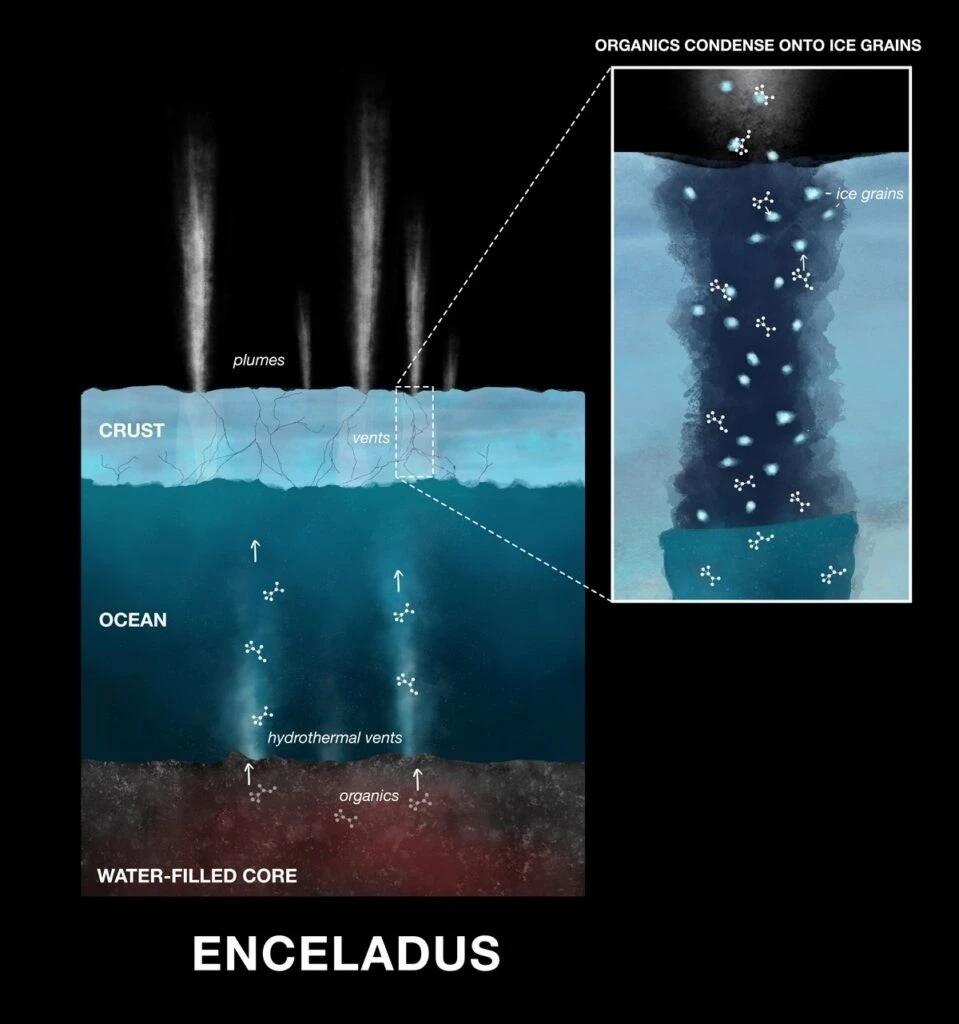
The process of light, soluble, and reactive organic compounds falling on ice grains ejected by water jets from Enceladus
Notably, geyser activity is concentrated at the moon's south pole, which can be explained by its thinner icy crust. Four giant fractures, called "tiger stripes," run there. It is from these fractures that the ice fountains erupt, feeding Saturn's ring and renewing Enceladus's already snow-white surface.
A Mission of the Future
Enceladus is undoubtedly a leading candidate for hosting extraterrestrial life. And we don't even need to drill to find out—the ocean generously spills into space.
The European Space Agency (ESA) is planning a large-scale mission to Enceladus, which would include not only an orbiter but also a lander that would land on the south pole to collect samples of emissions directly at the source. 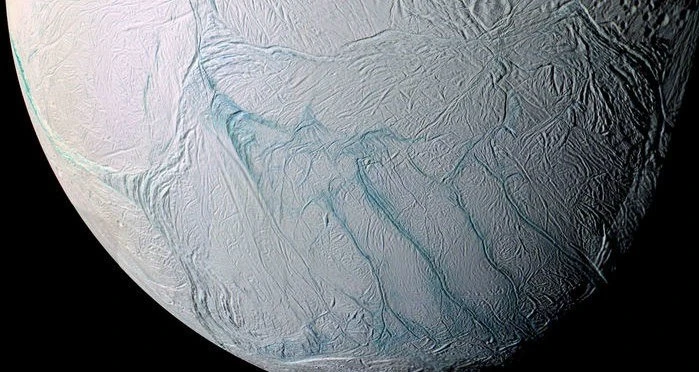
Fractures at the south pole of Enceladus, captured by the Cassini probe
If life truly exists beneath the ice of Enceladus, we may find evidence of it within the next few decades. But what if we don't find life there? Then we'll be looking for an answer to the question of why it didn't emerge under ideal conditions.