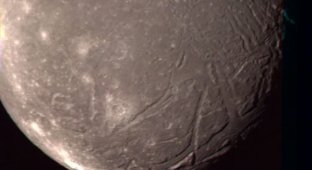
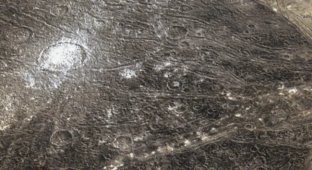
Enceladus and Titan: Two Potentially Habitable Worlds in One Frame (2 photos)
The image below was taken by NASA's Cassini spacecraft on March 12, 2012. This isn't just another beautiful space photo, but a map of the future—the direction humanity will take in its search for life beyond Earth. 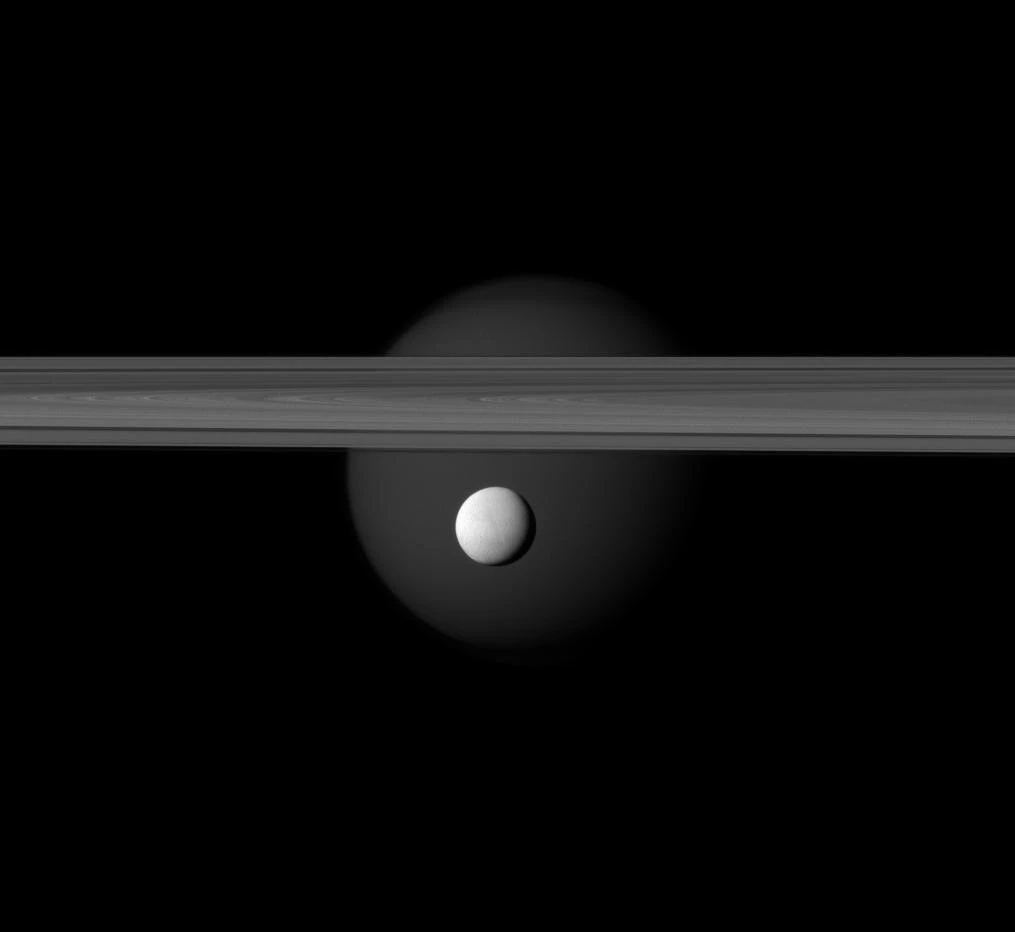
In the foreground is Saturn's icy, 504-kilometer-wide moon Enceladus. Its surface is covered in a thick crust of ice, averaging an impressive 20 kilometers. But beneath it lies a global subsurface ocean. From deep rifts at the south pole, poetically called "tiger stripes," jets of water vapor and ice particles regularly erupt—a geyser activity that ejects material directly from the ocean into space.
Cassini flew through Enceladus's geysers several times, analyzing samples as they passed. During these missions, the spacecraft discovered complex organic molecules, ammonia, methane, salts, and phosphates. Furthermore, a recent reanalysis of the data showed that Enceladus's ocean is significantly warmer than predicted by models, is very stable, and has certainly existed for a very long time. All of this provides indirect evidence that this is a very promising place for the origin and maintenance of life as we know it from Earth. Enceladus is likely already a habitable world.
In the background of the image is Titan, a giant moon with an average diameter of 5,152 kilometers. This world is larger than Mercury (average diameter 4,879 kilometers) and almost 1.5 times larger than the Moon. Titan is the only moon in the Solar System with an atmosphere (it's even 50% denser than Earth's) and has stable "reservoirs" on its surface, consisting of hydrocarbon "cocktails": rivers, lakes, and seas of liquid methane and ethane. In these "reservoirs," at temperatures below -180 degrees Celsius, chemical processes completely alien to terrestrial biochemistry—but perhaps no less complex—can occur. 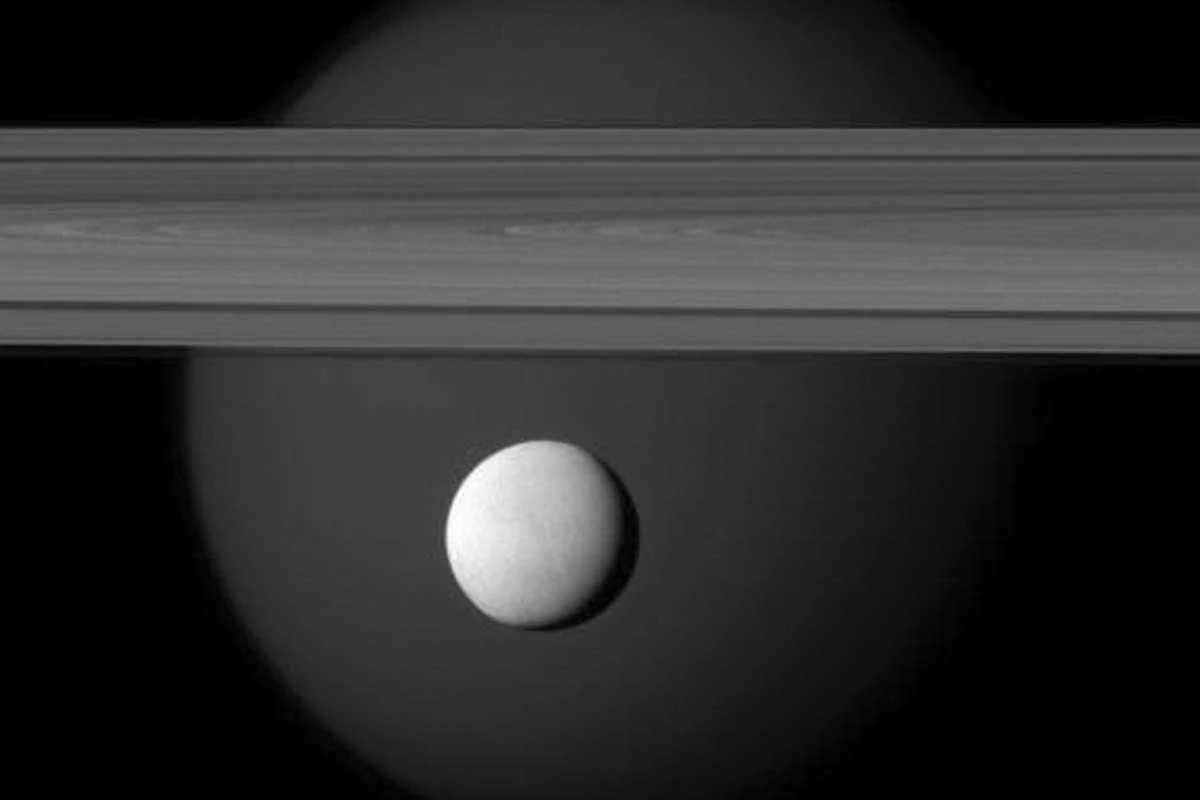
Enceladus offers us liquid water and organic matter—the basis of life on Earth. Titan is a liquid, but a different kind, and has an atmosphere capable of supporting unusual forms of chemical evolution.
Both worlds are more than just interesting objects. They are two natural laboratories for testing independent hypotheses about how life might arise in space. And in this image, two such different celestial bodies, of colossal scientific interest, are symbolically separated by Saturn's rings.