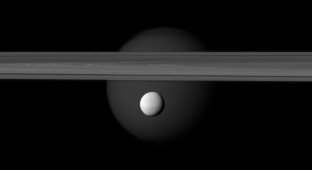
Ganymede: What Are the White Spots in the Galileo Image Hiding? (4 photos)
The Perrine Region (Latin: Perrine Regio) is a vast region in the north polar region of Ganymede, the largest moon of Jupiter and the solar system as a whole. The average diameter of this celestial body is 5,268 kilometers, making it approximately 389 kilometers larger than Mercury (average diameter 4,879 kilometers), a full-fledged planet. 
This image was acquired on December 27, 2000, by NASA's Galileo spacecraft and can be seen as indirect evidence that in some places the moon's crust is thin enough for a subsurface ocean to interact with space.
Note the bright white spots. These are deposits of pure water ice, reflecting most of the incident sunlight. The presence of large amounts of ice in the craters could be explained by the impactor delivering it, or by melting part of the icy crust, renewing the material beneath the dust layer. However, the ice in the fractures is likely associated with an ocean.
Tidal forces from the gas giant continuously compress and stretch the moon, causing small cracks and large fissures to appear on its surface. Where the crust is noticeably thinner, the deepest cracks form, allowing Ganymede's internal contents to escape. It's like taking a plastic bottle without a lid, filling it with water, and then sharply squeezing it. 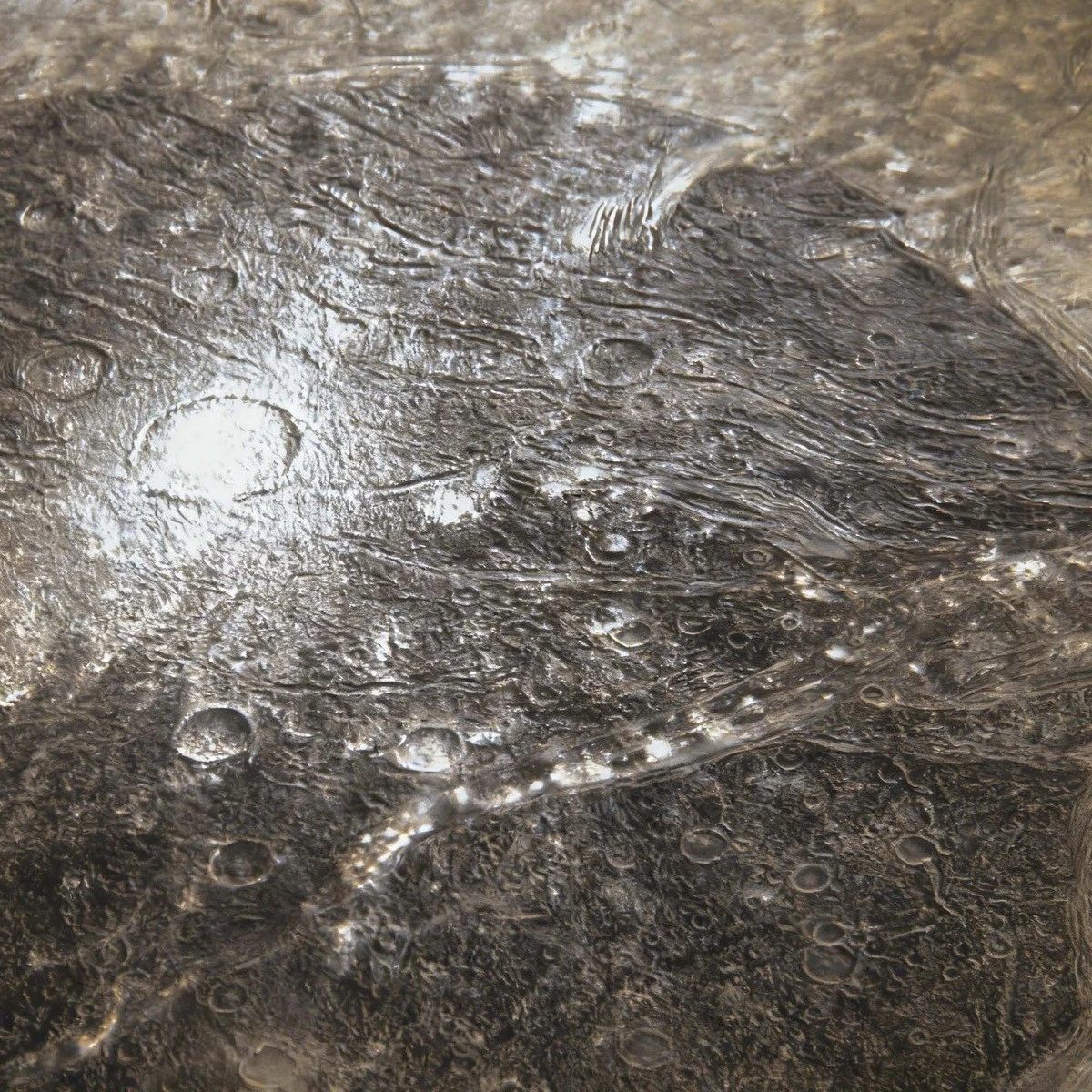
Image enhanced with AI 
Upon reaching the surface, the water immediately freezes, forming the snow-white deposits captured in the frame. 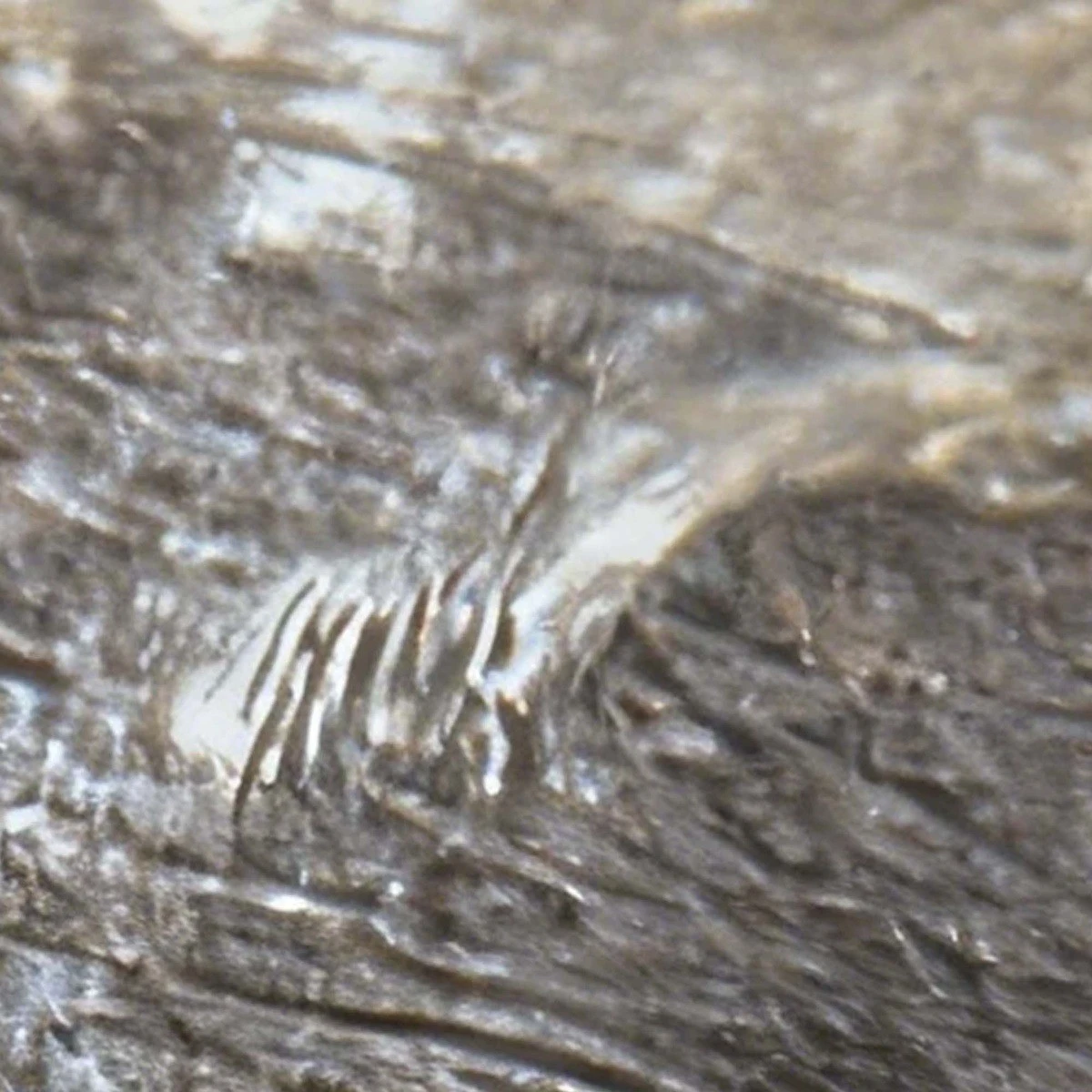
A very noteworthy detail
To test this hypothesis, additional data is needed, which will be obtained in the second half of 2031, when the European Space Agency's (ESA) JUICE probe begins operations. The launch of the spacecraft, designed to study Jupiter's icy moons Europa, Ganymede, and Callisto, took place on April 14, 2023.
If this information is confirmed, Ganymede will be considered a potential habitable world.