NASA changed the orbit of an asteroid for the first time (2 photos)
For the first time in history, humans have been able to intentionally change the trajectory of an asteroid. This will help Earth counter future cosmic threats. 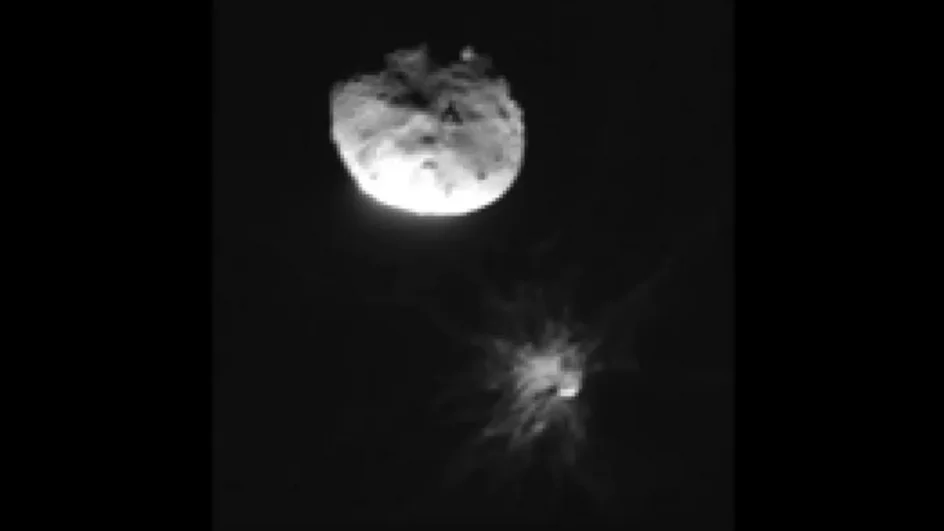
The moment the spacecraft collides with the asteroid. Source: NASA
NASA's historic DART (Double Asteroid Redirection Test) mission successfully changed the orbit of the asteroid Didymos around the Sun. This marks the first time humans have intentionally altered the motion of a celestial body. NASA has released the final analysis data collected after the DART spacecraft's collision with the asteroid Dimorphos, a moon of Didymos.
Dimorphos's initial orbital period around Didymos was 11 hours and 52 minutes. After the DART impact, it was reduced to 11 hours and 23 minutes. This change, although small, confirms that kinetic impact—the method used in the DART mission—is effective in altering the asteroid's orbit. 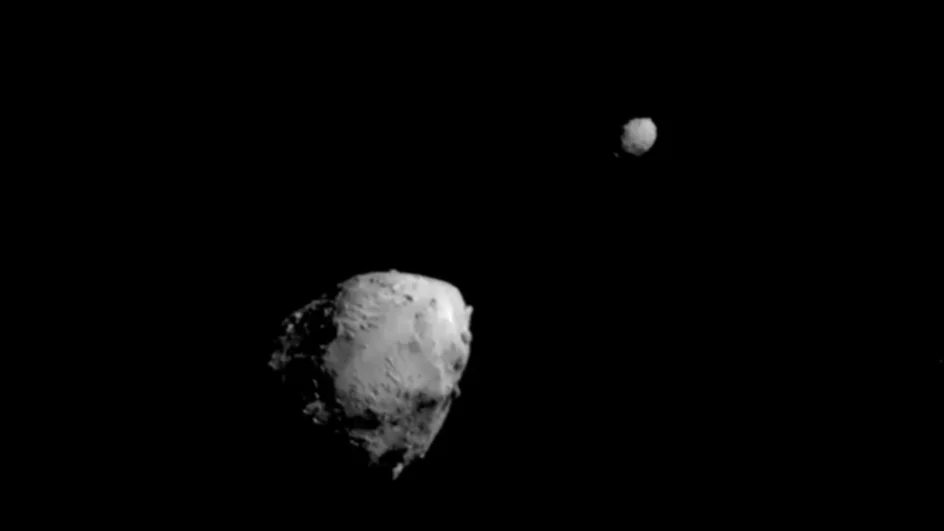
The asteroid before its orbital change. Source: NASA
The DART mission was designed to test technology that could be used in the future to deflect asteroids that pose a threat to Earth. Although neither Didymos nor Dimorphos pose a danger to our planet, they were chosen as the initial targets for testing this technology.
Scientists continue to analyze the data collected during the mission to better understand the physical properties of asteroids and optimize deflection methods. In the future, NASA plans to use this knowledge to develop more effective planetary defense systems.
The success of the DART mission gives hope that humanity can protect itself from potential cosmic threats.