Iapetus: Mesmerizing Photos of Saturn's Most Mysterious Moon (7 photos)
Iapetus is a remarkable moon of Saturn with an average diameter of 1,469 kilometers. It was discovered in 1671 by the Italian astronomer Giovanni Domenico Cassini, after whom the NASA Cassini spacecraft, which studied the ringed gas giant system from July 1, 2004, to September 15, 2017, was named. 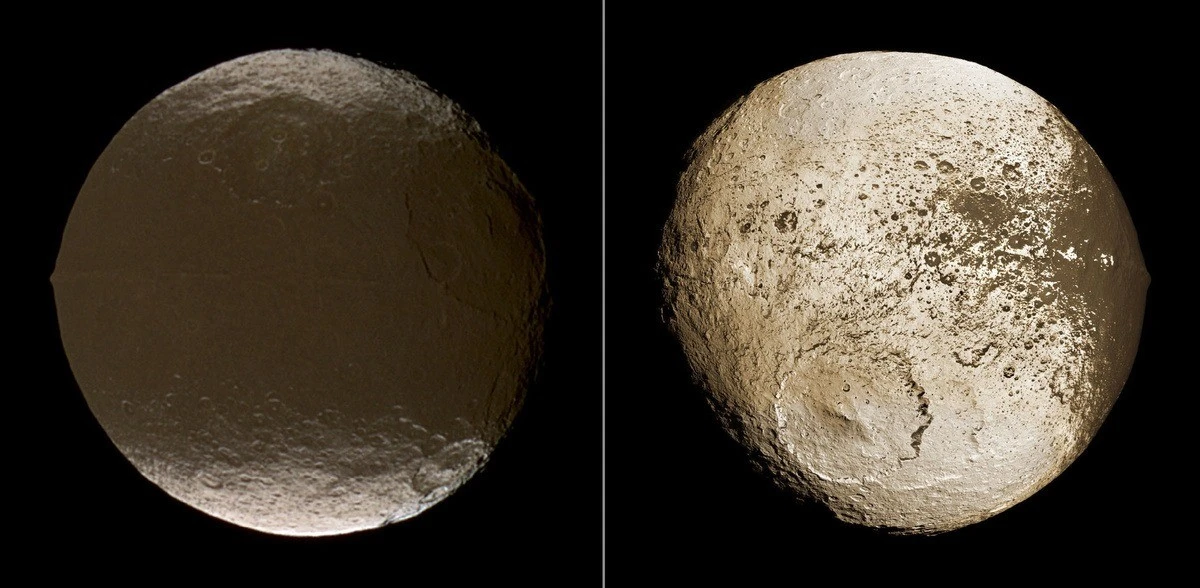
These and all other images used in this article were captured by NASA's Cassini spacecraft.
So, let's take a short virtual journey to Iapetus to get a closer look at this distant and cold world, whose nature remains one of the greatest mysteries of the Solar System.
A Two-Faced Giant
The first thing that strikes you when studying images of Iapetus is its radically different hemispheres. One side of Saturn's moon is reddish-brown, while the other is dazzling white. The albedo* of the dark side is only 0.05 (like soot), while the albedo of the light side is 0.5-0.6 (the surface is almost as bright as freshly fallen snow).
*Albedo is a coefficient indicating what proportion of the light falling on a surface is reflected.
This dichotomy is so pronounced that its discoverer, Cassini, could only observe the moon from one side of Saturn. Iapetus is tidally locked—it always faces the same side toward the planet. Therefore, when the dark hemisphere was facing Earth, the moon became invisible to 17th-century telescopes. It was Cassini, with instruments that were primitive by today's standards, who first concluded that Iapetus has a dark side and a light side.
Mysterious Equatorial Ridge
Observations by the Cassini spacecraft have revealed another unique feature – a giant ridge encircling Iapetus precisely along the equator. 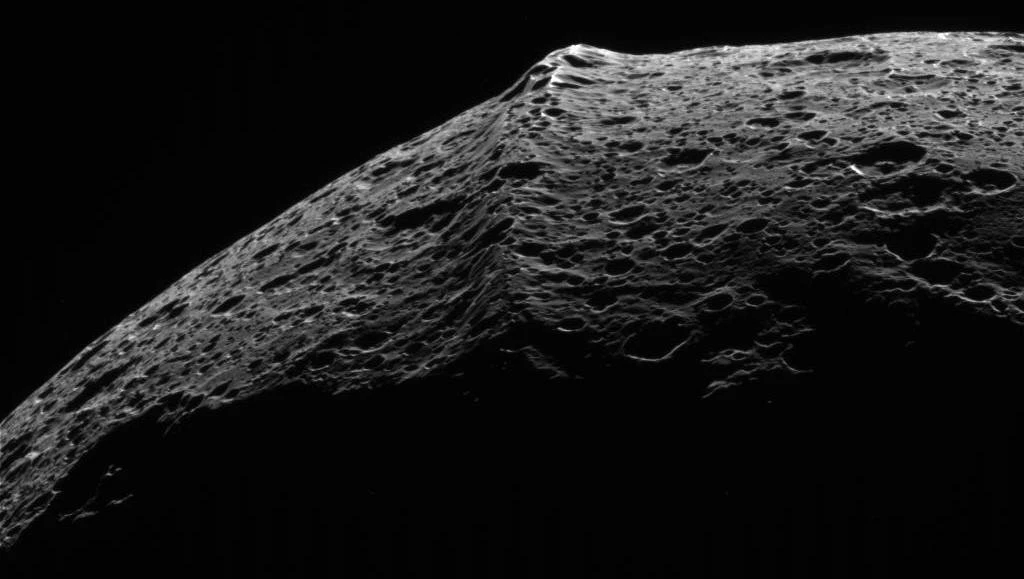
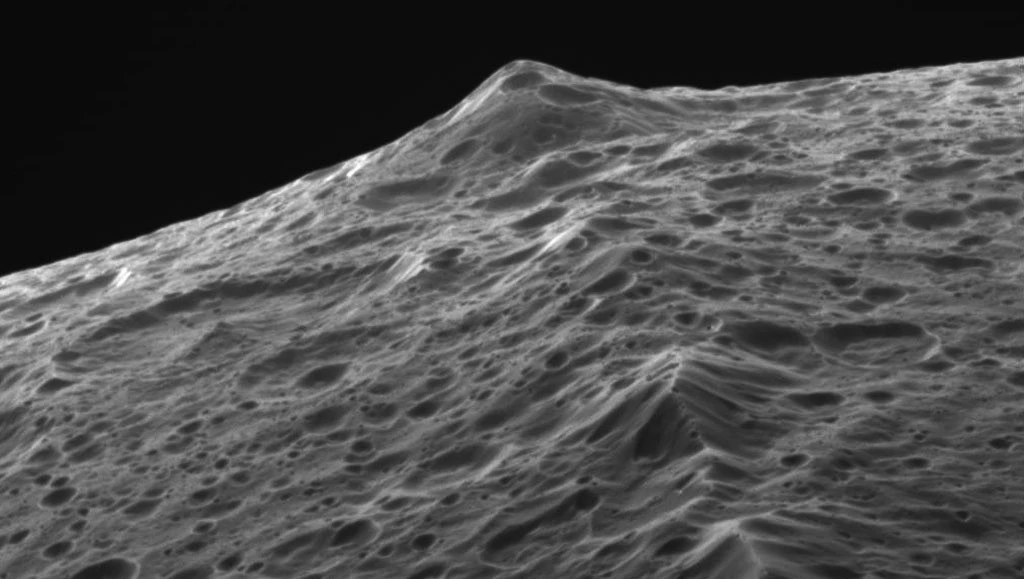
This mountain range, unofficially known as the "Iapetus Wall," reaches a height of 20 kilometers with a base width of up to 200 kilometers. The length of this formation is over 1,300 kilometers!
How did this ridge form? There are two hypotheses:
Iapetus once had a ring system, which, due to gravitational perturbations, settled at the equator;
Saturn's tidal forces compressed and stretched the young Iapetus, whose interior was still quite flexible. As the moon cooled, this stretching became less effective, and eventually culminated in a final compression and solidification of the "squeezed" material at the equator.
Note: the ridge is covered with numerous craters, indicating its ancient origin. Iapetus likely acquired this ridge shortly after its formation.
We know of no other body in the Solar System with a similar structure.
Ancient Giant Craters
Iapetus's surface is dotted with gigantic craters, the largest of which, Abisme, has a diameter of approximately 800 kilometers. The rim height (the elevation of the rim above the crater floor) of this impact feature exceeds ten kilometers. 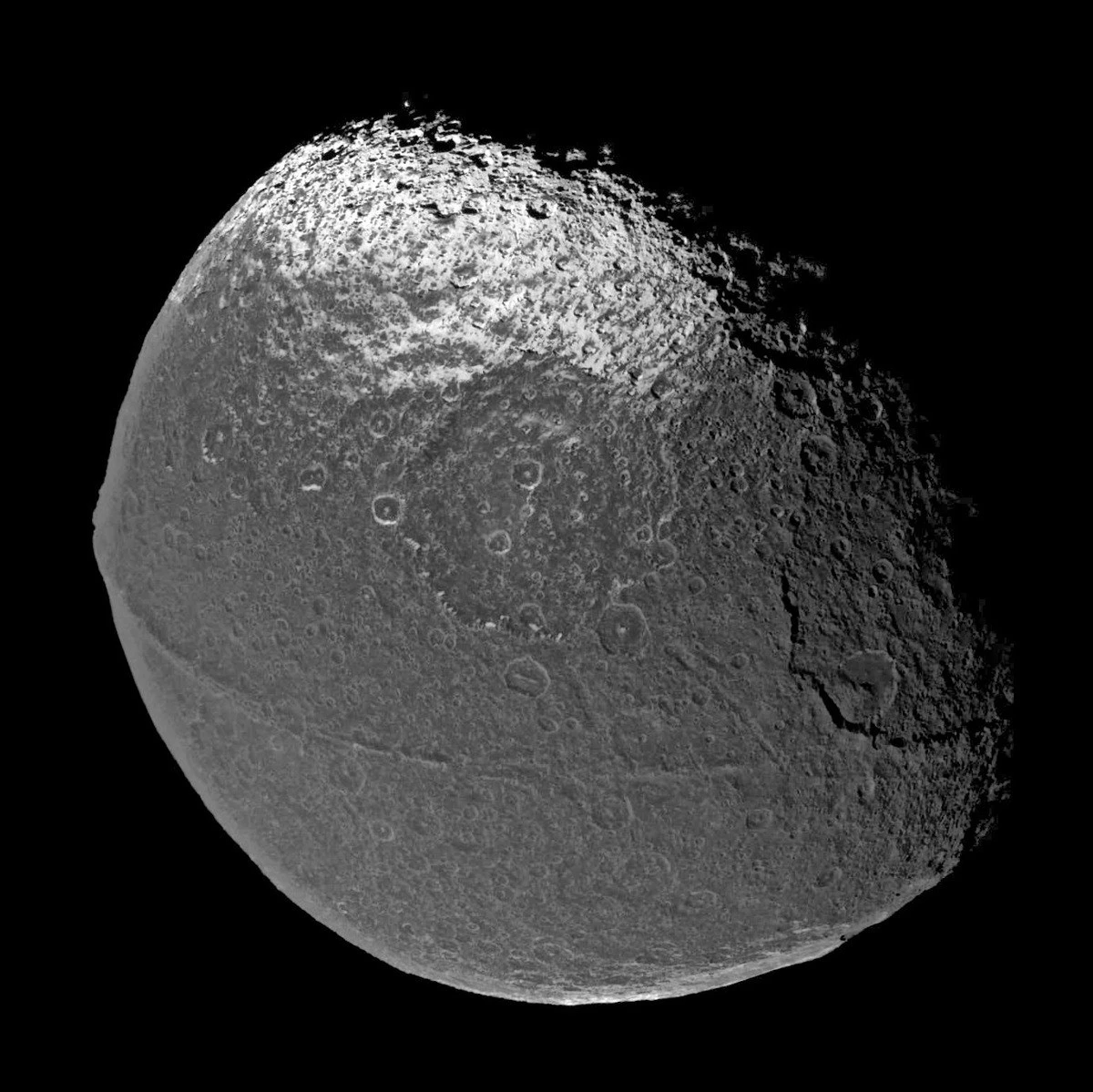
Abym occupies the upper left of the portion of Iapetus visible here. 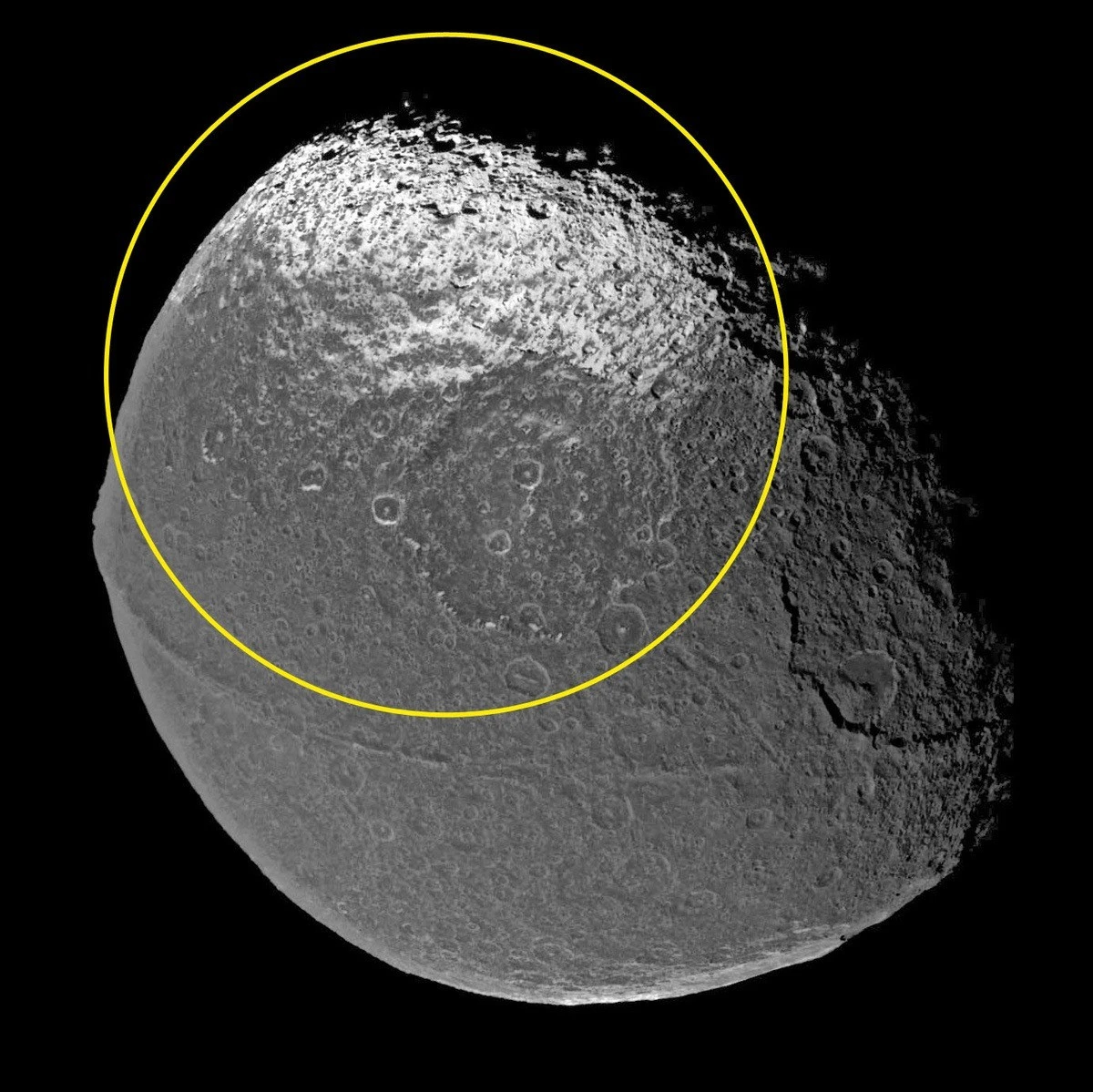
Abym may be one of the oldest craters in the Solar System, preserved from the era of planet formation about 4.5 billion years ago.
The Mystery of the Origin of Dark Material
For a long time, the prevailing hypothesis was that the dark matter enveloping one of Iapetus's hemispheres was dust and organic compounds ejected from the surface of the irregular satellite Phoebe by micrometeorites. However, spectral analysis by Cassini revealed a discrepancy in the compositions. 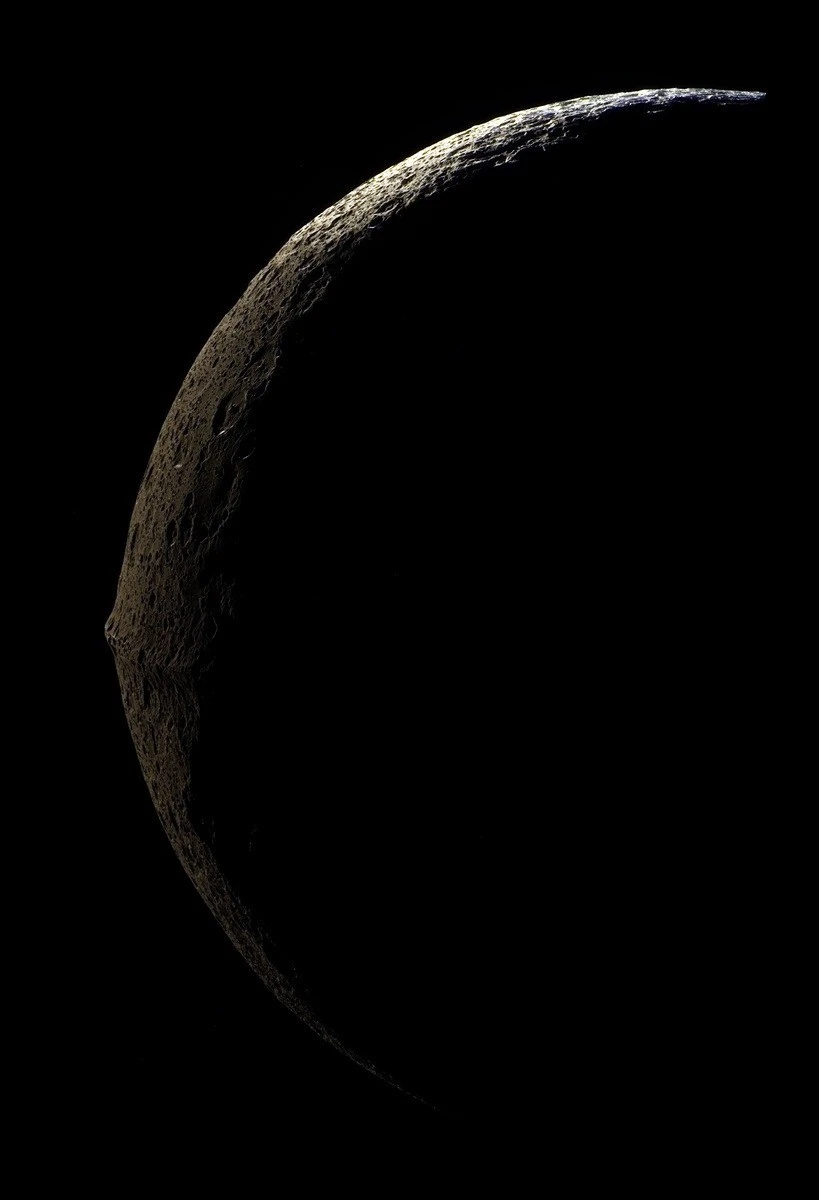
Today, scientists are leaning toward the theory that the source of the material may be the satellite Hyperion, whose composition is virtually identical to the dark material on Iapetus. This substance contains water ice, ammonia, carbon, and iron oxide, which have acquired a characteristic reddish hue due to exposure to cosmic and solar radiation.
The dark layer is only a few meters thick.
Polar Ice Caps
At the poles of Iapetus, the Cassini probe discovered bright white areas resulting from a unique process of water ice redistribution. Sunlight heats the dark surface to 130 Kelvin (approximately -143 degrees Celsius), causing the ice to sublimate and then precipitate at the colder poles. 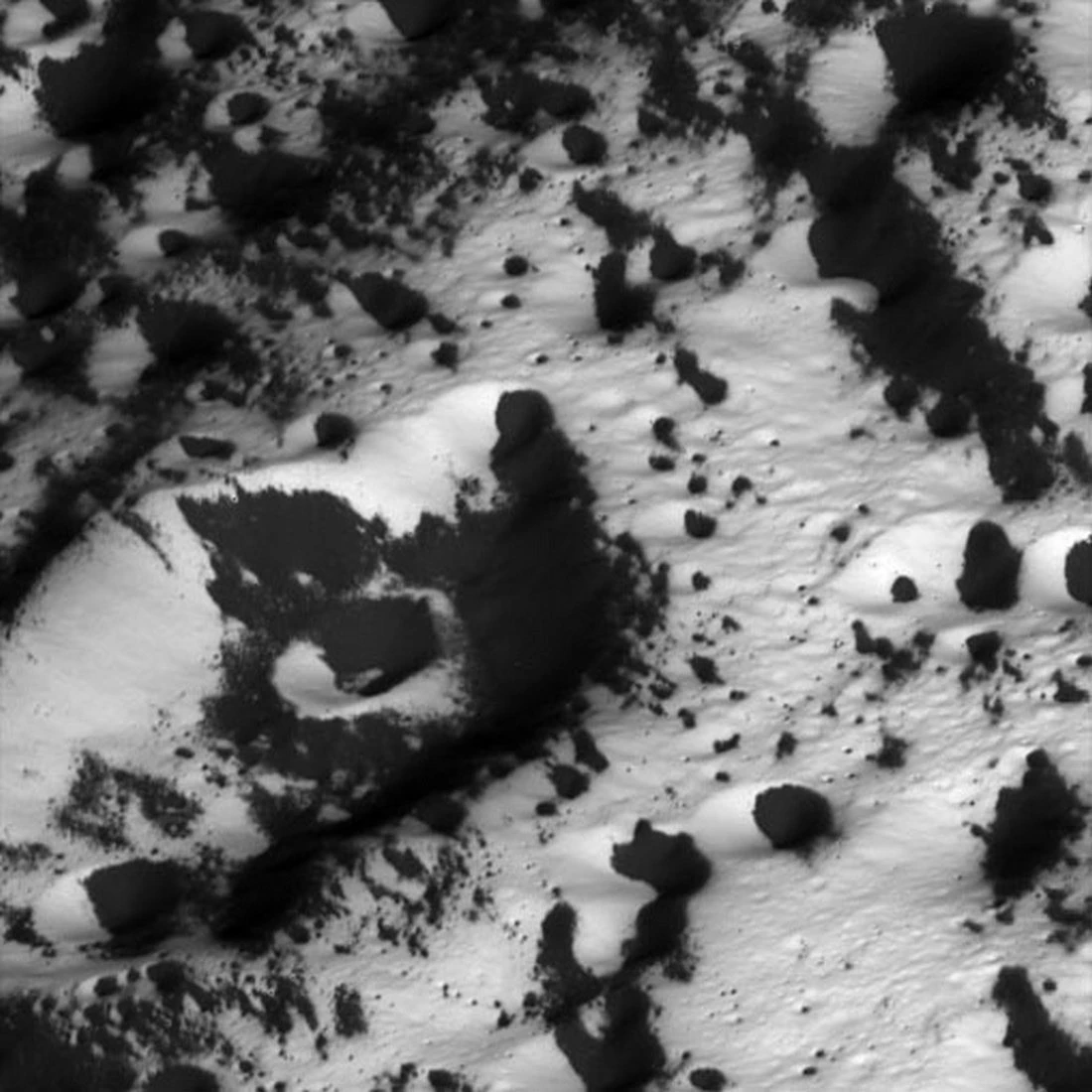
This simple process only intensifies the contrast between the dark and light areas of the moon over time.