Mount Wright on Pluto: A Cryovolcano That May Be Hiding an Ocean (3 photos)
Among the many stunning images of Pluto returned by NASA's New Horizons spacecraft after its historic flyby on July 14, 2015, the photograph of Mount Wright holds a special place. 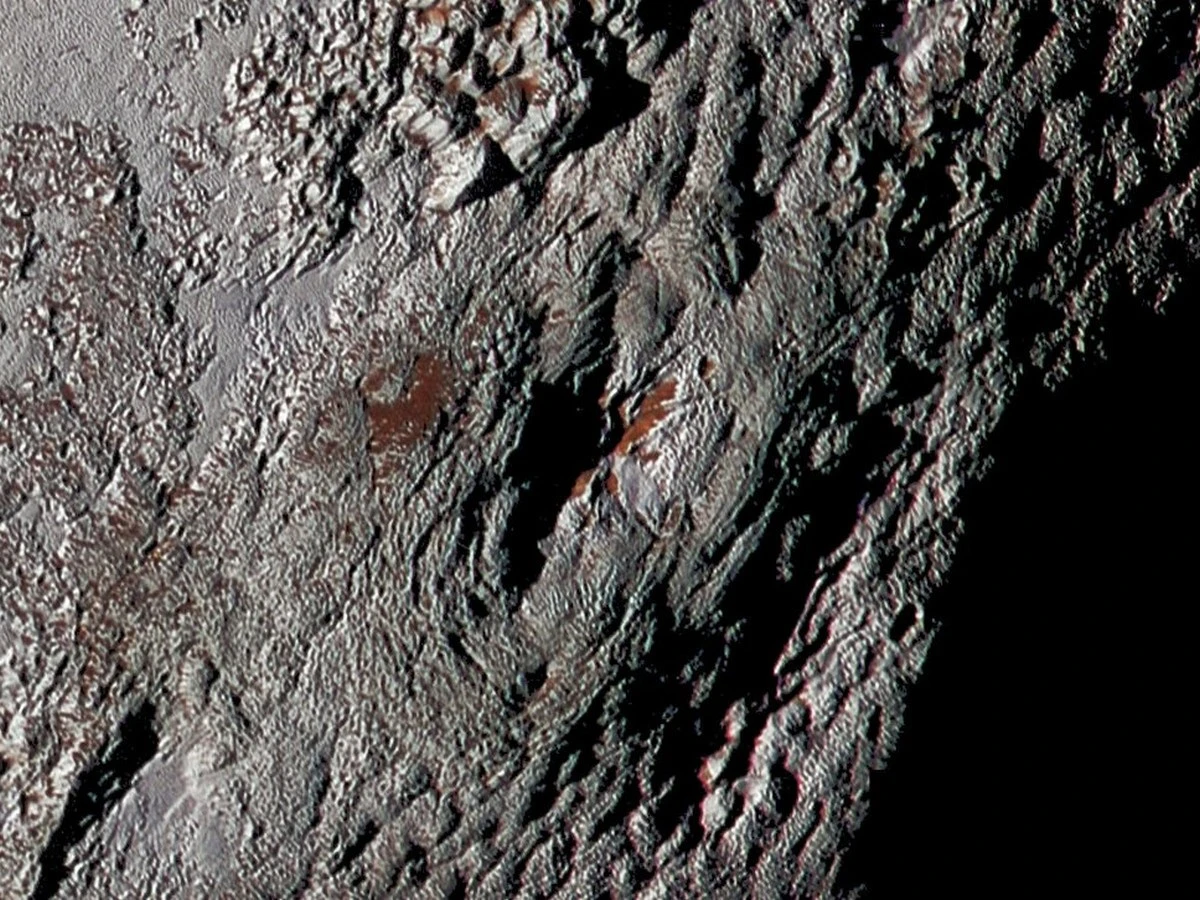
Mount Wright
This image became one of the key pieces of evidence that the dwarf planet on the outskirts of the solar system is much more active than previously thought.
What is Wright Mons?
Wright Mons is an unusual formation located in the southwestern part of Tombaugh Regio, the famous heart-shaped region of light on Pluto's surface. This region is approximately 2,300 kilometers in diameter and is home to some of the dwarf planet's most intriguing geological features. 
Natural-color image of Pluto, taken by NASA's New Horizons spacecraft on July 14, 2015. Pluto's "heart" is clearly visible in the image.
The mountain itself is also impressive in size: its base is approximately 150 kilometers in diameter and stands about four kilometers high. For comparison, Mount Everest is 8,849 meters high. At the summit of Mount Wright is a huge depression, 56 kilometers in diameter, with a characteristic lumpy texture along its edges, making it resemble a caldera on Earth's volcanoes.
Cryovolcanism on Pluto
Mount Wright is a cryovolcano—a giant icy geological formation that, instead of molten rock, erupts a liquid and gaseous mixture ("cryolava") of water, ammonia, nitrogen, and methane. At Pluto's extremely low temperatures, averaging around minus 230 degrees Celsius, these substances behave similarly to lava on Earth. 
Mount Wright is at the center of the image.
Cryovolcanic activity on such a distant celestial body is a highly unexpected discovery. Before the New Horizons mission, many planetary scientists were convinced that Pluto was a dead world whose geological activity had long ceased. The discovery of Mount Wright, coupled with other signs of relatively recent geological activity, completely changed this notion.
Subsurface Ocean
The existence of cryovolcanoes on Pluto strongly suggests that a vast reservoir of liquid water—possibly an entire subsurface ocean—is hidden beneath its icy crust. If this is true, Pluto's interior may still contain internal energy from its formation. Furthermore, its interior may be partially heated by tidal forces from Charon, the largest of its five moons.
The hypothesis of a subsurface ocean is supported by other observations. For example, Tombaugh Regio is virtually devoid of large craters, meaning the surface there is young by cosmic standards—no more than 100 million years old. This means that geological processes on Pluto occurred relatively recently and are likely still occurring in some form today.