From bandits to demons: the horrors of medieval roads (16 photos)
Traveling in the Middle Ages was nothing like our comfortable commutes with electronic tickets or hotel reservations via app. Without modern roads, transportation, and navigation, travel was time-consuming, fraught with danger, and required not only courage but also a compelling reason. Traveling often became a true adventure, full of risks, unexpected events, and amazing discoveries. Let's travel back in time and discover how people in the Middle Ages traveled distances, what motivated them, and what difficulties they encountered along the way. 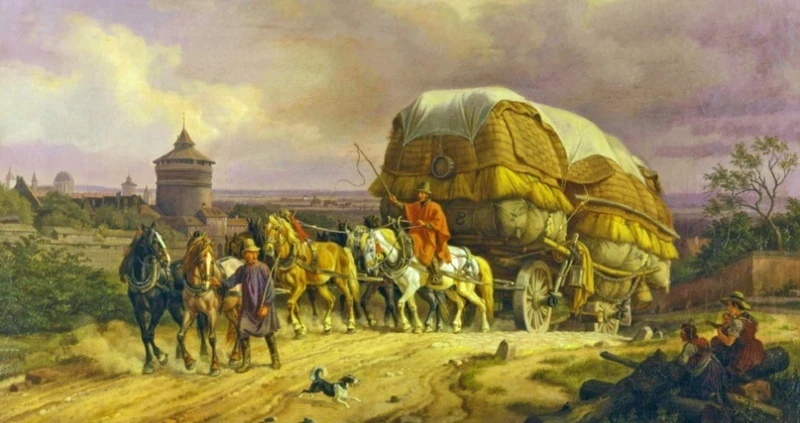
Medieval Travelers: From Pilgrims to Fugitives
Many believe that in the Middle Ages, people stayed in their villages and knew nothing of the world beyond. But this is not true. Then, as now, not everyone was satisfied with living in one place. Kings, merchants, soldiers, artists, clergy, pilgrims, and even peasants all set out on the road. The reasons for traveling varied: some traveled on business, some sought holy places, and still others went to war. 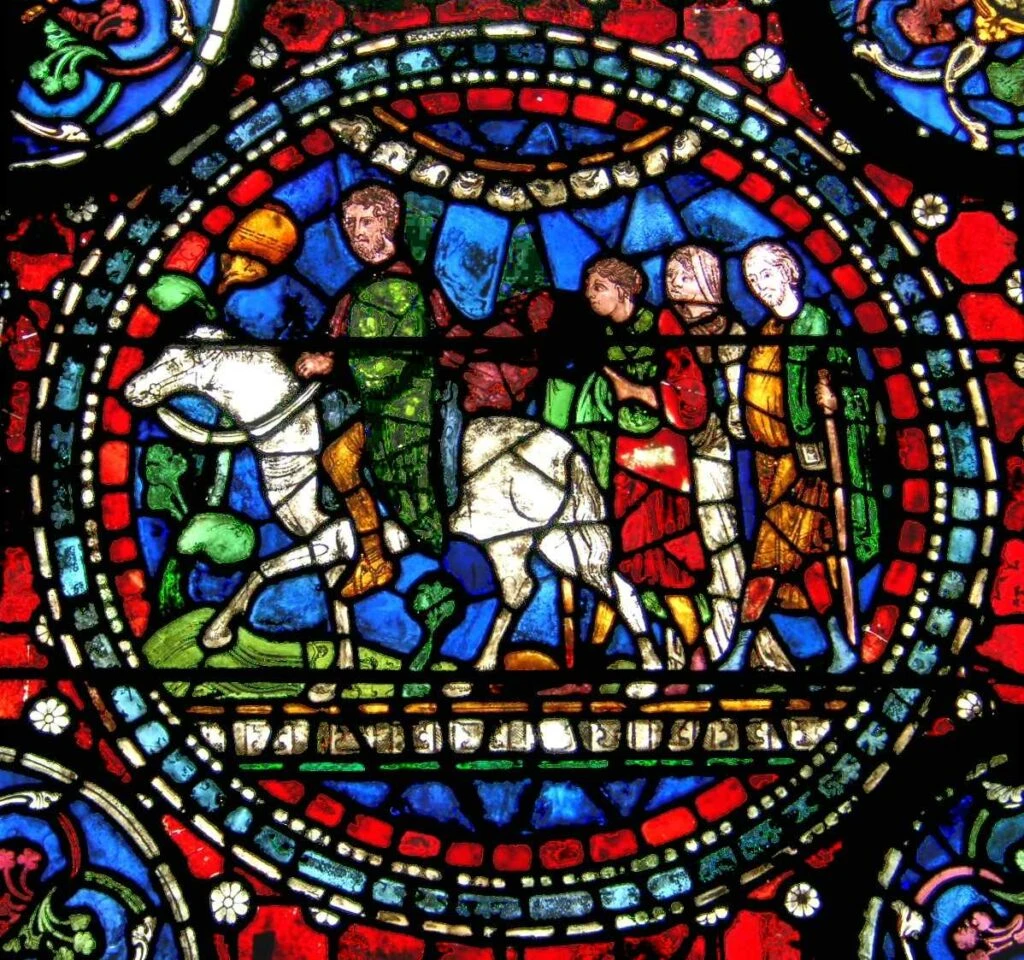
Wanderers. Stained glass from Canterbury.
It's impossible not to mention the Crusaders—the principal medieval wanderers. True, their numerous campaigns left rivers of blood and devastated cities in their wake, but the knights themselves undoubtedly gained new experiences. Many residents of medieval Europe, especially the poor, wandered in search of a better life or fled wars, epidemics, religious persecution, and the cruelty of their lords. Furthermore, throughout history, there have been those driven by a passion for exploration or a desire to become rich. Regardless of their goals, such travelers made important discoveries and contributed to the development of humanity. 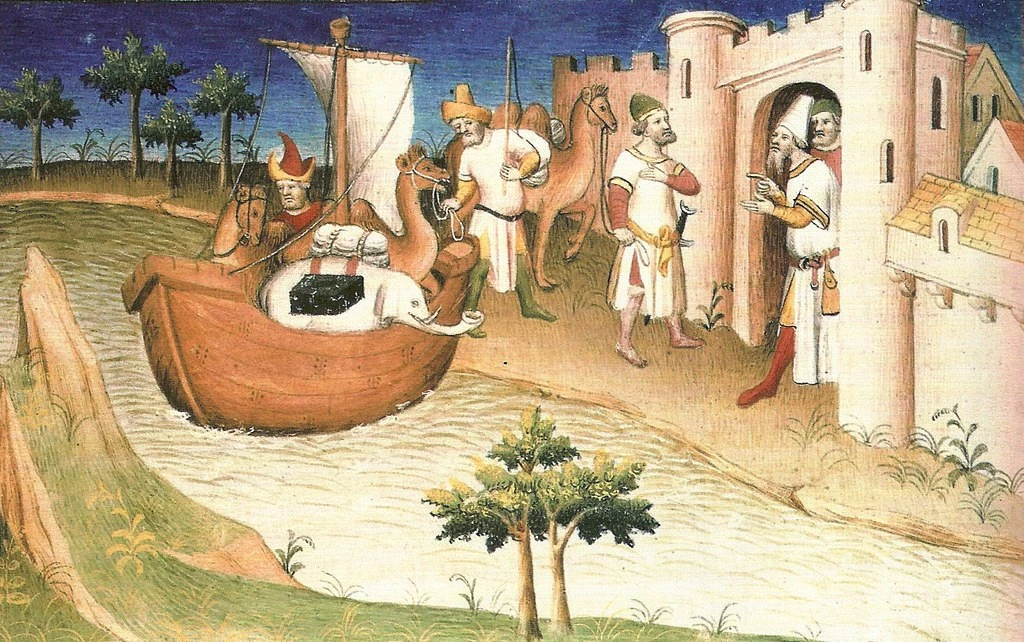
This antique illustration depicts the return of Marco Polo's expedition. The travelers are carrying an elephant.
In the Middle Ages, everyone could travel across Europe—from beggars to kings and the Pope. Borders were symbolic at the time, and travel was almost entirely unrestricted. But this didn't mean traveling was exciting or enjoyable. Travelers faced many hardships and dangers along the way. Even a relatively short journey could prove deadly due to bandits, wild animals, disease, the vagaries of the weather, and the arbitrary actions of feudal lords.
Roads and Transportation in the Middle Ages
After the fall of Rome, transportation became significantly easier. While the Romans built an impressive network of roads throughout the empire, travel became much less convenient in the Middle Ages. The system of interconnected roads and bridges collapsed along with the empire. The few roads that remained from the Romans remained in terrible condition for a long time: they were neglected and neglected. Medieval roads were more like animal trails—narrow, winding, often barely visible. In rainy weather, they turned into impassable swamps, and in winter, they became deadly dangerous. 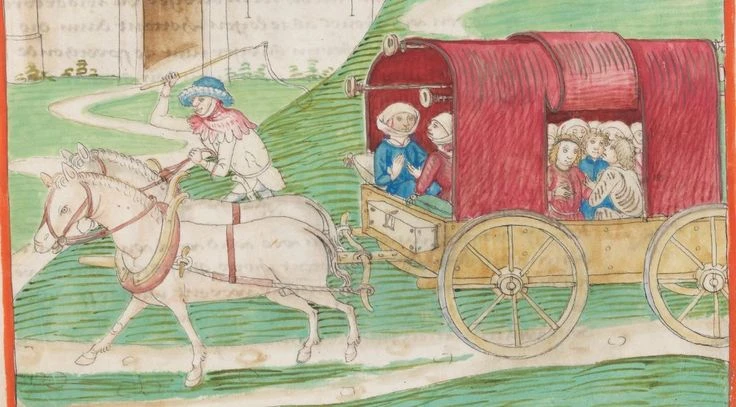
Travelers could walk, ride on horseback, or use carts pulled by oxen or horses. However, carts were extremely uncomfortable and often broke down on uneven roads. Carriages only appeared towards the end of the Middle Ages and were initially extremely uncomfortable. There were no springs, so every stone on the road was felt with every muscle. However, such travel was considered the height of luxury and emphasized the owner's high status. 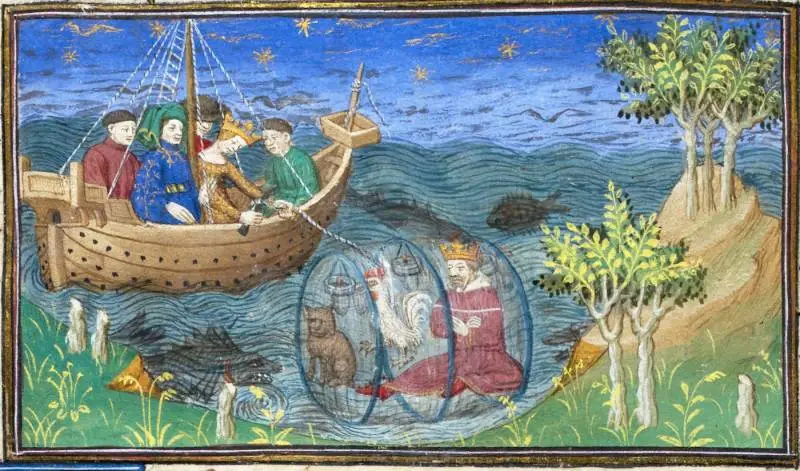
To cross rivers, travelers used boats or ferries—bridges were often rare and not always reliable. In mountainous regions, such as the Alps, crossings were especially dangerous due to landslides, avalanches, and narrow paths. In winter, travel became even more difficult, and many preferred to wait out the cold season at home.
Royal Travel: Not a Whim, but a Duty
Monarchs stood out among the most restless inhabitants of medieval Europe. Each king owned multiple residences and constantly moved between them with his court. This was not just the idle wanderings of a wealthy idler. The monarch traveled to hold important meetings, inspect his domains, and punish and reward his subjects. Moreover, in the absence of mass media, this was the only way to remind the people that they had a ruler. 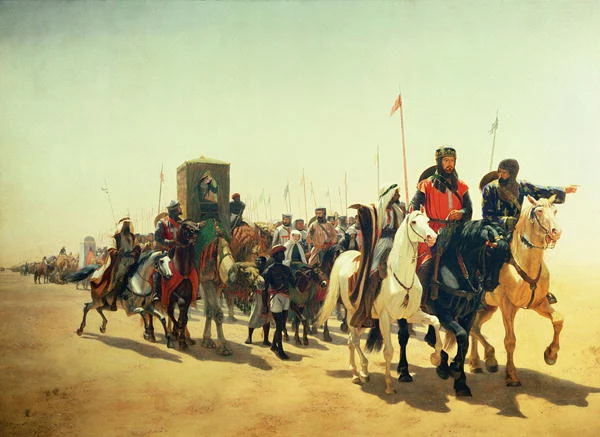
Richard the Lionheart on the Road to Jerusalem. Artist: James William Glass, circa 1850
Rulers often visited other countries and even left the borders of Christendom. In those days, such journeys were considered truly heroic and quickly became overgrown with fictional details. Some monarchs spent most of their lives on the road. For example, the famous King Richard the Lionheart spent only about six months of his ten-year reign in the British Isles. The rest of the time, he traveled with his retinue or army, visiting Sicily, Cyprus, the Holy Land, Austria, Germany, and France. 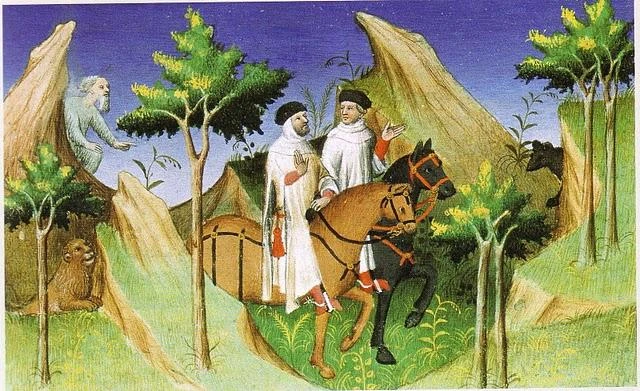
Lower-ranking aristocrats were no less fond of travel than kings. Many accompanied their rulers on military campaigns. Counts, dukes, and barons regularly toured their domains or visited vassals. Clergymen also traveled extensively. Archbishops and bishops traveled to and from the papal residence and visited parishes in their dioceses. Clergymen often traveled on errands for their superiors. In addition, numerous itinerant preachers and monks were encountered on the roads of Europe.
Easy on the map, difficult on the ground
Yes, borders in the conventional sense did not exist on the ground. They appeared only on maps, and sometimes existed only in the minds of those in power. The borders between kingdoms and principalities were constantly shifting, and travelers rarely paid attention to them. Merchants paid tolls upon entering foreign lands, and sometimes a fee was required to enter a city or cross a bridge. When traveling, it was crucial to avoid states and lands with which wars were ongoing or relations were tense. Otherwise, one could easily be captured, held hostage, or even killed. 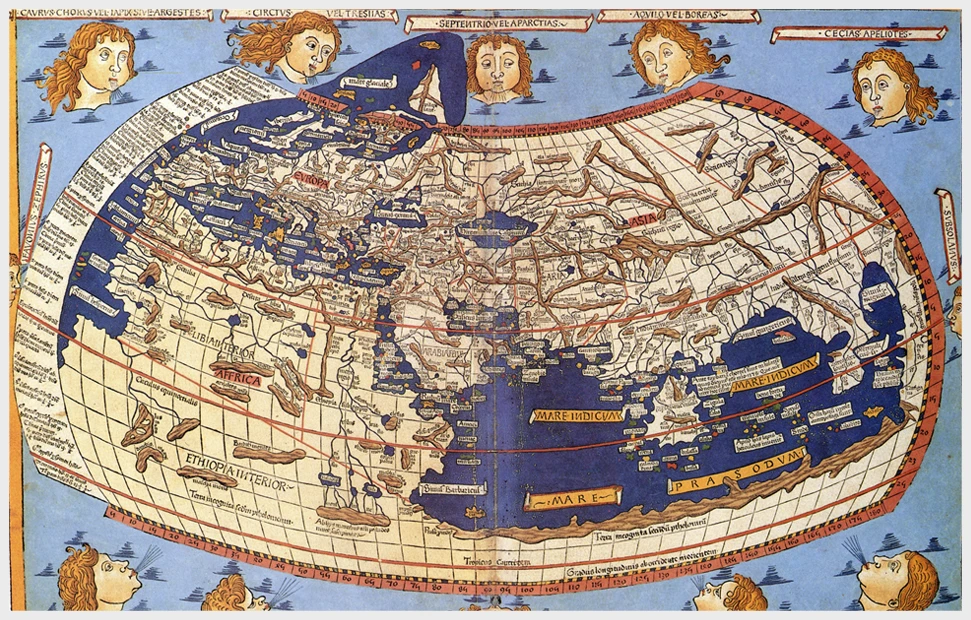
This is what the world of a medieval European looked like, before the Americas, Australia, or even Africa south of the equator existed.
Travelers still faced many difficulties along the way. Maps in those days were still primitive, and not everyone had them. Indeed, they were of little use. The landscape was changing too rapidly: forests were cleared, canals were dug, castles were built, villages and entire towns arose and disappeared, rivers changed their courses, and after floods, roads could disappear altogether.
Getting lost in unfamiliar lands was easy. Sometimes there were waymarks along the roads, indicating, for example, a shortcut through the forest. But the problem was that they could easily be turned or moved. Thus, travelers were lured right into the arms of lurking bandits.
Dangers on the Road
Traveling in the Middle Ages was fraught with risks. Bandits lay in wait on the roads, especially in forests or deserted areas. Robberies were common, and travelers tried to travel in groups to feel safe. The weather could also be an enemy: heavy rain, snowfall, or extreme heat made the journey grueling. 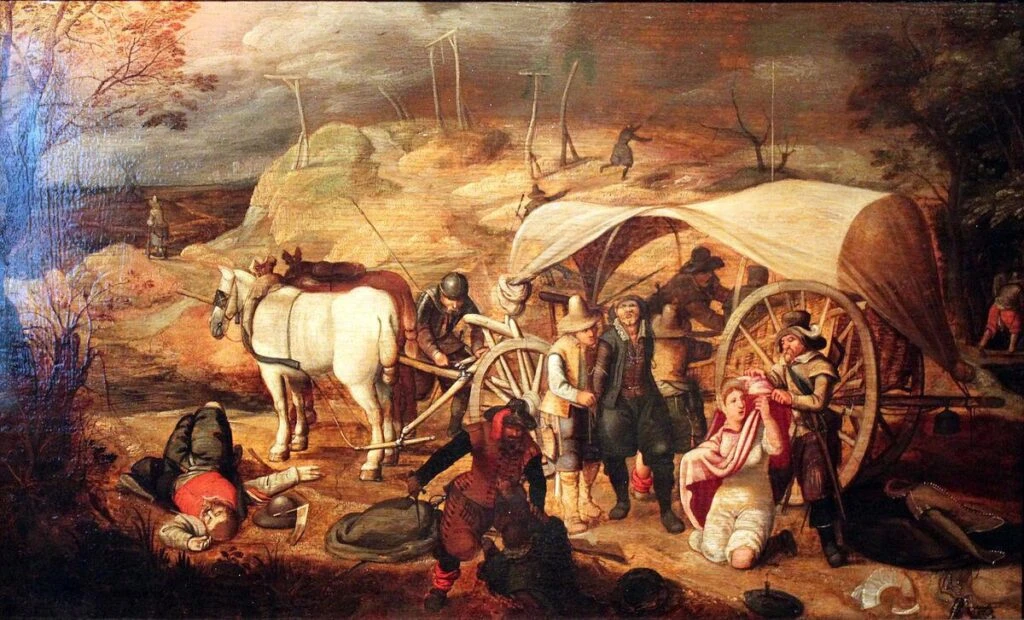
Robbers attacking travelers
Wild animals were no less a danger than robbers. Wolves, bears, and wild boars attacked lone travelers, especially in winter. Diseases also posed a serious threat. Without modern medicine and basic hygiene, travelers easily contracted infections, especially in crowded places like inns. Also, in the Middle Ages, many believed in demons. They were feared far more than robbers or wild animals.
People rarely traveled alone, and then only when absolutely necessary. They usually traveled in groups and tried to travel only during the day. Travelers on foot carried their luggage in knapsacks and sacks, while those on horseback strapped their belongings to their saddles. Trade goods or large baggage were transported in wagons.
Wind in the sails is better than dust from hooves.
The fastest and safest way to travel was by water. Rivers served as the main transportation arteries in the Middle Ages. Merchant ships sailed along the Danube, Rhine, Volga, and other major rivers, transporting goods and passengers. River travel was a relatively safe and fast means of travel. 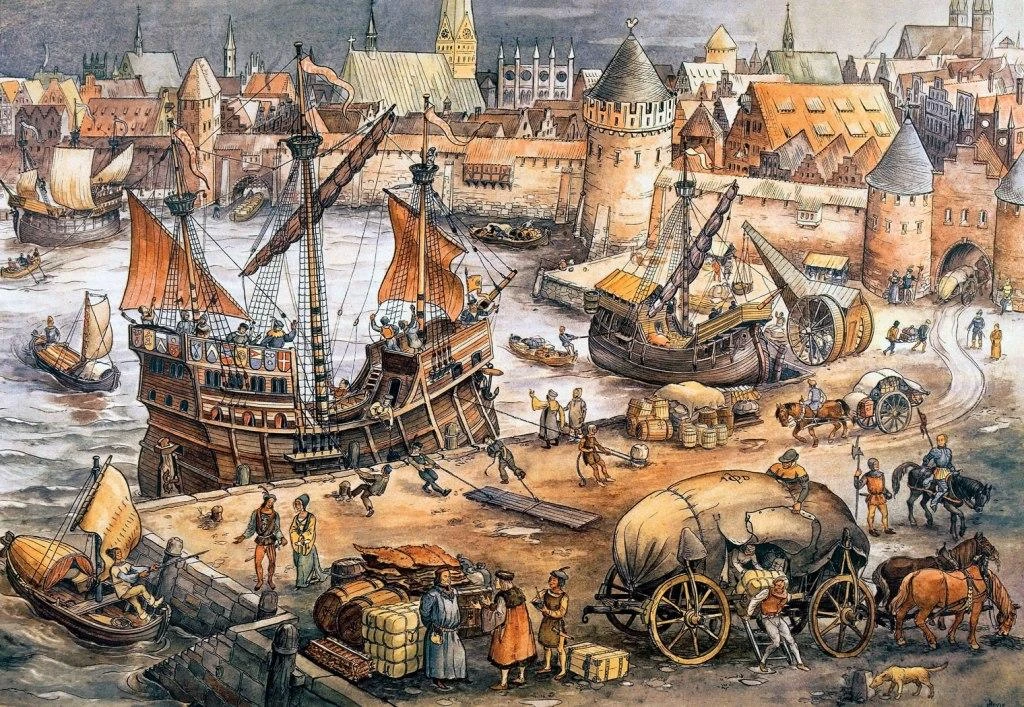
Duties had to be paid only when entering ports, and the only obstacles were weather conditions and sea or river pirates. However, the likelihood of encountering them while sailing was much lower than on land. Travel speed depended on the characteristics of the vessel, the skill of the crew, currents, and wind direction.
Sea travel remained the preserve of the daring. Medieval ships were small and unreliable. Storms, pirates, and inaccurate charts made sea voyages extremely risky. Nevertheless, merchants and pilgrims regularly crossed the Mediterranean and even ventured on long ocean voyages.
Speed of Travel in the Middle Ages
How quickly could one travel from one place to another in the medieval world? A pedestrian typically covered about 30–40 kilometers per day, assuming good roads. A horseman could travel 50–80 kilometers, but horses needed rest. Trade caravans moved even more slowly—only 20–25 kilometers per day. The distance traveled in a day depended on the length of daylight, the time of year, weather conditions, and the location of the next inn. 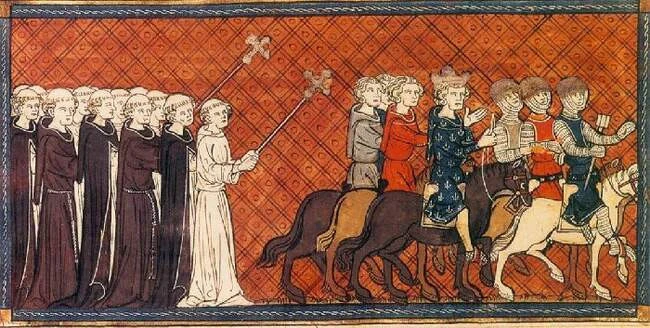
Today, the journey from Paris to Rouen, 130 kilometers, can be covered in just 2 hours. In the Middle Ages, it took 2 to 4 days. Traveling from Paris to London took about 10 days, if you managed to catch a boat crossing the English Channel. But the journey from London to Rome took about a month. It's important to note that life was not so fast-paced back then. People were rarely in a hurry and treated travel delays with philosophical composure.
Where did travelers stay?
Inns as we know them today were virtually nonexistent in the Middle Ages. Travelers had access to inns, taverns, and monasteries, which often offered shelter. The conditions in the inns—simple wooden houses along the main roads—left much to be desired: shared rooms, hard beds, and a modest meal of bread and stew. However, they could warm themselves by the fire and chat with other travelers, catching up on the latest news. 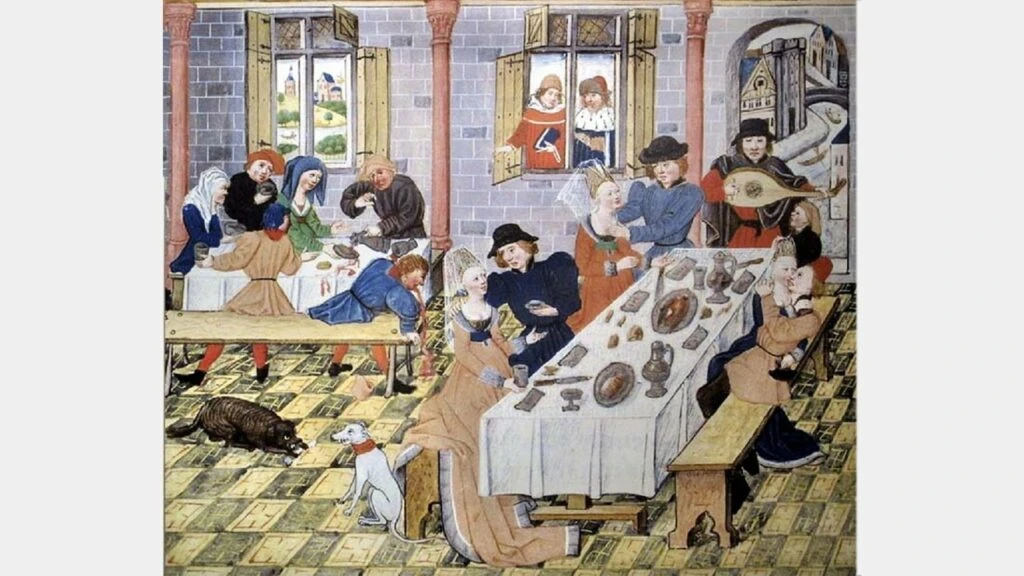
Tavern feast, Flanders, 1455
Wealthy travelers, such as merchants or nobles, sometimes stayed in the houses of local feudal lords if they had connections. But for most, spending the night meant either a cold night in the open or a cramped room in a tavern, sleeping next to strangers.
The Pilgrim's Way
Pilgrimage was considered the most important and noble purpose of travel in the Middle Ages. Travelers who set out on such a journey were called pilgrims. They sought to free themselves from sin and purify their souls. The farther the destination and the more dangerous the road, the greater the chances of salvation the pilgrims saw. 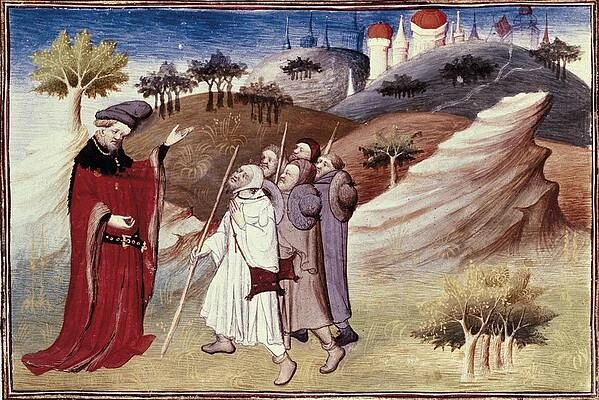
Pilgrims
Short pilgrimages were undertaken to enlist the support of a particular saint, especially before important undertakings. The choice of holy sites was vast. In France, the relics of Mary Magdalene, the Mother of God, Saint Martin, and Saint Martial were particularly popular among pilgrims. The Camino de Santiago, leading to the Spanish city of Santiago de Compostela, passed through southern Europe. In England, pilgrimages most often took place to the relics of Saint Cuthbert, Edward the Confessor, King Arthur, Queen Guinevere, and Thomas Becket. 
Pilgrims at the Holy Sepulchre in Jerusalem
Longer pilgrimages led to Rome, Constantinople, or the Holy Land. There, believers hoped to receive stronger support from the apostles, the early martyrs, and Jesus Christ himself. However, these were long, dangerous, and very expensive journeys, which many found difficult to undertake and unaffordable.
Poor but Welcome Guests
Pilgrims set out on long journeys in groups, sometimes quite large. If they were not knights themselves, they often hired warriors to guard them. The classic attire of a spiritual pilgrim included a felt hat, a simple cloak embroidered with religious symbols, a staff, and a bag. This attire was equally characteristic of both rich and poor pilgrims. When traveling to holy sites, flaunting one's wealth or status was considered a sign of bad taste. 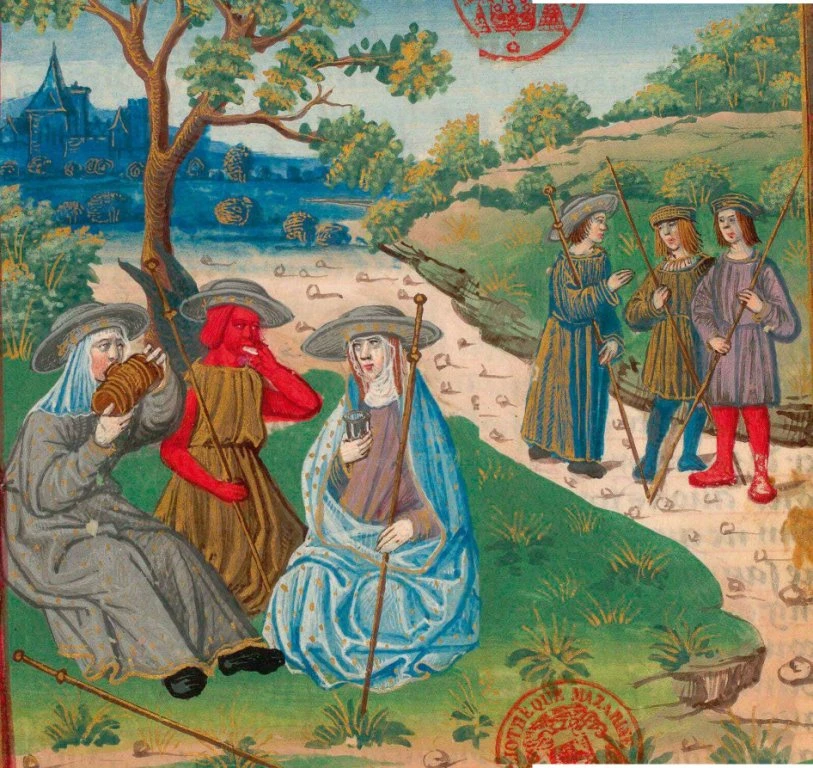
Pilgrims on Rest
Along the way, pilgrims could easily stop overnight in monasteries, abbeys, or simply churches. Many considered it an honor to shelter and feed someone traveling for a noble purpose. The Church created an entire infrastructure for pilgrims: special shelters, hospitals, and even banking services. The journey to the Holy Land could last years, but for medieval people, it was a lifelong journey, combining spiritual quests with a thirst for adventure.
Pilgrims were always welcome guests—in castles, simple homes, and poor hovels alike. They shared wondrous stories of their travels. Large groups often gathered to listen to such a guest. 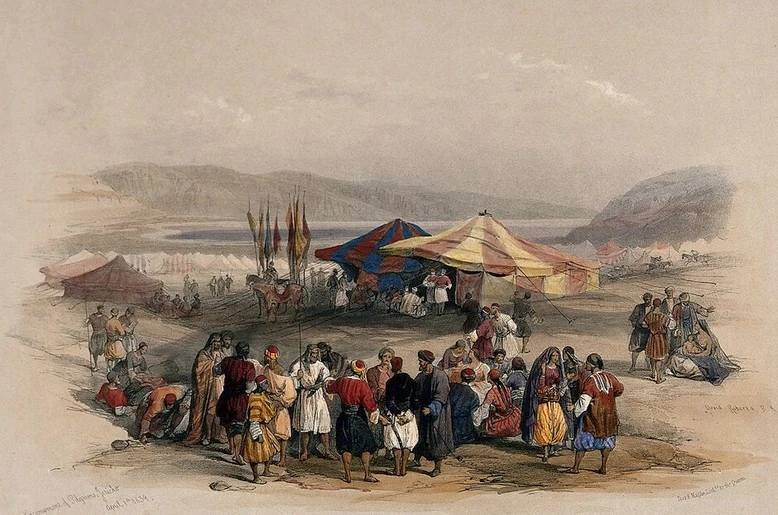
Pilgrim camp in the Syrian desert
Today we travel for pleasure or work, but in the Middle Ages, the road was a feat that required courage and determination. These stories remind us how far we have come from those times—and how much remains unchanged.
What kind of journey to the Middle Ages would you like to take: a pilgrimage to holy sites, a spice trade route, or perhaps a knight's quest? Share your thoughts in the comments!