5 Unsolved Deaths in the California Mountains (8 photos)
In 1978, five young men went missing in Chico, California. On their way home from a college basketball game, they vanished into thin air along with their car. Police found the vehicle, and six months later, four bodies—yet they were never able to explain what happened to the men. The case remains just as baffling as the Dyatlov Pass incident, continuing to haunt detective minds and true-crime sleuths alike. 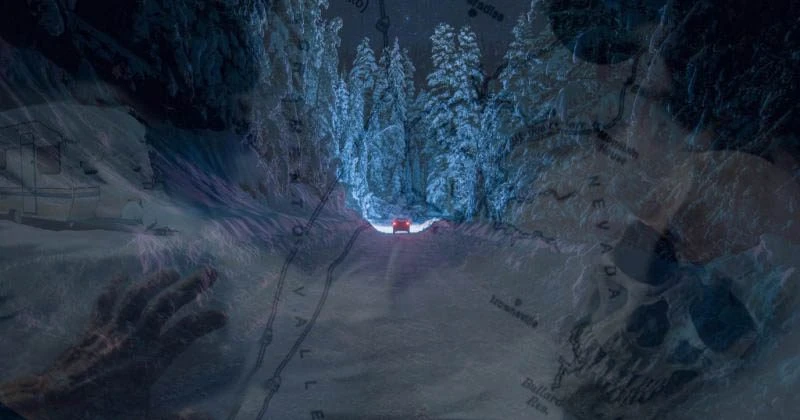
On February 24, 1978, after watching a college basketball game at California State University, Chico, five healthy young men aged 24 to 32 got into a Mercury Montego and set off for Yuba City. 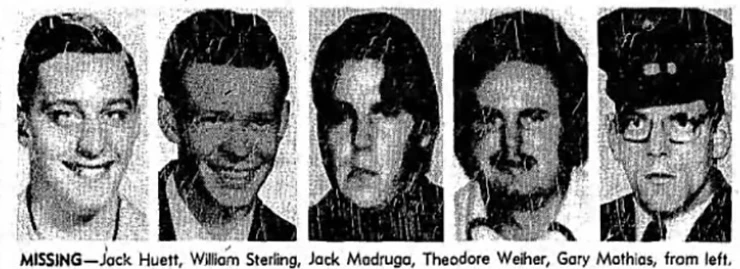
The five friends who vanished on February 24, 1978
The group had a 45-mile drive down a relatively quiet highway—a trip that usually takes about an hour. The next day, they were supposed to play in a basketball tournament back in Chico. But it wasn't meant to be. Ted Weiher, Jack Huett, Jack Madruga, William Sterling, and Gary Mathias vanished without a trace.
The men were last seen at a local convenience store, where they stopped for snacks and gas. Their car was later found stuck in a snowdrift on a deserted mountain road 70 miles from Chico. Detectives immediately noted that there was no visible damage; five able-bodied men could have easily pushed the car free.
The Mercury's engine was in working order, too; when an officer got behind the wheel, it started right up on the first try. The keys were missing, but the tank was still half full. Inside, the cabin was littered with food wrappers and snack debris. 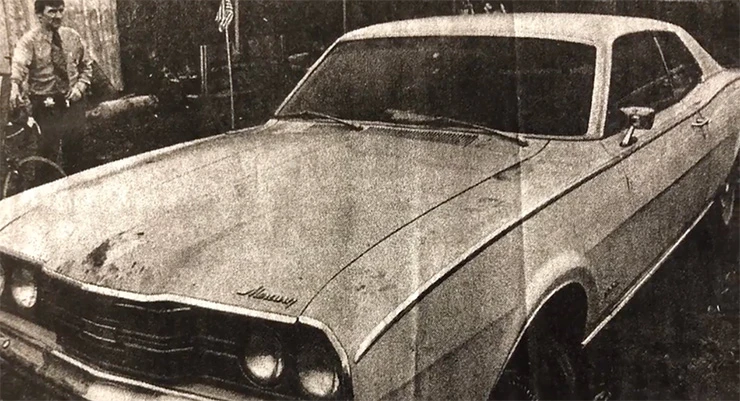
The Mercury Montego the group was driving
Investigators noted that whoever was driving either knew the road remarkably well or got extremely lucky. The car came to a stop just inches from a deep ditch that was obscured by snowdrifts. Everyone who knew the men insisted that Jack Madruga was always the driver, as he never let anyone else touch his car.
Interviews with relatives and friends revealed that none of the men, except Ted Weiher and Gary Mathias, had any wilderness survival experience. Even Ted was hardly an outdoorsman—his experience was limited to fair-weather deer hunting trips with his father. Mathias occasionally went camping and, according to friends, knew how to pitch a tent and start a fire.
Police search parties located the car during a severe blizzard. Try as they might, searchers found no trace of the missing men except for a single shoe. The grim truth didn't emerge until months later, on June 4, 1978. A group of motorcyclists riding through Plumas National Forest came across a secluded Forest Service trailer emitting a foul odor of decomposition. 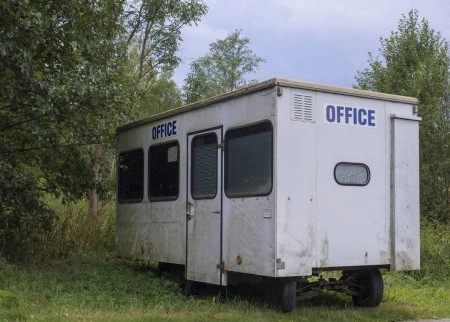
Trailers like this are used by park rangers
Inside the trailer lay the body of Ted Weiher, wrapped in eight sheets. He was dressed but barefoot. On a nightstand beside his bed lay his nickel ring engraved with "Ted", a wallet full of cash, a gold chain, and an expensive gold watch that none of his family or friends had ever seen before.
The deceased had grown a long beard, and his feet were severely frostbitten. Medical examiners determined that the physically strong 200-pound man had taken nearly 13 weeks to starve to death. Ted had reached the trailer, located 19 miles from the abandoned car, by smashing a window. For some unknown reason, he never lit the stove, despite the presence of matches, books, and flammable materials inside.
Empty C-ration cans opened with a P-38 can opener were scattered across the floor. Weiher didn't know how to use such an opener; only Madruga and Mathias, who had served in the military, would have known how. Furthermore, the trailer's storage lockers were packed with enough food to keep all five men alive for years. 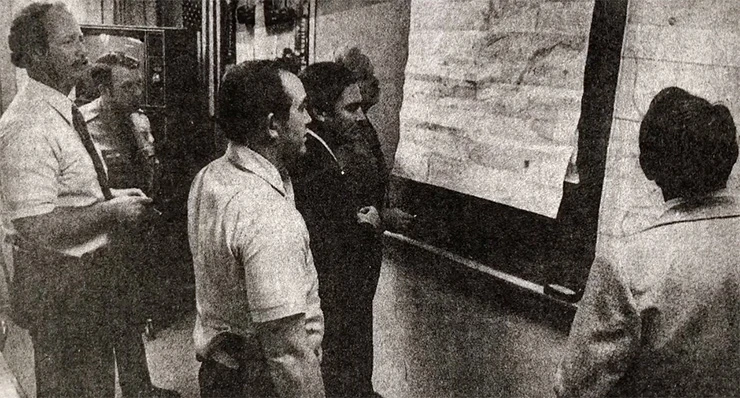
Search operation headquarters
Investigating officers were also baffled by an outdoor shed nearby containing full propane tanks. The stranded men could hardly have missed the structure, which held enough fuel to keep them warm and fed. Three wool blankets from the trailer and a rusty flashlight were discovered about a thousand feet away.
Yuba County Lieutenant Lance Ayers noted that all the men had to do was walk into the shed, turn a valve, and light the heater to solve most of their problems. Yet, it was painfully clear that Ted Weiher had slowly starved and froze to death without making any attempt to save himself.
Ayers had known all five men since high school, making solving the bizarre case a matter of personal honor. The search around the trailer resumed, and just a day later, officers stumbled upon the remains of Madruga and Sterling. They lay across the road from where Ted died; Madruga had been partially consumed by wild animals, while Sterling was reduced to skeletal remains. Madruga lay on his back, clutching a wristwatch in his hand. 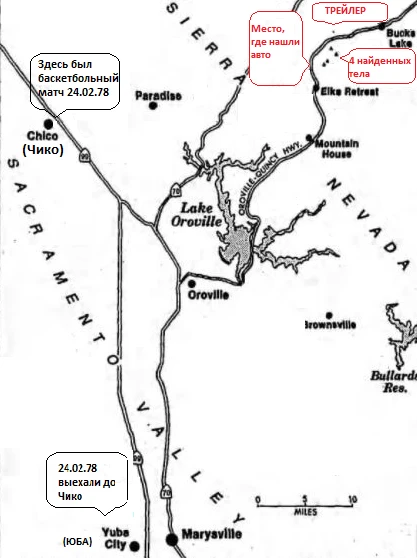
Two days later, closer to the trailer, Jack Huett's father found his son's spine. A day after that, a skull and several other bones were uncovered nearby. Dental records later confirmed the remains belonged to Jack.
Interviews with locals eventually led investigators to a witness who had been stranded on the same road around the time the men disappeared. The witness, 50-year-old Joseph Schons, explained that he had suffered a heart attack while attempting to dig his car out of the snow. He took his medication and lay inside his vehicle, waiting for it to kick in.
As Schons rested, he heard whistling and saw a woman carrying a child walk past down the road, followed by a group of people lighting their way through the snow with flashlights. Joseph shouted for help, but no one responded. He was forced to spend several hours in his car until he ran out of gas and grew dangerously cold. 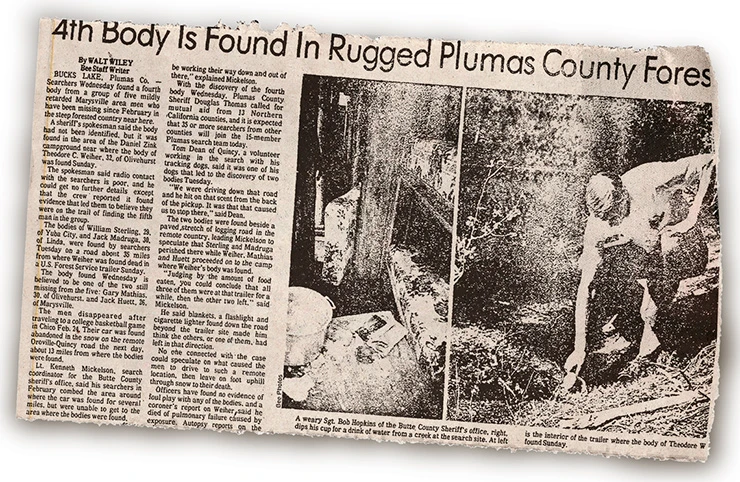
A newspaper clipping reporting on the discovered remains
Schons eventually abandoned his vehicle and set off on foot toward the nearest lodge, located six miles away. Along the way, he passed the abandoned Mercury Montego, empty. Despite his failing health, Schons managed to reach a mountain cabin where he found help.
Searches continued until the following winter, but the body of the final member, Gary Mathias, was never found. More than four decades after the tragedy, his fate remains a complete mystery. Of the whole group, Gary had been the most troubled.
Family and friends knew that Mathias had developed a drug addiction while serving in the U.S. Army in Germany. During his service, he had also begun showing signs of schizophrenia. In the two years following his discharge, Gary underwent treatment for substance abuse and had been doing well. 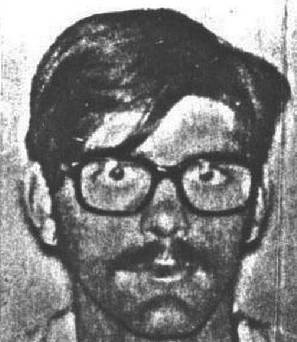
Gary Mathias
However, Gary's physician could not rule out that the high-stress situation triggered a psychotic episode, causing panic and disorientation. In such a state, Mathias might have wandered far away from his friends or fallen off a cliff.
The case left police and grieving families with a wall of unanswered questions. Why did the group split up instead of staying together? How could someone freeze and starve to death inches away from food and fuel? Who were the people Schons saw, and what became of Gary Mathias? These are just a few of the mysteries that continue to shroud the tragedy.
The events on that mountain road in the winter of 1978 remain as much of an enigma as the Dyatlov Pass incident in the Northern Urals in 1959. Many consider this tragedy to be America's most baffling mystery of the 1970s.