In 2019, an international team of astronomers led by Sergey Koposov of Carnegie Mellon University (USA) was studying the region around Sagittarius A*, the supermassive black hole lurking at the heart of the Milky Way. 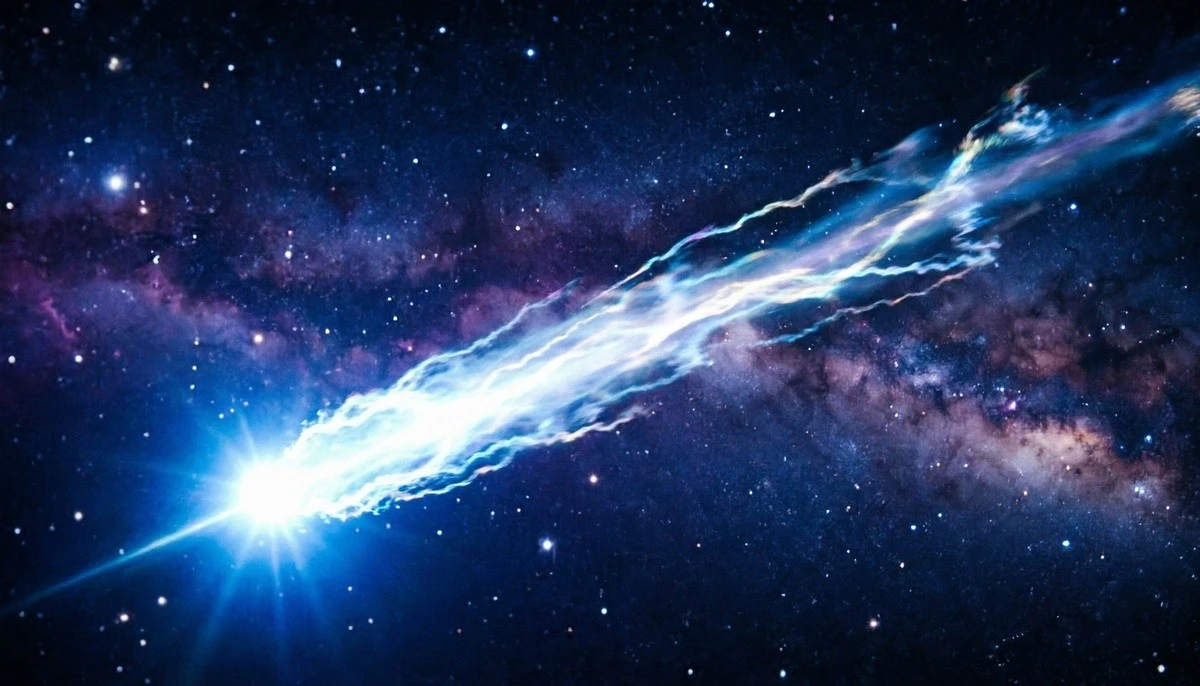
Turning their attention to the constellation Grus (The Crane), they discovered a star hurtling away from the center of our galaxy at a staggering 1,755 kilometers per second—or roughly 6.3 million kilometers per hour. By comparison, NASA's Parker Solar Probe—the fastest human-made object—reaches top speeds of about 192 kilometers per second, while our Sun orbits the galactic center at a modest 220 to 240 kilometers per second.
This stellar speed demon is moving so fast that the gravitational pull of the entire Milky Way cannot hold it back. In a few tens of millions of years, it will break free into the freezing void of intergalactic space, doomed to spend the rest of its existence as a solitary wanderer.
Designated S5-HVS1 (or S5 for short), this stellar runaway belongs to a rare class known as hypervelocity stars—and it is the fastest ever observed by astronomers.
Galactic Outcasts
Despite breaking speed records, S5 is far from unique. Astronomers have cataloged dozens of similar stars traveling well above the Milky Way's escape velocity (roughly 550 kilometers per second). All of them are bound for intergalactic space—an expanse of emptiness spanning millions upon millions of light-years. 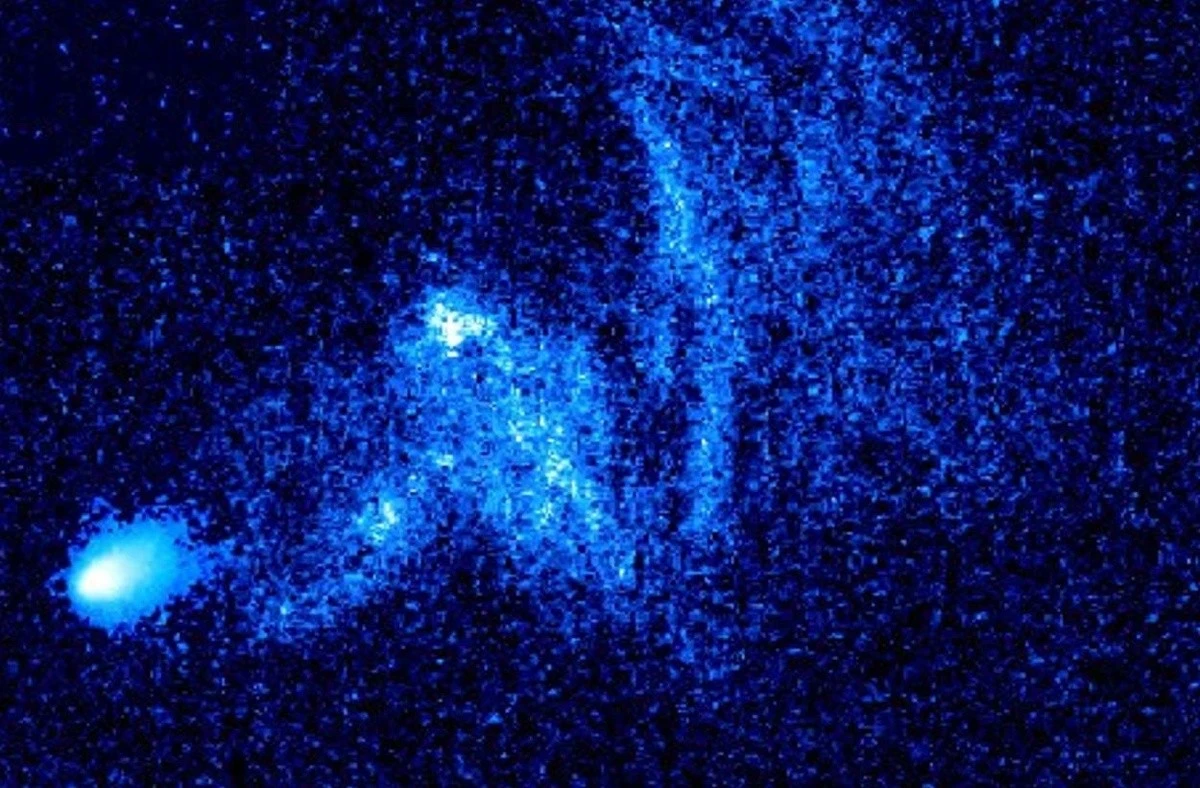
A hypervelocity star generating a bow shock as it tears through space. Image courtesy of the Hubble Space Telescope.
What kind of cosmic force could accelerate S5 to such unimaginable speeds? The answer lies with Sagittarius A*, the supermassive black hole over four million times more massive than our Sun. Its gravitational grip is so immensely strong that it easily warps the trajectories of nearby stars.
This slingshot mechanism was first theorized back in 1988 by American astrophysicist Jack Hills. When observational proof finally emerged years later, the scientific community named the phenomenon in his honor: the Hills Mechanism. Here is how it works:
A binary star system—two stars orbiting a common center of mass—strays too close to Sagittarius A*. The black hole's extreme tidal forces rip the pair apart. One star is captured into orbit and eventually swallowed, while the other is flung outward at breakneck speed, acting like a cosmic slingshot. The kinetic energy lost by the captured companion is transferred to the ejected star.
Calculations and computer simulations confirm that roughly five million years ago, S5 was indeed located in the galactic center, in close proximity to Sagittarius A*. It was there that S5 lost its binary companion and was catapulted into deep space.
Cosmic Travelers
Hypervelocity stars are rare, but as noted, astronomers have already detected dozens of them. This growing sample provides a clearer picture of their origins. Notably, not all hypervelocity stars owe their extreme speeds to an encounter with a supermassive black hole. 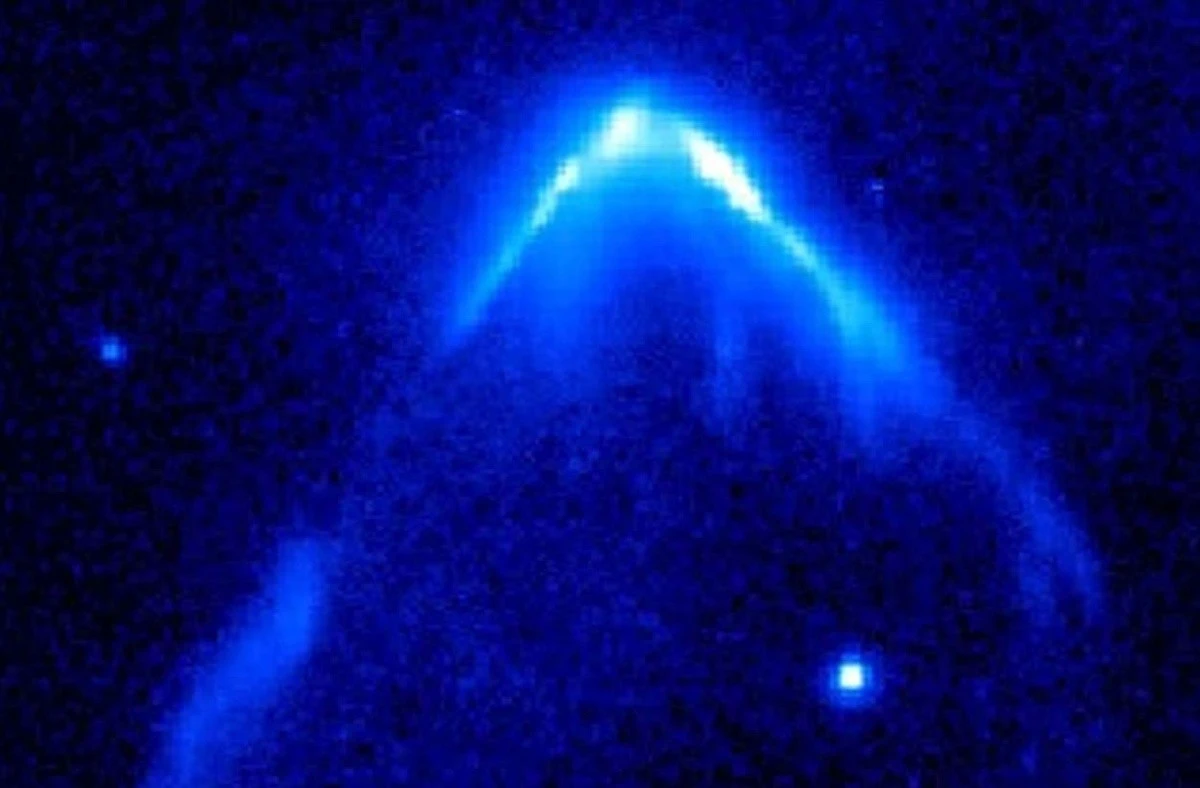
Another hypervelocity star captured by the Hubble Space Telescope.
Take US 708, a star located roughly 62,000 light-years from Earth, which is fleeing our galaxy at roughly 1,200 kilometers per second. It was accelerated not by a black hole, but by a supernova explosion in a tight binary system. The primary star stripped away its companion's outer layers before detonating, sending the remaining stellar core blasting into space.
Other hypervelocity stars were hurled into intergalactic space during galactic collisions. However, given the vast distances involved, we usually observe these not as individual stars, but as faint tidal streams composed of thousands of stars.
What Lies Ahead for S5?
Because we view the Milky Way from within, the exact extent of its galactic halo—the vast spherical region enveloping the disk—remains uncertain. As a result, estimates for when S5 will officially exit into true intergalactic space range from 50 to 100 million years.
Yet that exit is inevitable. Eventually, S5 will find itself outside its home galaxy, surrounded by nothing but tenuous ionized gas, freezing cold, and eternal darkness. No neighboring stars, no gravitational anchors. For billions of years, S5 will pierce that gloom with its light until its nuclear fuel runs dry. Since S5 is roughly 2.35 times as massive as our Sun, its lifespan will be significantly shorter. It will eventually expand into a red giant before casting off its outer layers as a vibrant planetary nebula. When its journey finally ends, all that will remain is a slowly cooling white dwarf—a tiny, practically invisible stellar remnant. 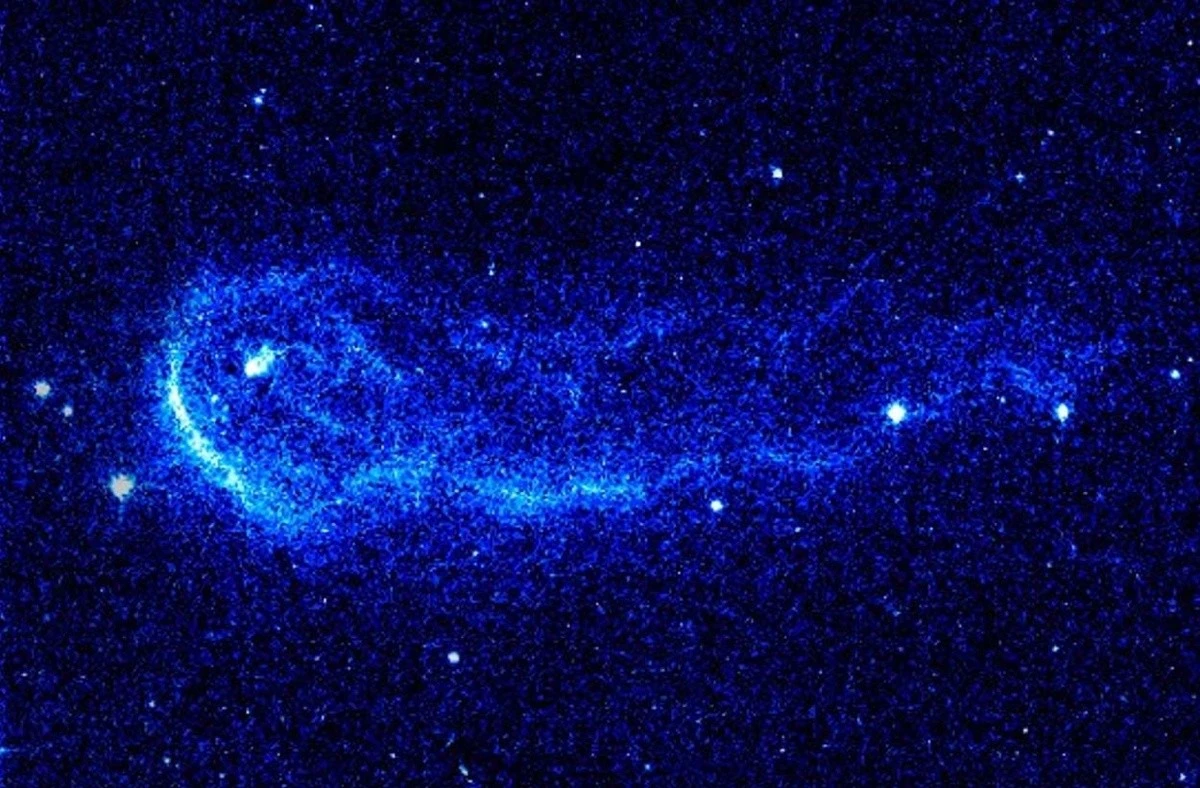
Yet another hypervelocity star captured by Hubble, also on its way out of the Milky Way.
Why Study Hypervelocity Stars?
Setting aside the cosmic romance, hypervelocity stars serve as invaluable diagnostic tools for astrophysicists:
Their numbers and trajectories help estimate the activity and refine the mass measurement of Sagittarius A*;
Tracing their paths allows researchers to map the distribution of dark matter throughout the galactic halo;
They offer insight into how star systems interact, evolve, and break apart under extreme gravitational fields near supermassive black holes;
They allow physicists to test general relativity in extreme conditions and evaluate alternative theories of gravity (spoiler: Einstein's theory continues to pass every test with flying colors).
Are There Even Faster Stars?
Theoretically, yes. Some astrophysical models predict the existence of "relativistic stars" accelerated to a significant fraction of the speed of light—tens of thousands of kilometers per second. Such objects could be launched during encounters with binary supermassive black holes in the process of merging.
None have been detected so far. However, given the vast scale of the cosmos, even the rarest phenomena are bound to exist somewhere. Somewhere right now, in a pair of colliding galaxies whose central supermassive black holes are merging, hundreds of stars may be hurtling through space at such terrifying speeds that S5 would look like a turtle by comparison.
Add your comment
You might be interested in:













Protective film Removing it with a power screwdriver

When a child plays hide-and-seek at a professional level

Super dads who swoop in to save the day

Precision carpentry

Looks like it's time to buy WinRAR

How to hang wallpaper neatly

Man sets up bedroom camera and discovers the reason for his

Athlete in Bavarian dress flies over a lake on a hydrofoil

First meeting with Mom's twin sister
