The volcanic hell of Io: an infrared portrait of Jupiter's moon (2 photos)
On July 5, 2022, NASA's Juno spacecraft turned its gaze on Jupiter's moon Io, coming within approximately 80,000 kilometers of its surface. 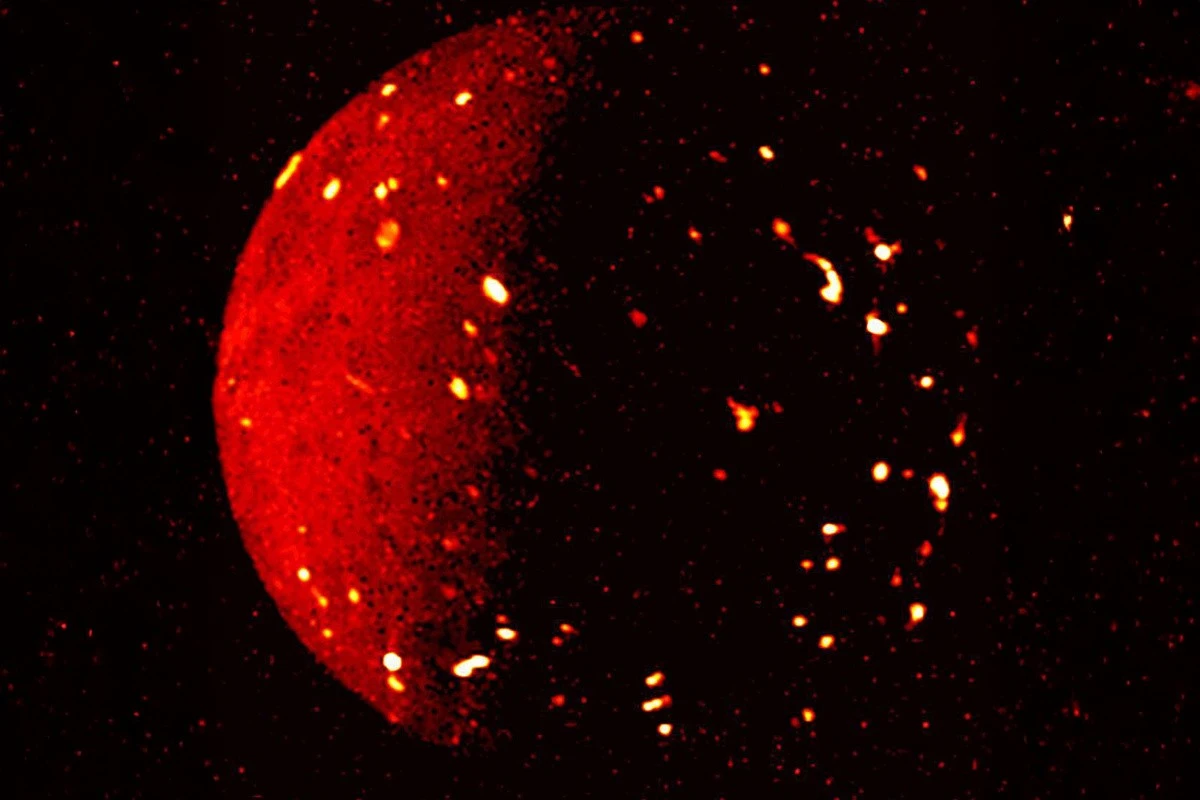
Using the Jovian Infrared Auroral Mapper (JIRAM), the probe captured an infrared image of the moon, which became a map of volcanic activity in one of its hemispheres.
The brighter the color in the image, the higher the temperature recorded by the instrument. Every bright spot on Io's surface is an active volcano, erupting at the moment we observe it.
Io is the Solar System's champion in volcanic activity. With an average diameter of just 3,642 kilometers, it boasts over 400 active volcanoes. What explains such intense volcanic activity? The main reason is the powerful tidal forces generated by the gravitational interaction of Jupiter and its neighboring moons.
Io is located 350,000 kilometers from the gas giant (for comparison, the Moon is 384,400 kilometers from Earth, but Jupiter is 318 times more massive than our planet), so Jupiter is the source of enormous tidal forces. Furthermore, Io is trapped gravitationally between Jupiter and its other large moons, Europa and Ganymede. Their combined gravitational influence continuously "crumples" and "stretches" Io, heating its interior to extreme temperatures; the moon's surface periodically rises and falls by 100 meters! 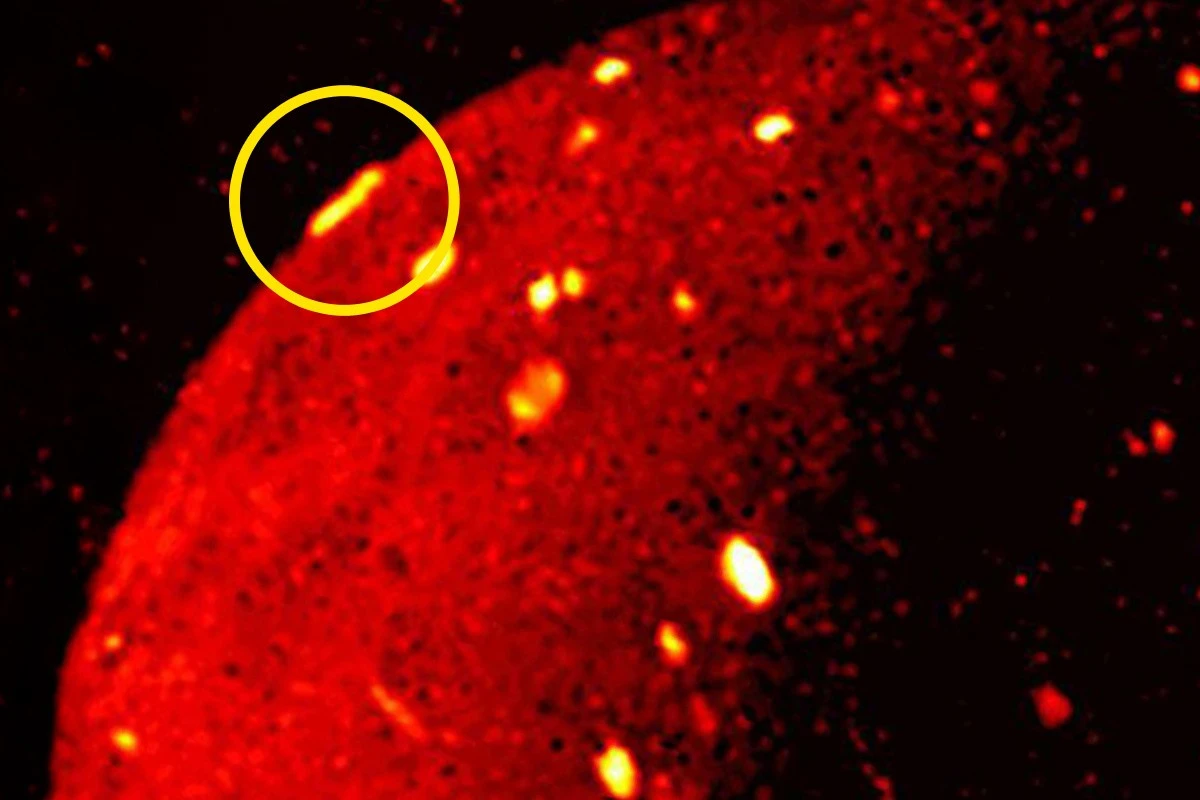
The moment of the fading ejection
During the most intense eruptions, Io's volcanoes can "shoot" up to 500 kilometers high, sending sulfur and sulfur dioxide into space. Due to this activity, the moon is constantly "shrinking"—scientists estimate that about a ton of material per second is ejected into space, much of which is captured by Jupiter's magnetic field, forming a plasma torus around the planet.
It's worth noting that many of the bright spots in the image represent not just volcanoes, but entire lava lakes or fields, some of which cover hundreds of square kilometers.