How the Star Methuselah Turned Out to Be "Older" than the Universe (3 photos)
About 190 light-years from Earth lies the star HD 140283, which has earned the unofficial biblical nickname "Methuselah." This name was chosen for a reason: according to early astronomer estimates, HD 140283 was about 14.5 billion years old. The problem is, the age of the Universe itself is estimated at about 13.8 billion years. 
Astronomers have known about this star for a long time: it was included in Henry Draper's catalog back in the first half of the 20th century. But HD 140283 only became truly famous when scientists attempted to determine its age.
So, how can a star be older than the world in which it exists?
Let me warn you right away: this is not a mystical story or a fantasy about an object from other dimensions, as journalists like to invent. This is an example of how science makes mistakes, refines data, and gradually arrives at the correct answer.
A Fossil Star
Methuselah is one of the very ancient metal-poor stars. In astronomy, "metals" refers to all elements heavier than hydrogen and helium. For example, HD 140283 has approximately 250 times less iron than the Sun, and approximately 50 times less oxygen.
This is typical of very old stars, formed early in the history of the Universe, when heavy elements were still extremely scarce. Methuselah formed relatively shortly after the Big Bang, when space was filled primarily with hydrogen and helium.
Methuselah is a relatively small star: its mass is about 0.8 times that of the Sun, and its radius is approximately 2.2 times that of the Sun. It is currently in the subgiant stage—the transition between a normal star and a red giant. This phase is short-lived in cosmic terms, making such objects particularly valuable to astronomers: they help us better understand the evolutionary path of Sun-like stars and predict the future of the Solar System. 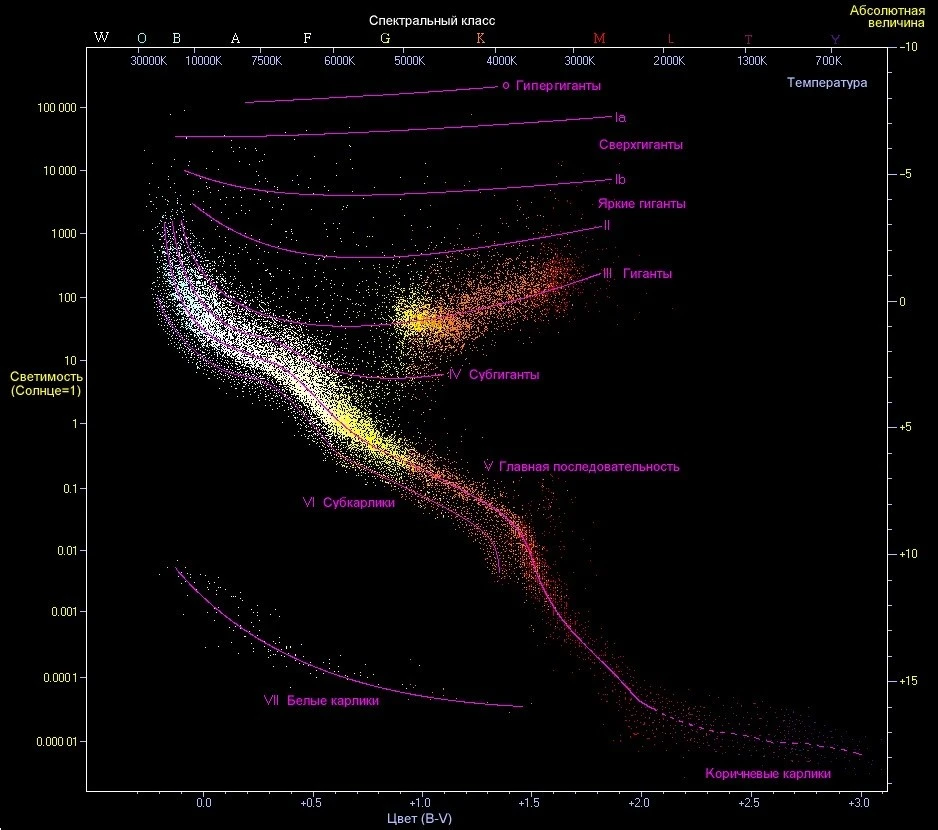
Hertzsprung-Russell diagram for stars in the solar neighborhood, with luminosity classes marked, including subgiants
Another curious detail: Methuselah is moving through the solar neighborhood at a very high speed—around 300 km/s. Such speeds are typical for ancient stars in the Milky Way halo. Essentially, it is a visitor from the oldest regions of our Galaxy, accidentally finding itself near the Solar System.
Methuselah is a true stellar fossil, a witness to the early Universe.
A Paradox Exaggerated to the Point of Sensation
When early measurements showed the star's age to be approximately 14.5 billion years, headlines immediately began to circulate about "anomalies," "the collapse of physics," "parallel universes," "the cancellation of the Big Bang," and other nonsense.
But scientists took a more relaxed view of the situation. They understood that the problem was likely not in the structure of the Universe, but in the accuracy of measurements and the imperfections of existing stellar models.
Data Refinement
In 2013, a study based on observations from the NASA/ESA Hubble Space Telescope was published. With its help, astronomers accurately measured the parallax of HD 140283, and therefore the distance to the star. Knowing its distance and apparent brightness, scientists were able to calculate its true luminosity and then refine its age.
The result was impressive: 14.46 ± 0.8 billion years. The uncertainty here plays a key role. It meant that Methuselah's actual age could have been as low as 15.26 billion years, or as high as 13.66 billion years. In other words, even after the initial refinement of the data, the star wasn't necessarily older than the Universe—it all came down to the accuracy of the measurements and models.
After this, scientists began refining the observational data and improving their theoretical calculations. They understood that to accurately determine the age, it was important not only to know the luminosity, but also to more accurately determine the star's chemical composition and refine its models of stellar evolution. Changing just a few parameters would significantly shift the final estimate. 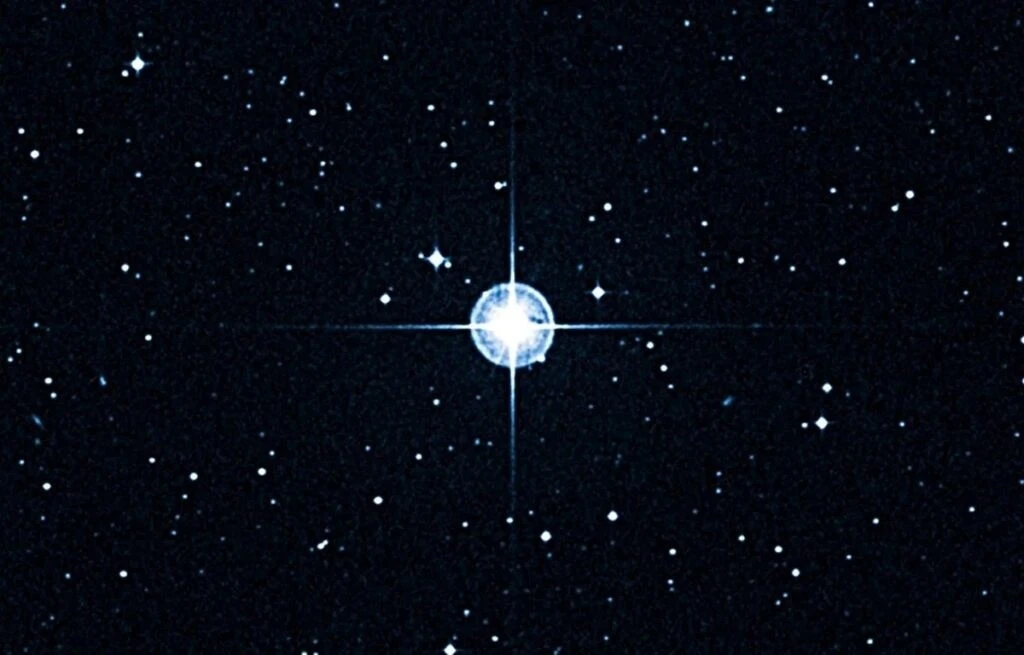
The star Methuselah as seen by the Hubble Space Telescope, March 13, 2013
Eight years later, a new model of HD 140283's evolution was developed using more sophisticated astrophysical modeling methods and data on millions of other stars. It took into account a whole range of physical processes within the star, including thermonuclear reactions, energy transfer, and changes in chemical composition. According to this work, the age of Methuselah is 12.01 ± 0.05 billion years, meaning the star now fits comfortably within the current estimate of the age of the Universe.
Today, Methuselah is still considered one of the oldest known stars, but it no longer seems like an impossible object that defies all modern physics. We now know of other extremely ancient stars—for example, HE 1523-0901, 2MASS J18082002-5104378 B, and SMSS J031300.36-670839.3, whose ages are estimated at approximately 13.2, 13.5, and 13.6 billion years, respectively. But the story of Methuselah became an important milestone in refining methods for estimating stellar ages and clearly demonstrated how science can transform an apparent anomaly into a solvable problem.
In closing this story, I want to emphasize the most important point: apparent contradictions in science do not always mean the collapse of a theory. Most often, they say new data, more precise measurements, and refined models are needed. Astronomy is currently experiencing a similar moment: NASA's James Webb Space Telescope has discovered numerous galaxies in the early Universe that appear too massive, bright, and mature for their age. But this doesn't mean the Big Bang didn't happen or that the age of the Universe is miscalculated. It shows that our understanding of the formation and growth of the first galaxies is still far from perfect.