Three Questions About Space That Science Has No Answer (14 photos)
They photographed a black hole. A real one. With an event horizon and a ring of fire around it. They captured gravitational waves from the collision of two dead stars a billion light years away—literally heard the fabric of space tearing. They measured time dilation over a height difference of less than half a meter. By 19th-century standards, that's god-like, even for those with a solid engineering education. 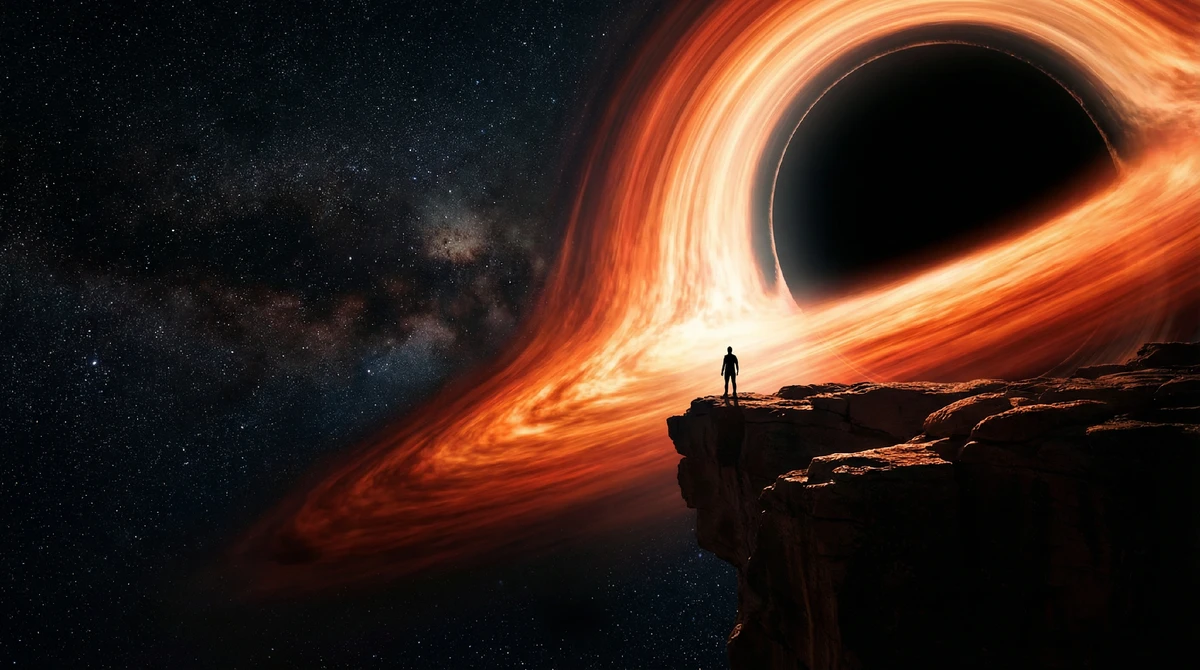
And at that moment, the physicist, adjusting his glasses, says:
— Oh, by the way… we still don't understand where all this came from.
We don't understand how the Universe began. We don't understand why there's a supermassive monster at the center of every self-respecting galaxy. And, most awkwardly, we don't understand whether time exists as a fundamental thing—or is it just a convenient illusion.
Let's look at these questions and examine them in more detail. They're all very interesting!
Where did anything come from?
Let's start with the most impudent question possible. Why does the Universe even exist? Why is it "something" and not "nothing"? 
Physicists have long noticed the awkwardness of the situation and have tried to resolve it with a trick: redefining "nothing" itself. In quantum field theory, absolute emptiness does not exist in principle.
A vacuum is not an empty box. It is a state of minimal energy where quantum fluctuations (oscillations) constantly occur: particles are created and annihilated faster than they can be noticed. Yes, matter is constantly being created in a vacuum!
In 1996, physicist Steve Lamoreaux conducted a remarkable experiment: he took two metal plates and placed them almost touching each other. No charges, no magnets. But the plates were drawn toward each other. Themselves. 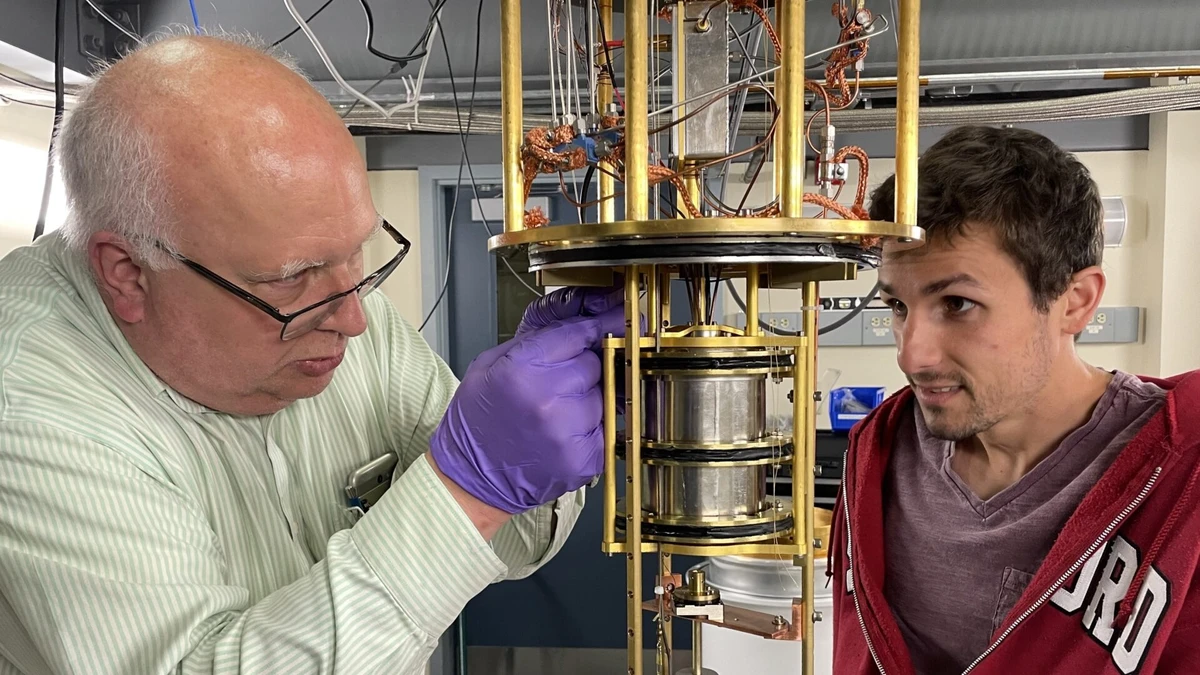
Steve Lamoreaux (left)
The reason is that the "emptiness" between them turned out to be not entirely empty. In the quantum world, the vacuum is constantly seething: particles are born and disappear without having time to "materialize." There are fewer of these invisible surges between the plates than outside—and the "pressure" from outside is stronger. It's called the Casimir effect. Nothingness turned out to be something.
But physics immediately paints itself into a corner. Okay, so the vacuum isn't empty. But where did the vacuum itself come from? Where do quantum fields and the laws by which they operate come from? The question doesn't disappear—it just moves up a notch.
Inflationary theory explains something different: how all the current structure—galaxies, clusters, filaments—grew from the nearly smooth early Universe. Tiny quantum fluctuations in a fraction of a second inflated to the size of future galaxies. Data from the 2018 Planck satellite confirms this. But this answers "how," not "why laws exist at all." 
Hawking went further and proposed describing the Universe itself as a quantum object—with a wave function instead of a hard starting point. Their competitor, Alexander Vilenkin, called it "tunneling out of nothing": the Universe simply "jumped" from nothingness, like a particle through a barrier. Beautiful. But both models make different predictions, and it's still unclear which one is right.
Spacetime simply has no edge—it's like the surface of a sphere, which also has no edge.
"What came before the Big Bang" in these models is a meaningless question, sounding like "what's south of the South Pole?"
The debate continues, with formulas and mutual claims in reviews. Both models fail to adequately describe origins—many holes remain. 
There's a popular version of the answer: "The universe arose from nothing because the total energy is zero—the positive energy of matter cancels out the negative gravitational energy." It sounds elegant. But it's not quite true.
In general relativity, the "total energy of the universe" is a concept that only works correctly for very specific spacetime geometries. In general, it simply cannot be defined. This isn't nitpicking—it's a mathematical fact. 
Emmy Noether
Mathematician Emmy Noether proved back in 1918 that all conservation laws are consequences of symmetries. If there's a symmetry, there's a conserved quantity. If there's no symmetry, there's no law. The question only shifts: why does nature have these particular symmetries?
Physics can describe how the Universe evolved from a very early state. Why this state existed at all is unknown.
Supermassive black holes at the centers of galaxies
Here's a fact that looks unusual upon closer inspection. At the center of almost every large galaxy sits a supermassive black hole. Not "some." Not "special." Most—and our Milky Way is no exception.
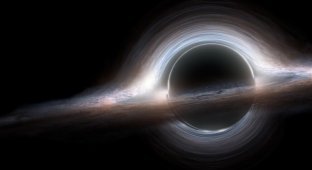
In 2019, the Event Horizon Telescope photographed the shadow of a black hole for the first time—in the galaxy M87, 55 million light-years away. A ring of glowing gas around a black spot. 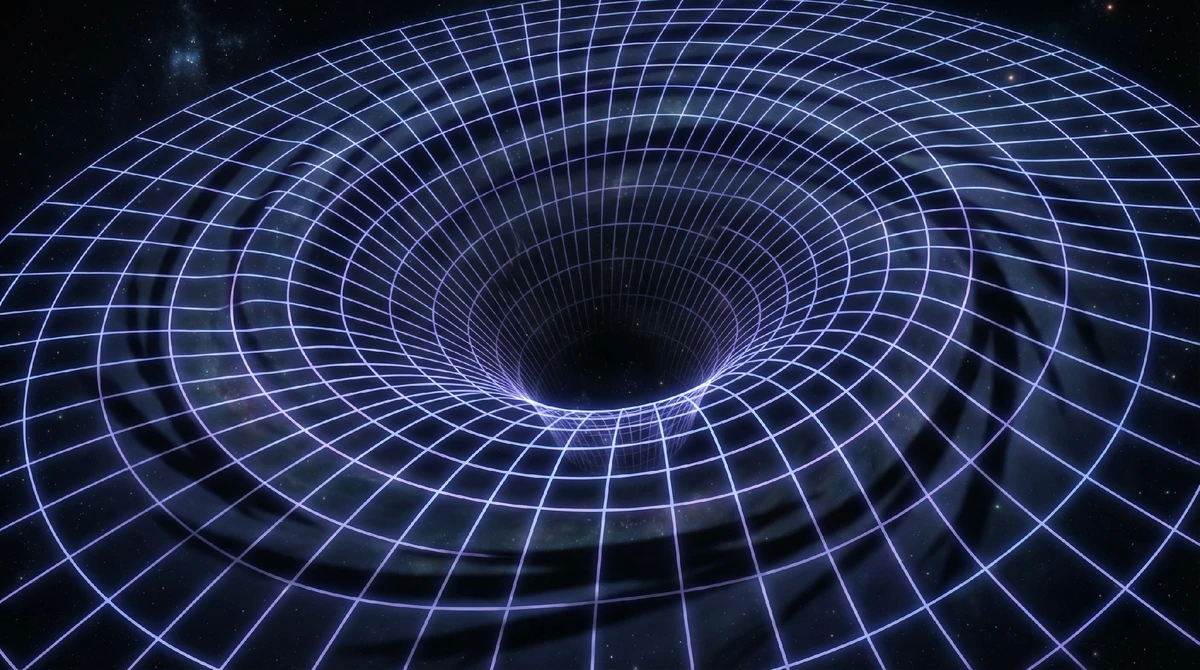
In 2022, a photograph of Sagittarius A* at the center of our galaxy. An object with the mass of 4.3 million suns, compressed to a size that would fit within the orbit of Mercury.
The problem isn't that they're there. The problem is that they got there so quickly.
Quasars—active galactic nuclei where a black hole devours matter and shines brighter than the rest of the galaxy—were discovered at a time when the Universe was less than a billion years old.
The black hole of quasar J0313–1806 weighs as much as 1.6 billion suns. Quasar J0100+2802 weighs 12 billion. The Universe at that time was less than a billion years old. How is this even possible?
From the perspective of modern physics, this time should not have been enough time for such an object to form.
It's like imagining someone who enrolled at Moscow State University, then founded a high-tech company. Created innovative products, brought them to market, and became a dollar billionaire. And this in... six years.
All of this is possible, but not in such a short time!
A black hole grows by absorbing matter. But there is a limit—the Eddington threshold. Above this, the pressure of its own radiation literally blows away the gas, and the hole stops consuming matter. This is a natural limiter on growth rate. A simple calculation shows that to grow a billion solar masses in 800 million years, you need to start with at least a thousand. Where can you get a thousand solar masses at the very beginning of the universe?
There are several hypotheses, and there is no clear winner yet.
The first is "light seeds." The very first stars were enormous, burned quickly, and left behind black holes weighing several hundred solar masses. The weak point: for such a seed to grow into a quasar, the hole must feed almost continuously, at the limit of its capacity. The slightest pause, and it doesn't make it. 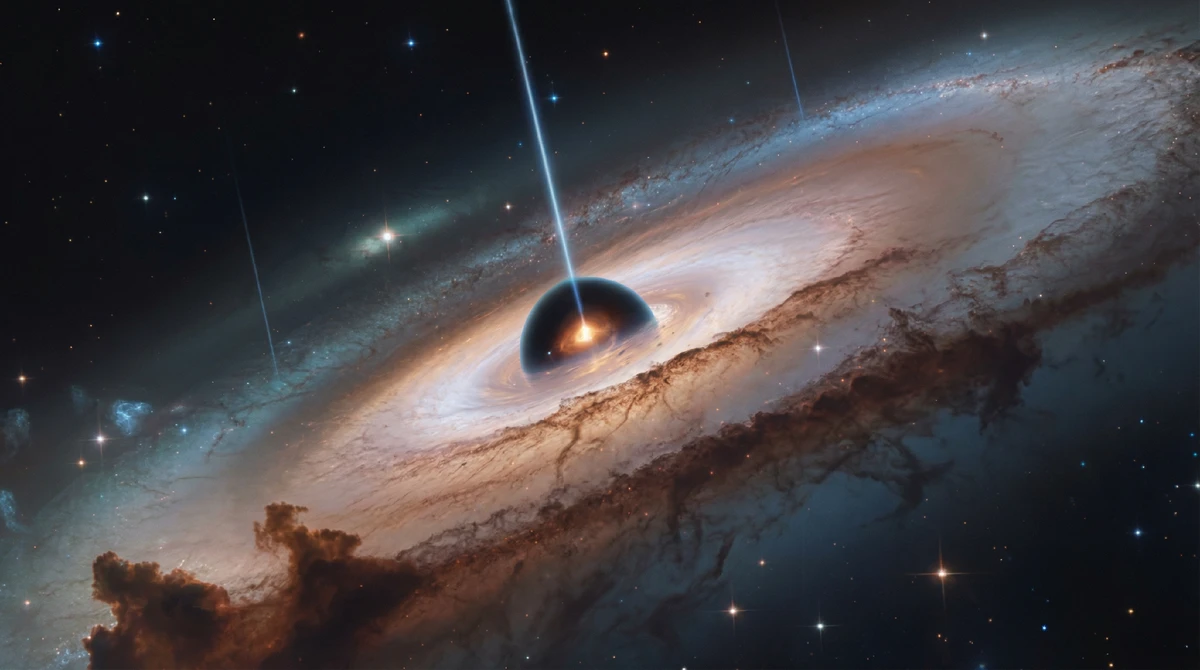
"Direct collapse." The second hypothesis states that the gas cloud collapses directly into a black hole, bypassing the star stage. At the start, the resulting object has a mass between 10,000 and 1,000,000 solar masses—the problem is greatly simplified. The main condition is that the gas must not fragment into normal stars along the way; that is, it must remain hot. In 2024, physicists proposed a mechanism for how this works—by suppressing molecular hydrogen, which typically cools the gas and triggers its decay into stars.
"Augmentative mergers." In dense clusters, black holes collide and merge, gaining mass over and over again. In 2020, the LIGO detector detected gravitational waves from the event GW190521—the birth of a black hole weighing 142 solar masses. This cannot be explained by the collapse of a single star. Someone clearly assembled it piece by piece.
There is also an exotic possibility: primordial black holes, which formed in the first seconds after the Big Bang from superdense clumps of matter. It's a beautiful idea, but there is zero observational evidence so far. 
The question of "which came first—the galaxy or the black hole" remains unanswered. Early observations suggest that black holes often "rush" to grow before the galaxy has accumulated its bulk of stellar mass. This could mean that the central monster isn't simply sitting in the galaxy, but is partly shaping it—through powerful outflows that heat and sweep away gas, regulating the rate of star formation. Not a parasite, but perhaps an architect.
Time: Does It Really Exist?
This question sounds like something you'd hear in a kitchen with friends at two in the morning. But there's some very specific physics behind it—and a very specific unsolved problem. 
Let's start with what's known for sure. Time in physics isn't a universal clock ticking the same for everyone.
This isn't just a theory anymore: in 2010, American physicists measured the difference in the rate of atomic clocks across a 33-centimeter difference in altitude. Clocks lower down tick more slowly—gravity drags time, slowing it down. In 2022, the same problem was solved on a scale of a few millimeters.
Your feet age slightly slower than your head. Not "philosophically," but literally! You just won't even notice it throughout your life; the magnitude is so small.
This is measurable, reproducible physics. GPS satellites account for relativistic time dilation in their corrections—otherwise, navigation error would accumulate at a rate of several kilometers per day.
So what's the problem? Physics perfectly describes "how time flows," but it can't explain "why it flows in one direction."
The equations of physics are almost universally symmetrical with respect to time. Play a movie of molecules moving backwards—the laws of mechanics won't be violated.
But a movie of a breaking cup, played backwards, immediately looks ridiculous. The shards don't bounce back into the cup. This is called the "arrow of time," and it's related to thermodynamics—to the increase in entropy. 
Physicist Robert Wald formulated it bluntly: for the arrow of time to exist, the Universe must have begun with anomalously low entropy—a state of "special order." This doesn't follow from any equations. It's simply a postulate—a "past hypothesis" in the philosophy of physics. Why the Universe started this way is unknown.
In 2012, physicists at the SLAC accelerator compared the probabilities of B mesons decaying "forward" and "backward" in time. The probabilities turned out to be different. Time at the microscopic level isn't quite symmetrical—but this effect is negligible. It doesn't explain why coffee cools down rather than heating up on its own. 
Robert Wald
The most radical idea is that time isn't fundamental at all. The Wheeler-deWitt equation, one attempt to unify quantum mechanics with gravity, doesn't contain a time variable. None at all. The Page-Wootters mechanism of 1983 shows that if a quantum system is divided into "clock" and "everything else," an observer inside will see time flowing. Outside, there is no flow. Time arises from correlations between parts of the system—as a side effect, not as a law of nature. 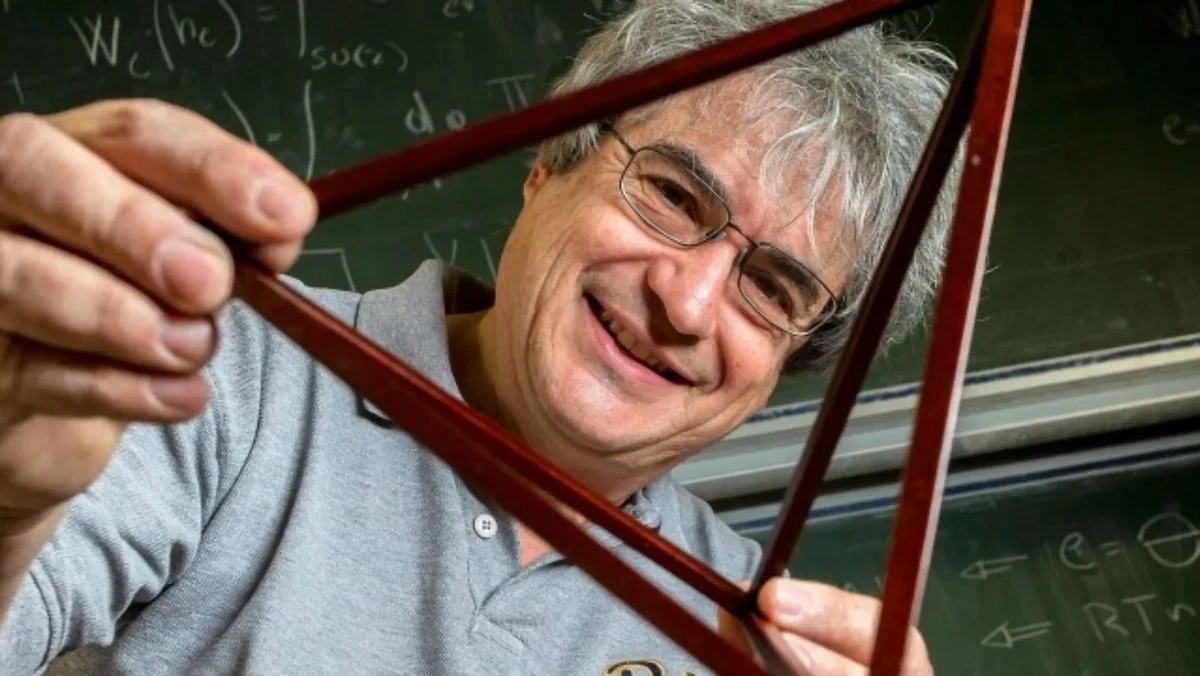
Carlo Rovelli
Physicist Carlo Rovelli puts it radically: time is not a thing that exists in itself. It is the way some physical processes describe others. A convenient number we attribute to change.
This is difficult to accept. The sense of "now," "flow," and "past" is the most immediate of all our experiences. And that's precisely why the situation is so awkward: the most obvious thing in the world can turn out to be derivative. An effect, not a cause.
What unites all three questions
In fact, there are, of course, many more unanswered questions about the cosmos than just these three. Dark matter and dark energy remain a mystery. The origin of the Universe is also not entirely clear (the Big Bang theory currently has difficulty explaining many observed facts). 
But I decided to focus today on these three questions, which have philosophical and ideological implications, not just purely scientific and physical ones.
Behind each of these questions lies the same thing. "Nothing" in physics almost always turns out to be "something." Vacuum presses, fluctuates, and leaves traces. Black holes grew earlier than we thought, and it's still unclear how. Time flows in one direction for no apparent reason.
We've learned to measure the Universe with millimeter-level accuracy in gravity and down to the event horizon of black holes. But three of the simplest questions—why does anything exist, where do the central monsters of galaxies come from, and where does time "flow"—all boil down to one thing: we don't understand the initial conditions. We don't know why the Universe started the way it did.
This isn't a reason to be upset. It's a reason to keep looking to the sky. And someday we will unravel these mysteries, which, I'm sure, will advance humanity greatly!