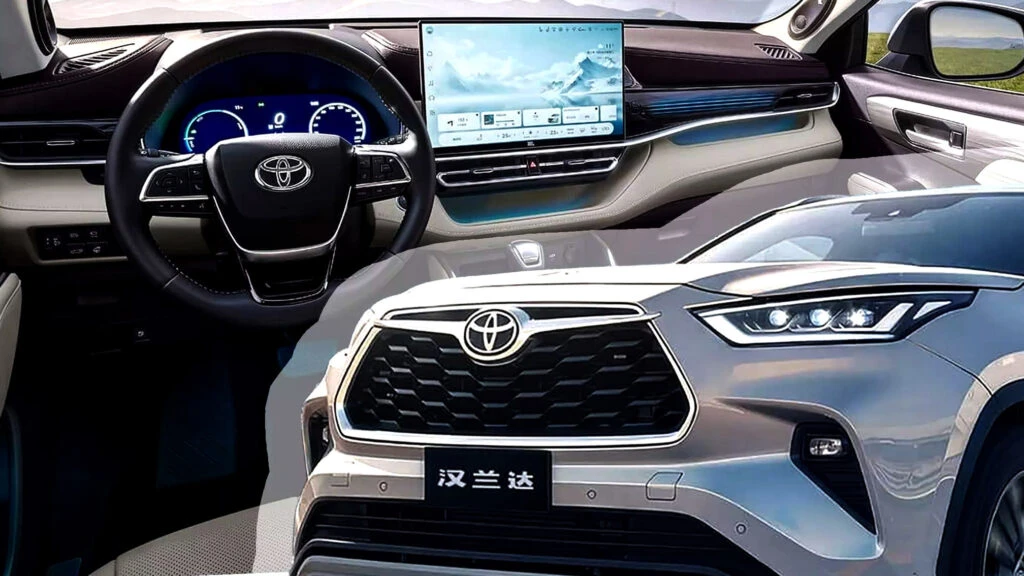
The Chinese Highlander has a larger screen and fewer buttons than yours (2 photos)
Updates for the Chinese market
While the Toyota Highlander for North America remains largely unchanged for the 2026 model year, aside from a significant price increase due to the elimination of a base model, the situation is different in China. There, buyers receive a series of interior updates that improve technological capabilities and give the interior a more modern look.
Bigger screens, fewer buttons
The Highlander for the Chinese market is produced by the GAC Toyota joint venture and is sold alongside the almost identical Crown Kluger model from FAW Toyota. At first glance, the 2026 Highlander looks the same as before, but the changes become apparent once you get inside. Every trim level now features a much larger 15.6-inch infotainment screen, replacing the previous 10.25- and 12.3-inch systems. It pairs with a standard 12.3-inch digital instrument cluster, while a head-up display remains an option.
In comparison, the Limited and Platinum trim levels for the U.S. market Highlander feature a fully digital instrument cluster that includes dual 12.3-inch screens and a 10-inch color head-up display. All other trim levels make do with a smaller 7-inch instrument cluster paired with an 8-inch infotainment screen.
To make room for the larger screen in the Chinese version, Toyota has redesigned the instrument panel with narrower air vents and done away with physical climate control buttons altogether. Other improvements include a faster 50kW wireless charging pad and new color options for the Nappa leather. Higher trim levels add a panoramic roof, power and heated rear seats, and an 11-speaker JBL audio system. Buyers can still choose between five- and seven-seat configurations.
The interior of the Toyota Highlander in China (top) and the US (bottom). 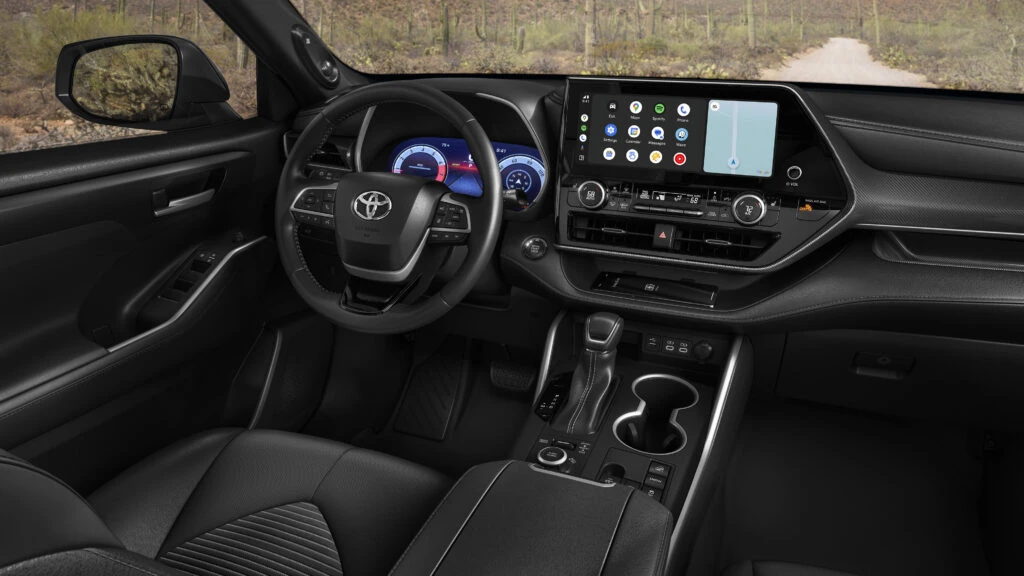
Technical part unchanged
As expected, the technical stuffing remained untouched. The non-electrified turbocharged 2.0-liter four-cylinder engine develops 244 hp (182 kW/ 248 PS) and works in tandem with an eight-speed automatic transmission and all-wheel drive system. The 2.5-liter hybrid powertrain produces a total output of 243 hp (181 kW/ 246 PS) and offers a choice between front-wheel drive and all-wheel drive (E-Four).
Prices and Availability
The slightly updated Toyota Highlander is now available for order in China, where it is priced between 249,800 and 325,800 yuan (approximately 35,000-45,700 US dollars). For comparison, the Highlander for the US market starts at 45,270 dollars and goes up to 54,675 dollars for the top-end versions.
The Future of the Highlander
The fourth-generation Highlander has been introduced since 2019, although it did not arrive in China until 2021. The GAC Toyota joint venture has confirmed that the next generation of the crossover will receive “major updates” along with the introduction of a range-extending powertrain option that is popular with Chinese buyers.
As for North America, it was reported that the all-electric Toyota Highlander could appear in dealerships in early 2026, although there is no official confirmation of this information. Toyota recently introduced the Highlander for the 2026 model year with available internal combustion engines and hybrid powertrains, where all-wheel drive has become standard across the lineup.
GAC Toyota
The difference in approaches to updating the Highlander for China and North America clearly demonstrates the specifics of these markets. Chinese consumers show significant demand for advanced digital technologies and innovations in the cabin, which forces automakers to adapt faster. At the same time, the US market demonstrates more conservative dynamics, where the emphasis is often placed on reliability and familiar solutions. This strategy allows Toyota to compete effectively in both regions, offering products that are as close to local preferences as possible. The future of the model, especially the possible transition to electric drive, indicates a global transformation of the automotive industry and the search for new paths of development.