Feared Even in Death: Why Zosia Was Buried with a Sickle at Her Throat (8 Photos)
What could be scarier than a vampire? Perhaps only one who turns out to be an ordinary 17-year-old girl. In 2022, Polish archaeologists unearthed a grave containing a padlock clamped onto a big toe and a curved sickle blade resting across the neck—classic measures used centuries ago to ward off the "undead." Four years later, researchers revealed that the young woman hailed from a noble family and ultimately fell victim to mass hysteria. Here is her story, from the initial discovery to the reconstruction of her face. 
The Grave Was Opened Twice
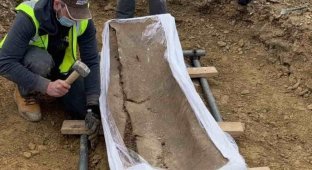
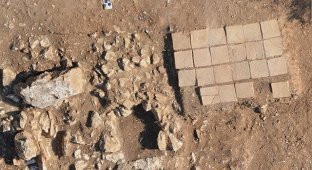
Excavations at a cemetery near the village of Pień in northern Poland’s Kuyavian-Pomeranian Voivodeship have been ongoing since 2005. But the site's most famous discovery wasn't made until 2022. Professor Dariusz Poliński and his team from Nicolaus Copernicus University in Toruń were surveying an abandoned plot of land absent from all historical maps.
At first, a curved metal object emerged from the soil. It soon became clear that it was a sickle. A few days later, a triangular padlock was uncovered nearby.
"A find like this, especially in Poland, was a complete surprise," Poliński recalled. 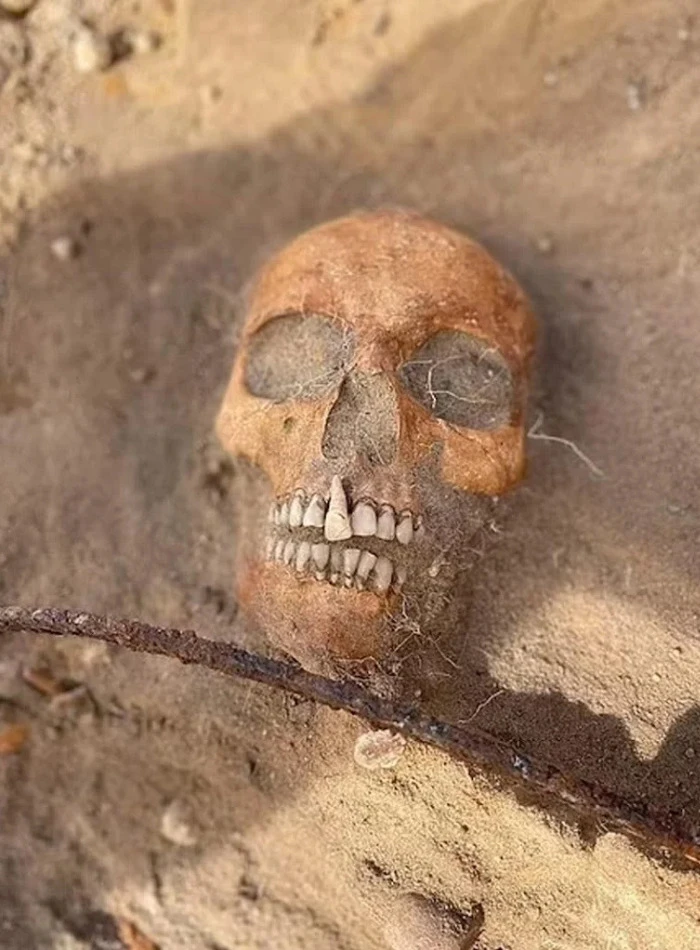
The layer of soil above the skeleton was unevenly filled—a clear sign that the grave had been reopened.
Soil disturbances indicated that the grave had been dug up again before the body had fully decomposed. Someone had repositioned the dead girl's arm toward the northeast. It was likely then that the sickle was placed around her neck.
Who Was Buried in Grave No. 75?
The young woman's real name appears in no surviving historical records. Archaeologists nicknamed her Zosia—a common Polish diminutive of Sophia—after the excavation purely for convenience.
Radiocarbon dating places her death between 1620 and 1674, most likely around the mid-17th century. Analysis of her teeth and bones suggests she was between 17 and 19 years old. She stood between 162 and 168 centimeters (about 5'4" to 5'6") tall. 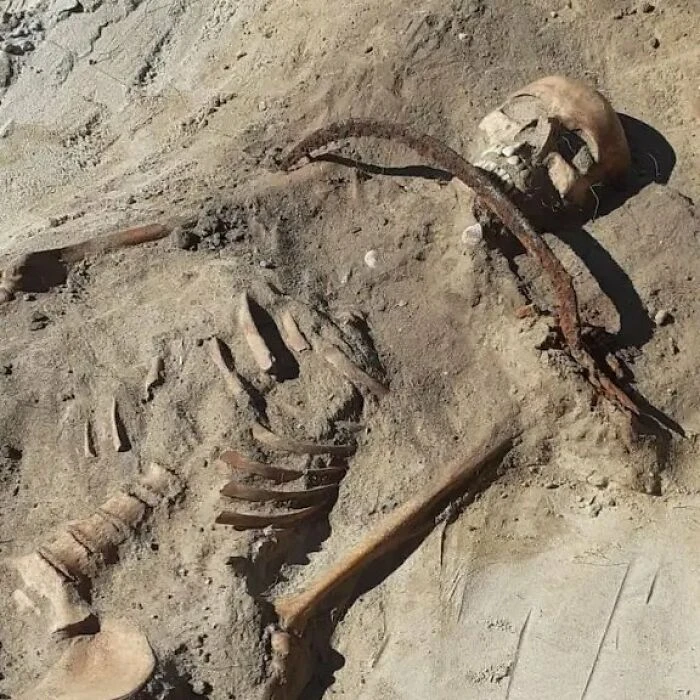
The bones were preserved well enough to determine her age, height, and signs of potential trauma.
DNA testing revealed a rare maternal genetic link to Scandinavia—one virtually absent among the region's modern Slavic population. Yet isotopic analysis of her teeth revealed that Zosia herself grew up near Pień. This indicates that her ancestors, rather than Zosia herself, migrated from Northern Europe—a common story for a region where Poles, Germans, and Dutch settlers coexisted for centuries.
The cemetery was active for roughly four generations during the 17th century. Archaeologists have identified 101 burials from that period. The absence of crosses and religious medallions points to a Protestant community, such as Lutherans or Mennonites.
A Silk Bonnet and Signs of Malnutrition
Near her skull and jaw, researchers found remnants of an ornate silk ribbon—likely the trim of a bonnet. The fabric contained threads of pure and gilded silver—luxuries largely reserved for the wealthy elite of the 17th century. 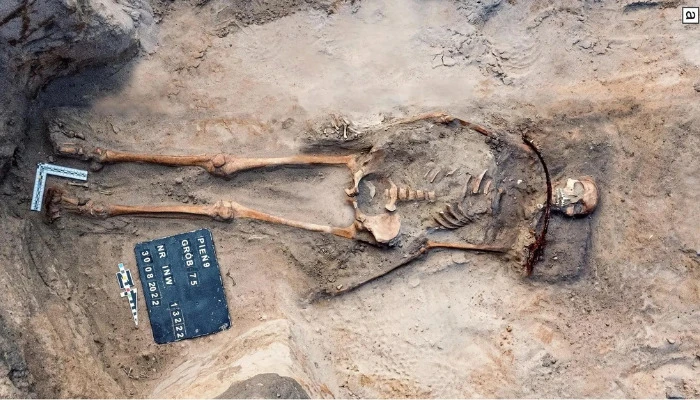
Such ornaments were worn by women from affluent families; ordinary peasant women could never have afforded them.
Yet her high status saved her neither from starvation nor from suspicion after death. Carbon and nitrogen levels in her bones point to periods of severe malnutrition. High birth and food scarcity coexisted in her life—much like the delicate beauty of her bonnet alongside the iron padlock on her toe.
A Padlocked Toe and a Blade at the Throat
The first precaution was a triangular iron padlock attached to the big toe of her left foot. According to Poliński, the padlock symbolically severed the connection between the living and the dead, while in some traditions it was believed to ward off misfortune or disease outbreaks.
"It was a way of ensuring the body stayed in the grave—meaning the fear of her return was extraordinarily intense," Poliński explained. 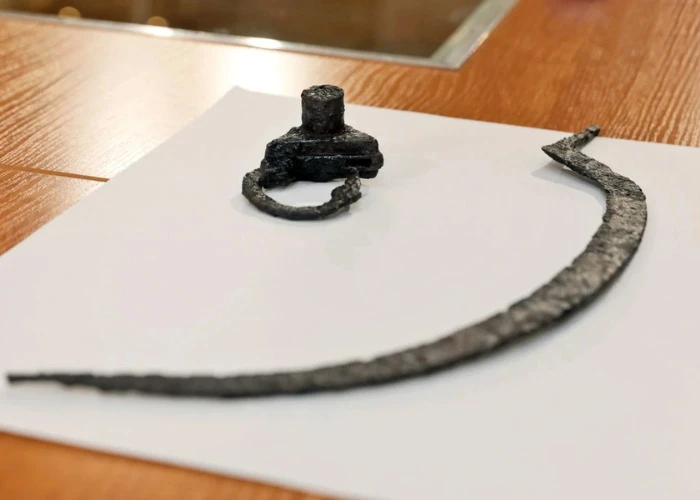
An iron sickle roughly 36 centimeters long lay with its blade pressed against her throat—designed to strike if the deceased tried to rise.
The second measure was this 36-centimeter iron sickle placed blade-down across her neck. Had the body tried to stand up, the blade would have cut into or severed her neck. Zosia's grave remains the first documented case where two distinct anti-vampiric rituals were used simultaneously in a single burial.
Who Were Called "Vampires" Before Dracula?
The word "vampire" itself only gained widespread currency in Europe during the 18th century. Before then, Slavic communities relied on terms like
upiór
and
strzyga
. Methods for dealing with the "undead" varied: corpses were decapitated, had their legs severed, were buried face-down, burned, or pinned down with heavy stones. 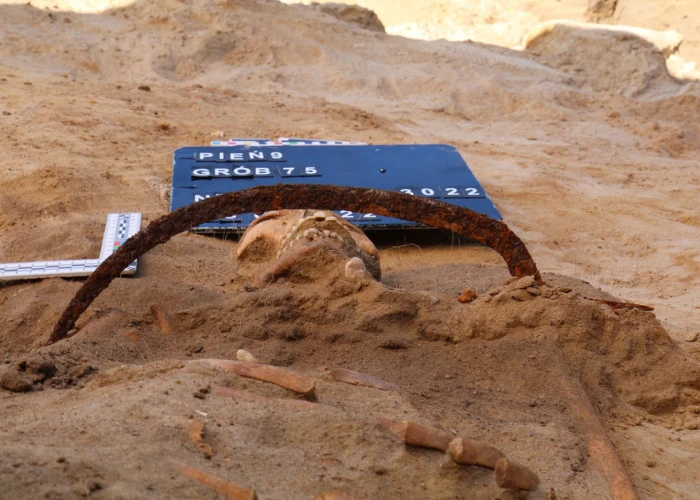
The cemetery sits far from any church and is absent from historical maps—suggesting it was reserved for outcasts.
The cemetery near Pień was located away from both the main village and the local church, indicating it was meant for social outcasts: the destitute, exiles, and those feared by the community. Just a few feet from Zosia's resting place, archaeologists later uncovered another grave containing the face-down remains of a child aged 5 to 7, featuring similar green stains on a fragment of the jawbone.
A Green Stain on the Palate
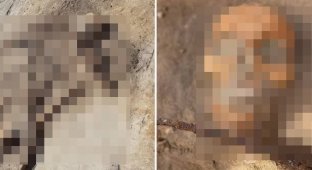
Scientists discovered extensive green staining on the young woman's hard palate, extending to her throat, nasal cavity, skull base, and upper vertebrae. Chemical analysis revealed traces of copper. The stain was far too large to be explained by a simple coin. 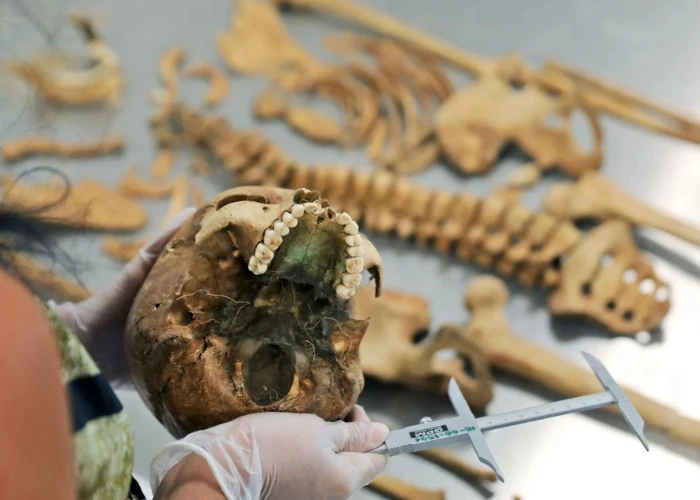
Chemical analysis confirmed the presence of copper—a metal that leaves this exact discoloration over time.
Researchers suspect a substantial copper object was placed inside her mouth, which disintegrated over time. Similar practices existed elsewhere in Europe: stones or bricks were stuffed into the mouths of suspected undead corpses to prevent them from returning to feed on the living.
Giving Zosia Her Face Back
Early reports in 2024 attributed her neighbors' terror to a potential chest deformity. However, recent research disproved this theory: scientists found only minor ligament damage, likely caused by repetitive arm movements. No severe pathologies were found that would account for her death or a striking physical deformity. 
Swedish sculptor Oscar Nilsson reconstructed Zosia's face using a 3D copy of her skull.
Most likely, the young woman became a scapegoat for broader misfortunes—an epidemic, illness, or crop failure. The 17th century in the Polish-Lithuanian Commonwealth was plagued by war, climate shifts, and famine—an era when unexplained tragedies were readily blamed on supernatural forces.
Swedish forensic artist Oscar Nilsson reconstructed her face based on a replica of her skull. The project was featured in the 2024 documentary
Field of Vampires
. "I wanted to restore her human dignity," Nilsson said. On July 30, 2026, Poliński’s team published their findings in the journal
Journal of Archaeological Science: Reports
.
Thus, the "vampire" of Pień was revealed to be an ordinary girl destroyed not by her own nature, but by the fears of others.
What do you think drove Zosia's neighbors to suspect her of being a vampire?