These Places Have Stood for Centuries—But Only Side-by-Side Photos Reveal How Much They've Changed (39 photos)
The world shifts subtly—day by day, year by year. But place two photos of the exact same location taken a century apart side by side, and it takes your breath away. Whole epochs lie hidden behind familiar facades. This is the art of rephotography: photographers hunt down the precise spot where a vintage photo was taken and recreate the shot from the exact same vantage point.
Here are 38 "then and now" pairs featuring ancient temples, modern metropolises, mountain castles, and coastal promenades. Take a look at what has changed—and what has stood the test of time. 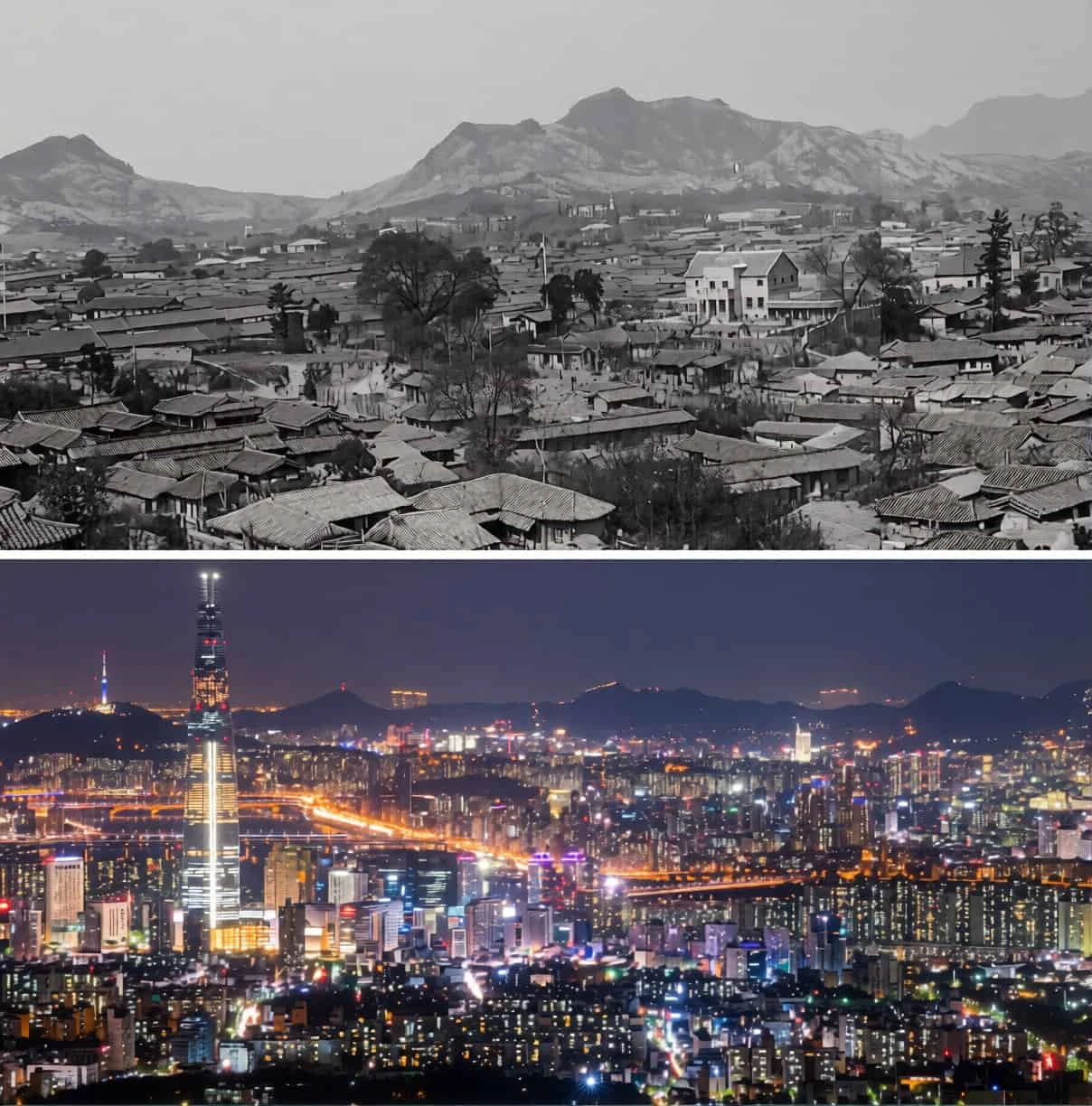
What Is Rephotography?
The images in this collection are known as rephotographs. The photographer locates the exact spot of an archival photo and recreates the scene today. There are two main approaches: documentary, where the images are placed side-by-side to let viewers spot the differences themselves, and artistic, where past and present are overlaid, creating the illusion of history bleeding through into the modern day.
Gerry Pycroft, one of the world's most traveled rephotographers, favors the artistic blend. He studies vintage postcards, travels to the location—often discovering the original view is now blocked by trees or scaffolding—and seamlessly merges the two images. Photographer Mark Klett says he is drawn to the "time paradox": standing in the exact footsteps of a photographer from a century ago is a deeply personal and startling experience. 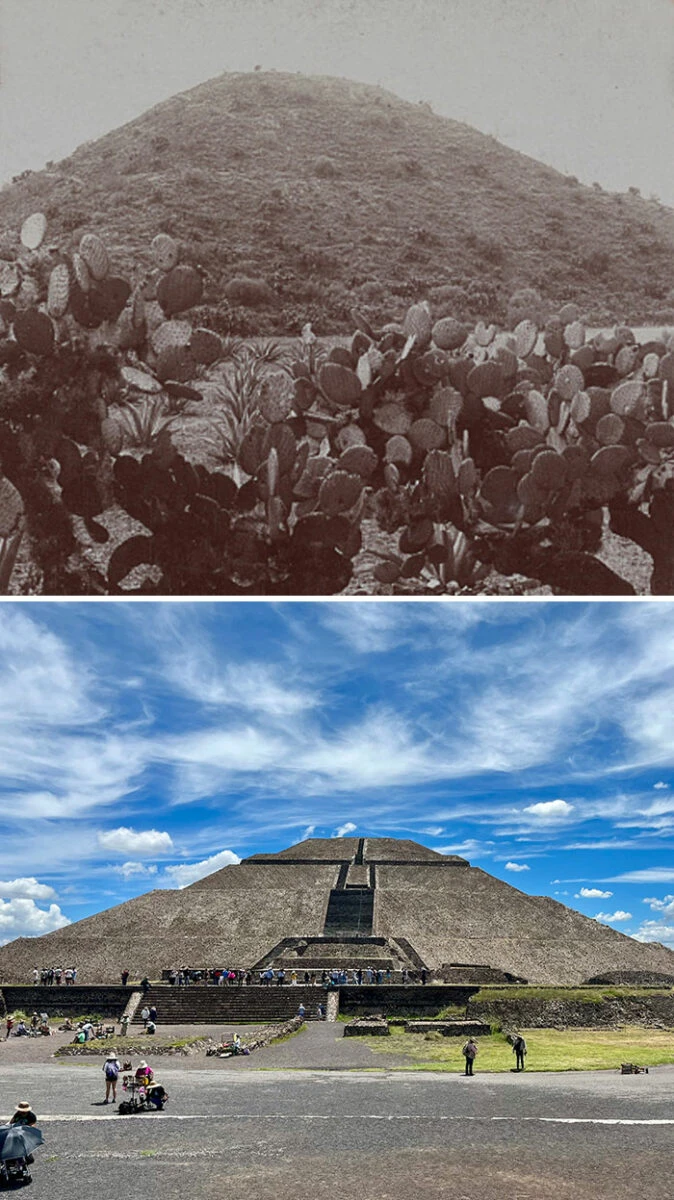
Pyramid of the Sun in Teotihuacan, Mexico — 1900 vs. 2023.
Teotihuacan was one of the largest cities in pre-Columbian America, housing between 100,000 and 200,000 residents during its peak (around the 2nd to 7th centuries AD). The Pyramid of the Sun is the third-largest pyramid in the world, standing 65 meters tall with a total volume comparable to the Great Pyramid of Giza. In the 1900 photograph, it is still buried beneath dirt and dense vegetation. Large-scale excavations began in the early 20th century, gradually uncovering the massive stone structure visible today. 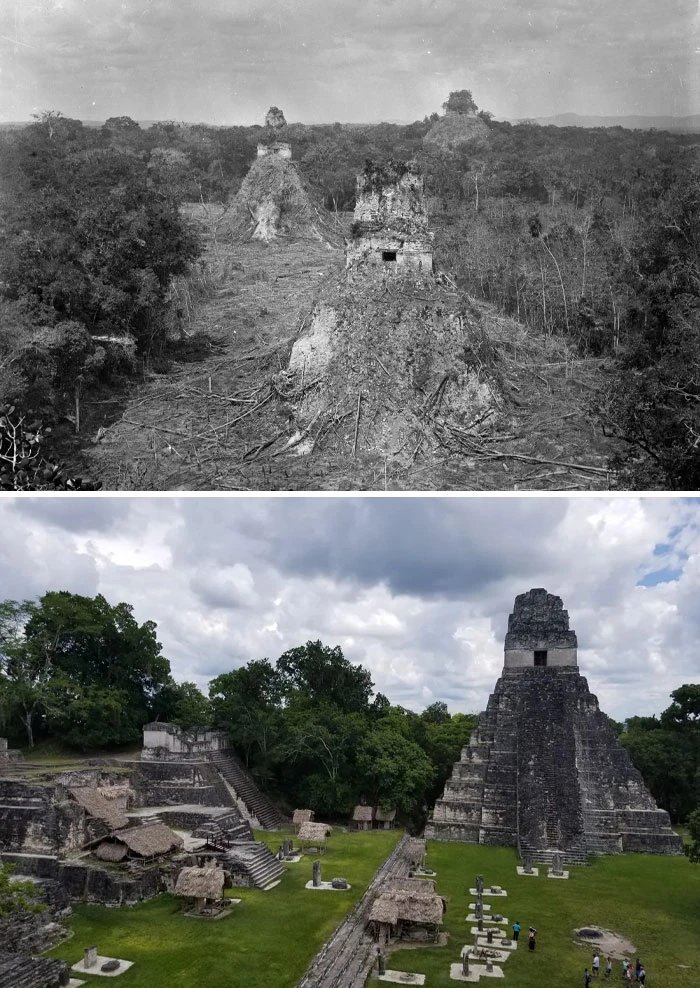
Ruins of Tikal in Guatemala — 1890 vs. 2023.
Tikal was a major urban center of the Maya civilization, flourishing from the 3rd to the 10th century AD. At its peak, it was home to roughly 90,000 people. By 1890, the jungle had almost entirely reclaimed the structures; in the archival photo, only faint outlines of the pyramids peek through the dense canopy. Systematic excavations didn't begin until the 1950s, finally exposing soaring temples up to 70 meters tall from beneath decades of earth and foliage.
Destroyed and Reborn
Several landmarks in this collection survived destruction, neglect, or centuries buried underground—only to be brought back to life. 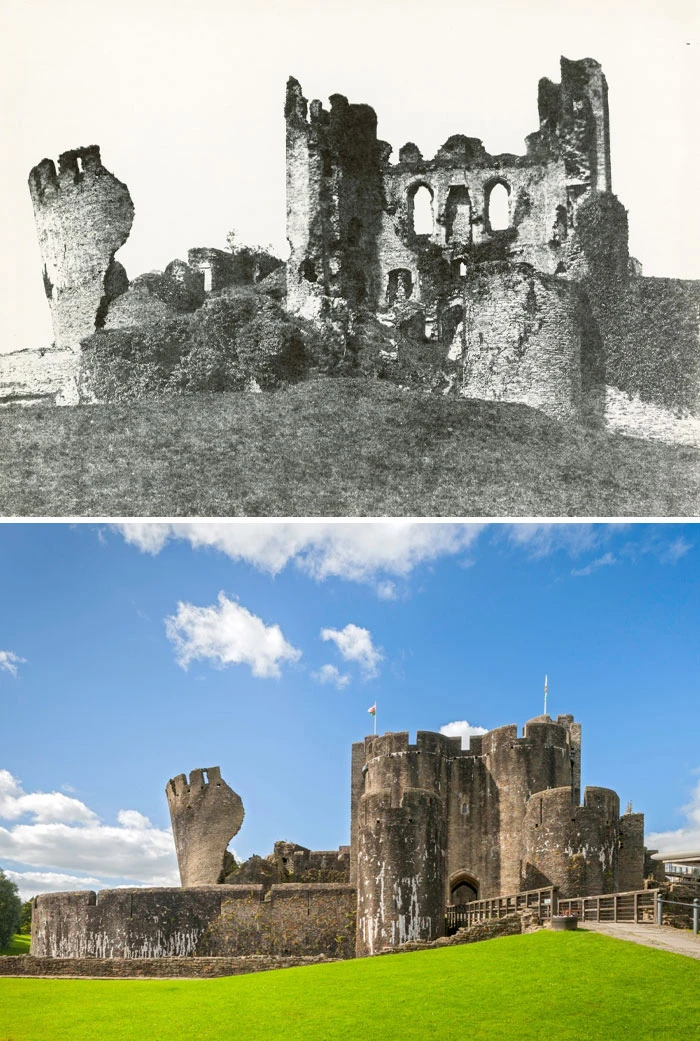
Caerphilly Castle in South Wales — 1855 vs. 2024.
Built between 1268 and 1271, Caerphilly Castle is the second-largest castle in Britain, surpassed only by Windsor. Its most striking feature is a leaning tower, tilted about three feet out of perpendicular due to damage sustained during the 17th-century English Civil War. In the 1855 photograph, there are no manicured lawns—just overgrown grass and neglect. Major restoration efforts didn't begin until the 20th century. 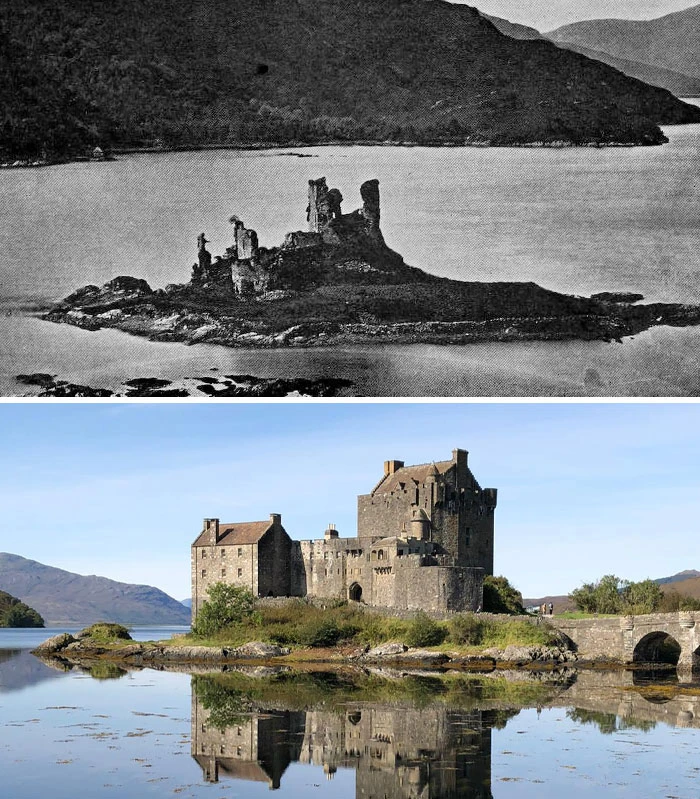
Eilean Donan Castle, Scotland — Pre-1911 vs. 2020.
The older photo shows nothing more than ruins. In 1719, three British warships bombarded the fortress, which was then occupied by Spanish troops supporting the Jacobites. The destruction was completed when 343 barrels of gunpowder found inside were detonated. For nearly two centuries, the castle lay in heaps of rubble. In 1911, Lieutenant-Colonel John MacRae-Gilstrap bought the island and set about rebuilding it using archival plans—and, legend has it, guided by a dream that revealed the castle's original layout to his clerk of works, Farquhar MacRae. By 1932, the reconstruction was complete. Today, Eilean Donan is Scotland's most photographed castle. 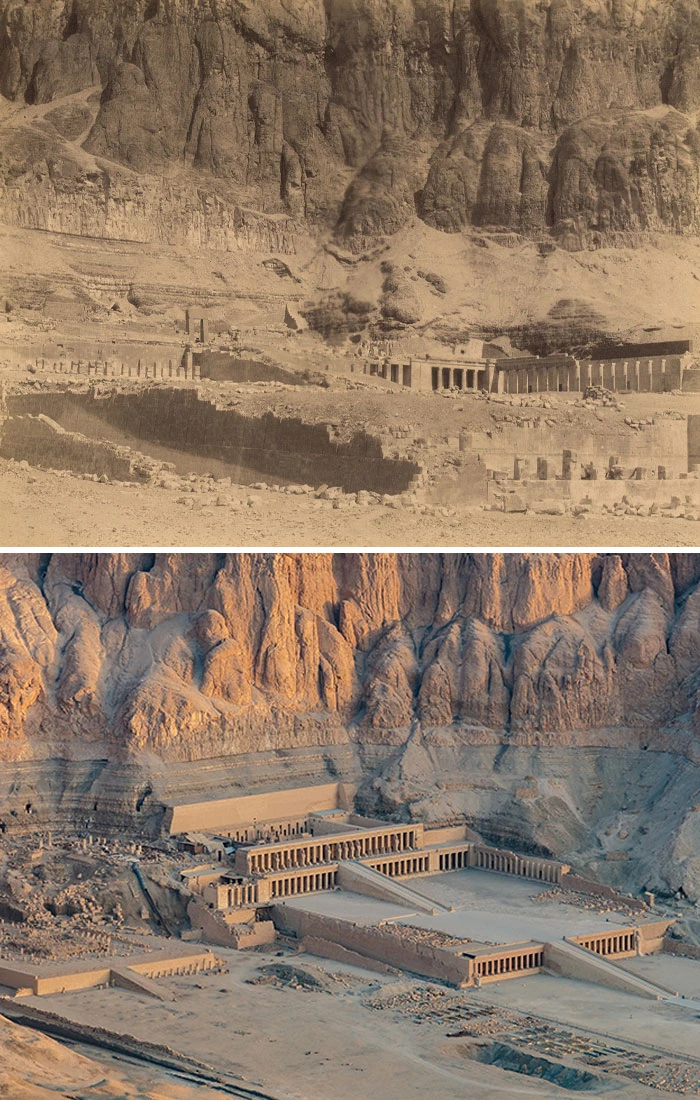
Mortuary Temple of Hatshepsut in Luxor, Egypt — 1880 vs. 2022.
Commissioned around 1470 BC, this cliffside complex was built for Hatshepsut, one of ancient Egypt's few female pharaohs. Its three terraced levels are carved directly into the rock face. Following her death, her successor Thutmose III attempted to erase her legacy, defacing her images and chiseling away her cartouches throughout the temple. In the 1880 photo, the structure remains half-buried under millennia of silt and sand. Excavations starting in the late 19th century eventually revealed one of the crown jewels of New Kingdom architecture. 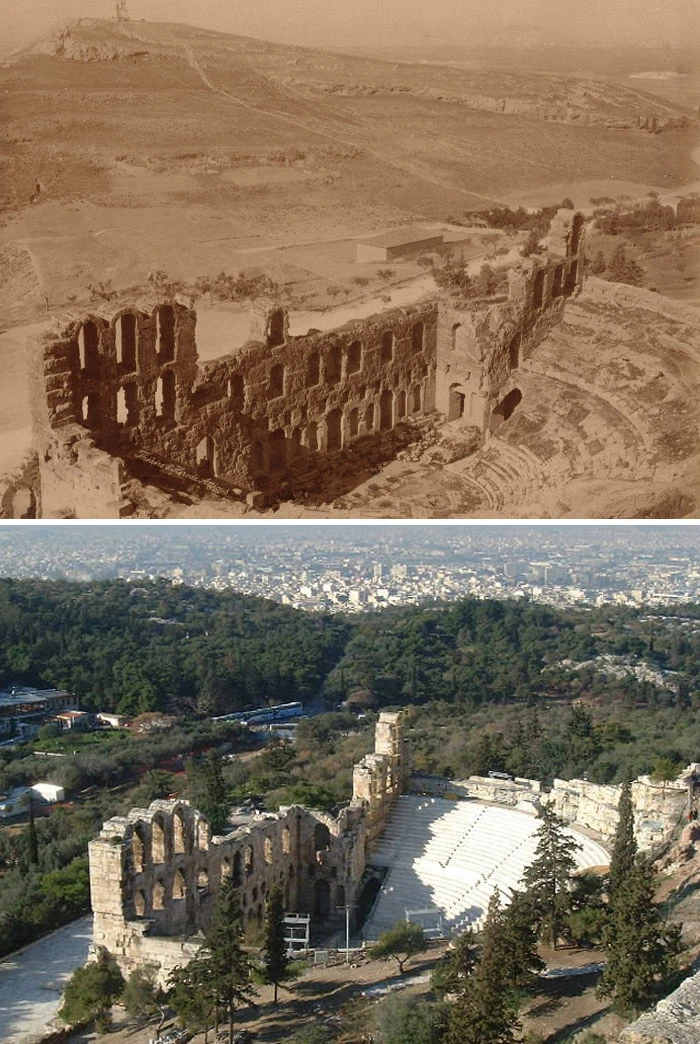
Odeon of Herodes Atticus at the foot of the Acropolis in Athens, Greece — 1893 vs. 2001.
Built in 161 AD by the wealthy Greek benefactor Herodes Atticus in memory of his late wife, this amphitheater originally seated around 5,000 spectators. In 1893, it was a roofless shell of crumbling walls. Following extensive restoration in the 1950s, the venue returned to life; today, thousands gather here every summer for performances during the Athens Festival.
Between Past and Future
Not every site featured here was a finished monument when first photographed. Some were still mid-construction, while others continue to evolve to this day. 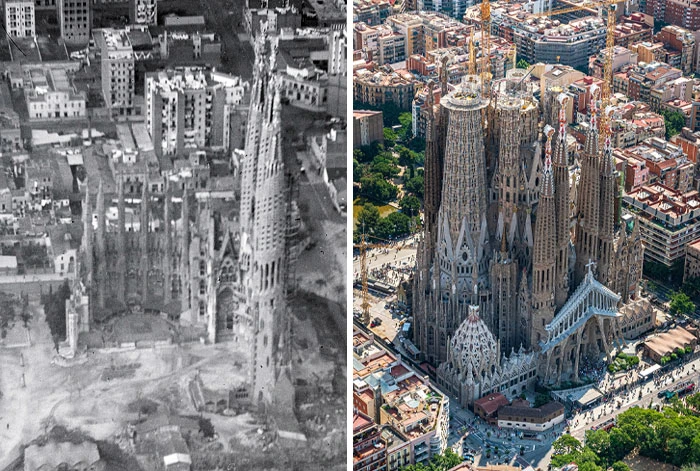
Sagrada Família in Barcelona, Spain — 1930 vs. 2020.
Construction of the basilica began in 1882. With the installation of the cross atop the 172.5-meter central Tower of Jesus Christ in February 2026, the Sagrada Família became the tallest church in the world. While the exterior construction is largely complete, work on the interior details and the final spires of the Glory Facade will stretch into the early 2030s. Throughout its remarkable 144-year build, the monument has been designated a UNESCO World Heritage Site. 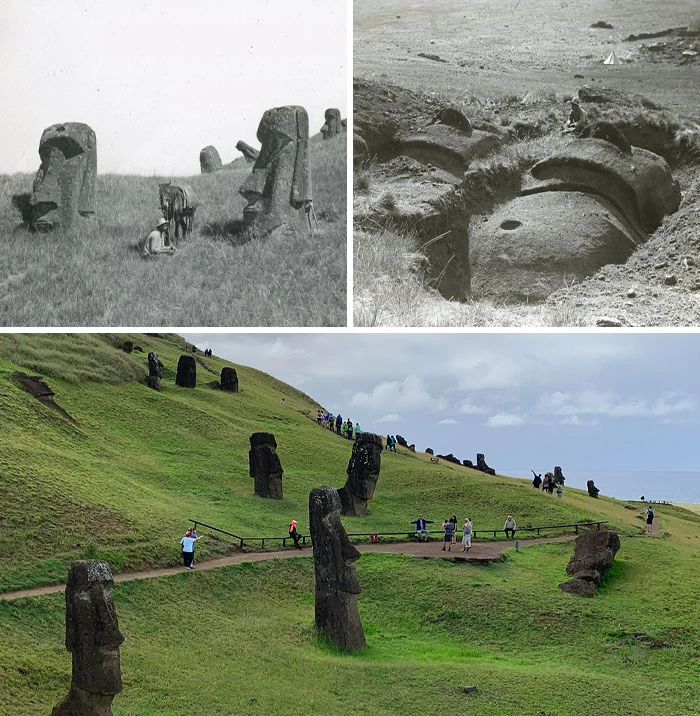
Moai statues in Rano Raraku crater on Easter Island — 1914 vs. 2019.
Rano Raraku is the volcanic quarry where nearly 95% of Easter Island's moai statues were carved. In the 1914 photograph, far more statues are visible, poking out from the hillside at various angles. By 2019, soil erosion and settling caused some to sink deeper into the earth, while others were excavated. These digs famously revealed that many of the iconic "heads" actually have full bodies buried several meters underground. 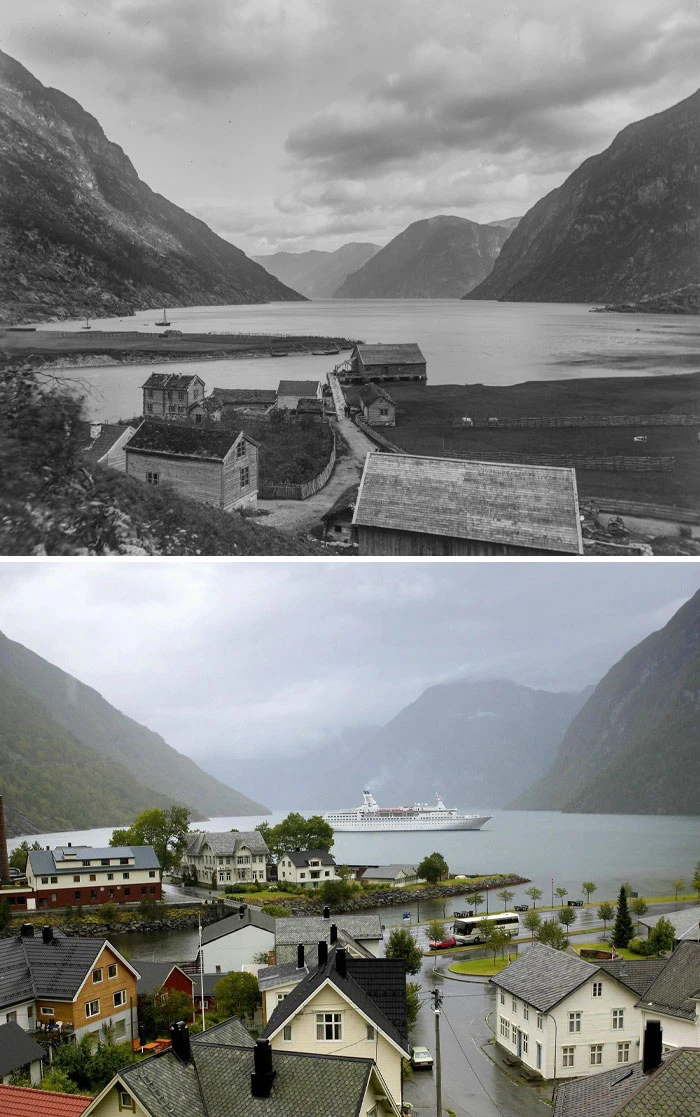
Hellesylt, Norway — 1885 vs. 2016.
Hellesylt is a small village situated at the head of Sunnylvsfjorden, near the Geirangerfjord. In 1885, it was home to a quiet community of fishermen and farmers. Today, it serves as the main ferry hub for tourists visiting Geirangerfjord, a UNESCO World Heritage Site renowned as one of the world's most breathtaking fjords. Comparing the photos reveals that the dramatic landscape itself has remained virtually untouched—only the 19th-century wooden structures have been replaced by modern homes. 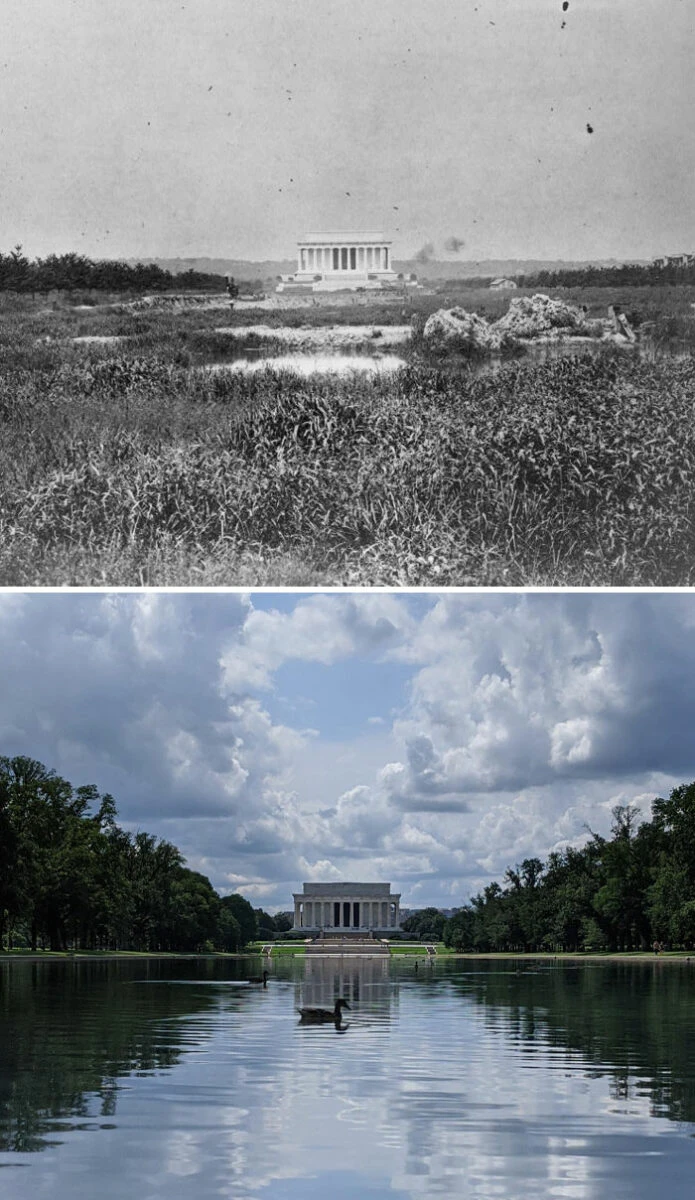
Lincoln Memorial in Washington, D.C., USA — 1917 vs. 2020.
Built between 1914 and 1922, the Lincoln Memorial was caught mid-construction in the 1917 photograph. The iconic colonnades were in place, but the roof was unfinished, surrounded by heavy scaffolding. The monument went on to become an enduring symbol of American democracy and the backdrop for defining historical moments—most notably Martin Luther King Jr.'s "I Have a Dream" speech in 1963. 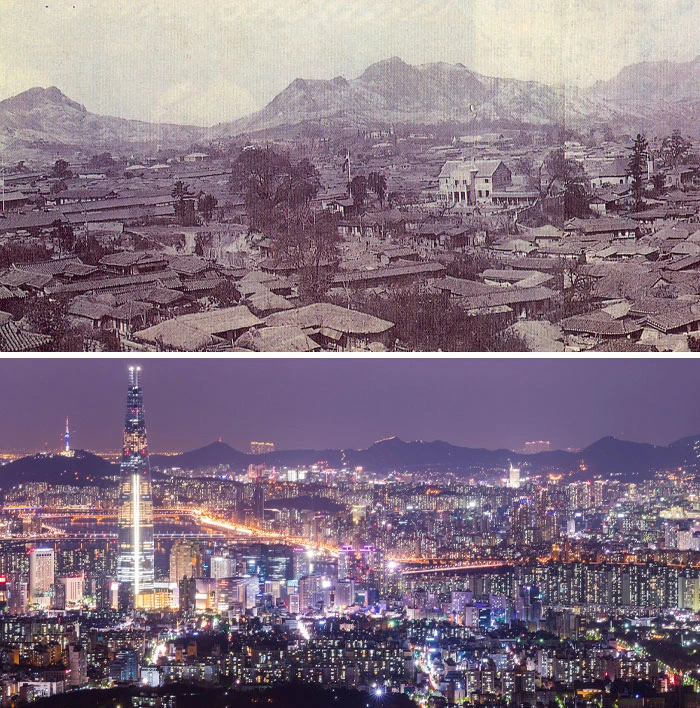
Seoul, South Korea — 1900 vs. 2016.
Perhaps the most staggering contrast in the collection. In 1900, Seoul was a modest Asian city of traditional wooden houses and an unhurried pace of life. By 2016, it had transformed into a bustling megacity of towering skyscrapers, hyper-dense development, and one of the world's fastest 5G networks. South Korea accomplished this astonishing metamorphosis in less than seven decades. 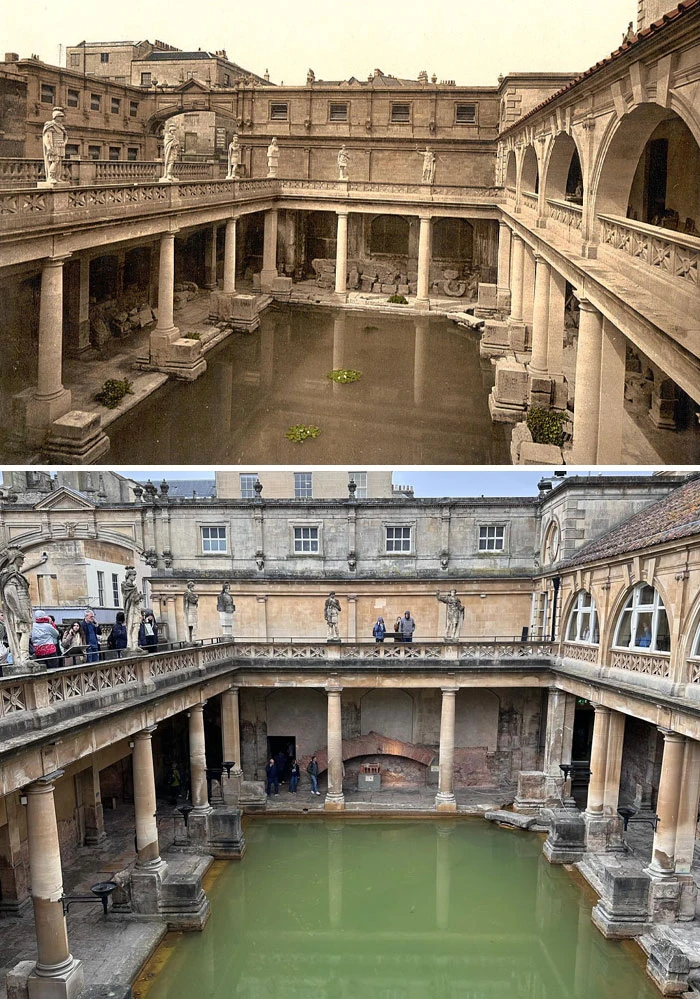
The Roman Baths and Abbey in Bath, England — 1890 vs. 2024.
Bath is the only city in Britain endowed with natural hot thermal springs. The Romans established a bath complex here around 70 AD. By 1890, excavations in the city center were well underway, capturing laborers uncovering the ancient pools. Today, the Roman Baths stand as one of the best-preserved examples of Roman engineering in the world and form part of Bath's UNESCO World Heritage designation.
Mountains, Jungles, and Cities: How the Planet Shifted
Here are locations where time left vastly different marks: some landscapes look unchanged after a century, while others are unrecognizable. Mountain gorges, ancient ruins, sprawling capitals, and sacred temples—each carries its own story of transformation. 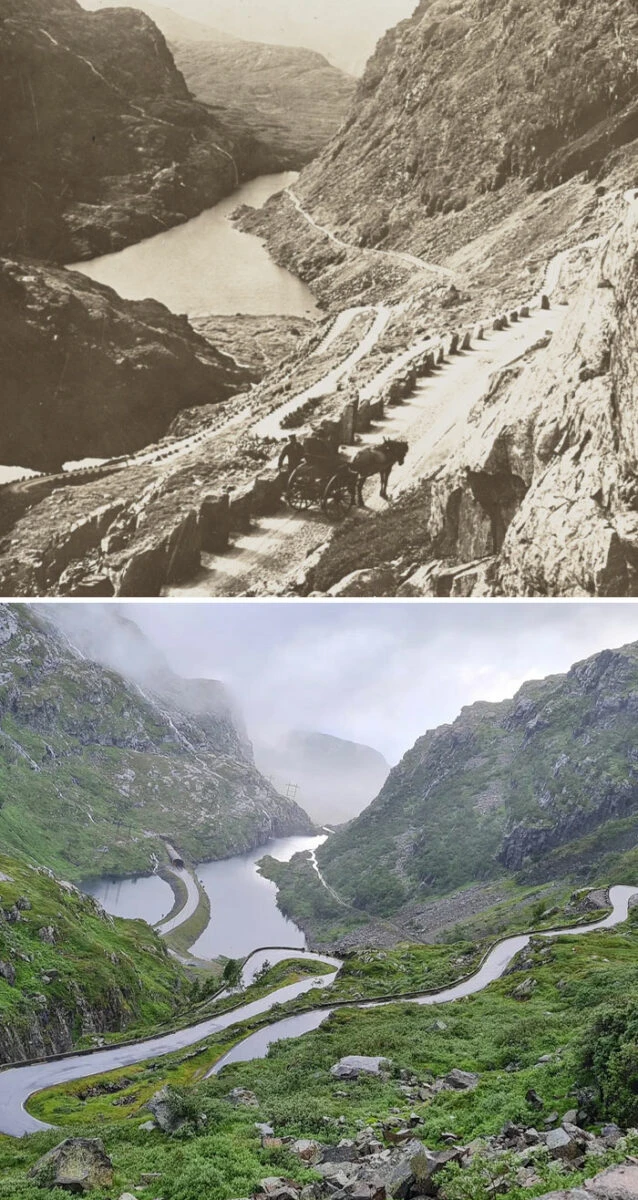
Seljestadjuvet in Odda, Norway — 1905 vs. 2022.
Seljestadjuvet is a dramatic gorge in Norway's Hardanger region that emerged as a popular tourist attraction in the late 19th century. European travelers flocked here to admire cascades pouring over the narrow mountain pass. Though 117 years separate these images, the cliffs and waterfalls look nearly identical; only the fashion of the visitors and the quality of the road surface have changed. 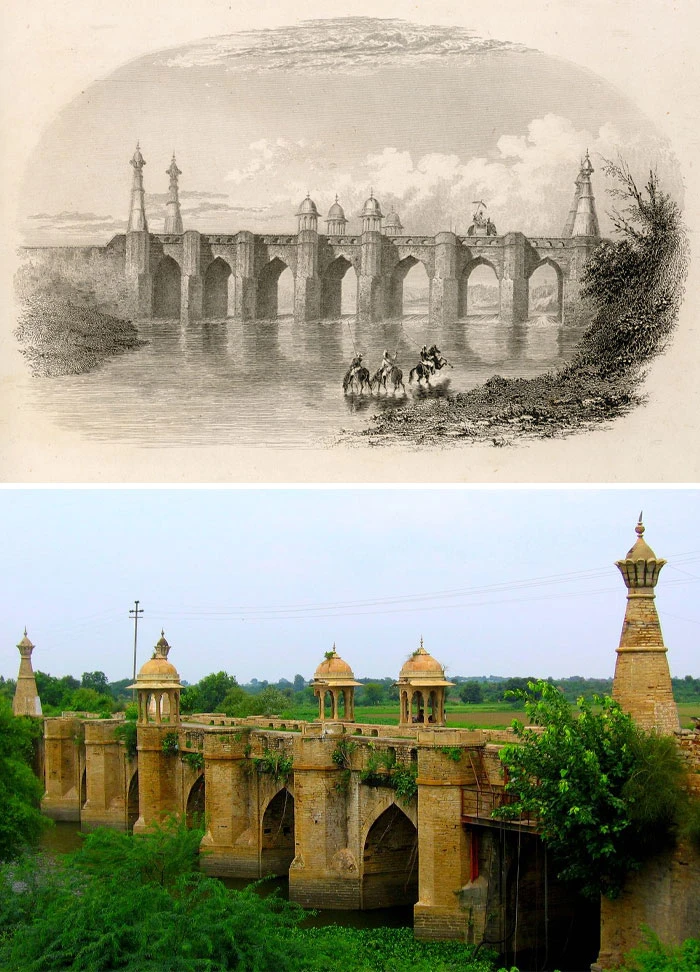
Noorabad Bridge in Morena, India — 1829 vs. 2010.
Located in Madhya Pradesh, this bridge dates back to the Mughal Era. The 1829 watercolor used as the "then" image shows a wide, flowing river beneath well-preserved arches. By 2010, the riverbed had dried significantly—a stark trend seen across many Indian waterways over the past century and a half. 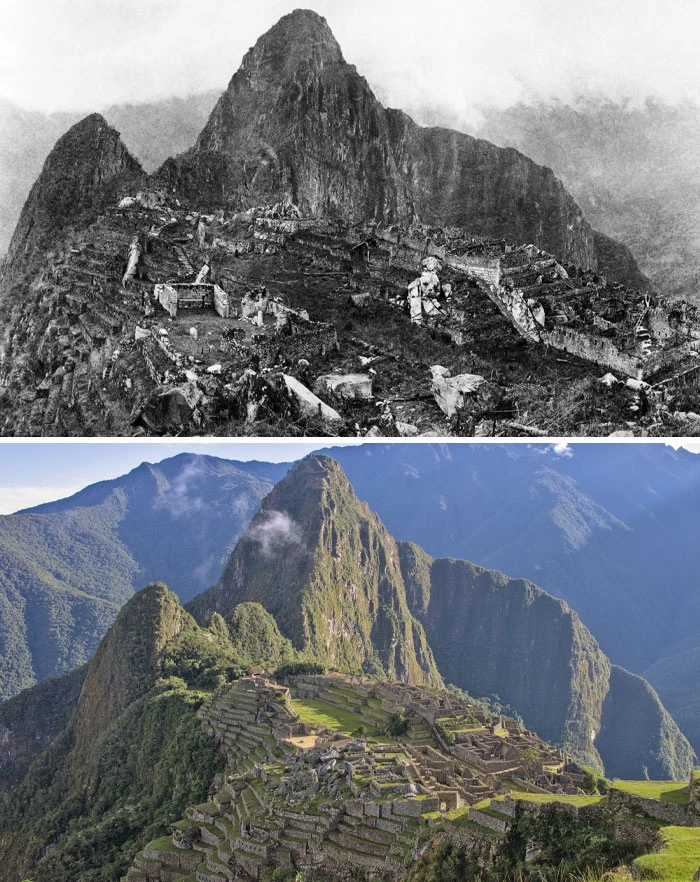
Machu Picchu in 1912, after initial clearing efforts, vs. 2023.
American historian Hiram Bingham introduced Machu Picchu to the global public in 1911—though local residents had known of it for generations. The 1912 photograph captures the site shortly after initial clearing work began, exposing terraced slopes and stone foundations through the thick foliage. By 2023, the Inca citadel welcomed nearly 1.5 million visitors annually, raising major preservation concerns. 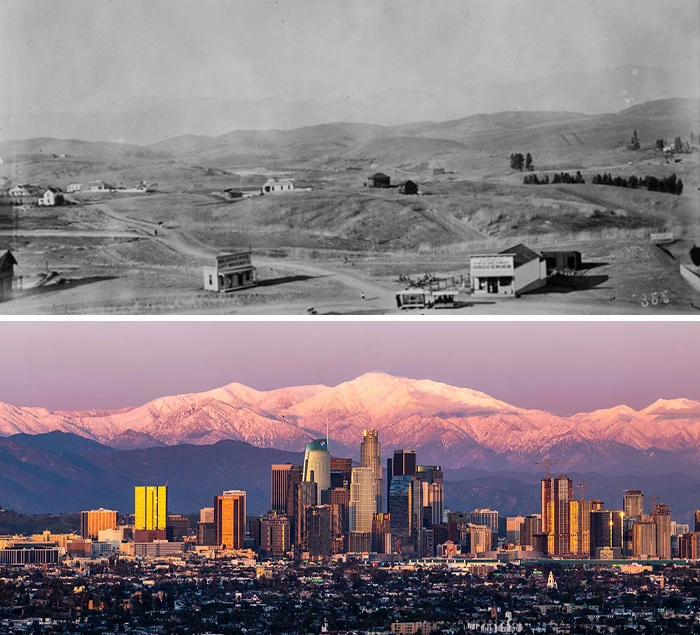
Los Angeles — 1880 vs. 2019.
In 1880, Los Angeles had a population of roughly 11,000 residents. The sleepy, single-story town tucked against the Sierra Madre foothills bore little resemblance to the global capital of cinema and tech it would become. By 2019, Greater Los Angeles was home to nearly 13 million people, marking one of the fastest urban expansions in American history. 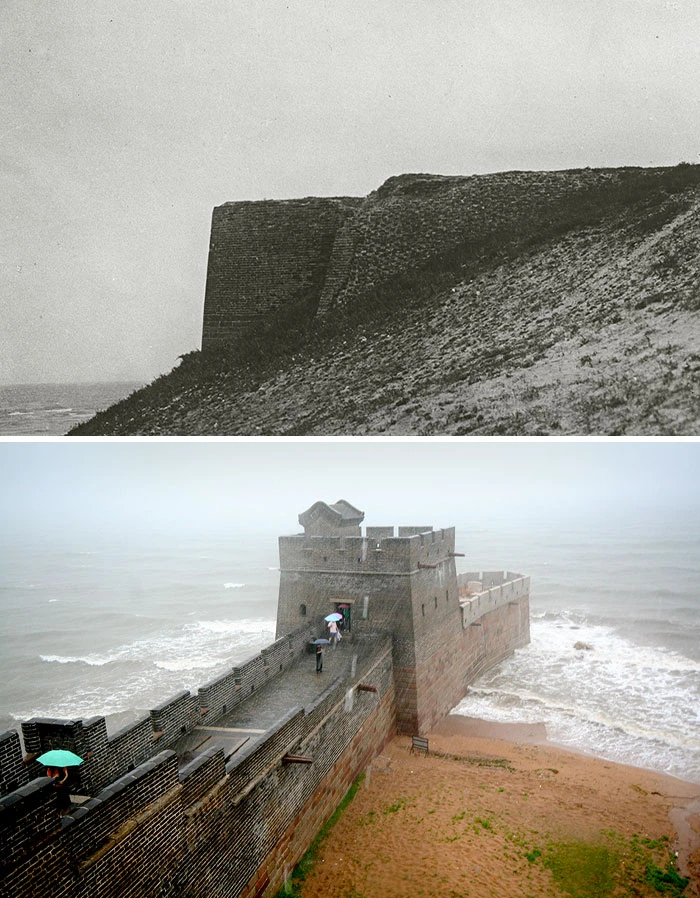
The eastern end of the Great Wall of China at Shanhaiguan Pass — 1930 vs. 2008.
Shanhaiguan represents the eastern terminus of the Great Wall, where it meets the Bohai Sea. In 1930, the section lay in ruin: towers were crumbling amidst overgrown fields. By 2008, extensive restoration, newly constructed observation decks, and a steady influx of tourists completely reshaped the landscape. 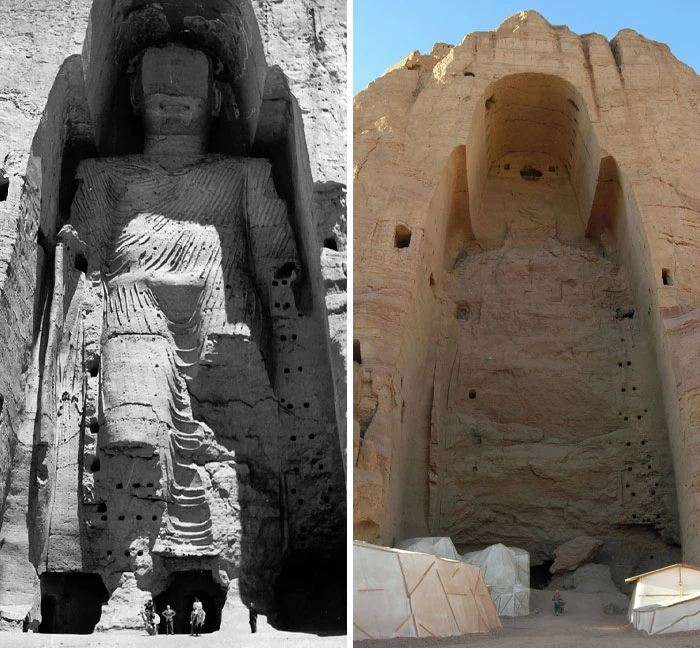
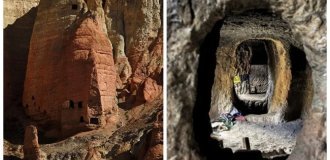
The Buddhas of Bamiyan in Afghanistan — 1963 vs. 2008.
This is easily the most tragic comparison in the collection. In 1963, two monumental Buddha statues—standing 55 and 38 meters tall, carved into the cliffs of the Bamiyan Valley in the 6th century AD—still reigned over the landscape. In March 2001, Taliban forces destroyed them with dynamite, branding them "idols." The 2008 photograph shows only hollowed-out niches. Discussions within the international community regarding their potential reconstruction remain ongoing. 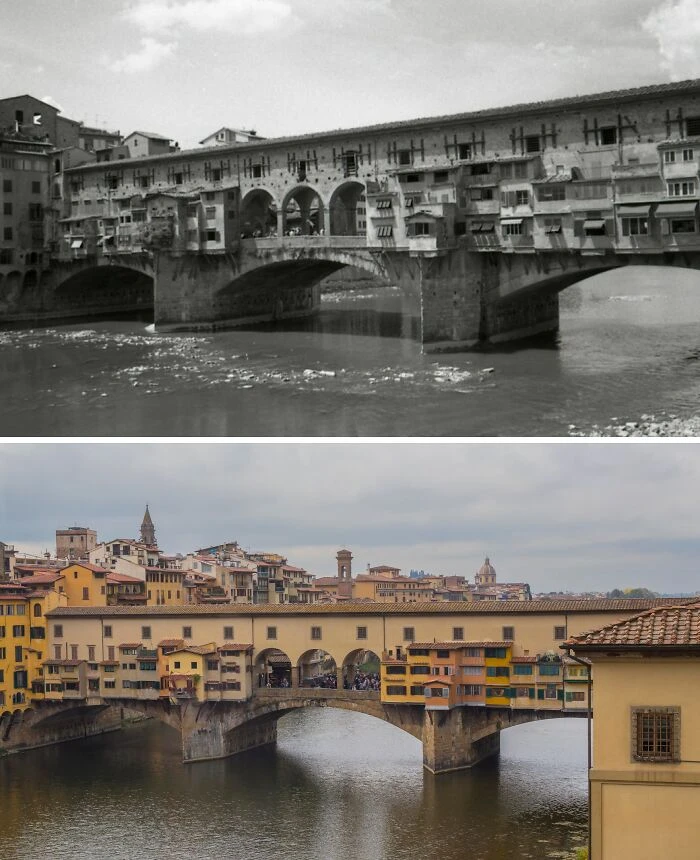
Ponte Vecchio in Florence, Italy — 1965 vs. 2019.
The Ponte Vecchio is Florence's oldest bridge, dating back to 1345. It was the only bridge across the Arno spared by retreating German troops in 1944—legend has it Hitler personally ordered it preserved. During WWII, the valuable inventory of the jewelers operating on the bridge was secretly evacuated and saved. Little separates the photos from 1965 and 2019: the bridge looks remarkably as it did seven centuries ago. 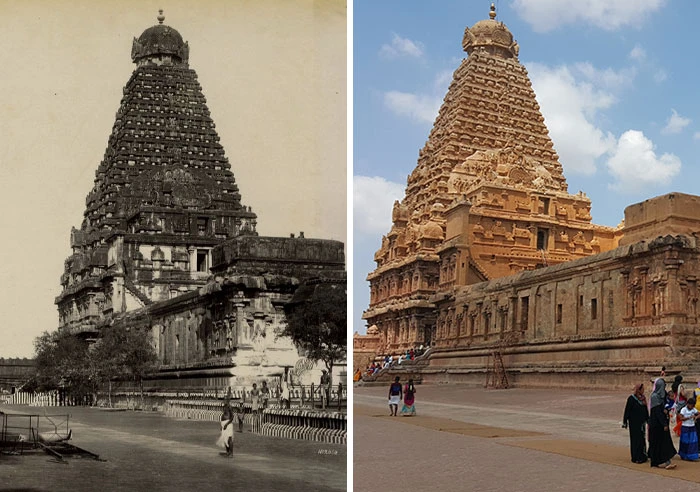
Brihadishvara Temple (Peruvudaiyar Kovil) in Thanjavur, India — 1880 vs. 2016.
One of the largest Hindu temples in the world, Brihadishvara was built by Emperor Raja Raja Chola I between 1003 and 1010 AD. Its 66-meter temple tower (vimana) is the tallest of its kind anywhere. Remarkably, the entire complex was constructed from granite quarried 60 kilometers away and transported without wheeled vehicles. The UNESCO World Heritage Site celebrated its millennium in 2010. 
Magnesia on the Maeander in Anatolia, Turkey — 1984 vs. 2013.
Magnesia on the Maeander was an ancient Greek city in Asia Minor, believed to have been founded in the 7th century BC and later expanded under Alexander the Great and the Roman Empire. In the 29 years between these photos, archaeological work has made significant headway, exposing columns, ornate details, and structural foundations. Excavations at the site are still active. 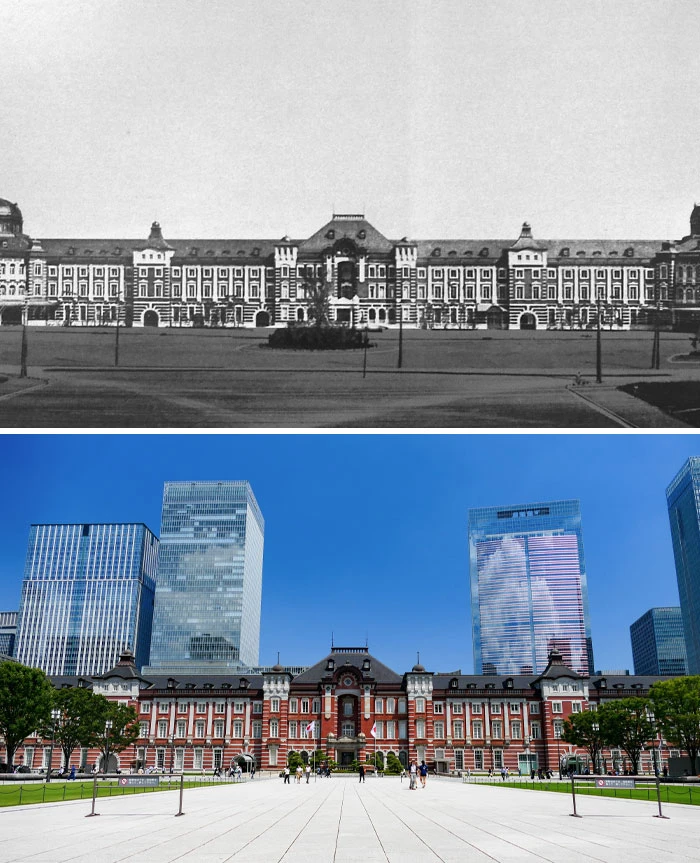
Tokyo Station — 1914 vs. 2023.
Tokyo Station opened in 1914 and has retained its iconic facade ever since—even after its original domed roofs were destroyed in Allied air raids in 1945. They were faithfully restored using historical blueprints in 2012. Today, the red-brick European Neo-Renaissance landmark appears almost identical to its opening day, even as bullet trains zip through its modern underground concourses.
Architectural Gems: Instantly Recognizable Then and Now
Certain structures are so deeply woven into our collective consciousness that their silhouettes are instantly recognizable, no matter the era. That is precisely why rephotographing these landmarks is so intriguing: you find yourself searching for subtle shifts in scenes that feel entirely familiar. 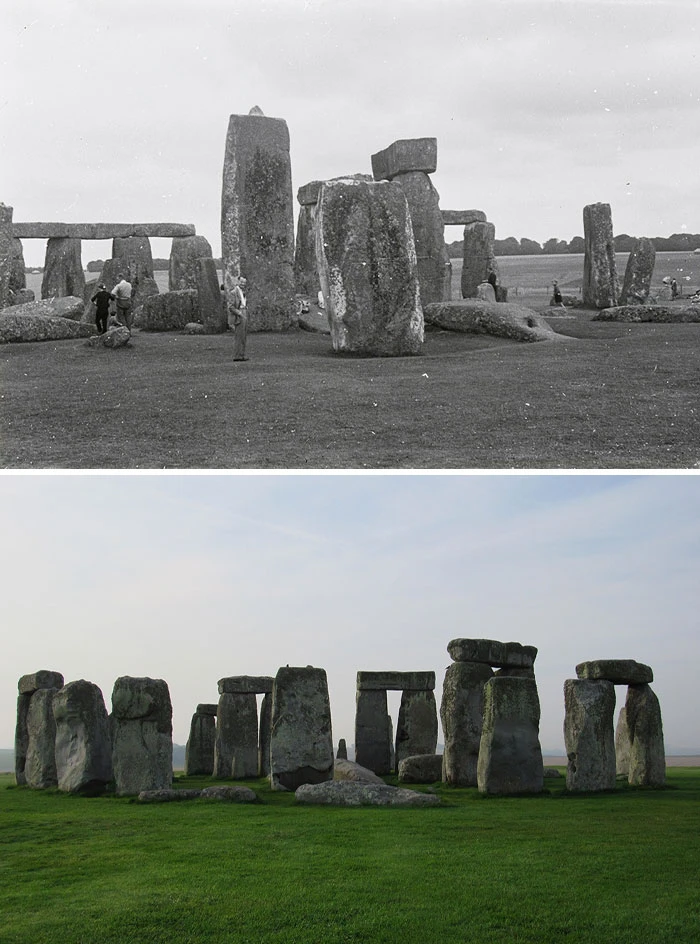
Stonehenge in Wiltshire, England — Vintage photo vs. 2019.
Stonehenge was erected between 3000 and 1500 BC, meaning its construction spanned over a millennium. Sarsen sandstone megaliths weighing up to 25 tons were transported from 25 kilometers away. In early photographs, the stones lean precariously or lie fallen. Beginning in 1901, restoration projects straightened tilting monoliths and re-erected fallen ones—meaning some of the stones we see today no longer sit in their original archaeological positions. 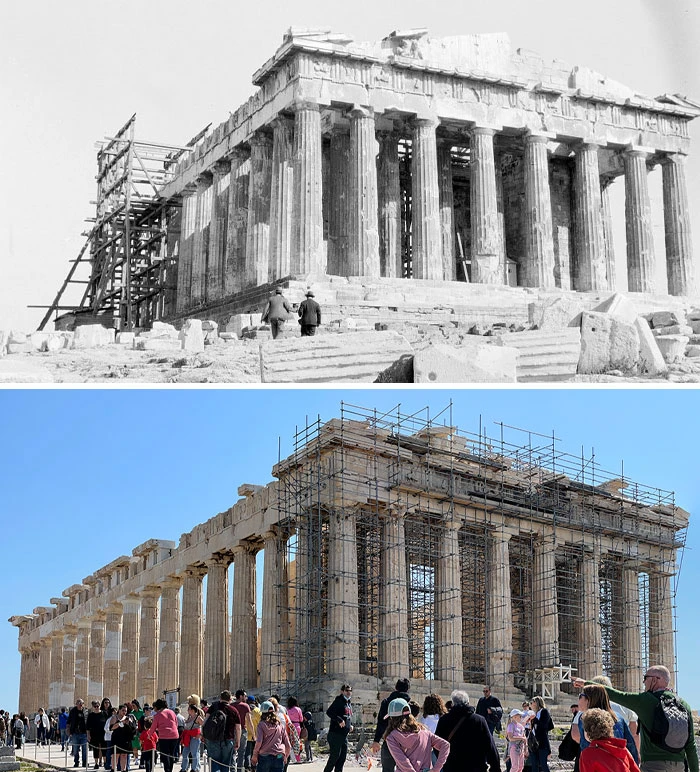
Parthenon in Athens, Greece — 1900 vs. 2022.
The Parthenon was built between 447 and 432 BC. Over the past 2,500 years, it has served as a pagan temple, an Orthodox church, a mosque, a gunpowder magazine, and a world-famous tourist attraction. In 1687, a Venetian mortar shell ignited the powder stored inside, blowing off the roof and causing catastrophic damage. The 1900 photo shows essentially the same ruins as today, albeit enveloped in a different generation of restoration scaffolding.
"I’ve taken a lot of landscape rephotographs, and sometimes the ones I love most are those showing that almost nothing has changed, even after a hundred years. Together, they challenge our very understanding of time passing," says photographer Mark Klett. 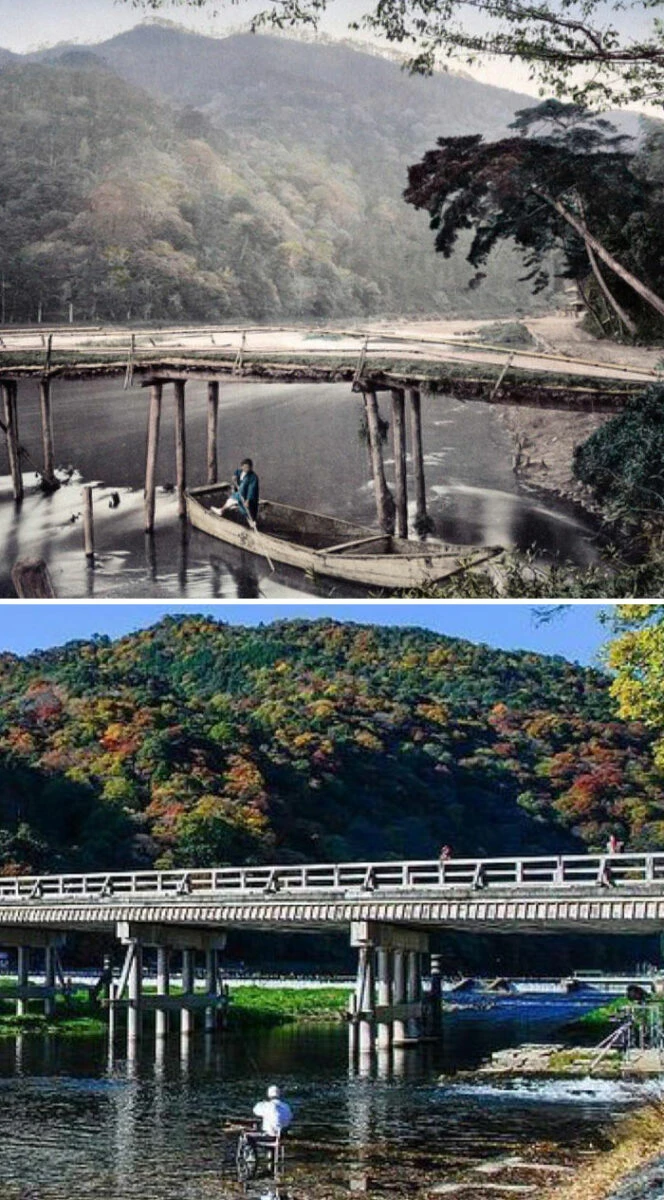
Togetsukyo Bridge in Kyoto, Japan — 1870 vs. Present Day.
Spanning the Oi River in Arashiyama, Togetsukyo Bridge was first documented in historical records in 836 AD. The current structure was built in 1934, replacing earlier timber spans. The 1870 image shows a wooden bridge over a modest river channel. Today, Togetsukyo ("Moon Crossing Bridge") is one of Kyoto's signature landmarks, celebrated especially during cherry blossom season and autumn foliage. 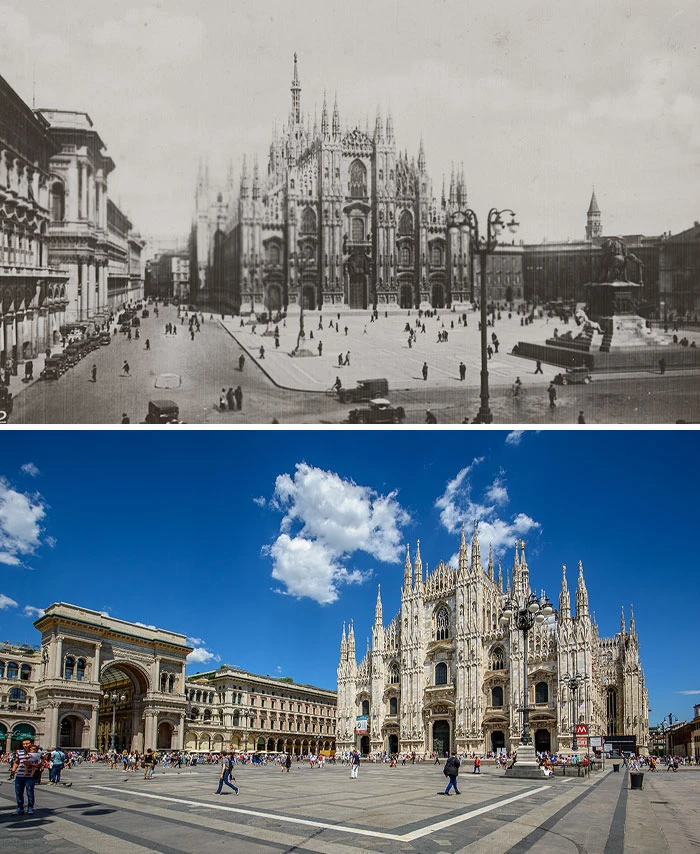
Milan Cathedral (Duomo), Italy — 1938 vs. 2016.
Construction of Milan Cathedral began in 1386 and wasn't officially completed until 1965—spanning nearly six centuries. With a capacity of 40,000, it is the third-largest Catholic church in the world. In the 1938 photograph, the Piazza del Duomo appears remarkably open, reflecting urban clearing initiatives under Mussolini's regime, which pushed to finish longstanding construction projects for propaganda purposes. 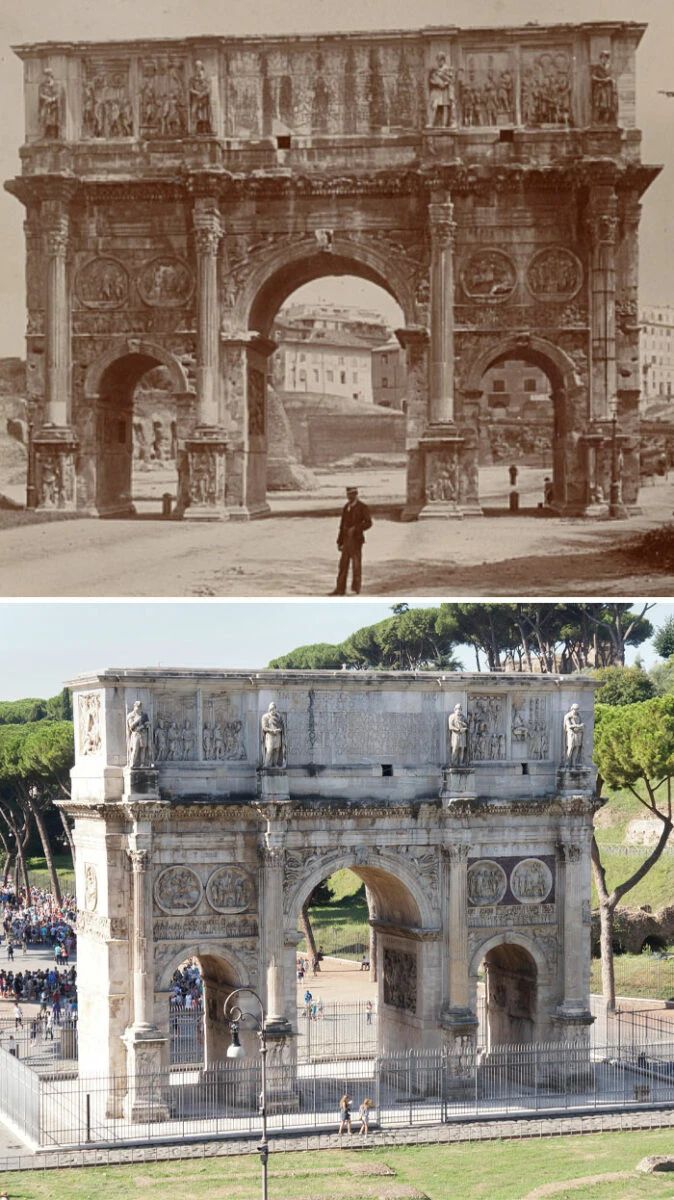
Arch of Constantine in Rome, Italy — 1896 vs. 2022.
Erected in 315 AD to commemorate Emperor Constantine I's victory over Maxentius, this triumphal arch remains exceptionally well-preserved—partly because it was incorporated into a medieval fortress, saving its stonework from being pillaged. The 1896 image reveals overgrown vegetation and haphazard structures encroaching on the site. Today, the plaza is cleared, highlighting the arch as one of Rome's defining ancient monuments. 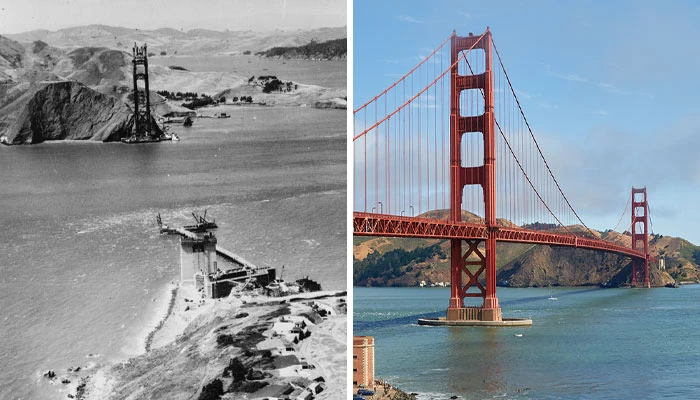
Golden Gate Bridge in San Francisco, USA — 1934 vs. 2017.
The 1934 photo captures the Golden Gate Bridge under construction: the iconic towers stand tall, but the main suspension cables have yet to be strung. Opening in 1937, it held the record for the world's longest suspension bridge until 1964. Its signature "International Orange" color was selected to enhance visibility through the bay's thick fog—inadvertently creating one of the most recognizable architectural palettes in history.
Metropolises, Monuments, and Waterfronts
Cities evolve faster than anything else, making urban comparisons the most dramatic of all. Quiet waterfronts fill with high-rises, lonely monuments become surrounded by tourist hubs, and former grazing pastures turn into bustling intersections handling millions of commuters. 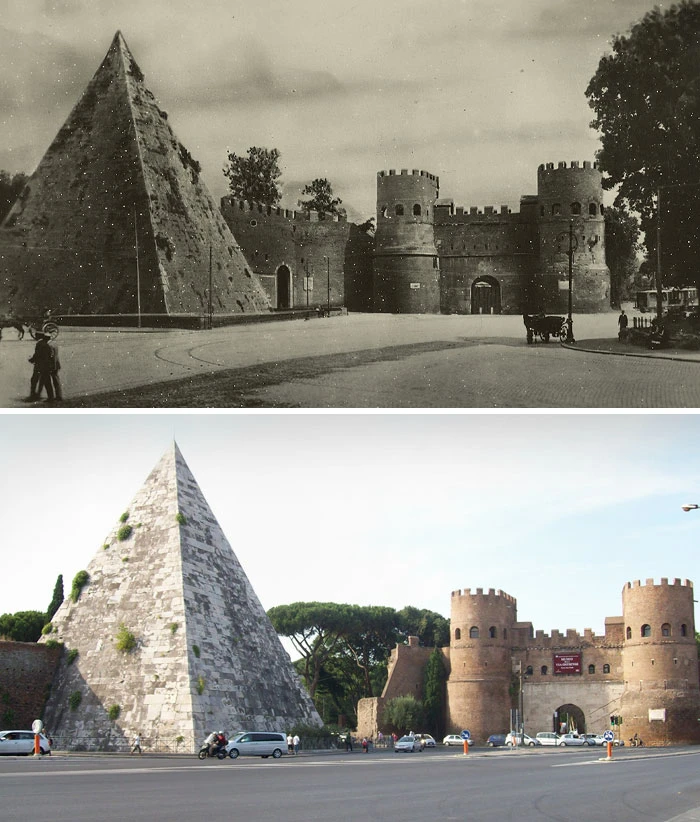
Pyramid of Cestius and Porta San Paolo in Rome, Italy — 1920 vs. 2012.
The Pyramid of Cestius was constructed around 18–12 BC as a tomb for the magistrate Gaius Cestius, inspired by Rome's campaigns in Egypt. Standing 36 meters high, the monument had heavy traffic buzzing right up against its base in the 1920 photo. By 2012, the surrounding area had been cleared and pedestrianized. 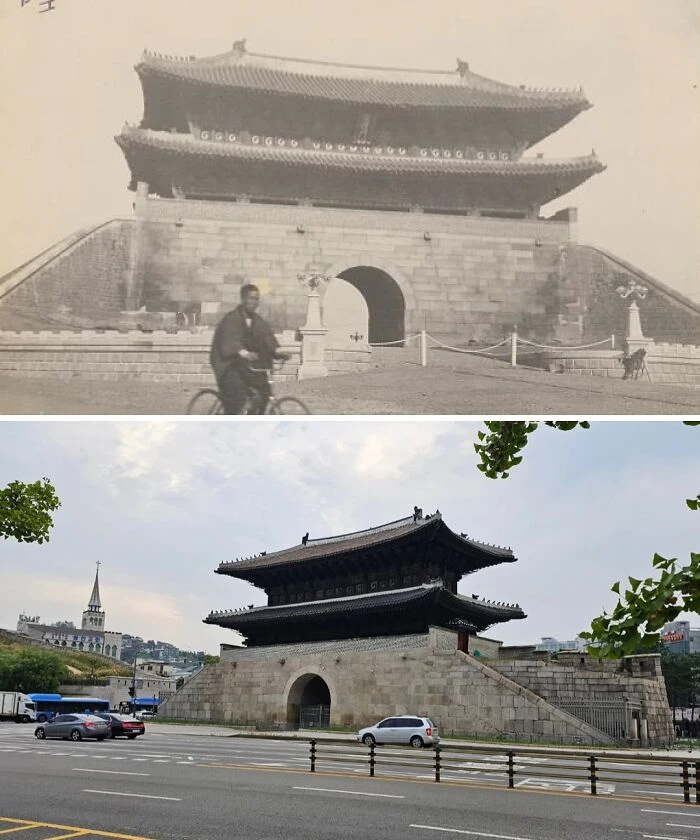
Namdaemun Gate in Seoul, South Korea — 1910 vs. 2024.
Namdaemun ("Great South Gate"), officially designated National Treasure No. 1 in South Korea, was originally constructed in 1398. In 2008, an arson attack severely damaged the wooden structure, sparking national grief. A painstaking five-year restoration was completed in 2013. In the 1910 photo, the gate stands in an open landscape; by 2024, it is cocooned by a high-density financial district. 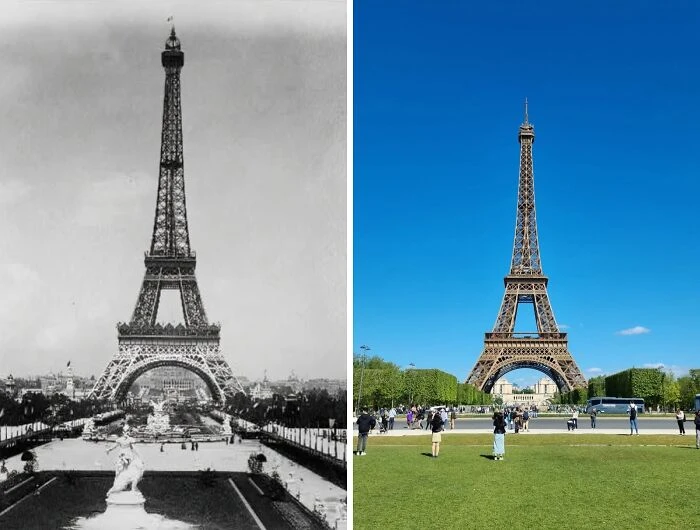
Eiffel Tower in Paris, France — 1889 vs. 2025.
Constructed in just over two years (1887–1889) for the World's Fair, the Eiffel Tower is shown freshly completed in the 1889 photo, surrounded by construction debris. Parisian critics originally reviled the tower, branding it an "iron eyesore" and a "monstrous rivet-covered column." However, plans to dismantle it were eventually scrapped, and today the iconic landmark welcomes around seven million visitors a year. 
Reichstag Building in Berlin, Germany — 1900 vs. 2024.
The Reichstag opened in 1894. A devastating arson fire in 1933 served as the pretext for establishing the Nazi dictatorship. In 1945, Soviet troops raised the victory banner over its roof. Following decades of neglect, the building underwent a dramatic transformation led by architect Norman Foster in 1999, which added a striking glass dome accessible to the public. Cyrillic graffiti left on the interior stone walls by Soviet soldiers was deliberately preserved as a historic reminder. 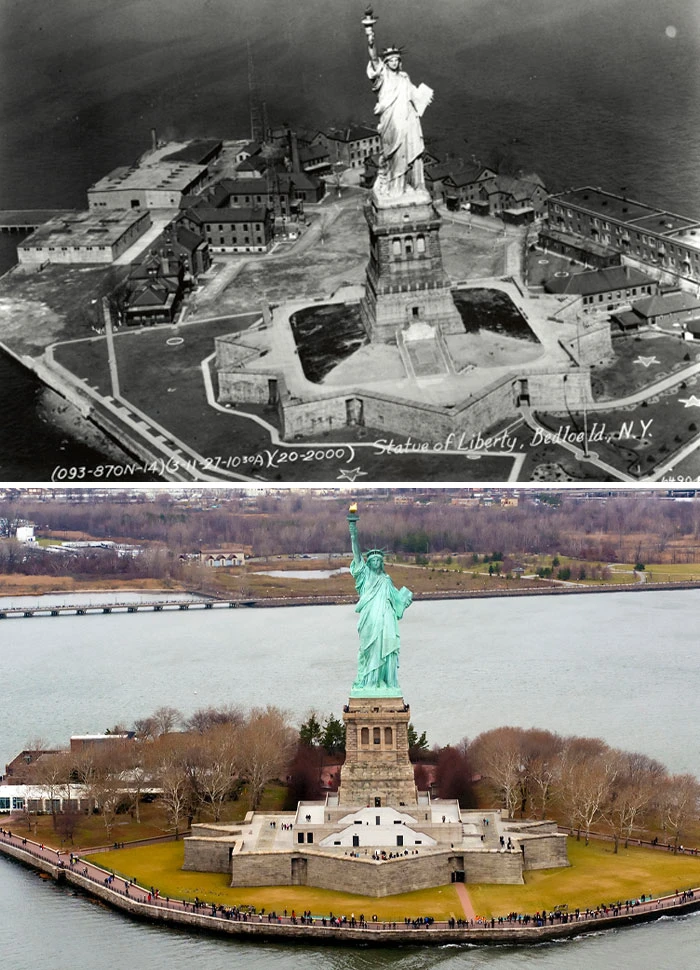
Statue of Liberty on Liberty Island, New York — 1927 vs. 2014.
A gift from France celebrating the centennial of American independence, the Statue of Liberty was dedicated in 1886. In the 1927 image, the copper skin had not yet fully oxidized into its signature blue-green patina, which set completely by the 1930s. The torch balcony was permanently closed to visitors in 1916 following a German sabotage explosion nearby. From base to torch tip, the monument reaches a height of 93 meters (305 feet). 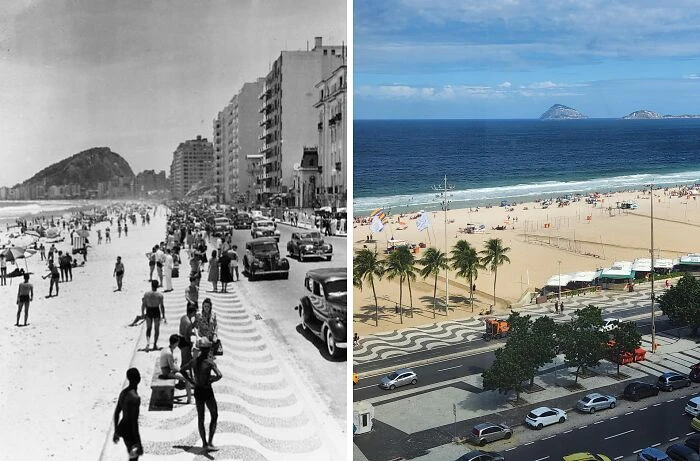
Copacabana Beach in Rio de Janeiro, Brazil — 1930 vs. 2022.
In 1930, Copacabana was only beginning its transformation into a world-famous resort destination; the early photo captures a sparsely populated shore with few buildings. Over subsequent decades, a dense wall of high-rise hotels and apartments sprang up along the strip. The iconic mosaic promenade with its wave pattern was designed by landscape architect Roberto Burle Marx in 1970. 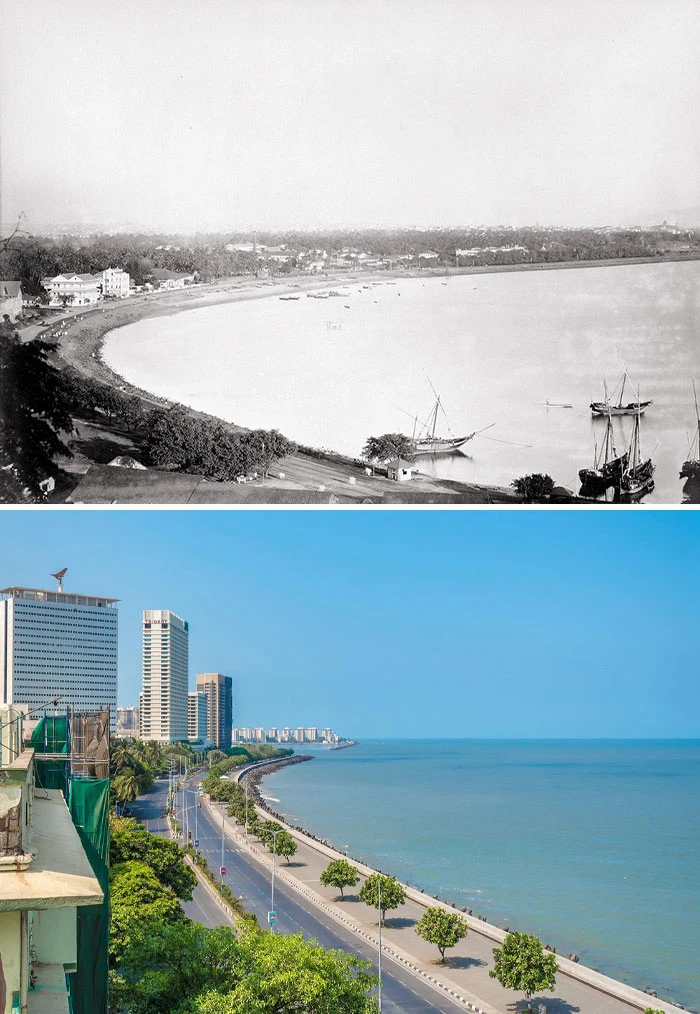
Malabar Hill in Bombay (Mumbai), India — 1860 vs. 2021.
Malabar Hill is Mumbai's most exclusive residential district, perched on a hill overlooking the Arabian Sea. In 1860, only a handful of colonial bungalows dotted the lush tropical foliage. By 2021, high-rise development had completely engulfed the hill, leaving almost no trace of the original landscape. Today, the Mumbai metropolitan area is one of the world's most populous, home to over 20 million residents. 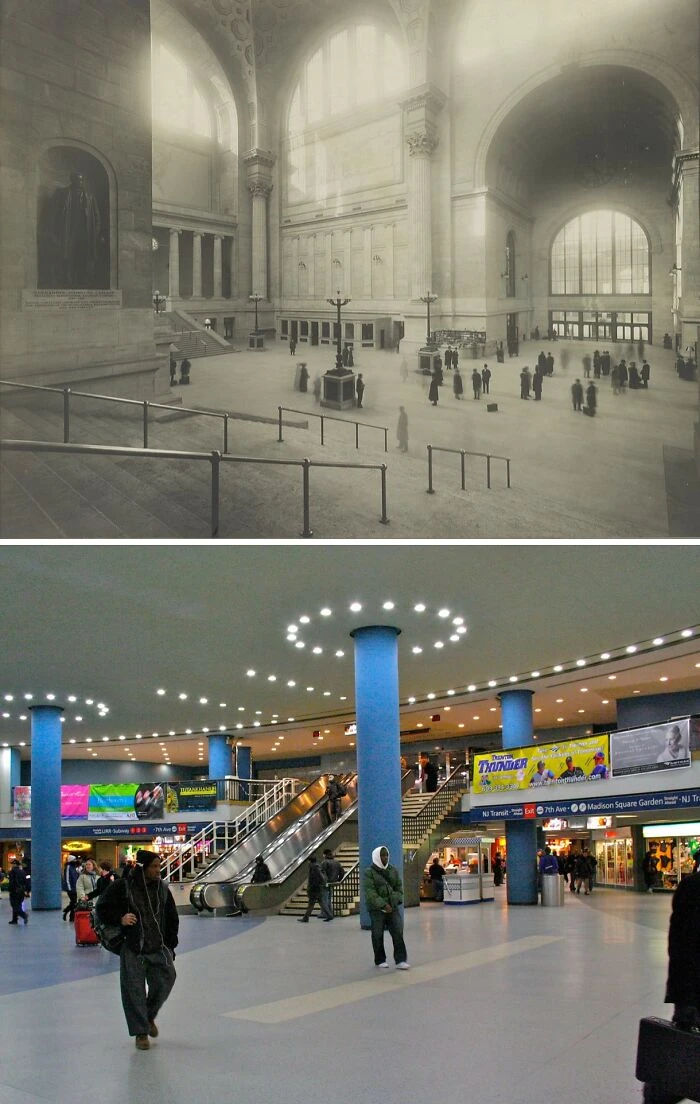
Pennsylvania Station in New York City, USA — 1911 vs. 2007.
The fate of Penn Station remains one of the most cautionary tales in architectural preservation. The original 1910 headhouse, modeled after the Roman Baths of Caracalla, was celebrated as a majestic gateway to New York. Between 1963 and 1968, it was demolished to make room for commercial real estate. Public outrage over the destruction led directly to the creation of historic preservation laws across the US. The 2007 photo depicts the functional yet utilitarian subterranean terminal that replaced it. 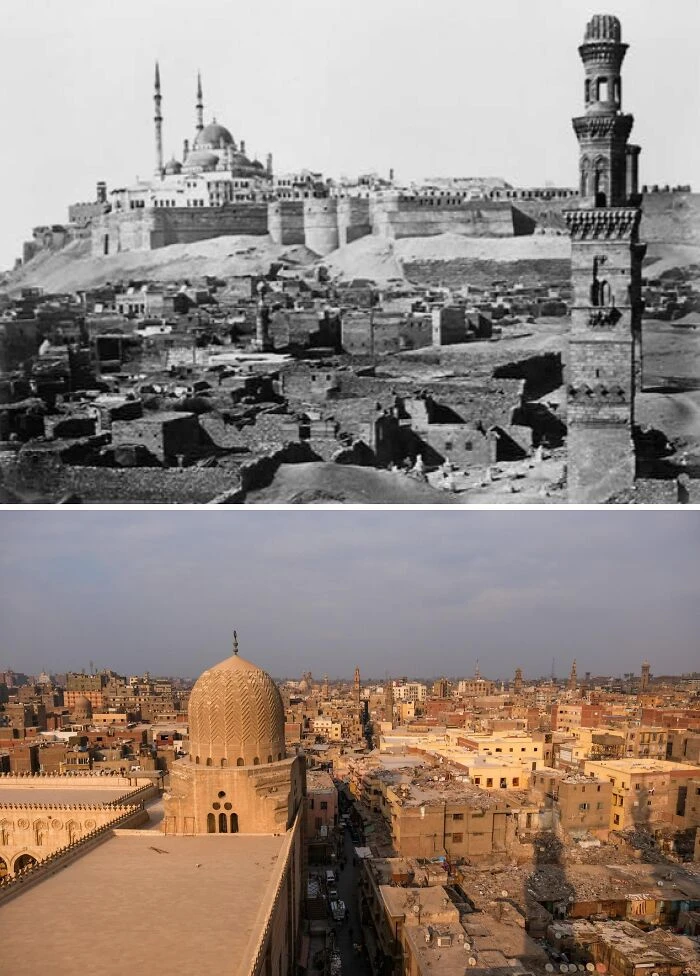
Cairo, Egypt — 1870 vs. 2019.
In 1870, Cairo had a population of around 350,000 and was already regarded as one of Africa's primary cities. The vintage skyline featured minarets and flat rooftops under open skies. By 2019, the panorama was dominated by a dense grid of residential towers and elevated highways. Today, Greater Cairo boasts a population of roughly 21 million. 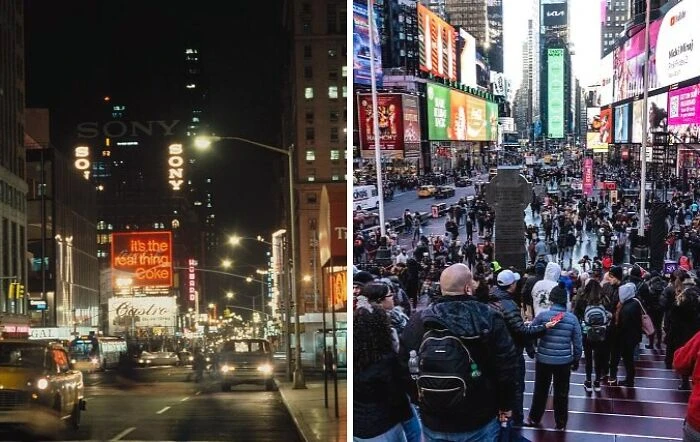
Times Square in New York City, USA — 1980 vs. 2023.
Times Square in the 1980s was a world away from what it is today. At the time, the intersection was notorious for crime, covered in graffiti, and filled with shuttered storefronts, adult theaters, and illicit joints. A major urban overhaul in the 1990s—fueled by aggressive policing and massive redevelopment capital—turned the area into a commercial powerhouse drawing 50 million tourists annually. The LED billboards grew brighter, the crowds larger, and the gritty edge faded away.
What These Images Tell Us
Rephotography is far more than just a captivating hobby. Photographer Mark Klett summed up its deeper meaning: "The process can show changes that took place over time, but the photographs themselves cannot explain the causes of those changes." Thus, every pair of photos invites us to ask: what lies behind the image? War? Restoration? An economic boom? A single person's resolve?
Gerry Pycroft recalls the most memorable moment of his career: at an exhibition, an elderly woman approached him, broke into tears upon seeing a historical photo of a mother holding a little girl, and revealed that she was that very girl—and the original photographer was her father.
This is the true magic of side-by-side photography: time collapses, history comes alive, and we suddenly realize how fleeting human life is against the backdrop of stone, water, and sky. Have you noticed how the places around you are changing?
Then and Now: 30 Fascinating Photos Showing the Passage of Time
Remarkable Little-Known Historical Photos
Historical Photos Showing the Past from a Different Perspective