Why Outdoor Heating Pipes Zigzag — And Why It's Not a Design Flaw (4 Photos)
You're walking through a courtyard and notice the district heating pipes running straight—until they suddenly swing into a massive U-shaped loop, almost as if steering clear of an invisible garage. At first glance, it looks like a bizarre waste of space and materials. Running the pipe straight across would obviously be shorter, cheaper, and cleaner. 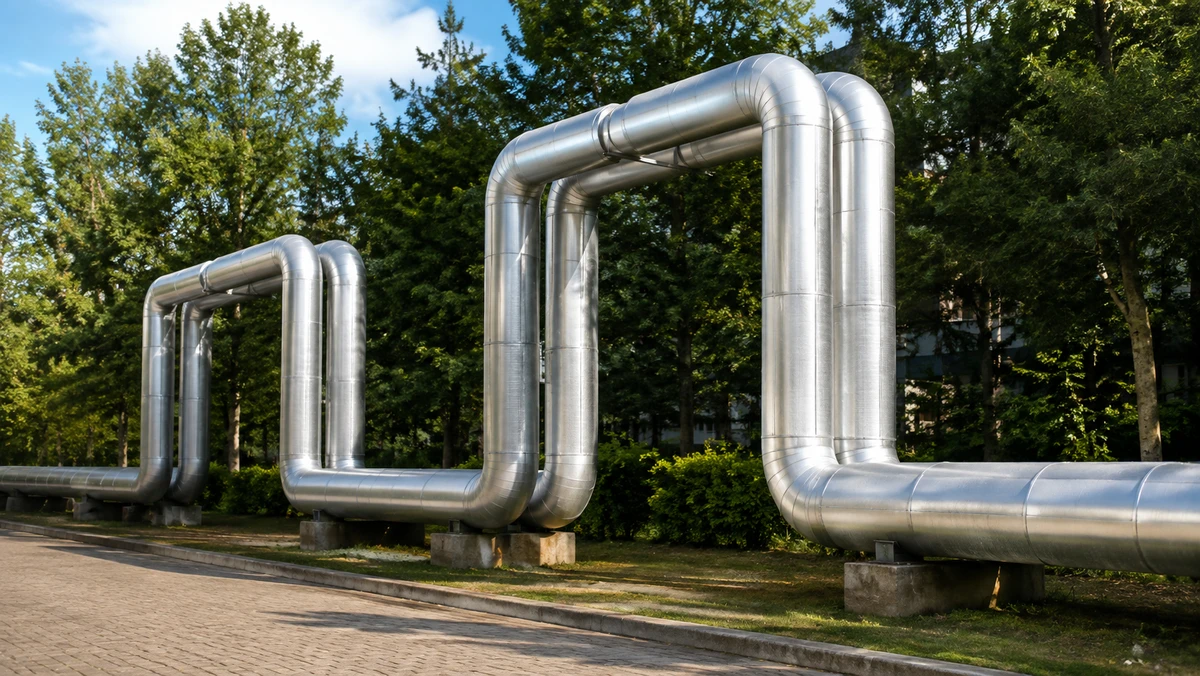
As a kid, I always thought these loops were some kind of odd gateway—though why anyone would need a gateway leading straight into a bush was a mystery. In reality, the purpose is purely engineering: this strange loop is designed to keep the pipe from destroying itself.
Hot Metal Expands
Steel expands when heated. The thermal expansion coefficient for steel is relatively small—about 12 millionths of its length per degree Celsius. On a one-meter section of pipe, the difference is virtually imperceptible. But across a district heating line that spans an entire city block, it's a completely different story.
Consider a 100-meter steel pipe installed at a room temperature of 20°C and then heated up to 130°C. That 110-degree jump causes the pipe to expand by roughly 13 centimeters. Over a 300-meter stretch, that growth reaches nearly 40 centimeters. 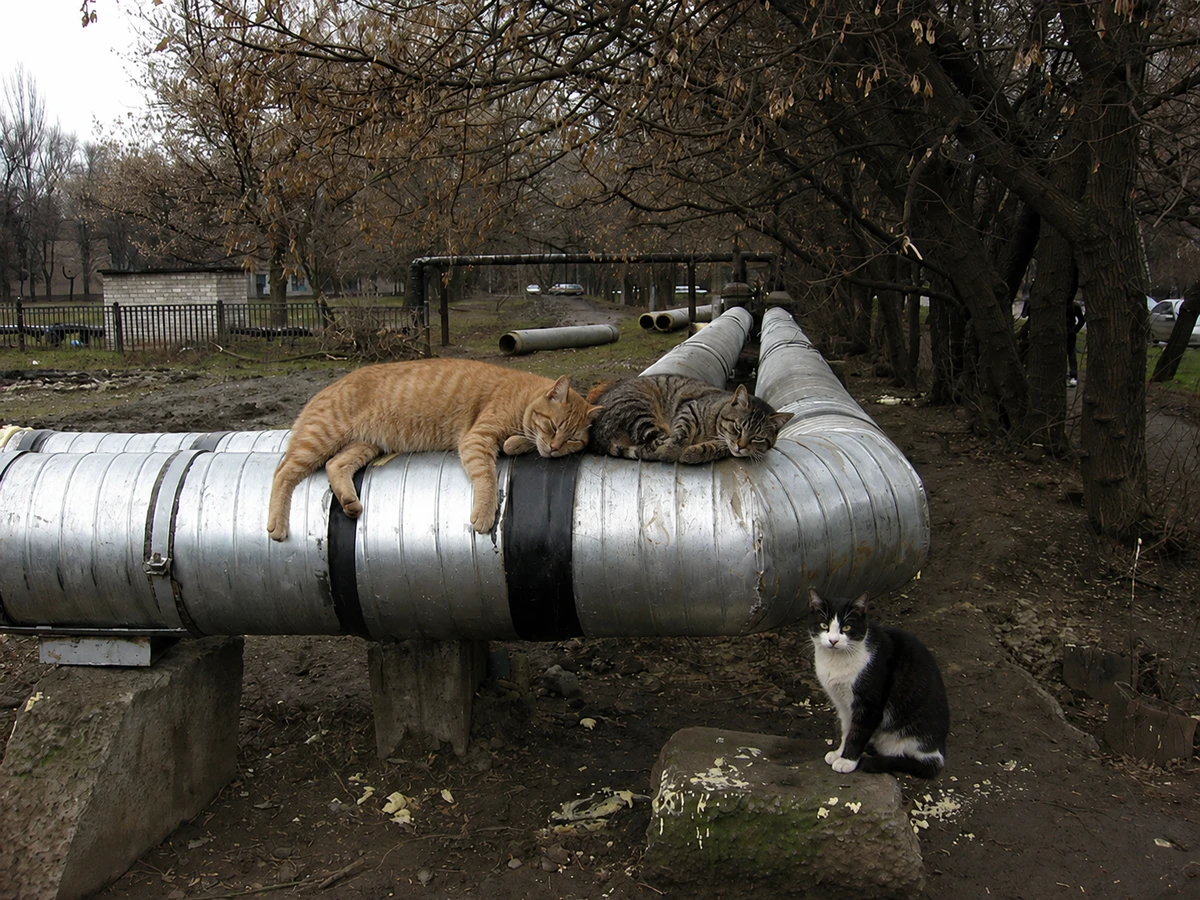
A water temperature of 130°C isn't unusual for main heating lines. Different systems operate on different thermal schedules, and supply water can easily exceed 100°C without boiling because it's kept under high pressure.
Now imagine what happens when those extra centimeters need somewhere to go, but the pipe is clamped in place and forbidden from moving.
Hundreds of Tons of Force Against the Anchor
If a steel pipe is rigidly anchored at both ends and then heated, thermal expansion has nowhere to dissipate. Instead of physical movement, internal stress builds up inside the metal.
There is a counterintuitive detail here: under complete restraint, thermal stress depends solely on the material and the temperature differential—not on whether the pipe is one meter long or one hundred meters long.
For a large pipe roughly half a meter in diameter with an 8 mm wall thickness, heating it by 110 degrees generates axial forces that theoretical calculations put in the hundreds of metric tons. In real-world installations, forces rarely reach these extreme theoretical limits because sections begin to flex, supports shift slightly, and the joints and steel absorb some strain.
Still, even a fraction of that force is enough to cause severe damage. Expanding pipes can bend anchor supports, rupture welds, overstress valves, or crack branch connections.
That is why an engineer's goal isn't to lock the pipeline down as rigidly as possible. Quite the opposite: they must decide in advance exactly where the line should remain fixed and where it needs freedom to move.
The Loop Acts Like a Spring
This is where the U-shaped expansion loop comes in. There are no pistons, hinges, or hidden mechanisms inside it. The pipe itself acts as the spring.
As the straight section expands, it pushes against the legs of the U-loop. The long sides bend slightly, safely absorbing the thermal displacement. When the system cools down, the metal flexes back to its original shape.
You can see a similar effect with a plastic ruler: if you push both ends toward each other, the middle bows outward. The longer the flexible section, the more easily it can absorb movement without experiencing destructive levels of stress.
Engineers don't guess the size of these loops. The dimensions are calculated based on pipe diameter, segment length, operating temperatures, steel grade, and allowable stress limits. That is why one loop might be the size of a wardrobe, while another is as big as a garage.
There's another clever engineering trick involved: during installation, the expansion loop is often pre-stretched in its cold state. The exact amount of pre-stretch is specified in the design plans based on ambient installation temperature. This pre-tensioning gives the pipe an optimal range of movement between cold and hot operating states.
Why You Can't Just Weld Everything Rigid
Heating pipelines are held up by different types of supports. Fixed anchors hold calculated points rigidly in place, while sliding supports bear the pipe's weight while allowing it to glide longitudinally.
If someone welds an extra rigid support between two anchors without calculating the stress—just thinking "more supports mean more strength"—it can ruin the entire engineering setup. The loop will no longer absorb the movement it was designed for, transferring destructive forces to unexpected parts of the system.
Moreover, dedicated U-loops aren't always necessary. Sometimes the pipeline layout itself does the job naturally. 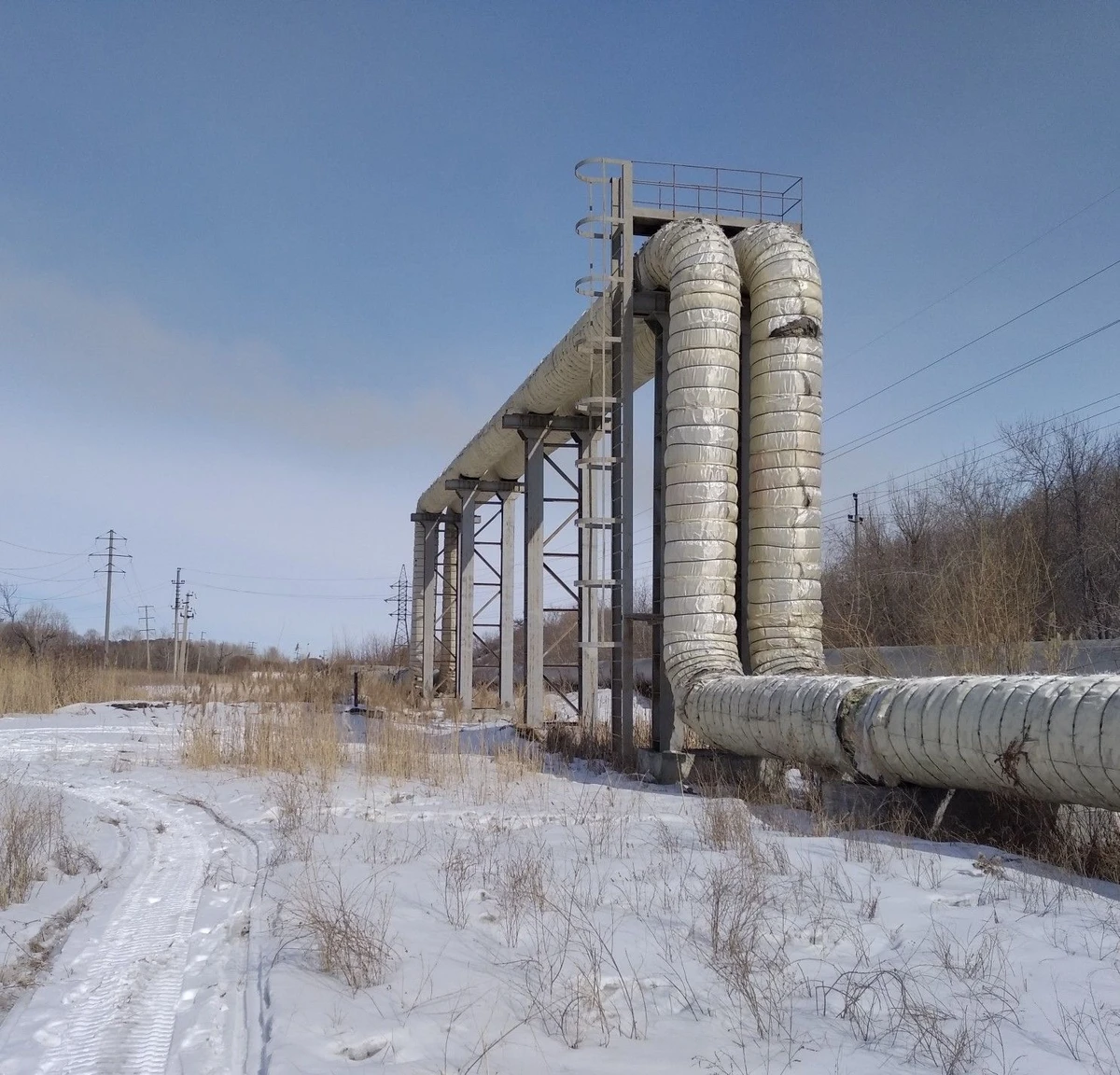
A 90-degree turn can act as an L-shaped expansion bend: as one straight run lengthens, the adjacent segment flexes slightly. A Z-shaped bend achieves the same result through lateral displacement. As a result, that strange detour near a road might be bypassing a physical obstacle and absorbing thermal expansion at the same time.
Why Newer Pipes Are Hidden Underground
You see these giant loops far less often in modern developments, but not because engineers have somehow defeated physics.
Today, many heating networks are laid underground using pre-insulated piping systems: an inner steel pipe surrounded by polyurethane foam insulation and an outer protective jacket made of high-density polyethylene. Copper sensing wires are often embedded within the insulation layer to detect moisture leaks automatically.
The surrounding soil partially restrains the pipe, converting thermal expansion into pre-calculated internal stress rather than visible physical movement. At turns and junction points where expansion accumulates, designs incorporate flexible foam cushions and movement zones.
In short, underground heating mains expand too—they just do it without taking up half the courtyard with a giant metal loop. 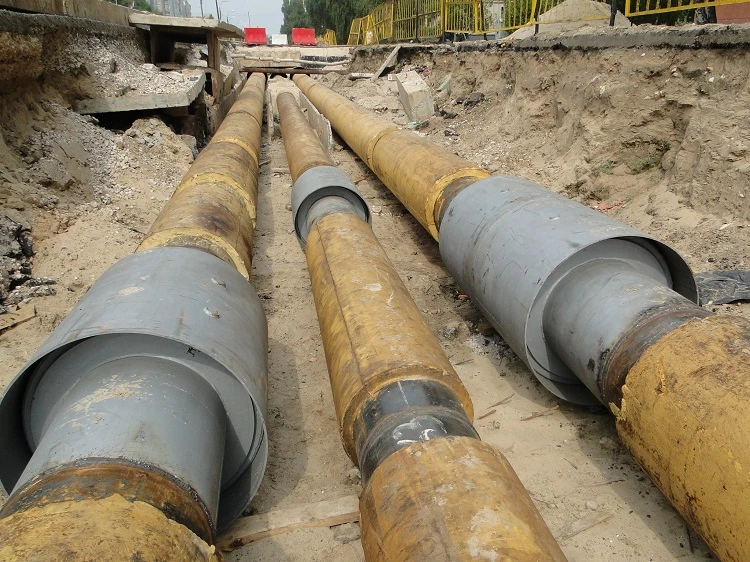
There is also a more compact solution: the bellows expansion joint. This is a short, corrugated metal element that expands and compresses like an accordion along with the pipe. It takes up far less room, but requires precisely placed guide supports and has a limited stroke length.
That's why classic U-loops haven't vanished. They are simple, reliable, have practically no moving parts to break, and do an excellent job wherever space allows.
So the next time you spot a massive zigzag in an outdoor heating line, you don't need to wonder if a contractor made a mistake or routed around a missing structure. When running hot, that pipe is literally inches longer than when it's cold—and the loop gives those extra inches room to breathe.