Ernest Bazin’s Roller Steamship: Why the Ship on Wheels Turned Out to Be a Flop (10 photos)
The late 19th century saw a massive leap in technological progress. The first automobiles, streetcars, electric elevators, and telephones were making their debut, with newspapers reporting on breakthroughs almost daily. Engineers around the world seemed to be locked in a race to see who could come up with the wildest idea. While some of these projects laid the groundwork for vital modern technologies, others went down in history as useless—or even dangerous—gimmicks. The high-speed steamship designed by French inventor Ernest Bazin definitely belonged to the latter category. 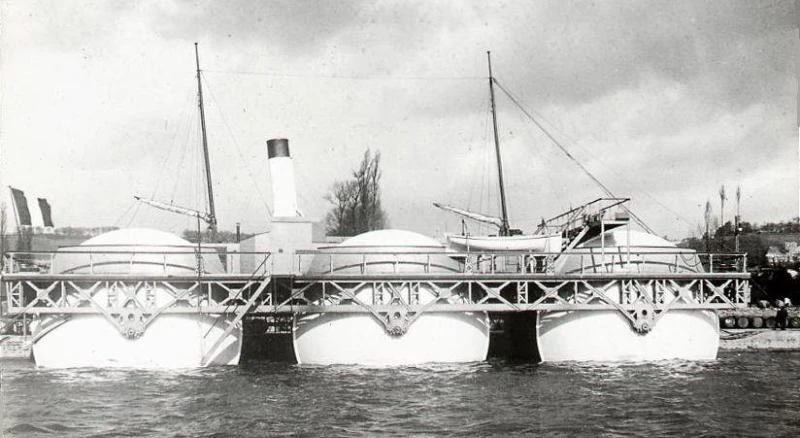
A Fresh Approach
In 1896, French engineer Ernest Bazin announced he had designed a vessel capable of reaching speeds of up to 60 km/h. This was a bold claim, considering that even the fastest transatlantic ocean liners from Germany and Britain could barely reach 35 km/h at the time. 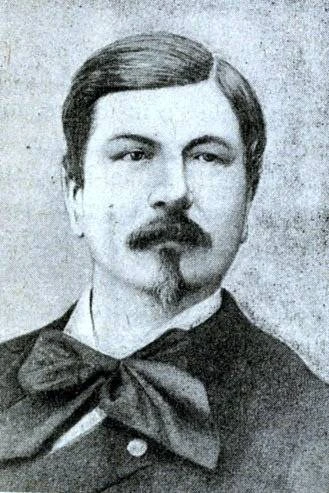
Ernest Bazin
Despite sounding like science fiction, Bazin's promised speed managed to win over believers. He introduced a radically new type of vessel that looked nothing like conventional ships: a platform riding atop six hollow, lens-shaped wheels. It was this bizarre design that captured the public's imagination and lent credibility to his claims. 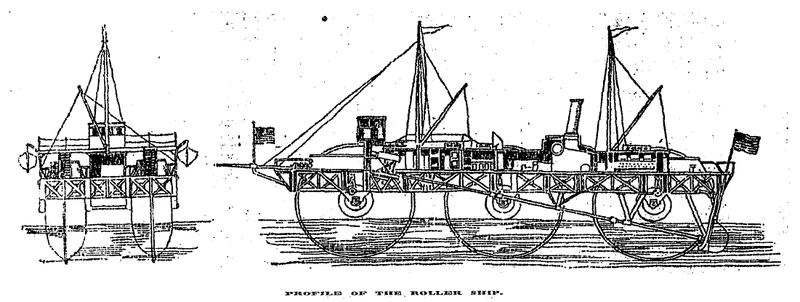
Blueprint of Ernest Bazin’s vessel
The inventor calculated that elevating the hull above the water on giant floats would dramatically reduce drag. As a result, the steam engines would operate far more efficiently, propelling the ship to unprecedented speeds. The lens-shaped wheels were designed for minimal contact with the water surface, with their rotation theoretically cutting friction even further. 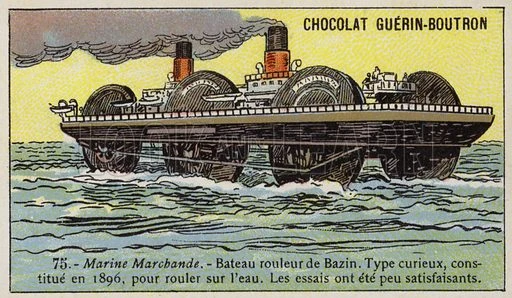
As early as 1880, British inventor Robert Fryer had proposed a similar concept. However, his experimental craft, the
Alice
—fitted with triangular floats—proved utterly unseaworthy. Tweaking the prototype, which was powered by oars, dragged on for 12 years and cost £14,000, yet all that effort yielded no tangible results.
Trials at Saint-Denis
Ernest Bazin skipped the small steps and went straight to building a full-sized steam-powered vessel. Over five years and more than £20,000 were spent testing and refining the 280-ton ship, named *Ernest-Bazin* in his honor. Only then did the inventor feel ready to unveil his creation to the public. The debut took place on August 19, 1896, at the docks in Saint-Denis, near Paris. 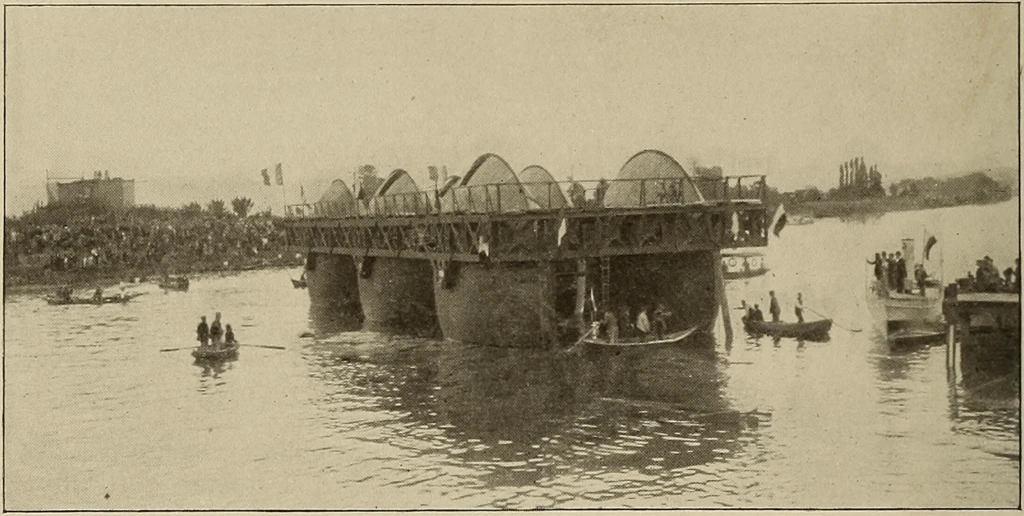
The unusual vessel was assembled right on the water
Spectators gathered to gawk at the eccentric ship, suspended above the water on three pairs of massive 10-meter float-wheels. Each wheel measured 3.6 meters thick at its center, tapering toward the edges, and sank about one-third into the water under the ship’s weight. The vessel's hull, measuring 40 by 12 meters, hovered a full four meters above the surface. Several steam engines generating a combined 200 horsepower drove the wheels, while a primary 550-horsepower engine turned a central propeller to provide main propulsion. 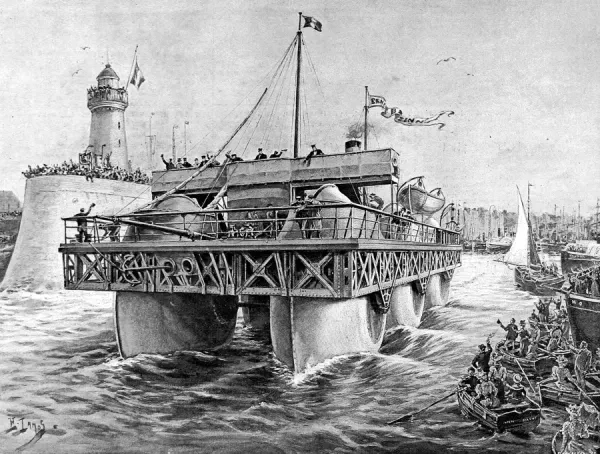
Trials at Saint-Denis
Before the trials began, Bazin announced that the ship would first reach 30 km/h before pushing to 35. Under ideal conditions, he hoped to hit the coveted 60 km/h mark. That would have made his craft 1.5 times faster than naval cruisers and twice as fast as contemporary passenger liners. The ambitious promises raised expectations through the roof.
A Harsh Reality
Bazin also touted the incredible fuel efficiency of his design, boasting that it could cross the Atlantic on just 800 tons of coal—compared to the 3,000 to 4,000 tons consumed by standard ocean liners. But the sea trials quickly shattered those calculations. Friction between the rotating wheels and the water was far higher than expected. Instead of gliding, the steamer crawled along at a snail's pace while churning up massive waves, and its fuel consumption skyrocketed far beyond projections. 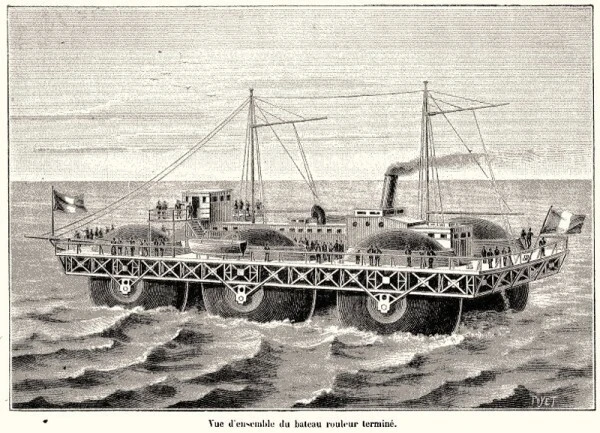
The *Ernest-Bazin* was a clear disappointment, but the inventor refused to give up. By late 1897, he claimed to have fixed all design flaws and announced an upgraded version featuring four pairs of wheels that was ready for a transatlantic voyage. Bazin even promised that the crossing from Le Havre, France, to New York would take a mere 60 hours. Reality, however, had other plans.
An Unfinished Project
Just weeks after making that optimistic announcement, Bazin passed away unexpectedly on January 21, 1898. At his funeral, a tribute read:
“Monsieur Bazin, the Frenchman who invented the ship on wheels to cross the Atlantic in 4 days, has himself departed for the unknown world without ever seeing his brain-child succeed.” 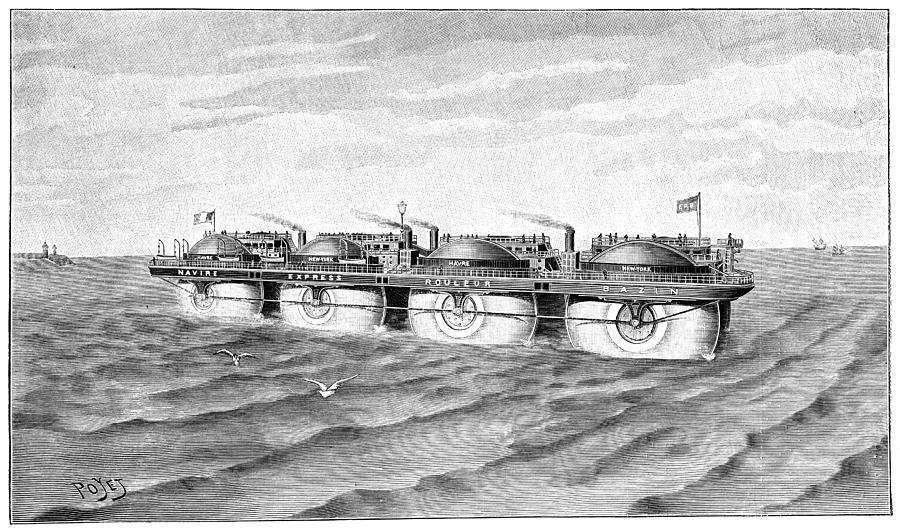
The new 8-wheeled steamship concept
Following Bazin’s death, his heirs inherited the six-wheeled prototype, a scale model of the eight-wheeled version, and mountains of blueprints. Nobody stepped up to continue the project, and in 1899, the *Ernest-Bazin* was sold at auction. Its new owner promptly scrapped it for metal. 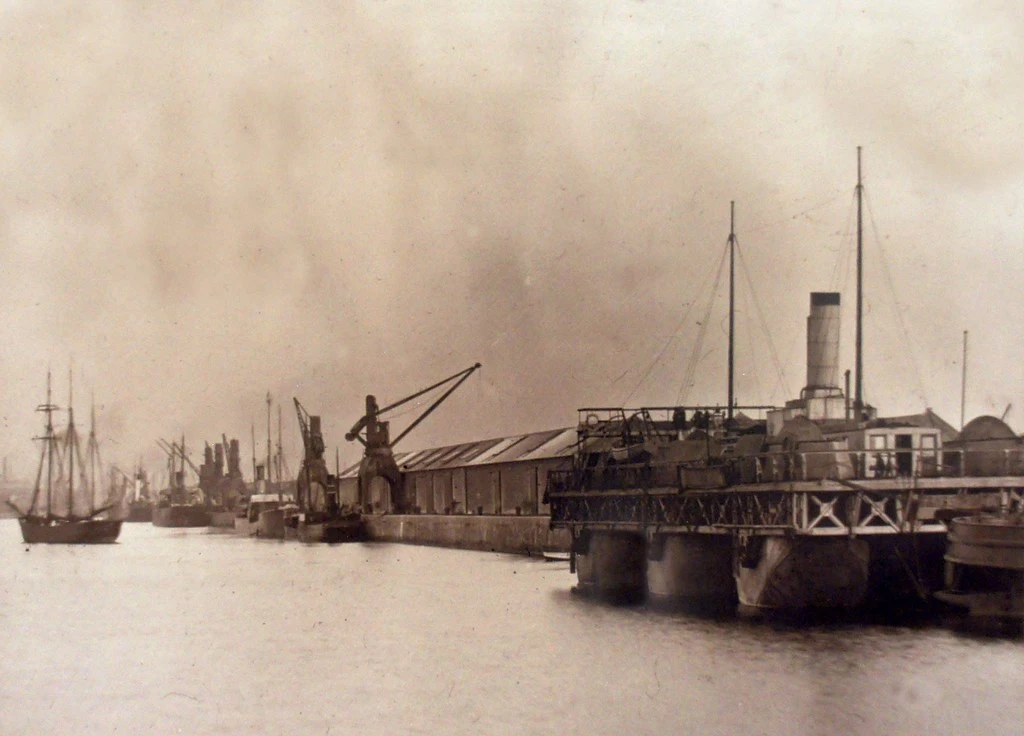
The abandoned Ernest-Bazin at its final berth
The French inventor's concept intrigued ship designers for years to come, but it never progressed beyond early prototypes. In the mid-20th century, amphibious swamp buggies with oversized tires emerged—vehicles still in use today. Designed for marshy terrain, they can float using their massive tires as pontoons. Their aquatic speed, however, remains painfully slow, proving once again the flaw in Bazin’s grand vision. 
The Typhoon amphibious ATV
The story of Ernest Bazin is a reminder that even the boldest engineering vision can hit an immovable wall of physics. Still, it makes you wonder: had late-19th-century technology been more advanced, could his invention have truly revolutionized maritime travel? What modern inventions seem useless to us today, but might just change the world tomorrow?