The Dahomey Amazons: The Women Who Put the French Army to Flight (15 photos)
Dahomey, a small West African kingdom, proved a tough nut to crack for European colonizers. For decades, France, which laid claim to these lands, struggled to subdue a poorly equipped native army. It is a historical chapter the French prefer to forget—and for good reason. 
Historical accounts of the late 19th-century colonization of Dahomey are sparse in French literature and textbooks. This isn't merely because it recalls a shameful period of imperial expansion and native destruction. Rather, the reluctance stems from a more embarrassing reality: the African kingdom's army—a significant portion of which was made up of women—inflicted crushing defeats on the invaders time and again. 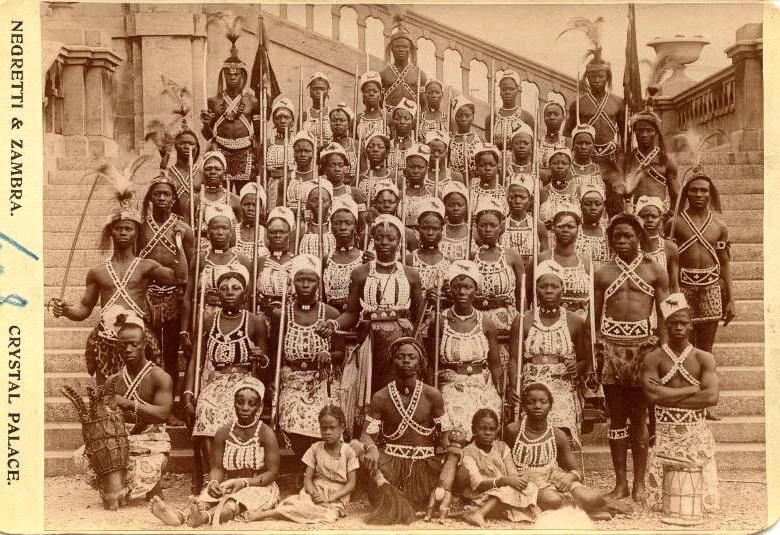
Tales of fierce female warriors trace back to ancient historians. Today, it is impossible to pinpoint where Greek travelers first encountered these legendary Amazons. All that remains of those early accounts is the assertion that these women fought as fiercely as men, surpassed them in cunning, and showed no mercy. 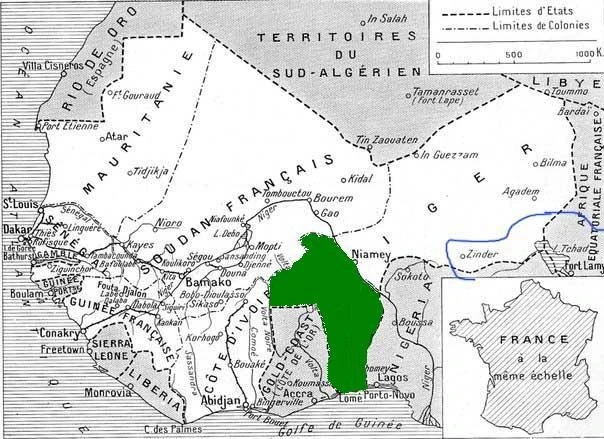
French colonial forces faced a strikingly similar challenge in 1890. Expecting brief, disorganized resistance, European commanders were stunned to find themselves up against an all-female army. Though poorly armed by Western standards, these warriors possessed a formidable understanding of tactics and strategy.
French troops were equally bewildered—they had never faced women on the battlefield. At first, the battle-hardened soldiers, who had brought numerous native states to their knees, found the prospect amusing. But a single engagement was all it took to shatter their confidence. 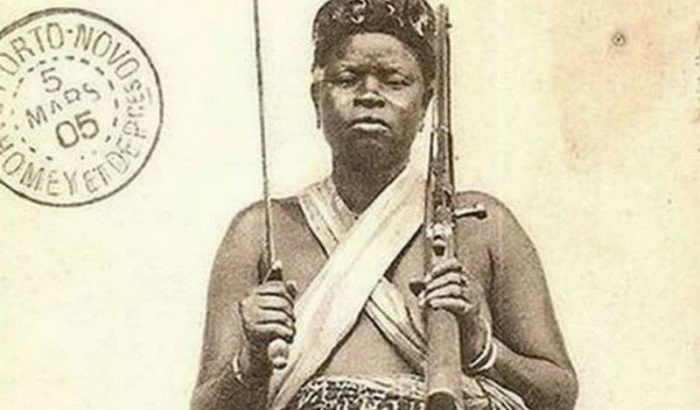
In their first clash with the Amazons, the French suffered a humiliating defeat. Worse still, many veteran soldiers developed a visceral terror of an enemy that was cold-blooded, ruthless, and entirely fearless in the face of death. Troops turned to alcohol to numb their fear, further eroding military morale.
It took time for the French to adapt to the fighting style of the Dahomean Amazons and secure their first modest victories. While superior firepower eventually handed the Europeans a formal victory, they failed to completely crush this "African Sparta," remaining under constant threat from sabotage and guerrilla strikes.
From Hunters to Warriors
The Kingdom of Dahomey traces its roots to King Houegbadja, who ruled from 1645 to 1685. It was he who unified the country’s scattered tribes and established the capital, Abomey. The king held absolute and sacred authority, his divine lineage reaffirmed through regular sacrifices to his ancestors. 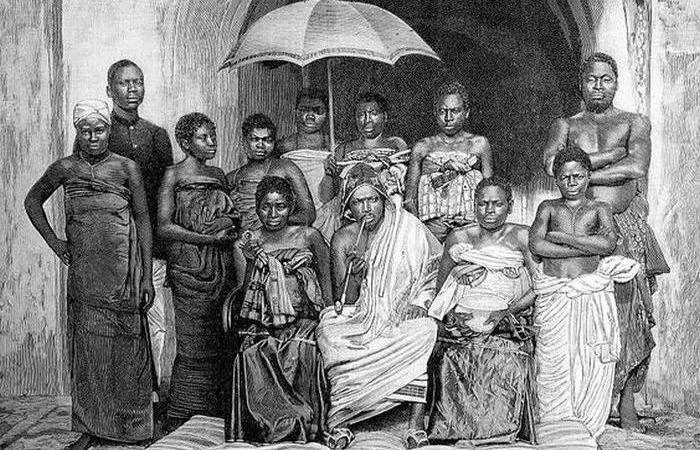
Yet Houegbadja's ambitions grew, and the modest territory no longer satisfied the self-proclaimed "descendant of gods." Dahomey embarked on a path of expansionism. By launching raids against neighbors, funneling captives into the West African slave trade, and buying European firearms, the kingdom steadily built its power. Ruler succeeded ruler, but the pattern remained unchanged: new territories were annexed, while their inhabitants were either slaughtered or sold into slavery.
However, human resources were finite, and Dahomey eventually ran low on soldiers. Native recruits were depleted, and arming subjugated tribes was deemed too risky. Facing yet another war, one of the kingdom's rulers turned his gaze toward women. Legend has it that the first combat unit of female warriors was originally conceived as an elite bodyguard unit to protect the sovereign and his royal household. 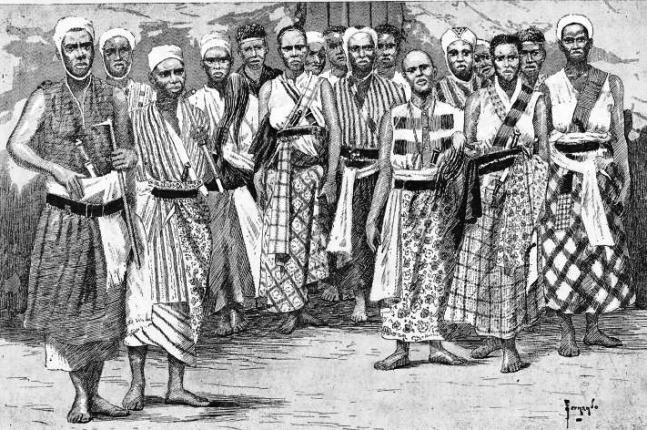
Another theory suggests that Dahomean women were skilled elephant hunters. According to this account, the women approached the king themselves, offering to fight as combatants in an upcoming war. The monarch agreed, placed them on the military payroll, and was thoroughly impressed by his new troops.
A third account links the all-female force to the royal guard. By ancient tradition, men were forbidden from remaining in the same building as the king after dark. Consequently, as dusk fell, heavily armed women took over all sentry posts, both outside and within the palace.
Training and Self-Denial
The female warriors of Dahomey referred to themselves as the mino or n’nonmiton, meaning "our mothers" in their native tongue. Any woman or girl could try out for the units, but only a fraction passed muster. The selection process was grueling, beginning with a strict physical examination: candidates had to be in peak health, tall, and visually striking. 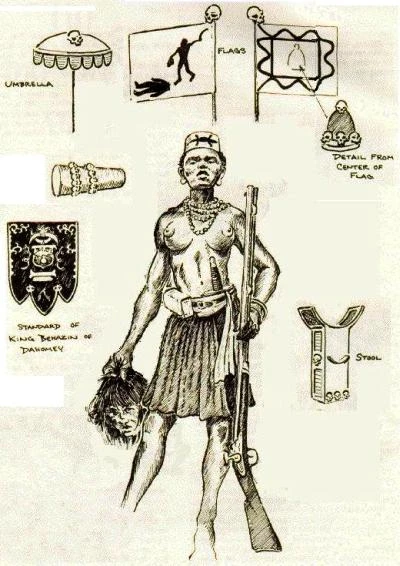
Those who passed were thrown into a brutal training regime overseen by seasoned female veterans. Alongside marksmanship training, the recruits underwent rigorous conditioning in hand-to-hand combat using machetes, a core discipline of the force.
To complete their training, candidates had to pass a final test: cleanly decapitate a captive or an erring slave. Decapitation was a trademark of the Amazons, who routinely severed their enemies' heads on the battlefield to claim them as trophies.
The warriors also endured intense physical conditioning designed to build raw strength, agility, and high pain tolerance. Obstacle courses were mandatory; one of the toughest drills involved scaling vertical walls covered in thorny acacia branches. 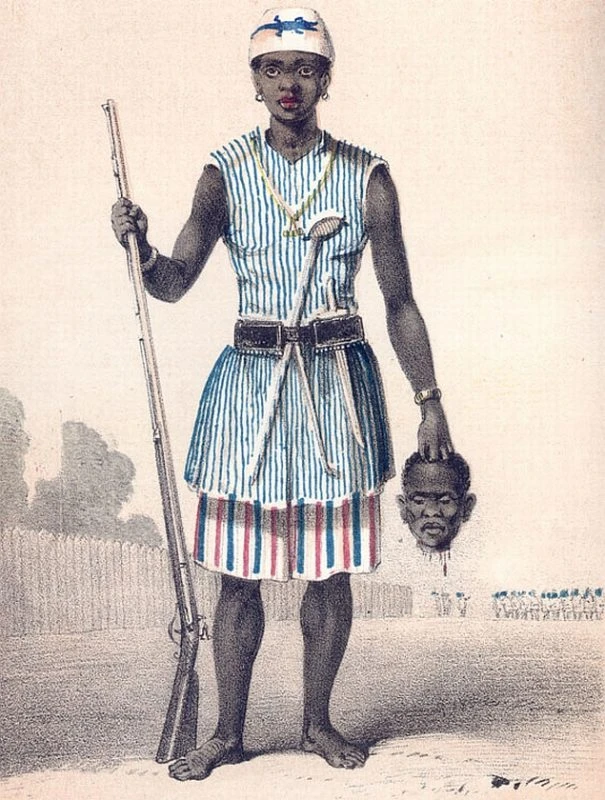
Trainees were also subjected to multi-day jungle survival marches armed only with a machete. Unsurprisingly, many failed to make the cut, but recruits were eager to replace them. Service in the army offered immense financial security and high social standing.
British explorer Stanley Alpern noted that whenever an Amazon unit left the royal grounds, a female slave walked ahead ringing a bell. The sound alerted men along the route to clear the path and avert their eyes. All male contact with the warriors was strictly forbidden, as the women were officially considered wives of the king. 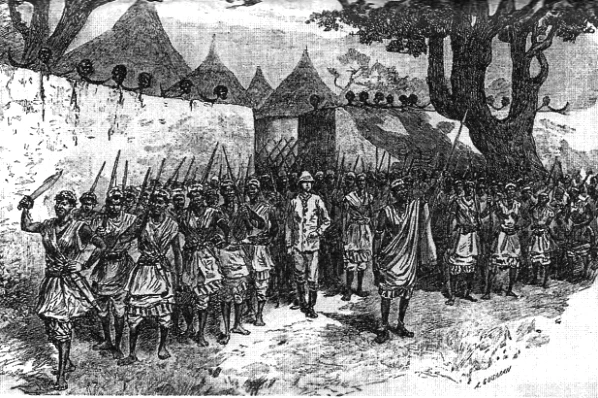
Enlistment was not always voluntary. Parents seeking a comfortable life for a daughter often delivered her directly to the barracks. Alternatively, a husband could complain of a wife’s rebellious nature to a royal official, whereupon she would be taken from the home and turned into a killing machine.
Peak of the Monarchy
Dahomey reached the height of its military power under King Ghezo, who ruled from 1818 to 1858. Fiercely ambitious, Ghezo envisioned an empire spanning far beyond neighboring lands. He boosted military spending significantly, pouring special resources into expanding and refining the mino.
Under his reign, women made up at least a third of the entire army, with some sources putting the number of Amazons at around 6,000. Selection standards shifted: beauty and height were no longer enough; raw physical power became the primary metric. Eventually, Ghezo instructed recruiters to ignore looks altogether—the warlike king needed deadly soldiers, not models. 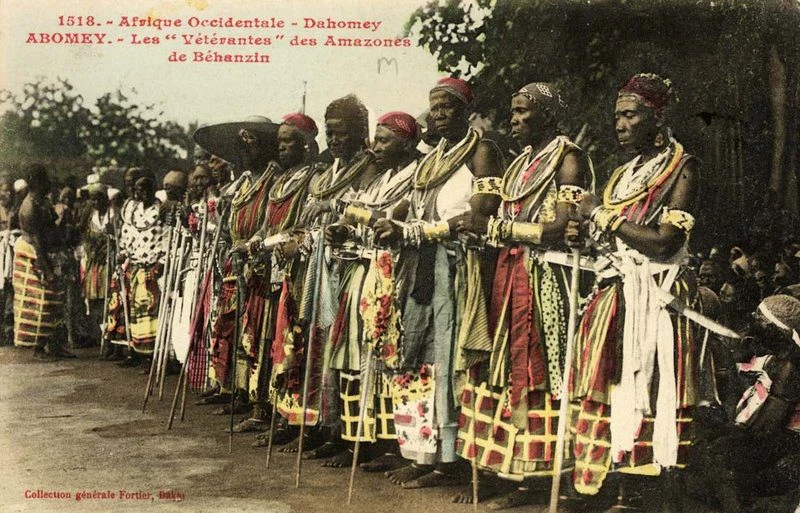
Visitors who encountered the mino remarked on their impressive presence. British trader Richard Burton, who visited Dahomey in 1863, witnessed the Amazons execute prisoners. He observed that their muscular builds were so pronounced that, were it not for their breasts, they could easily be mistaken for men.
King Behanzin, who succeeded Ghezo, pressed ahead with militarization, placing a heavy focus on modernizing the army’s arsenal. Dahomey began purchasing rifles and artillery pieces from Germany. 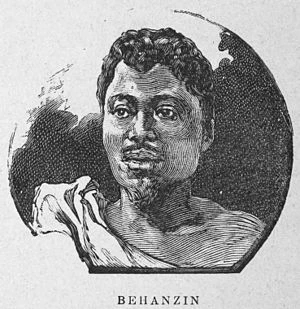
Under Behanzin, a unit of female intelligence operatives was formed. Trained in espionage and disguise, these operatives posed as merchants, beggars, or shepherdesses to infiltrate enemy territory, gather intel, or carry out political assassinations.
It was during Behanzin's reign that French interest in Dahomey intensified. Vain and eager to impress, the king hosted foreign dignitaries, showing off his nation's wealth and military prowess—including the mino. French army officer Jean Bayol recorded one striking encounter:
"I saw a teenage girl named Naniska undergo her first trial by kill. She crept up behind a bound prisoner, swung a large blade, and his head rolled to her feet. As the crowd cheered, she held up her gruesome trophy and licked the victim's blood from her blade."
At the time, the mino wore a distinct uniform of baggy trousers and long blue tunics gathered with a belt. They shaved their heads, topping them with small crowns. By the late 19th century, their main weaponry consisted of European rifles, supplemented by machetes and short daggers. 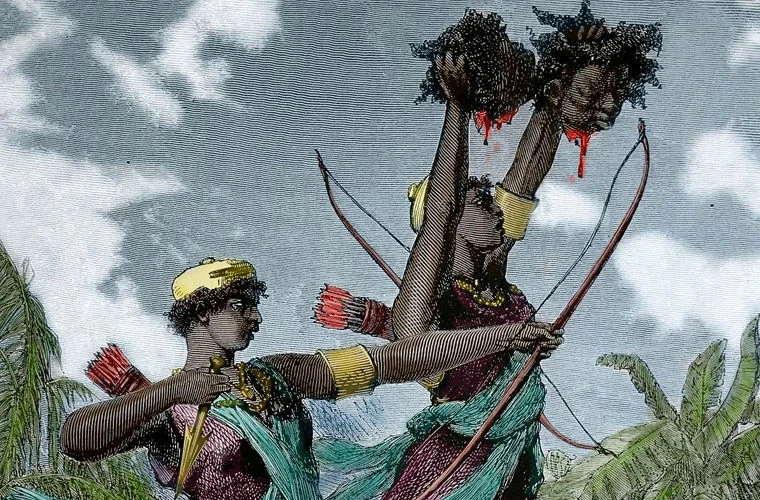
The army also featured archers and saber units. The Dahomean saber was a hybrid of a machete and a spear, featuring a long curved blade mounted on a two-foot handle, making it equally effective for thrusting and slashing.
Yet despite these displays, the French were unimpressed, dismissing the mino as theatrical showmanship by a boastful tribal king. They would soon come to regret their arrogance.
The Final Battles
Officer Bayol later recalled spotting Naniska on the battlefield, the same young woman he had watched execute a prisoner in Abomey. She had just slain a French infantry commander and was methodically severing his head. After the battle, Bayol found her corpse among the fallen:
"Bound to her left wrist was a battle-axe with a curved blade inscribed with magical symbols. In her right hand, she still clutched the barrel of a carbine adorned with cowrie shells."
Following the First Franco-Dahomean War—from which Dahomey emerged victorious, albeit at heavy cost—Behanzin redoubled his efforts to reform his forces. Knowing the French would return, he braced for conflict. He was proven right when French forces invaded again in 1892, sparking a war that raged for two more years. 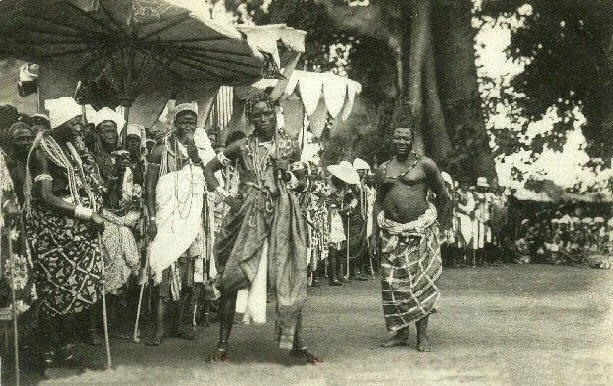
This conflict was intensely violent. Beyond skirmishes and sabotage, both sides clashed in over twenty major battles, taking heavy casualties. Ultimately, Dahomey could not withstand the superior force of the French military. Nearly all the mino perished in the fighting. Back home, the French press justified the military's brutality by publishing sensationalized accounts and vivid illustrations of Amazon savagery.
One famous newspaper illustration depicted an Amazon tearing open a French soldier's throat with her teeth in hand-to-hand combat. Such propaganda effectively swayed public opinion, justifying a war fought thousands of miles from French soil. 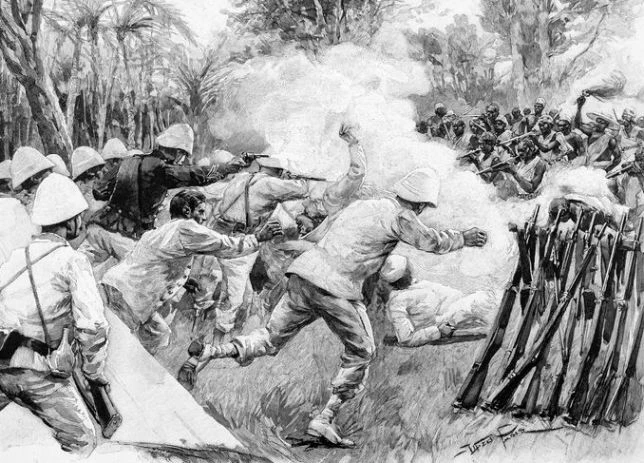
The few surviving mino turned to guerrilla tactics after Dahomey fell and became a French colony. Infiltrating enemy camps by night under the guise of sex workers, they assassinated French soldiers in their sleep.
The fall of Dahomey was finalized on March 30, 1894, when King Behanzin and his family were exiled to Martinique. He remained in exile until 1906 before being relocated to Algeria, where his health failed and he died of pneumonia shortly after arrival. By 1899, Dahomey was officially annexed as a French West African colony, with the tacit backing of former allies Britain and Germany. 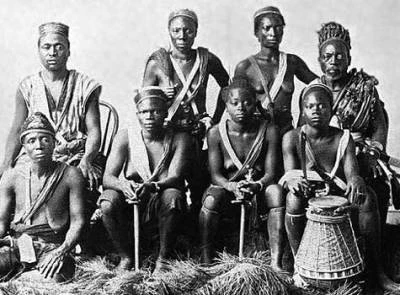
Dahomey remained under French rule for over half a century. Following independence, the nation briefly retained the name Republic of Dahomey before adopting its modern title, the Republic of Benin, in the 1970s.
Today, the mino are remembered mainly during national celebrations, when women don traditional Amazon attire to sing war songs and chant ritual hymns. But as a military institution, they are gone forever. The last surviving Dahomean Amazon, a woman named Nawi, passed away in 1979 at over 100 years of age.