A Flash Brighter Than 570 Billion Suns: What Was It? (4 Photos)
It happened on June 14, 2015. ASAS-SN, an international network of automated robotic telescopes designed to continuously monitor the entire visible night sky, detected a burst of monstrous brightness in the constellation Indus. 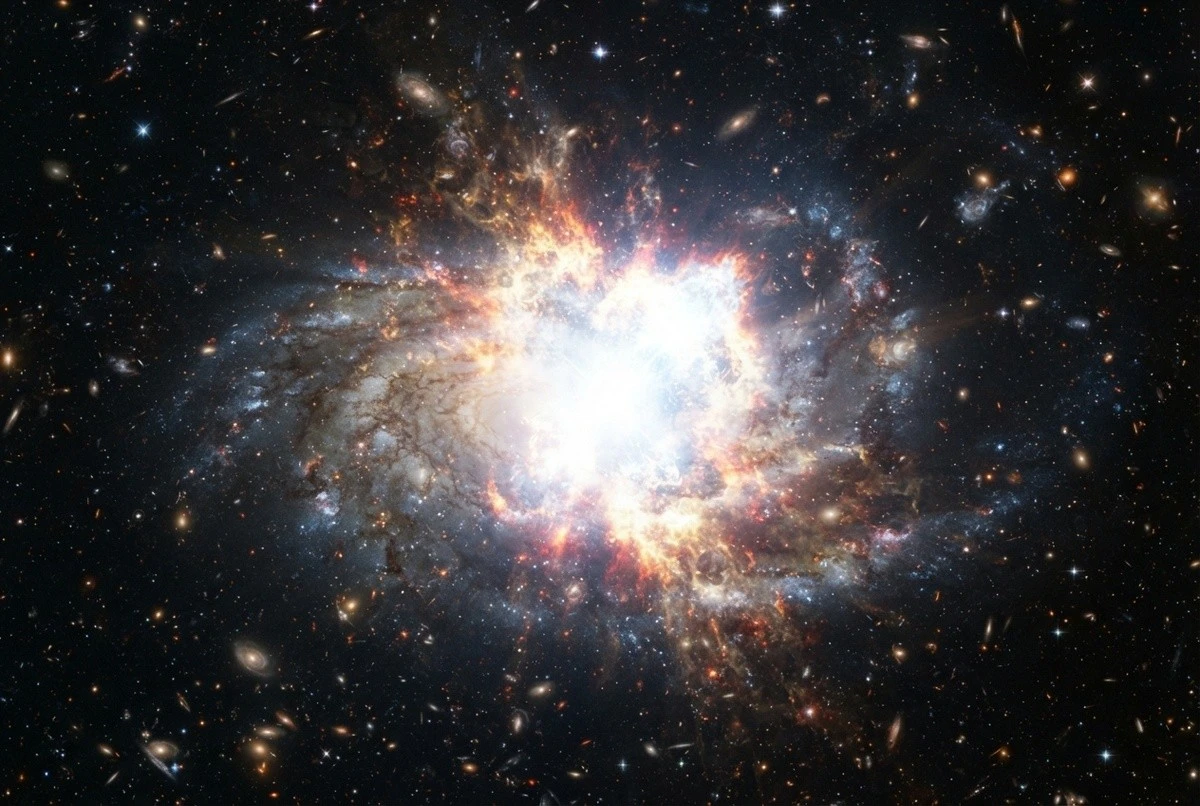
The event, designated ASASSN-15lh, erupted with such brilliance that it easily outshone its host galaxy—entirely, with all its billions of stars. The numbers calculated were mind-boggling: at its peak, its luminosity surpassed that of our Sun by roughly 570 billion times. For context, the entire Milky Way is "only" about 20 billion times brighter than the Sun.
In January 2016, a team of scientists led by Professor Subo Dong of the Kavli Institute for Astronomy and Astrophysics at Peking University published a study in Science naming ASASSN-15lh "the brightest supernova in recorded history." Doubts quickly emerged, however, and within a few months, several follow-up studies were published refuting the Dong team's conclusions.
To understand why, let's take it from the beginning.
A Low-Cost Yet Effective Network
ASAS-SN is an array of small robotic telescopes with primary mirrors measuring just 14 centimeters across, scattered around the globe. Their mission is both simple and monumental: scan the observable sky every night for the slightest variations in brightness. Supernovae, galactic nucleus flares, variable stars—any transient event disrupting the usual tranquility of the night sky.
The system operates fully automatically. Cameras image the same patch of sky several times a night, while algorithms cross-reference the frames to pinpoint new bright spots. When an anomaly is flagged, astronomers are immediately alerted and redirect larger ground-based and space telescopes to inspect it. That's precisely how ASASSN-15lh was discovered: a brilliant point of light appeared on images where previously there had been only a faint, barely discernible galaxy roughly 3.8 billion light-years away.
Why It Was Initially Deemed a Supernova
At first, everything pointed to a superluminous supernova of type SLSN-I—an extremely rare class of stellar explosions tens of times brighter than standard supernovae. ASASSN-15lh exhibited off-the-charts luminosity, a hydrogen-free spectrum, and a smooth rise to peak brightness over roughly 30 days followed by a gradual decay. On paper, it fit the profile of known superluminous supernovae almost perfectly. The only catch was its utterly unprecedented scale. 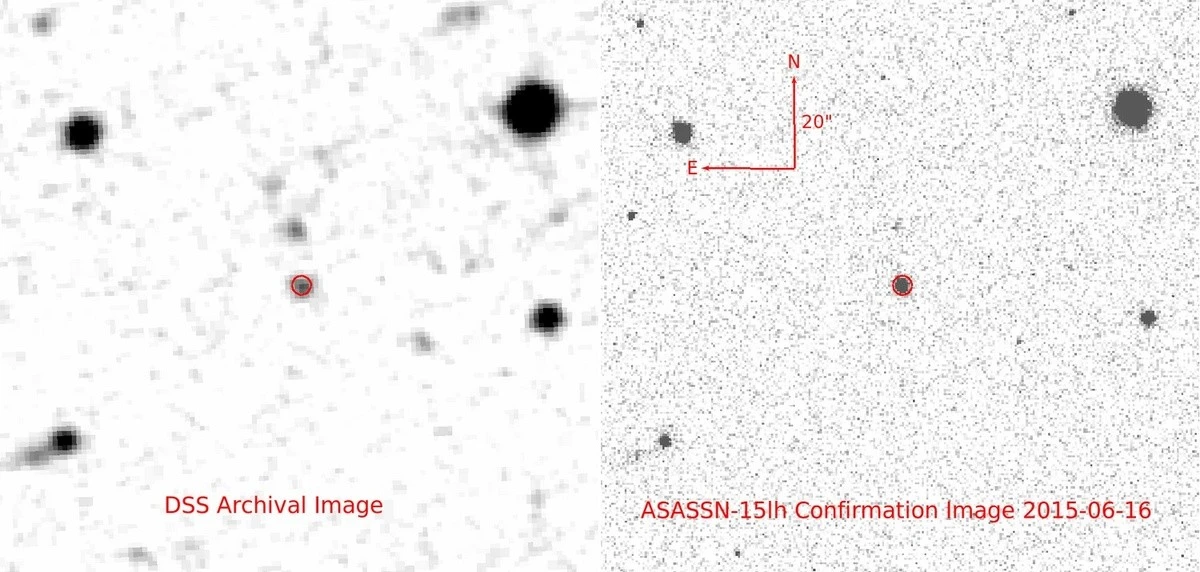
Left: An archival Digitized Sky Survey image of the galaxy prior to the flash. Right: Discovery confirmation by the Las Cumbres Observatory network. Due to the vast distance, even an explosion of this magnitude appears only as a subtle shift in pixel brightness inside the red circle.
Dong's team attributed this anomaly to the birth of a magnetar at the center of the explosion—a rapidly spinning neutron star possessing an unimaginably powerful magnetic field. As it rotates, the magnetar sheds energy, illuminating the ejected stellar envelope from within like a colossal lightbulb inside an expanding cloud of gas and dust. This mechanism accounted for both the prolonged glow and the extreme luminosity. Yet scientists conceded this was effectively a workaround solution. The hypothesis sounded neat on paper, but in reality, the pieces didn't quite add up.
Flaws in the Foundation
Superluminous supernovae typically reach peak brightness and then fade rapidly over a matter of weeks or months. ASASSN-15lh dimmed much more slowly, even hovering at maximum luminosity for a brief period. Furthermore, its spectrum raised eyebrows: spectral lines were unusually broad, and the ejecta velocities were anomalously high. Simply put, under closer scrutiny, ASASSN-15lh defied the standard template of a superluminous supernova.
There was another intriguing clue that had raised red flags from the outset: its location. Most superluminous supernovae occur in low-metallicity, star-bursting dwarf galaxies—nursery grounds for massive, hot stars that burn fast and die young. In contrast, ASASSN-15lh went off in a large, quiescent galaxy. Crucially, it was located right at the galactic core. Not on the outskirts, nor in a spiral arm, but dead center—right where a supermassive black hole resides.
Act Two
In late 2016 and early 2017, the fading object unexpectedly flared up again, boosting its brightness by about 10%. Supernovae simply do not behave this way; the death of a star is a one-time event. While the expanding shroud of stellar debris can be watched as it cools and interacts with its surroundings, a supernova only detonates once. This unexpected revival provided strong ammunition for researchers who had questioned the Dong team's initial interpretation.
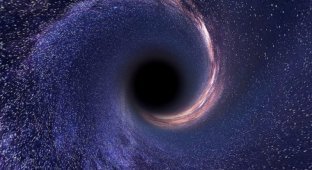
Several independent international teams put forward a radically different explanation: a Tidal Disruption Event (TDE). This is a fundamentally different cosmic catastrophe—one triggered not by an exploding star, but by a black hole. 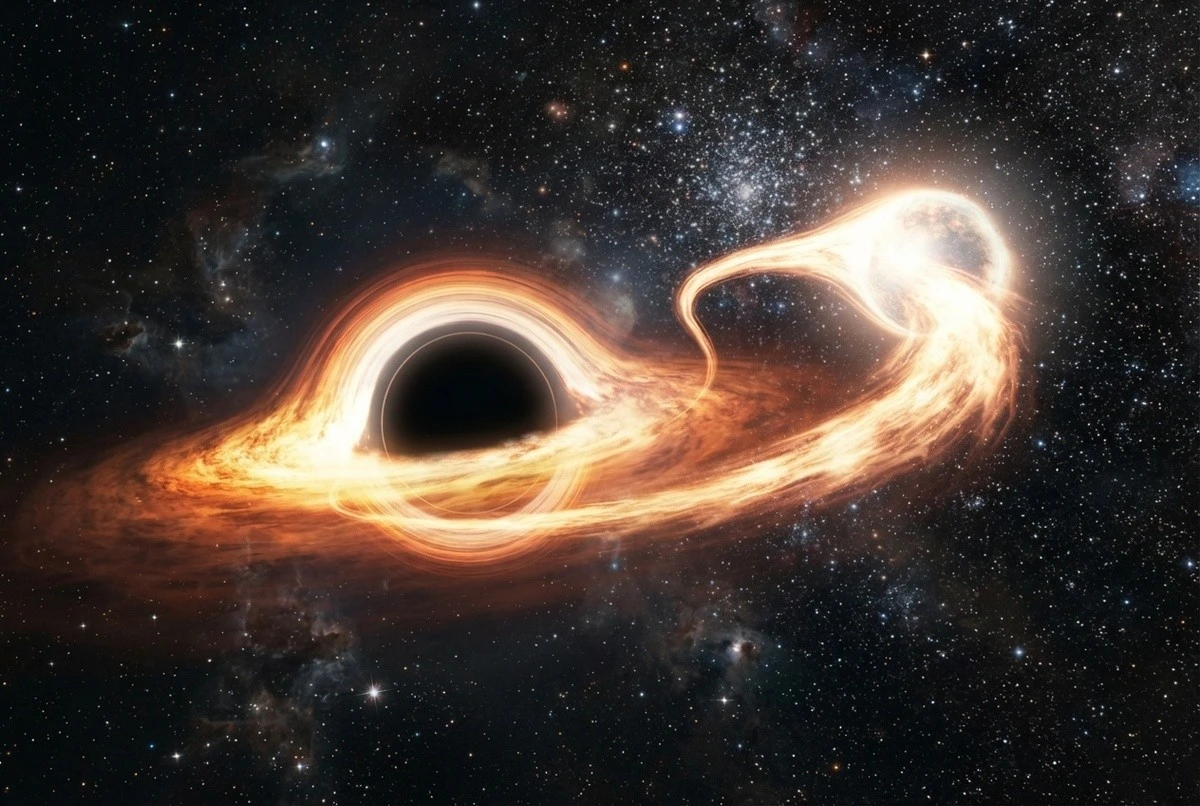
Imagine a star straying too close to a supermassive black hole millions or billions of times more massive than our Sun. Crossing the threshold known as the tidal disruption radius, the star experiences a gravitational gradient so immense that it is literally torn apart. The side of the star closer to the black hole feels a gravitational pull far stronger than the far side, stretching the star into a long ribbon.
As a portion of the shredded stellar material falls toward the black hole, it settles into an accretion disk. The gas spirals around at tremendous speeds, heating up to millions of degrees and glowing fiercely across X-ray, ultraviolet, and visible wavelengths. This process can last for months or even years, slowly fading as the matter is consumed.
TDEs are rare phenomena. In a typical galaxy, such a "gravitational shredder" tears a star to pieces only once every 10,000 to 100,000 years. Although the observable universe contains around two trillion galaxies, astronomers have caught only a few dozen of these events in the act—and most were relatively faint. If ASASSN-15lh truly was a TDE, it was a record-breaker beyond compare.
A Compelling Case
Astrophysical teams led by Giorgos Leloudas and Peter Brown conducted a thorough analysis of the object's spectrum, light curve, and spatial location. Its position at the absolute core of the galaxy—home to a supermassive black hole roughly 100 million times the mass of the Sun—was no longer mere coincidence. Spectral changes revealed signatures unique to an accretion disk rather than a cooling supernova shell.
Virtually every piece of evidence pointed to a TDE, but with one critical caveat: the black hole had to be spinning rapidly. A black hole's spin directly affects how much energy is released when it devours matter. To yield the colossal luminosity recorded in ASASSN-15lh, the supermassive monster that ripped the star apart must have been spinning near its theoretical speed limit. 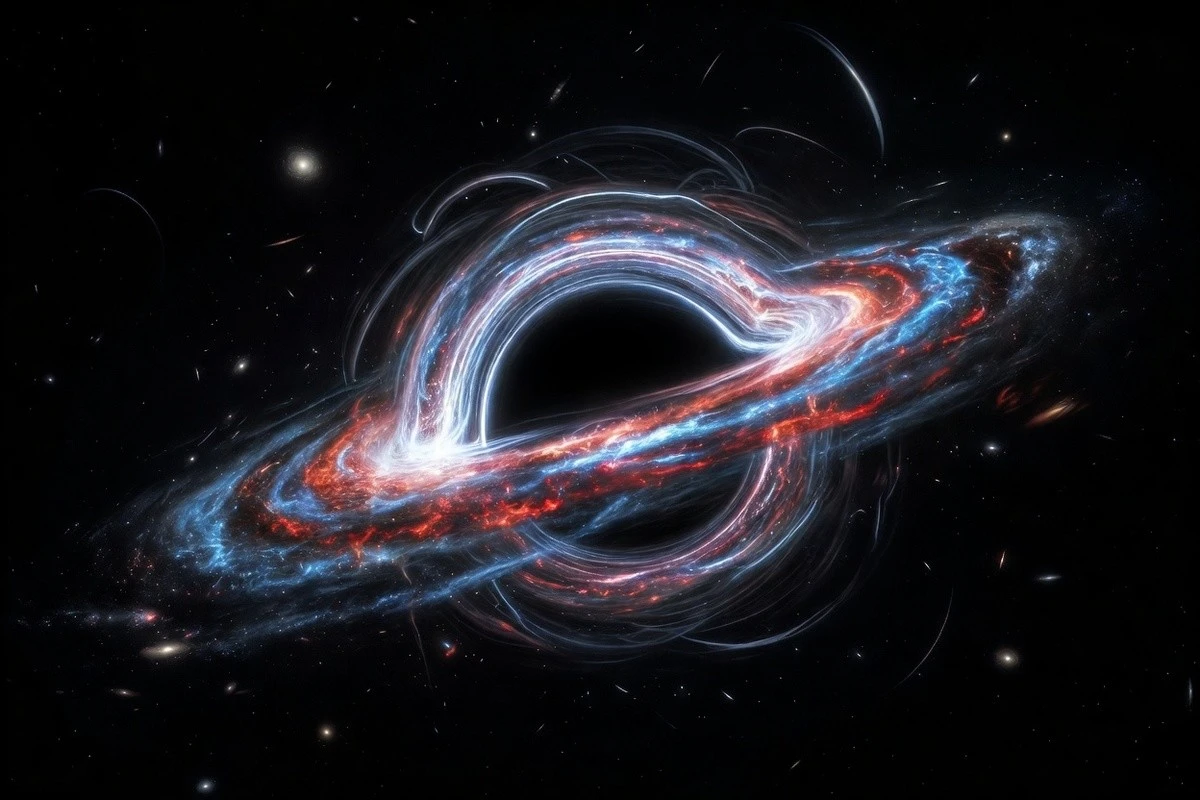
Incidentally, the secondary flare fits right into this picture: matter does not plunge into a black hole uniformly, forming clumps in the accretion disk that trigger periodic bursts of radiation. This is expected behavior for a TDE, but entirely atypical for a supernova.
The Debate Continues
The debate remains far from settled. Some astronomers still maintain that ASASSN-15lh was an exotic supernova. In their view, the early-stage spectra aligned more closely with a stellar explosion than a tidal disruption event. The object's color evolution initially followed the textbook trajectory of a superluminous supernova—shifting from blue to red—before anomalies surfaced. Furthermore, they argue that the late-stage brightening in 2016–2017 could have stemmed from complex interactions between the expanding shockwave and surrounding circumstellar material.
There is another counterargument: even for a TDE, ASASSN-15lh was exceptionally luminous. Producing such immense brightness requires a perfect storm of conditions: an extreme black hole spin, a highly massive progenitor star, and likely a narrow relativistic jet pointed almost directly at Earth when ASAS-SN picked it up. This set of circumstances makes the scenario improbable, though by no means impossible.
Should ASASSN-15lh flare up once more, it would provide ironclad evidence in favor of the TDE hypothesis. For now, astronomers can only wait and watch.