Giants of the Void: The 7 Most Supermassive Black Holes in the Universe (9 Photos)
Black holes are among the most mysterious objects in the universe. They form following the death of massive stars: as a star reaches the end of its life cycle, it collapses under its own gravity, triggering a supernova explosion. The star's core continues to shrink, becoming denser and heavier until only a singularity remains—an infinitely small point of infinite density known as a black hole. 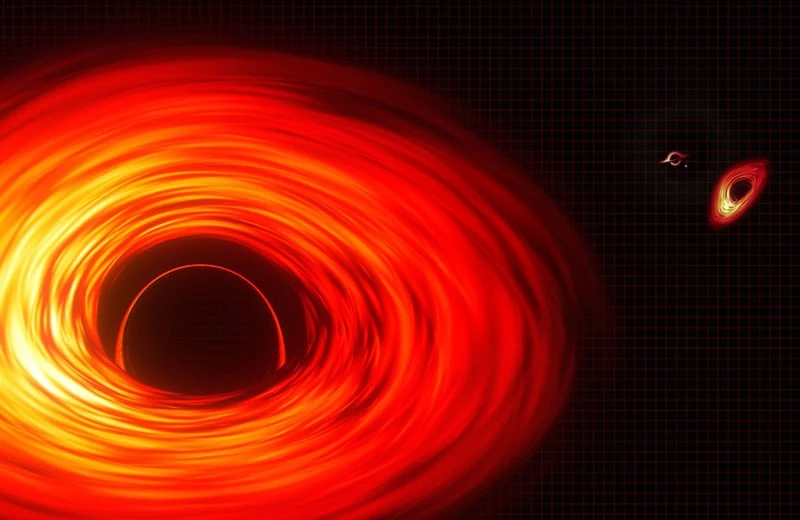
Black holes fall into different categories based on the stars from which they originated:
Stellar-mass black holes (SBHs) – Formed from the collapse of massive stars, their masses range from 3 to 100 times that of our Sun (roughly 1.99×10³⁰ kg).
Intermediate-mass black holes (IMBHs) – These remain poorly understood and are thought to form through mergers of stellar-mass black holes. Their masses range from 100 to 1,000 solar masses.
Supermassive black holes (SMBHs) – Anchored at the center of almost every galaxy, these leviathans range from millions to hundreds of billions of solar masses.
Let’s take a look at seven of the largest black holes in the universe, each with distinct features, ranked by mass relative to our Sun.
1. Phoenix A
Mass: 100 billion solar masses
Location: Phoenix Cluster 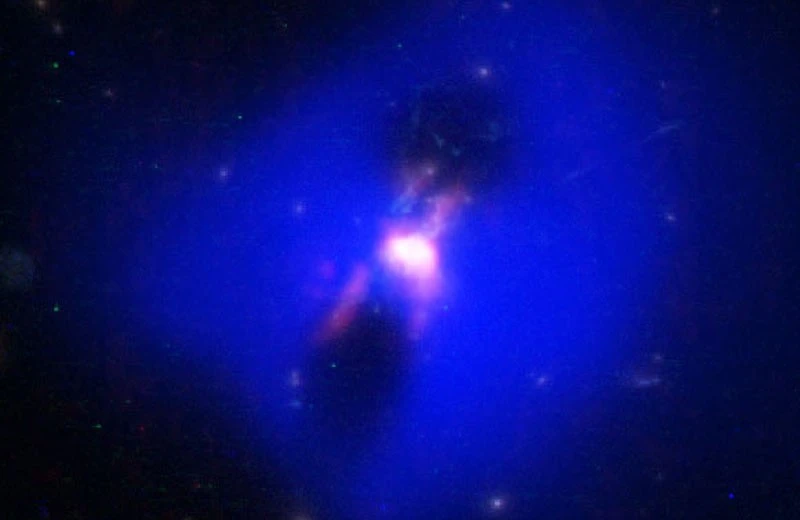
The Phoenix Cluster is a colossal group of thousands of galaxies bound together by gravity, making it one of the largest galaxy clusters ever discovered.
At the heart of this cluster lies Phoenix A, the central galaxy hosting an active galactic nucleus (AGN). Supermassive black holes power AGNs and play a crucial role in shaping galaxy formation and evolution.
The supermassive black hole at the core of Phoenix A is central to this active nucleus. Theoretical models estimate its mass at a mind-boggling 100 billion solar masses, making it potentially the largest black hole known to science today.
Its circumference is so vast that circumshedding it at the speed of light (299,792 km/s) would take 71 days and 14 hours!
The spherical Schwarzschild diameter of its event horizon is roughly 590.5 billion kilometers—more than enough to swallow our entire solar system whole. The Schwarzschild diameter defines the theoretical boundary around a non-rotating black hole from which nothing, not even light, can escape.
2. IC 1101
Mass: 40–100 billion solar masses
Location: Abell 2029 Galaxy Cluster 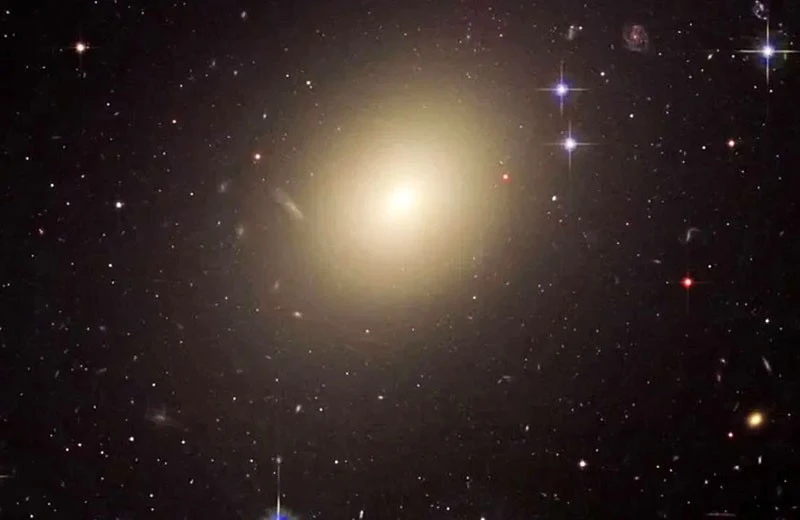
IC 1101 is a lenticular galaxy—a structural middle ground between spiral and elliptical galaxies. They feature a disk shape similar to spiral galaxies but lack spiral arms and exhibit virtually no active star formation.
Residing at the center of IC 1101 is a black hole with an estimated mass ranging between 40 and 100 billion solar masses.
This wide range stems from differences in theoretical models and observational data. Astronomers infer the black hole's presence by analyzing its gravitational pull on nearby interstellar gas.
3. TON 618
Mass: 40.7 billion solar masses
Location: Near the constellations Canes Venatici and Coma Berenices 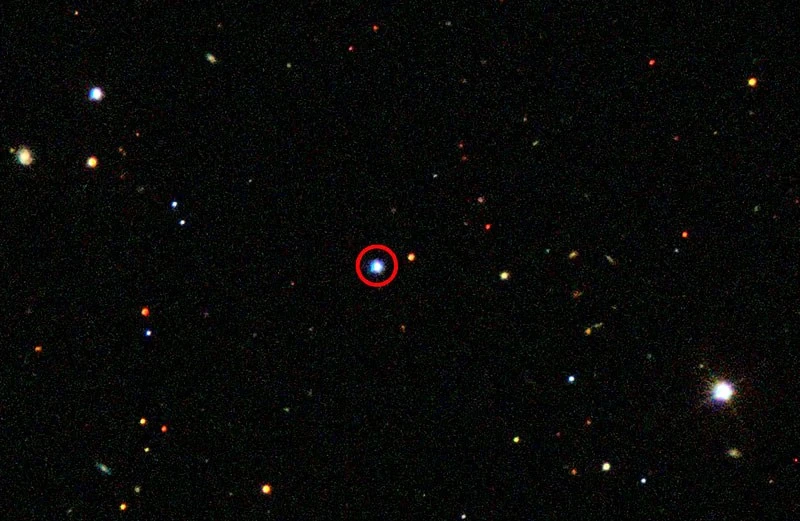
TON 618 is a hyperluminous quasar—objects essential to understanding how galaxies form and evolve over time.
At the center of TON 618 sits a supermassive black hole with a mass calculated at 40.7 billion solar masses, derived from analyzing the quasar's emission spectra.
Shining 140 trillion times brighter than the Sun, its extreme luminosity offers astronomers crucial data on the behavior of SMBHs and their accretion disks—swirling structures of gas and dust spiraling inward.
The TON 618 system also contains vast amounts of neutral hydrogen, the most abundant element in the universe and the fundamental building block of all cosmic structures.
4. S5 0014+81
Mass: 40 billion solar masses
Location: Near the constellation Cepheus 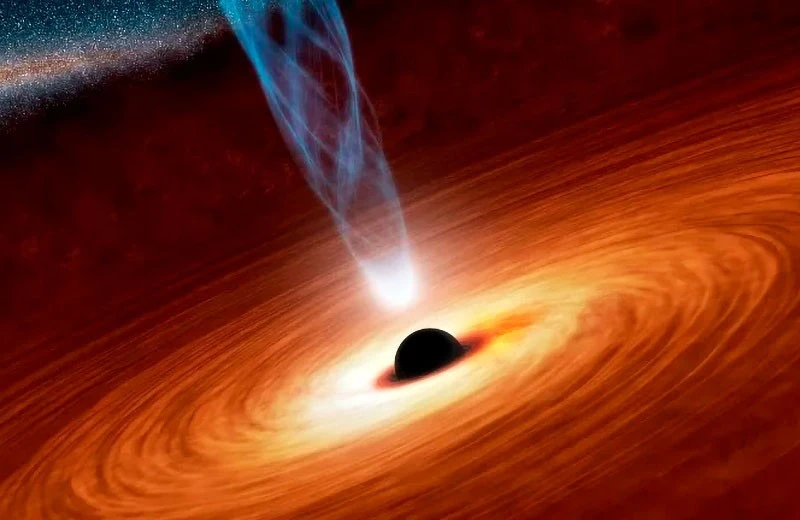
S5 0014+81 is a hyperluminous blazar (a flat-spectrum radio quasar, or FSRQ). Much like TON 618, it features an active galactic nucleus driven by a central supermassive black hole.
Due to its extreme brightness, the SMBH's mass was estimated using the emission spectra of its host galaxy. It comes in at 40 billion solar masses—the equivalent of four Large Magellanic Clouds (the largest satellite galaxy orbiting the Milky Way).
The black hole's Schwarzschild diameter measures 240 billion kilometers, about half that of Phoenix A. Evolutionary models suggest its host galaxy formed in the early universe, roughly 1.6 billion years after the Big Bang, and could endure for another 1.3×10⁹⁹ years!
5. Abell 1201 BCG
Mass: 32.7 billion solar masses
Location: Abell 1201 Galaxy Cluster 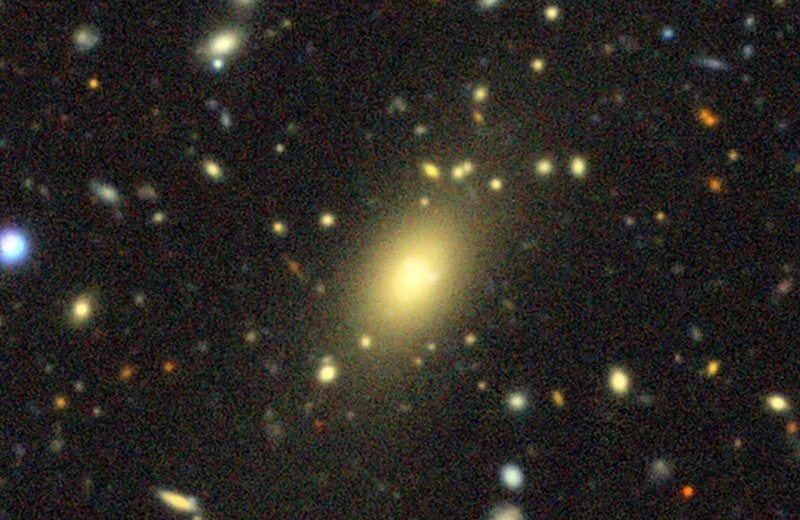
Abell 1201 BCG is the brightest cluster galaxy in Abell 1201, positioned near the cluster's center.
According to a 2023 study, the galaxy harbors a supermassive black hole weighing 32.7 billion solar masses.
Because of its massive size and immense gravitational pull, this black hole acts as a gravitational lens, bending light from a more distant background galaxy. This bending effect visibly warps the background galaxy's image, which researchers used to determine the SMBH's mass.
Dark matter distribution also plays a role in gravitational lensing, making this galaxy a key subject for studying dark matter properties.
6. NGC 4889
Mass: 21 billion solar masses
Location: Northern Coma Cluster (Abell 2634) 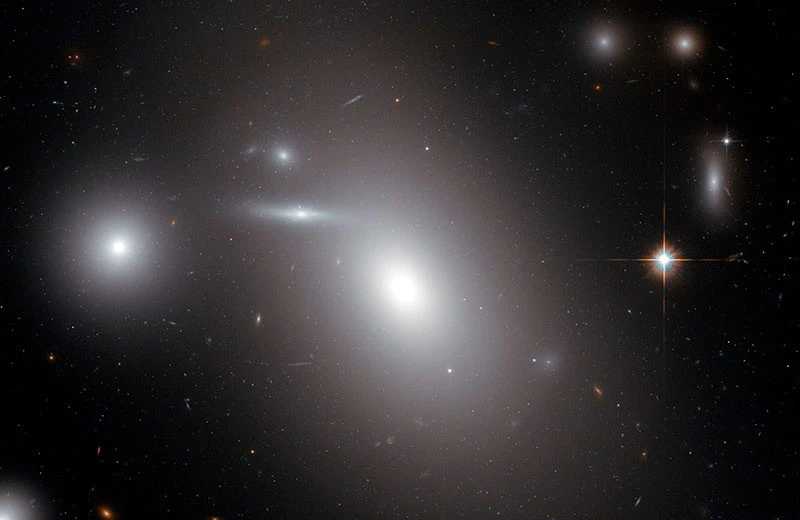
Located in the northern section of the Coma Berenices constellation (one of the richest and densest galaxy clusters in the northern sky), the host galaxy NGC 4889 is a supergiant elliptical galaxy home to an ancient SMBH.
Theoretical models place the mass of this giant black hole between 6 and 37 billion solar masses, with the best estimate pointing to roughly 21 billion solar masses.
Today, the black hole is dormant; it is no longer accreting matter or producing high-energy emissions. This quiescence makes measuring its mass difficult, yet it offers scientists vital clues about how supermassive black holes transition into active quasars. Such behemoths strongly influence the dynamics and evolution of host galaxies and their environments.
7. Messier 87 (M87)
Mass: 6.5 billion solar masses
Location: Constellation Virgo 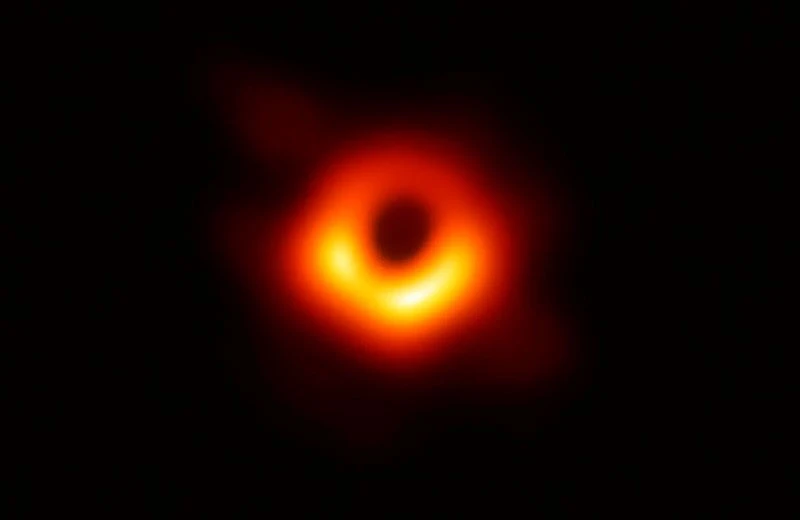
Like NGC 4889, Messier 87 (M87) is a supergiant elliptical galaxy in the constellation Virgo. At its center lies the only supermassive black hole ever directly imaged.
In 2019, humanity saw the historic first image of this supermassive black hole, reconstructed from data gathered by the Event Horizon Telescope. That same dataset allowed astronomers to pinpoint its mass at 6.5 billion solar masses.
The central SMBH powers M87's active galactic nucleus. It is surrounded by a rotating disk of ionized gas perpendicular to a relativistic jet—a narrow beam of high-energy plasma launched from near the event horizon.
The jet itself extends over 5,000 light-years across—a distance greater than that from Earth to the Orion Molecular Cloud Complex. M87’s relative proximity and the clear view of its central engine make it invaluable for studying black hole dynamics and galactic evolution.
The surrounding interstellar medium is enriched with heavy elements shed by evolved stars, and observations indicate that its outer structures were sculpted by gravitational interactions with neighboring galaxies.
The Theoretical Limit for SMBHs
You might have noticed that aside from Phoenix A, every black hole on this list comes in under 100 billion solar masses. There is a solid scientific reason for this. 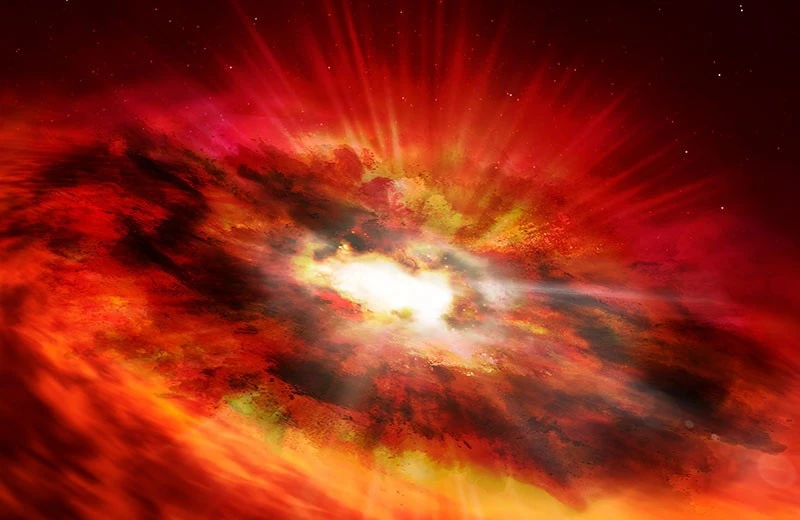
There is a theoretical upper limit to how massive a black hole can become. Radiation feedback can slow down gas accretion and suppress star formation within the accretion disk, effectively capping the black hole's growth rate.
Based on the age of the universe and its matter density, models suggest the ultimate ceiling for an SMBH is around 270 billion solar masses. This boundary underscores the complex dynamics of black hole growth and highlights the immense challenge of measuring cosmic giants buried in dense, complex environments like galaxy clusters.