Nature invented zombies before Hollywood: 6 parasites that turn animals into living creatures Puppets (11 photos)
The Last of Us featured a fungus that turns people into monsters. But the writers didn't invent much of it. A real-life Cordyceps unilateralis has been controlling ants in tropical forests for 48 million years. Five other puppeteers work alongside it: a surgeon wasp, an invisible parasite in rodent brains, a worm with dancing horns, and a rabies virus. Each takes control of another's body for one purpose: reproduction. We'll tell you what a real zombie apocalypse looks like in the world of insects, snails, and rodents. 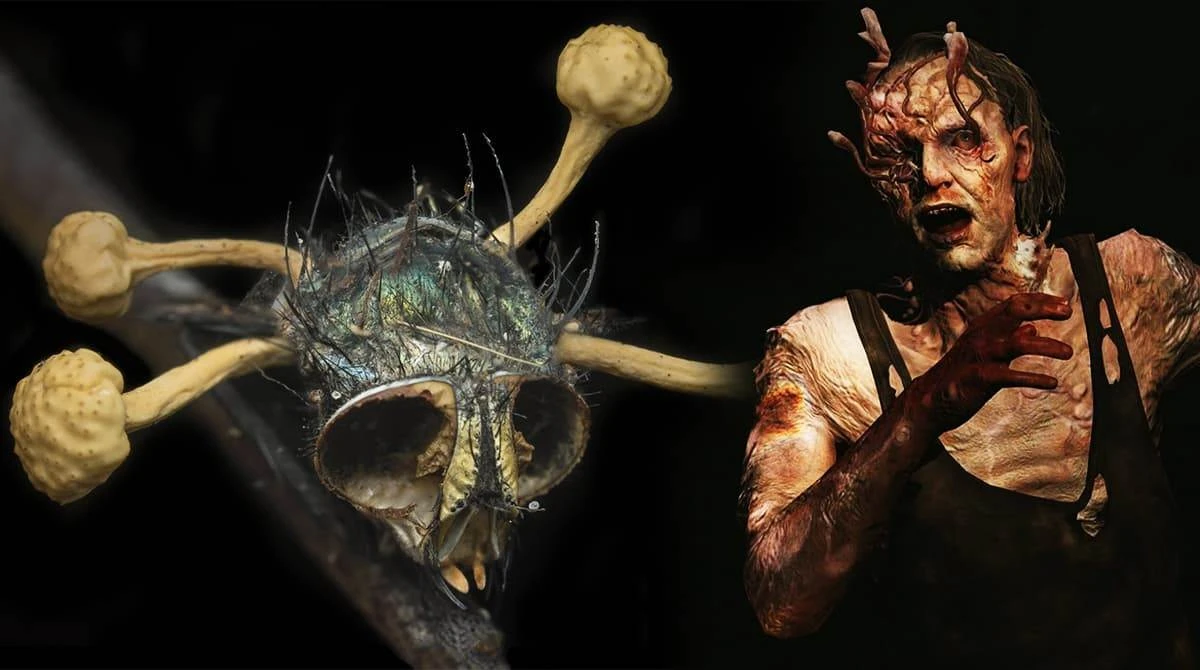
Ophiocordyceps unilateralis: The Mushroom That Inspired Hollywood
If you're familiar with the world of The Last of Us, you've already encountered the cordyceps unilateralis. This is the Ophiocordyceps unilateralis mushroom. British naturalist Alfred Wallace first described it in 1859. Paleontologists later found traces of it on a fossilized leaf. The find, 48 million years old, was discovered in the Messel quarry in Germany. The fungus is highly specialized. Each subspecies preys only on a specific species of carpenter ant of the genus Camponotus. The same Cordyceps fungus is not found on both a wasp and a grasshopper. Different species of the same genus of fungi are effective against other insects. 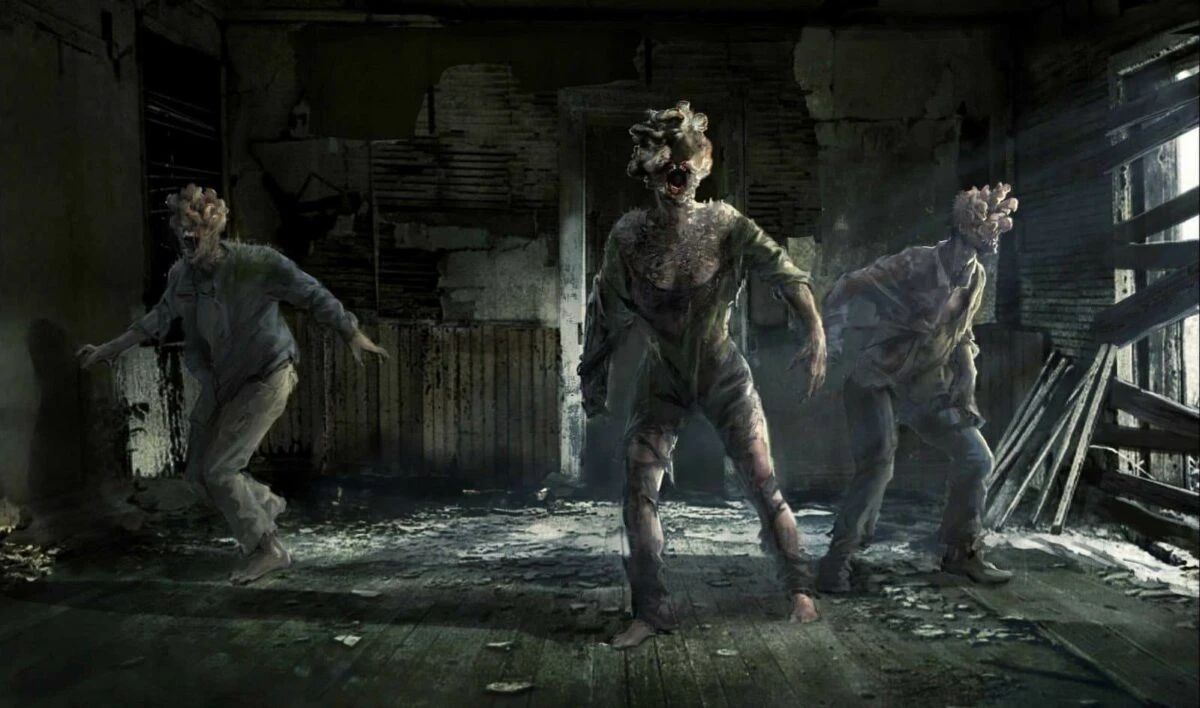
The Last of Us series is inspired by the real-life parasitic fungus Ophiocordyceps unilateralis.
The spore germinates through the ant's breathing holes in the shell. For two to three weeks, it grows silently inside the body, consuming soft tissue. For a long time, scientists believed the fungus penetrated the brain and controlled it directly. Recent research has shown otherwise. The mycelium weaves a network of fine threads around the insect's muscles. It manipulates them with chemical signals, leaving the ant's brain intact. This interference disrupts the insect's circadian rhythms and its odor system. The ant loses recognition of its fellows and abandons the colony.
The Deadly Ascent of the Carpenter Ant
An infected ant descends from the canopy to the understory. Around midday, it begins to climb the stem of a low plant—scientists have observed that this process is linked to the position of the sun. The ant stops about 25 centimeters above the ground. This is almost always the north side of the stem. Here, humidity remains above 94 percent, and temperatures range from 20 to 30 degrees Celsius. These are ideal conditions for the fungus to grow. 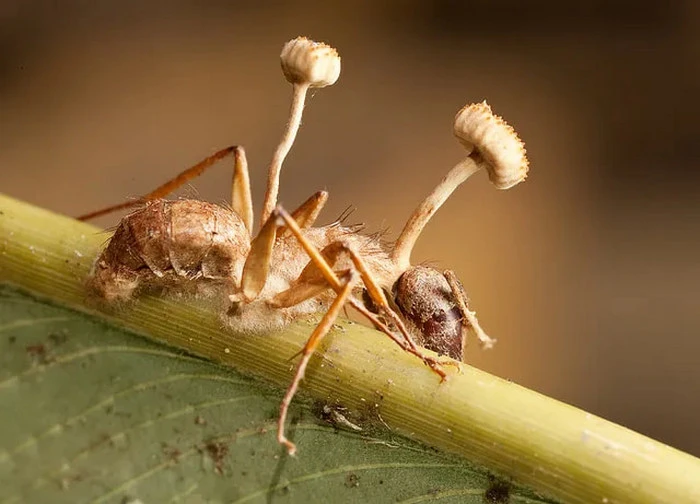
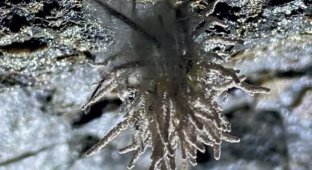
A few days after the ant's death, a stalk of fungus containing spores sprouts from its head.
Having reached the desired location, the ant firmly attaches its jaws to a leaf vein. The muscles that are used to open the jaws atrophy. Scientists call this mechanism a "death grip." It is irreversible. The insect dies within a few hours, remaining attached to the leaf. After 4-10 days, a long stalk emerges from the back of the ant's head. After another one to two weeks, spores mature at the end of the ant. They rain down on the ant trails below, infecting new ants. The cycle begins anew.
Emerald Green Wasp: Two Stings That Turn a Cockroach into a Slave
The emerald green wasp (Ampulex compressa) hunts prey twice its size—the American cockroach. It strikes first at the prothoracic ganglion. This causes a brief paralysis of the forelimbs, lasting two to three minutes. While the cockroach is unable to escape, the wasp performs its main task. With pinpoint precision, it inserts its sting into the second ganglion—directly into the brain. The strike hits the area responsible for the self-preservation instinct. 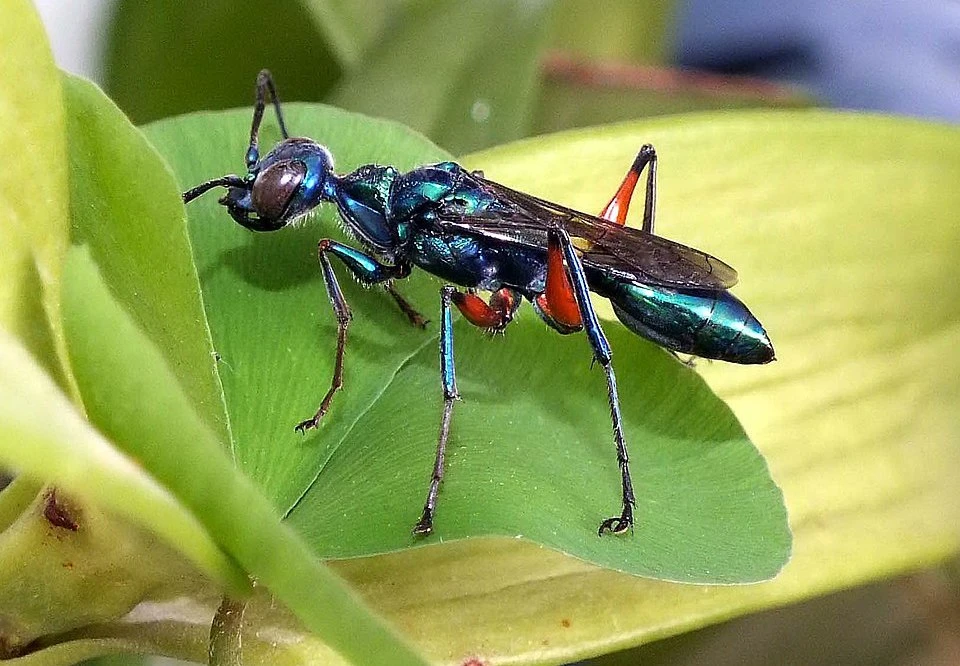
The emerald wasp hunts cockroaches, which are often larger than itself.
The venom contains an octopamine blocker. This is a neurotransmitter without which the insect cannot fully move and defend itself. Entomologists have experimentally tested the reversibility of this effect. If a stung cockroach is injected with a substance that unblocks octopamine receptors, its ability to move independently is restored. But in the wild, there is no antidote. The cockroach remains a docile, will-less victim for the rest of its life. And that life will be very short.
A Living Incubator: How a Wasp Controls a Cockroach
After stinging, the wasp bites off the tips of the cockroach's antennae. It drinks the hemolymph that emerges, likely to verify that the venom dose has worked properly. Then the wasp grabs the cockroach by the antenna fragment and leads it, as if on a leash, into a pre-dug burrow. The insect goes willingly. Nothing physically prevents it from escaping—its will to resist is simply disabled. 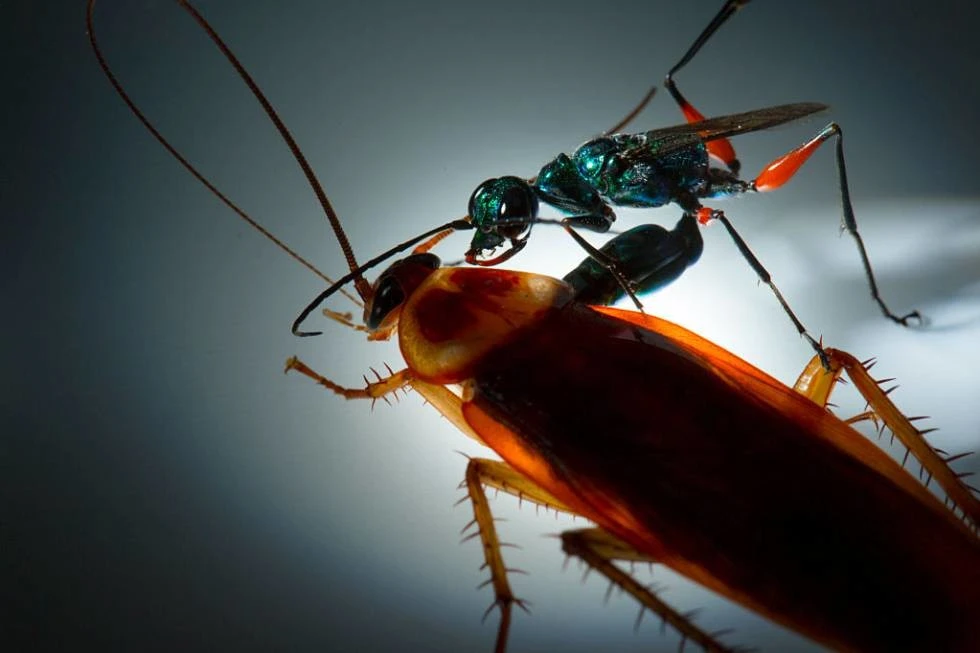
The wasp's second sting directly targets the brain, disabling the cockroach's survival instinct.
In the burrow, the wasp lays one egg on the cockroach and covers the entrance with soil. A few days later, a larva emerges from the egg. It begins to consume the cockroach from the inside, but acts prudently: first, it consumes the organs less essential for survival, saving the vital ones for last. This keeps the live food supply fresh until the larva pupates.
Toxoplasma: A Parasite That Cures Fear with Love
The protozoan Toxoplasma gondii completes its sexual reproduction only in the intestines of cats. However, the parasite can only reach the intestines through an intermediate host—usually a rat or mouse. Having penetrated the rodent's brain, Toxoplasma forms cysts in the structures responsible for memory, motivation, and fear—the amygdala and hippocampus. There, the parasite can remain dormant for the rest of the host's life, causing no external symptoms. 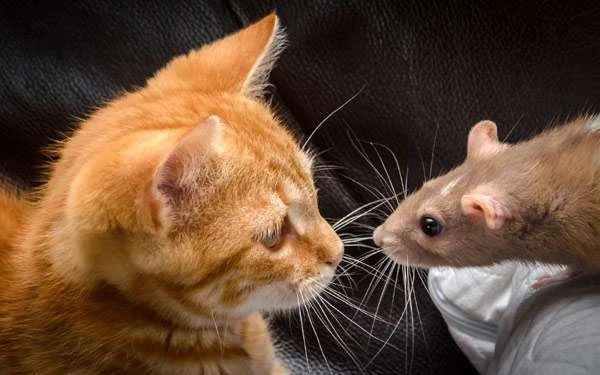
Toxoplasma alters the functioning of the amygdala and hippocampus of the infected rodent.
Classical experiments have shown that infected rodents lose their fear of the smell of cat urine. Moreover, they begin to seek out this smell and voluntarily approach the predator. Research in 2020 clarified the mechanism. The parasite causes mild inflammation in the brain. It reduces the rodent's overall anxiety and caution, rather than developing a selective attraction to cats. The result for the parasite is the same: the unwary victim becomes easy prey. The cat eats it, and the Toxoplasma life cycle is completed.
Leucochloridium paradoxum: A Snail with "Caterpillars" in Its Head
The adult flatworm Leucochloridium paradoxum lives in the intestines of small passerine birds. Its eggs are excreted in the feces. Small, amber-colored snails of the genus Succinea consume the infected vegetation along with this feces. Inside their bodies, the eggs hatch into worm larvae. The larvae migrate to the snail's tentacles, where the eyes are located. The left tentacle is usually the first to be occupied, while the next larva occupies the right. 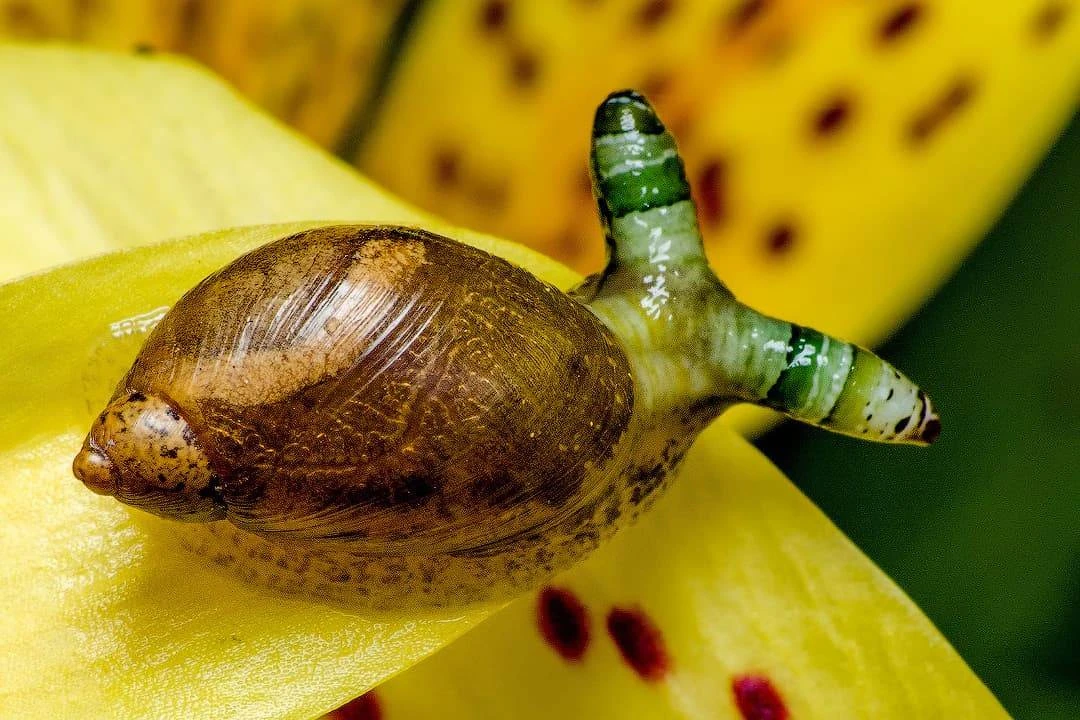
The snail's pulsating tentacles look like juicy caterpillars to passing birds.
Inside the tentacles, the parasites grow rapidly. They develop bright green-brown stripes and begin to pulsate like fat caterpillars. As the larvae grow, the snail becomes blind. Instead of hiding, it instinctively crawls to open, well-lit areas—precisely where it is easier for birds to spot it. The birds peck at the tentacles, mistaking them for prey, and the parasite returns to the bird's body. A blinded snail doesn't die: it can grow new tentacles. But another larva immediately takes the vacant spot, and the whole thing repeats itself. We've already discussed how this parasite continues to control the body of a dead snail.
Glyptapanteles Wasp: A Bodyguard from Beyond the Coffin
A parasitic wasp of the genus Glyptapanteles paralyzes the moth caterpillar Thyrinteina leucocerae. It lays about 80 eggs inside the caterpillar's body. The larvae develop inside, feeding on the host's hemolymph. They then gnaw through the skin and pupate nearby, on the same branch or leaf. It's logical to think that this is the end of the caterpillar's life. But it remains alive. 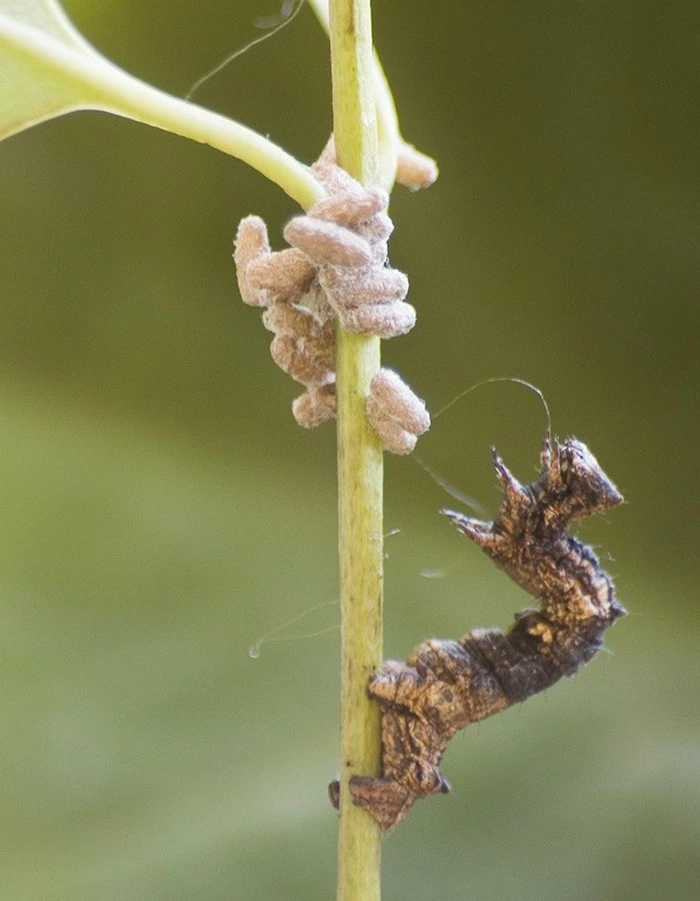
An infected caterpillar remains alive and guards the cocoons of others until its own death.
The secret lies in the fact that one or two larvae remain inside the caterpillar's body. Apparently, they control its behavior even after the majority of its offspring have left the host. The infected caterpillar stops feeding. Instead, it arches over the cocoons and guards them. When predatory shield bugs approach the cocoons, the caterpillar violently shakes its head from side to side, scaring off the enemy. In one experiment with 400 infected caterpillars, cocoons under this guard survived almost twice as often. The caterpillar dies almost simultaneously with the emergence of adult wasps from their cocoons—its purpose has already been fulfilled.
Rabies Virus: An Ancient Mechanism of Aggression
The rabies virus spreads along nerve fibers to the brain at a rate of about 3 millimeters per hour—slowly but inexorably. The largest number of viral particles accumulate in the Ammon's horns, a part of the brain that is also responsible for aggression. Once it reaches its target, the virus causes two changes in the host's behavior. 
Excessive salivation facilitates the transmission of the rabies virus through bites.
First, it causes the salivary glands to produce massive amounts of viral particles. Second, it disables the neural centers that normally inhibit aggression. The infected animal becomes unusually vicious, attacking any living creature nearby. This isn't a side effect of the disease, but a spreading strategy: the virus is transmitted to a new host through bites and saliva. After the first symptoms appear, rabies is almost always fatal. The chances of survival without early vaccination are slim. The few patients who have been saved after symptoms have already begun are a rare exception, not a system. Read more about how one patient managed to survive in our separate article.
Is it dangerous for people?
After six such stories, it's no wonder you start looking at trees with caution. What if tomorrow you too feel like biting a leaf? Scientists are quick to reassure everyone: The Last of Us scenario is almost impossible to achieve in real life. Cordyceps is a one-dimensional, highly specialized organism. It has been attuned to the nervous systems of specific ant species for tens of millions of years. Human biochemistry differs too radically from that of ants. The fungus simply won't be able to pinpoint it. Moreover, close relatives of Cordyceps—Chinese Cordyceps and Cordyceps militaris—have long been used in Eastern cuisine and medicine as a delicacy and dietary supplement. 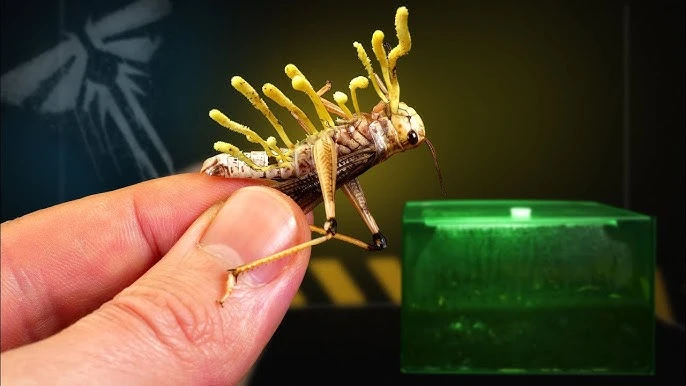
Cordyceps is capable of infecting other insects, but other species of fungi are used for this purpose.
Of the six insects in this article, only one poses a real threat to humans: the rabies virus. It affects all mammals, including humans, and without timely vaccination, it almost always leads to death. Toxoplasma can also survive in humans. It infects approximately half the planet's population. However, in people with healthy immune systems, the disease is usually asymptomatic. Nature has not yet invented true zombie parasites that threaten humans in the spirit of Hollywood scripts. Although, given the ingenuity of evolution, it's certainly not worth saying no to. 
Each of nature's six puppeteers solves the same evolutionary problem—reproduction.
Nature doesn't need screenwriters to invent nightmares. It does it itself, honing its scripts over millions of years on ants, cockroaches, and snails. Perhaps there's already a parasite out there, subtly influencing our habits or tastes. We just haven't learned to notice it yet. Do you think microorganisms are capable of manipulating human behavior the same way they do with animals? Or are our minds too independent for such manipulation?