A near-detective story: How humanity first encountered botulism (9 photos)
Botulism is an acute infectious and toxic disease caused by the bacterium Clostridium botulinum and its toxic metabolic products. It is a life-threatening illness that continues to claim lives worldwide. To avoid becoming a victim of the infection, you need to know how it enters the body and what symptoms accompany it. 
Mass Poisoning in Elsel
The causative agent of botulism has always existed alongside humans. However, it was only discovered in the late 19th century. On December 14, 1895, in the Belgian village of Elsel, the funeral of 87-year-old Antoine Créter, the leader of the local orchestra, took place. Thirty-four musicians from Créter's band, as well as neighbors, relatives, and friends of the deceased, attended the wake at the Le Rustic restaurant. 
The Le Rustic restaurant is still open.
The table was filled with plenty of alcohol and excellent food. But the guests relished the ham, which had been pulled from the chimney two weeks earlier after 50 days of smoking. The feast ended well after midnight, and the guests went home. That morning, two local doctors were called to 20 houses at once.
All the sick people complained of similar symptoms—diarrhea and vomiting. Some also experienced painful urination. A little later, all the patients began complaining of another problem: double vision, and their upper eyelids wouldn't open. Several of the sick people also suffered from thirst. But they couldn't drink, as after the first sip, they began to choke and the liquid would pour out of their nose. 
Emil van Ermengem
Obviously, the guests were poisoned by something at the wake, but the symptoms were very strange. Doctors were unable to help, and within just a week, three patients had died painfully. Detectives from the city arrived in Elsel. They questioned local residents, and the town hall concierge told them that a mass murder had been committed. Allegedly, one of the deceased's numerous heirs was to blame, determined to eliminate his competitors.
Dr. van Ermengem's Discovery
But the investigators approached their work professionally and did not rely on rumors. They called in microbiologist Emile van Ermengem from Ghent, a specialist in intestinal infections. The professor examined samples of the ham eaten by all the sick patients. He also performed autopsies on the deceased and examined their spleens and livers under a microscope. 
The causative agent of botulism, Clostridium botulinum
Van Ermengem discovered anaerobic (able to survive without air) Clostridium botulinum bacteria. Their waste products were incredibly toxic. A rabbit died after being injected with just 0.0005 milligrams of this toxin. The scientist determined that those who died were those who ate more than 200 grams of ham. The rest recovered slowly, but it took about six months for them to recover.
The heirs of the late Antoine Créterre were fully acquitted. The scientist established the full nature of the poisoning. Before smoking, pork was salted in barrels. The pieces were laid in layers and doused with a small amount of salt water. The water only covered the bottom pieces, and it was in these, without access to oxygen, that the deadly bacteria developed.
Botulism and Hercule Poirot
Few people know, but spoiled ham gave the world a popular literary character. The poisoning story made the newspapers and was discovered by writer Agatha Christie. She wrote the story "The Chocolate Box," featuring the detective Hercule Poirot. The brilliant detective was based on Dr. Emile van Ermengem. 
Agatha Christie made the village of Elsel, where the mass poisoning occurred, the birthplace of Poirot. The character proved so successful that he became a staple of Christie's works. He became famous worldwide, just like his British counterpart, Sherlock Holmes, created by Conan Doyle.
Botulism in the Service of Medicine and Beauty
"Everything is poison, everything is medicine. The dose determines both" – this saying by the great medieval physician and alchemist Paracelsus is well known. It perfectly applies to botulism. In the 20th century, the military decided to use the deadly botulinum toxin. Its use as a biological weapon was considered promising. Scientists calculated that only 4 kg of the toxin would be needed to destroy all of humanity. The military conducted experiments on monkeys, which yielded unexpected results. 
At a research center in Camp Detrick, Maryland, USA, a monkey with a pronounced tic was tested. Botulinum toxin injections cured it. It was discovered that carefully selected doses of the toxin can treat spasms and strabismus. It also has wrinkle-smoothing properties, as it paralyzes facial muscles. The drug was named "Botox" and is now used in "beauty injections" worldwide.
How botulism is contracted
The bacterium Clostridium botulinum and its effects on the body have been extensively studied. It is a misconception that you can only become ill by eating contaminated food. There are three forms of botulism:
Foodborne. This dangerous microorganism develops in foods prepared without air, most often in canned foods;
Infection through wounds. The bacteria can enter an open wound, for example, with soil;
Infantile. The infection enters the infant's body and develops in the child's intestinal tract between 2 and 8 months of age. 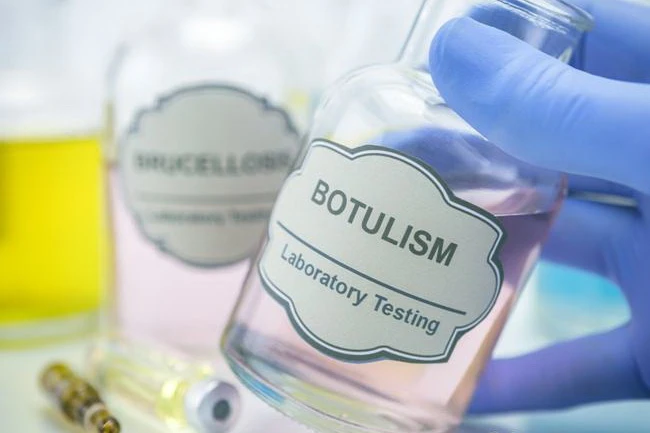
However, 99 percent of all cases of botulism are food-related. It is important to remember that there is no such thing as a "mild form" of botulism, and any case of the disease can be fatal.
Symptoms of the Disease
Signs of foodborne botulism appear between 12 and 36 hours after the toxin enters the body. However, in some cases, the onset of the disease is not accompanied by severe symptoms, and serious problems can develop even after a few days. Everything depends on the state of the body and the amount of bacteria ingested. Symptoms of the disease include:
Dry mouth;
Difficulty swallowing and speaking;
Weakness of the facial muscles;
Blurred vision or double vision;
Breathing problems;
Squashed eyelids;
Nausea, vomiting, and painful abdominal cramps. 
If symptoms of botulism appear, seek medical attention immediately. Time is running out, and the condition will only worsen. Successful recovery is only possible with prompt assistance.
How to avoid getting sick
Botulism prevention is very simple. To avoid becoming a victim of this insidious infection, avoid consuming questionable foods. These include dried, salted, and smoked fish, as well as home-canned meat, fish, mushrooms, and vegetables. 
Unfortunately, there have been cases of botulism infection from store-bought food. The bacteria typically develops in canned food and fish past their expiration dates. Foods that have been improperly stored and transported are also at risk.
To prevent infection through wounds, they must be treated promptly. If the wounds come into contact with contaminants, especially soil, seek medical attention. Finally, it's worth noting that a vaccine against botulism exists, but it is rarely used. Its effectiveness is questionable, and it can have a number of dangerous side effects.