Scientists May Have Underestimated the Chances of Life in Titan's Ocean (3 photos)
I recently wrote an article, "Enceladus: A World Where the Absence of Life Would Be More Surprising Than Its Existence," as part of my extensive research into the mechanisms of life's origins, the emergence of consciousness, and technological civilization. This should all culminate in a book, but for now I'm continuing to delve deeper into these questions, turning to other worlds in the Solar System and analyzing the data available to humanity. 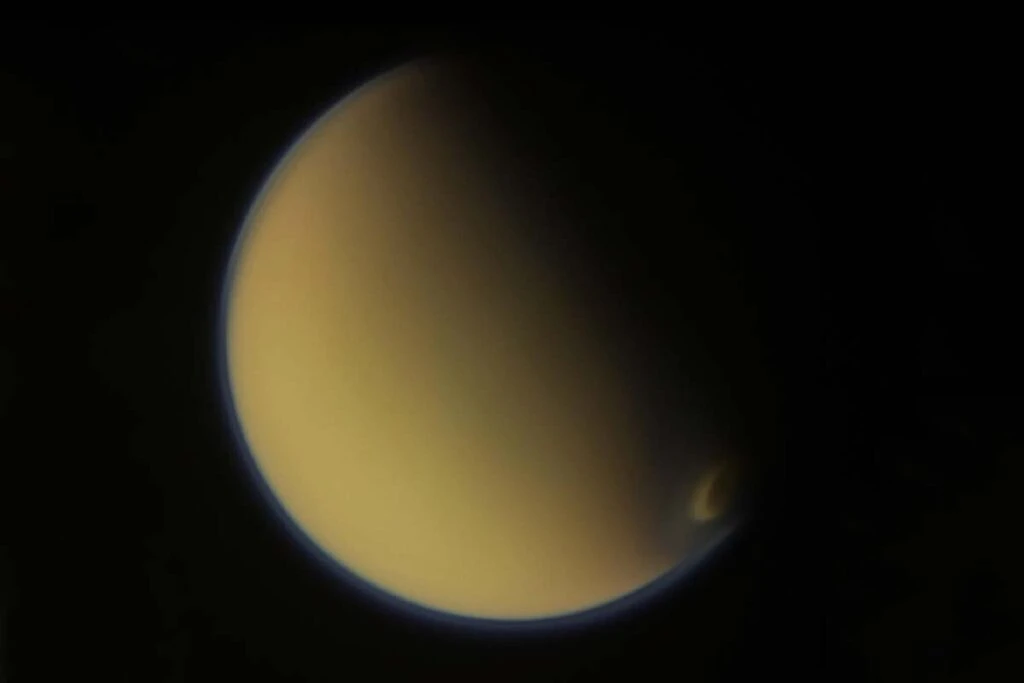
Titan and the icy cloud system over the south pole. Image from NASA's Cassini probe
My attention was focused on Titan, another intriguing moon in the Saturnian system, which boasts not only a subsurface ocean but also a very dense atmosphere. It is the only known world besides Earth with stable "water bodies" of liquid methane and ethane on its surface. While the presence of life on the surface, with an average temperature of around -180°C, seems highly unlikely, a liquid subsurface ocean is precisely the kind of environment that deserves close attention.
Specific Research
I recalled a 2025 study that concluded that if there is life in Titan's subsurface ocean, it is extremely small. So small that it could all be "fitted in carry-on baggage on a passenger plane."
The study's authors argued that surface organic matter, necessary for the origin and maintenance of life, is difficult to penetrate beneath the ice and ultimately end up in the ocean. This is not so much due to the ice itself, but rather to the dense atmosphere, which leads to the destruction of impacting bodies. So, only a small remnant reaches the surface, unable to penetrate into the ocean.
And yet, under specific conditions, large "space rocks" can reach the surface, impact, release colossal amounts of energy, melt the ice, and deliver organic matter into the ocean. However, the rarity of such events should make organic matter extremely rare in Titan's subsurface ocean.
And then it dawned on me: this study relies on the controversial assumption that impact events are the key mechanism for delivering organic matter to the ocean. The authors' logic is clear. Titan's surface is abundant with organic matter: it forms in the atmosphere from methane and nitrogen under the influence of solar ultraviolet radiation and then settles down. But the thick icy crust prevents the surface from communicating with the ocean, meaning the latter is virtually devoid of this organic matter. 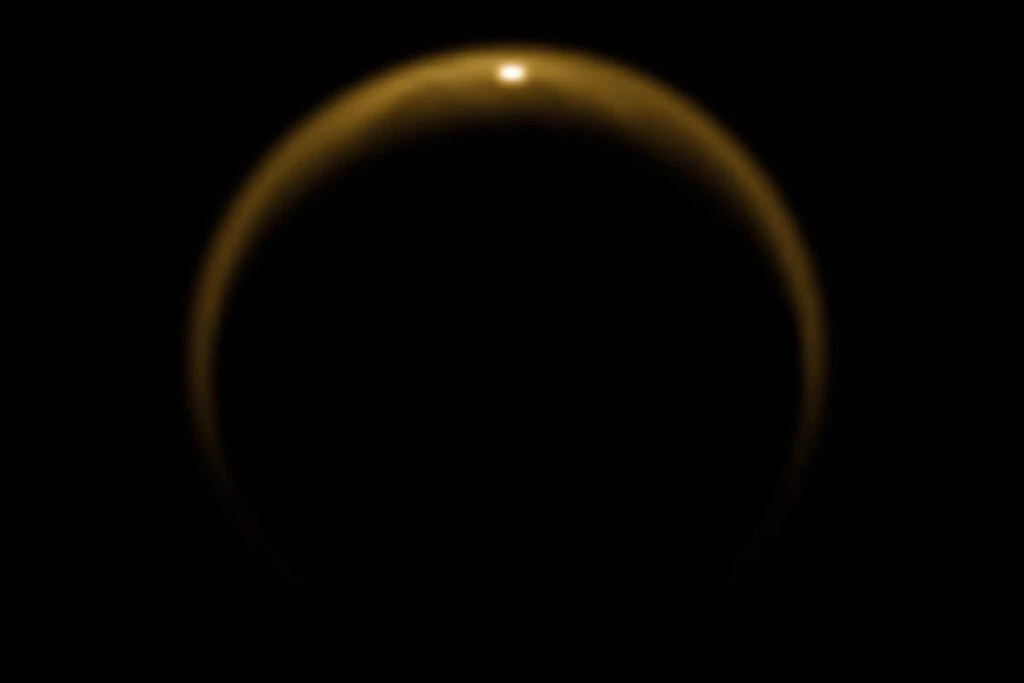
Reflection of infrared solar radiation from the surface of a methane lake in Titan's north polar region, as captured by the Cassini probe
But this is not the same as being devoid of organic matter altogether. A subsurface ocean need not obtain all its organic matter from the surface. The icy moon may have internal sources of organic compounds.
Organic matter could have been part of Titan's composition since its formation and was released from its interior during the moon's differentiation. Furthermore, its source may be reactions between water and the rocky core, which are capable of producing or creating organic compounds within the moon itself.
The Role of Enceladus in This Criticism
Enceladus clearly demonstrates that the organics in the icy moon's ocean system may not be the result of delivery from above. Enceladus's subsurface ocean lies at depths of tens of kilometers, and its south polar rifts do not deposit material into the ocean, but rather eject material from within. Complex organic compounds have been discovered in this ejected material.
Therefore, Enceladus may not simply be a repository of ancient organics, but a world where organic compounds are linked to the internal chemistry of the ocean and rocky core. What NASA's Cassini mission discovered is difficult to reduce to remnants of material preserved from the moon's formation.
This, of course, doesn't prove that Titan is exactly the same. But it does demonstrate the main point: organics in the ocean of an icy world could be part of the planet's internal chemistry, not a gift from the surface or asteroid impacts.
My Conclusion
The study is useful in that it examines one specific scenario for the possible biosphere of Titan's subsurface ocean being fueled by glycine delivered from the surface via impact melts. 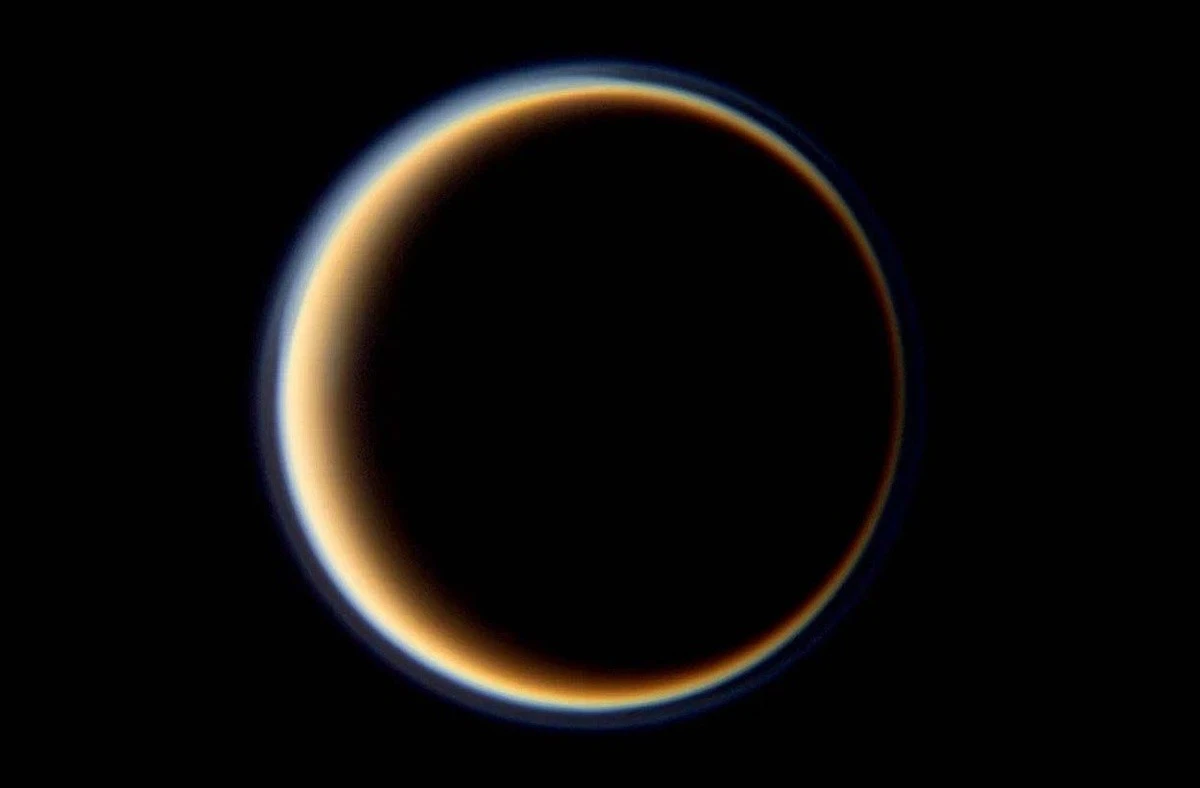
Titan through the eyes of the Cassini spacecraft
But the conclusion that life on Titan is "most likely almost nonexistent" because of this seems extremely hasty. A more accurate statement would be: if hypothetical life on Titan depends precisely on this glycine supply, then it should be very low.
And if the ocean contains local organic matter, a primordial supply of organic compounds, or internal water-rock chemistry, then the picture could be entirely different.
Therefore, Titan, especially its ocean, should continue to be one of the leading candidates for potential habitability within the Solar System.