Saturn's Hexagon: An Atmospheric Anomaly with a Giant Vortex in the Center (4 photos)
This raw image shows a powerful vortex at Saturn's north pole, located at the center of a mysterious hexagon—one of the most unusual atmospheric structures in the Solar System. This image was acquired by NASA's Cassini spacecraft on November 27, 2012. 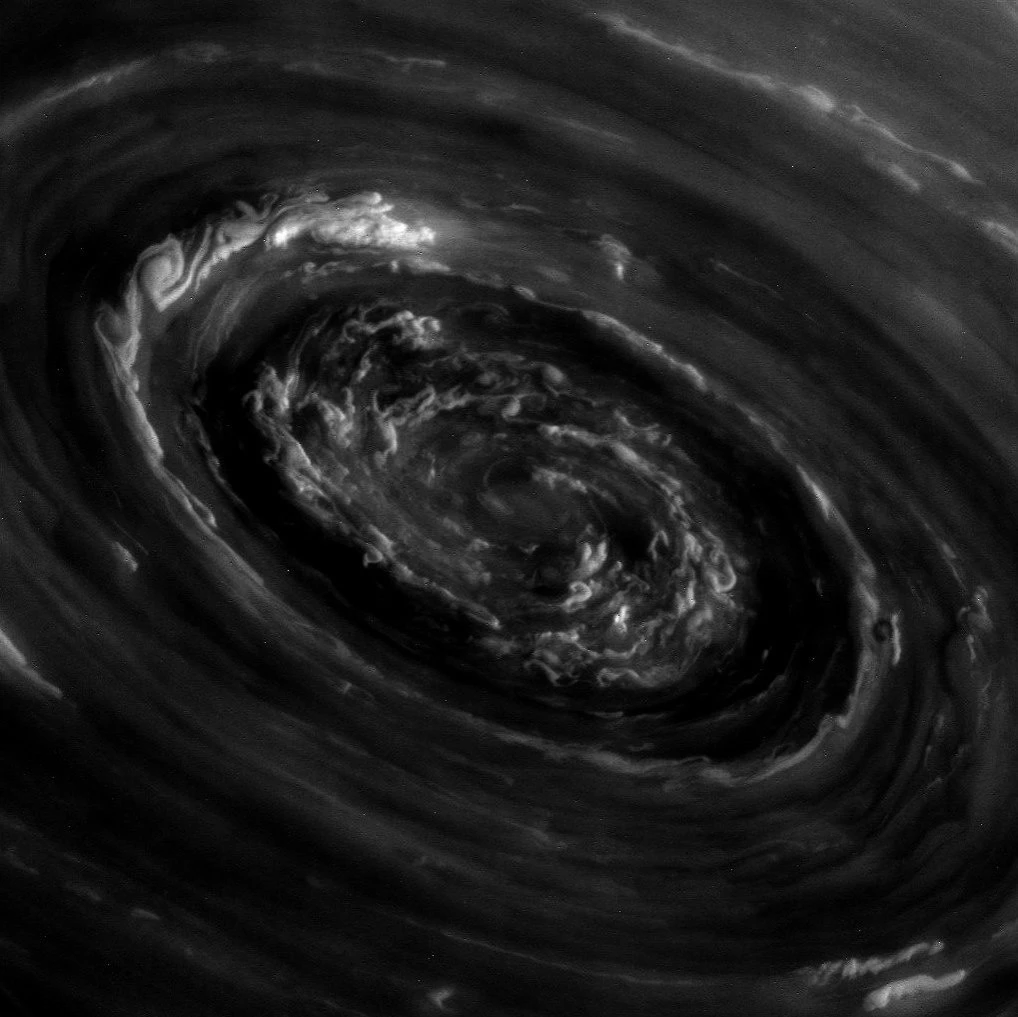
Saturn's giant hexagon is an atmospheric phenomenon found nowhere else in the Solar System. It measures approximately 25,000 kilometers across, with each side measuring 13,800 kilometers. For comparison, the average diameter of Earth is 12,742 kilometers.
A Vortex That Never Disappears
The hexagon, along with its central vortex, was first spotted by NASA's Voyager 1 and 2 probes back in the 1980s. A quarter of a century later, in 2006, the Cassini spacecraft rediscovered it in the same location. 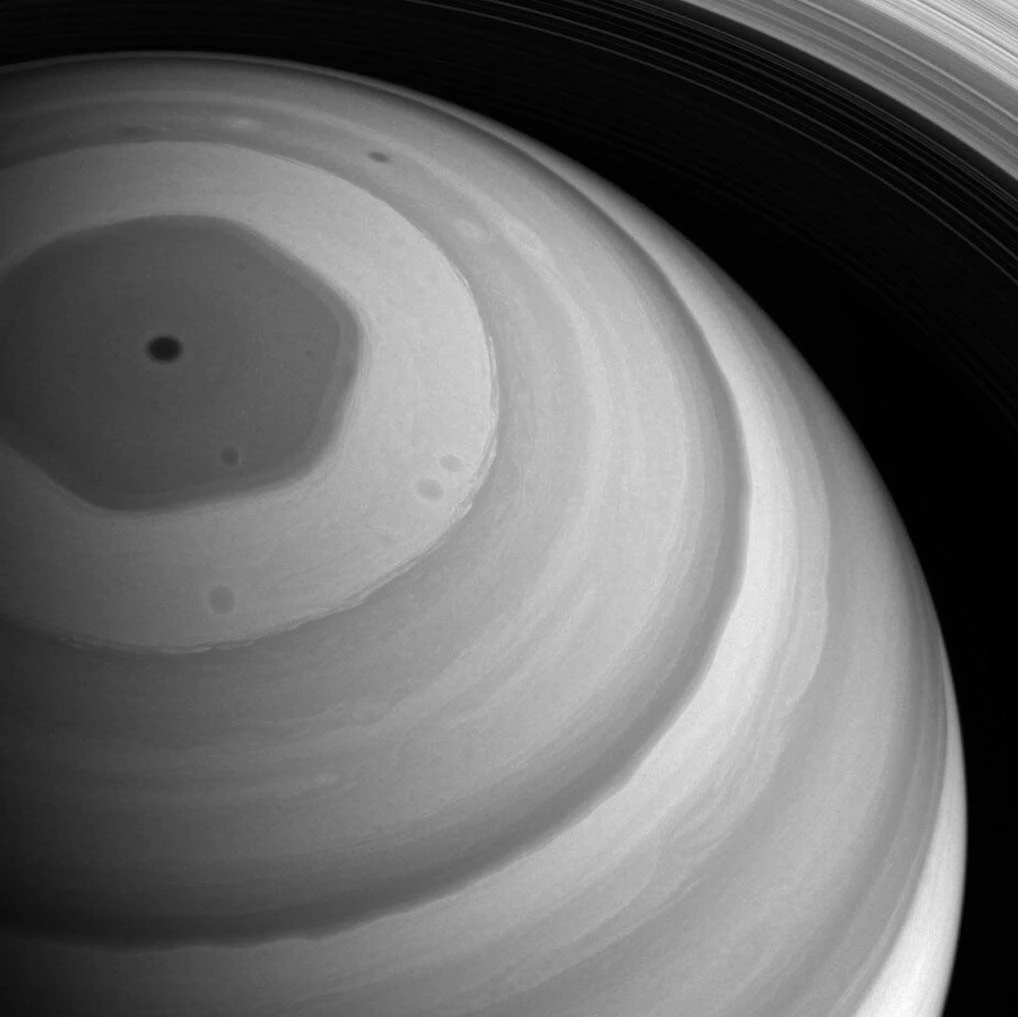
A hexagon and central vortex at Saturn's north pole. NASA Cassini image, September 9, 2016
Extended Cassini observations revealed that the hexagon rotates counterclockwise at 530 km/h, completing a full rotation every 10 hours and 40 minutes. At this speed, its regular geometric shape appears even more puzzling. Typically, vortices are rounded, like the vortex at Saturn's south pole or the Great Red Spot on Jupiter.
Infrared observations revealed that within the hexagon are areas of thinner cloud cover, revealing deeper layers of Saturn's atmosphere—at least approximately 75 kilometers below the clouds visible in normal light. Moreover, the structure itself is not limited to the cloud tops: it has been established that it extends even higher, rising more than 300 kilometers above the main cloud layers.
Furthermore, successive layers of haze were detected over this region, consisting of particles of condensed hydrocarbons resulting from photochemical reactions.
The vortex in the center of the hexagon is the warmest spot on the entire planet. While other regions of Saturn experience temperatures no higher than -185°C, in this region the atmosphere "heats up" to -122°C.
Incidentally, a characteristic "eye" can be seen in the center of the vortex—similar to tropical cyclones on Earth. 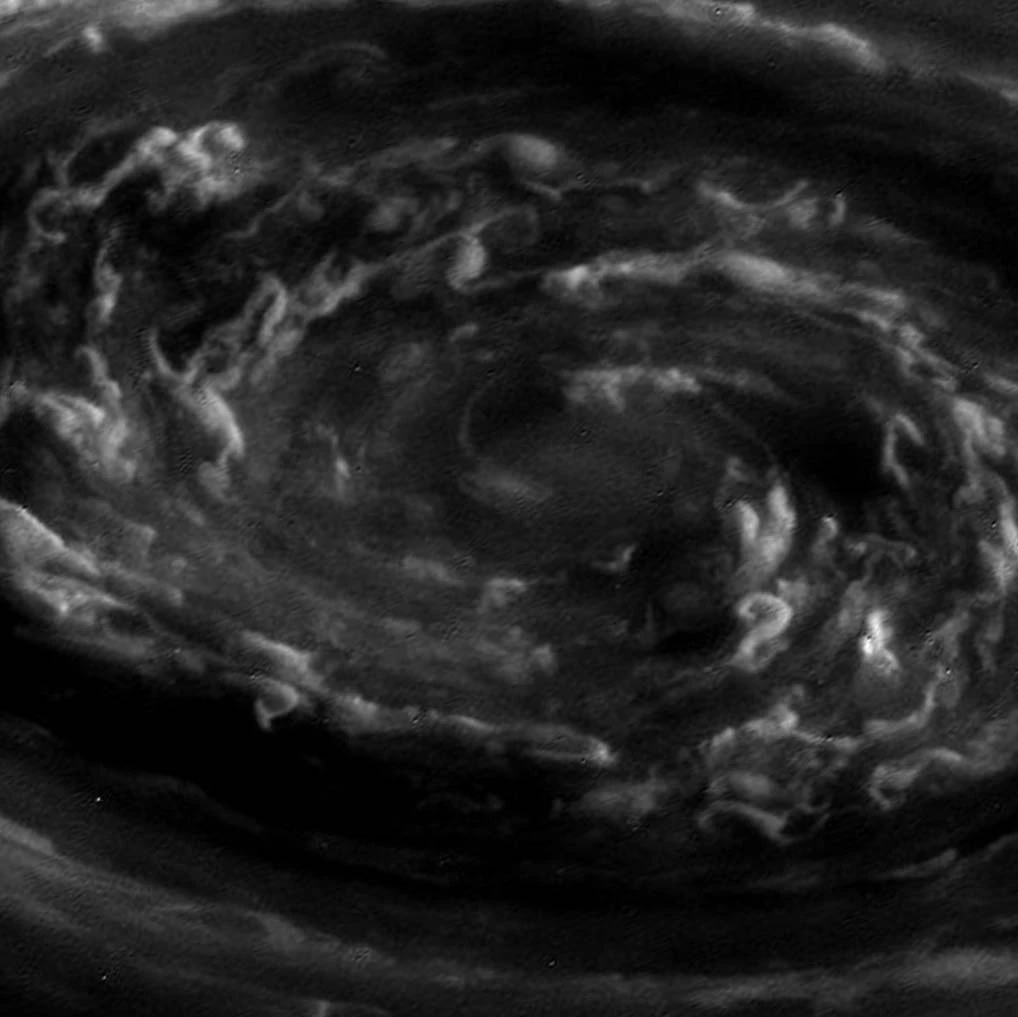
However, this storm is twice as powerful as the most powerful hurricane ever recorded on Earth.
Why a hexagon?
Scientists don't yet have a definitive explanation for this phenomenon. However, the leading hypothesis suggests that the hexagon is formed due to the interaction of jet streams in the planet's atmosphere.
This theory is supported by an experiment by a team of researchers from Oxford University. The scientists used a cylindrical container of water, simulating Saturn's atmosphere, mounted on a slowly rotating platform. Within the system were rings of varying diameters, also rotating, but faster than the vessel itself. By varying the rotation speed of these rings, which acted as the multilayered structure of the atmosphere, the researchers achieved the formation of vortices at the "poles" that deviated from a rounded shape. Under certain conditions, they took the shape of a triangle, a square, an oval, and finally, a hexagon.
Unique Asymmetry
Interestingly, a powerful vortex was also recorded at Saturn's south pole, but without a hexagonal structure. There, the hurricane has a typical round shape with a distinct "eye" in the center. Why the north and south poles behave so differently is another mystery of the gas giant.
Saturn's hexagon also changes color depending on the seasons and solar activity. Cassini images showed that at different times the vortex can be gray, golden, or even bluish in color. 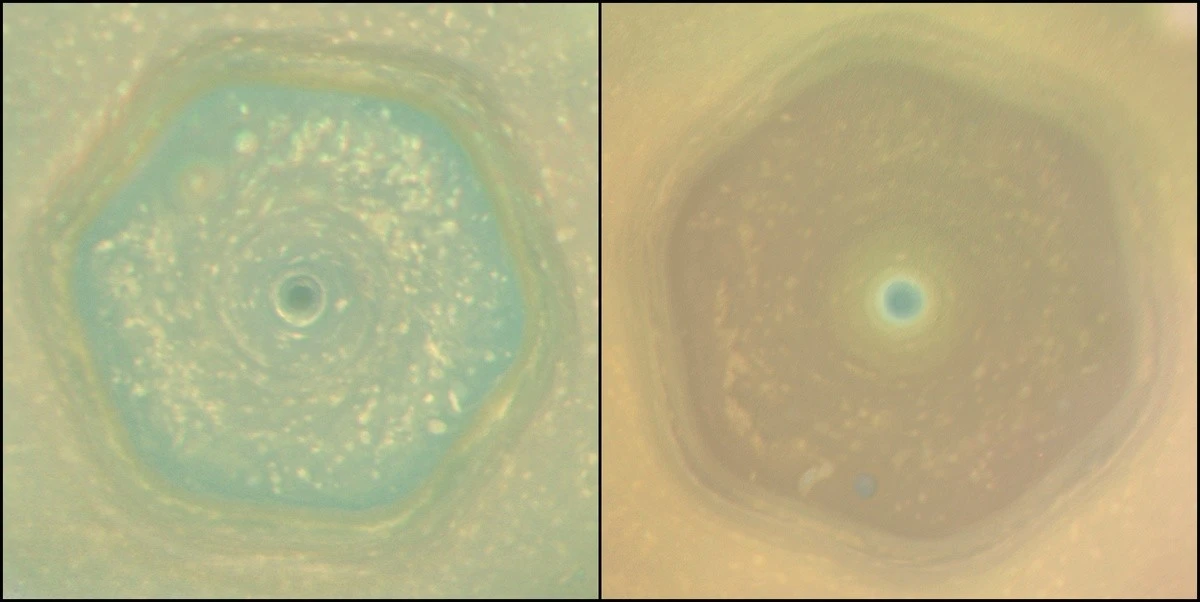
The hexagon at Saturn's north pole in 2012 and 2017. Natural-color images from NASA's Cassini spacecraft.
The hexagon at Saturn's north pole is one of the most mysterious atmospheric structures in the Solar System. This formation demonstrates how complex and unpredictable processes can be on gas giants.