Neutrinos Outpaced Light: How We Knew About a Star Exploding Before We See It (1 photo)
February 23, 1987. Supernova SN 1987A exploded in the Large Magellanic Cloud dwarf galaxy, located approximately 160,000 light-years away. 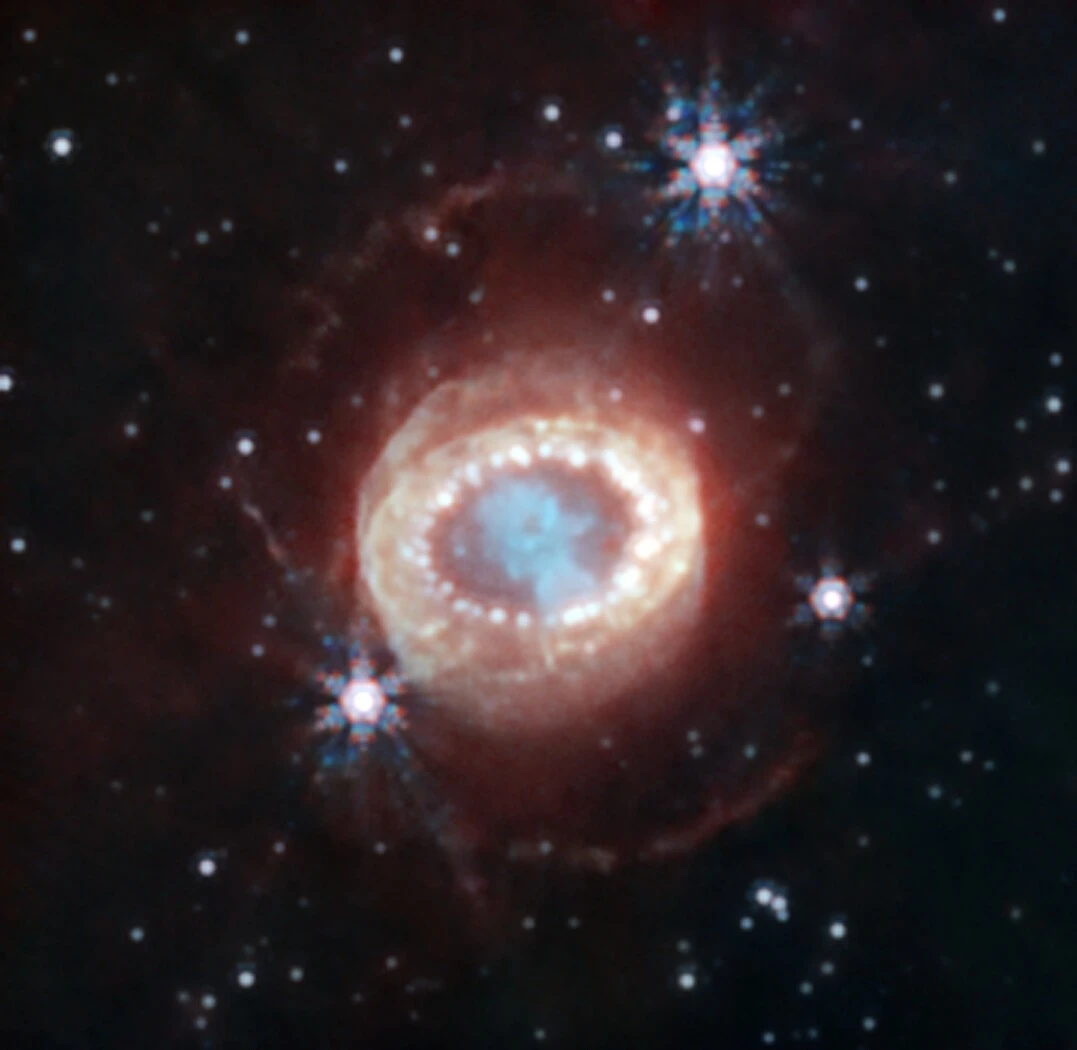
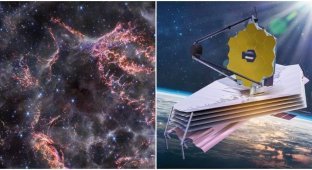
The remnant of supernova SN 1987A as seen by the James Webb Space Telescope
But three hours before the first light, which conveyed information about the explosion of a massive star, neutrinos* arrived on Earth.
*Neutrinos are a class of neutral fundamental particles that participate only in weak and gravitational interactions.
Did neutrinos reach us faster than light? Yes. And that's not a mistake. The fact is that at the moment of a star's collapse, the core emits neutrinos, which pass through the outer layers as if through empty space. Light, however, is delayed because it needs time to "break through" the exploding shell. So it turns out that neutrinos, endowed with the ability to bypass obstacles, outpace light, but do not exceed the speed of light.
On that day, Earth-based detectors detected 24 neutrinos. This confirmed that our understanding of the mechanism of stellar explosions is absolutely correct.
Today, neutrinos continue to act as our informants, capable of conveying news of cosmic catastrophes before light.