Throughout my time in science communication, I've run into dozens of people pushing the idea of a "hollow Moon." Naturally, I was curious to find out where this theory came from and what arguments its supporters use to back it up. 
So, let's unpack what's really behind the claim—and see what science actually has to say about it.
Where the Myth Came From
Speculation about a hollow Moon has been floating around since the mid-20th century. It gained widespread traction in 1970 when Soviet researchers Mikhail Vasin and Alexander Shcherbakov published an article proposing that the Moon might actually be artificial—essentially a giant spaceship.
It's important to remember that just because a theory is written by scientists doesn't automatically make it absolute truth—or even a legitimate peer-reviewed study capable of taking the scientific community by storm.
Mainstream scientists rightly ignored Vasin and Shcherbakov's paper, but science fiction fans ate it up—after all, H.G. Wells had explored a similar idea in his 1901 novel "The First Men in the Moon." From there, the "hollow Moon" hypothesis spread by word of mouth, found its way into print media, and eventually settled into internet conspiracy forums.
Argument #1: The "Ringing" Moon
The most widely cited piece of "evidence" stems from a genuine historical event. During the 1969 Apollo 12 mission, after ascending from the surface, astronauts deliberately crashed the lunar module's ascent stage back onto the Moon. The goal was to record the impact using seismometers left on the surface, allowing scientists to model the Moon's interior without having to drill down to its core. 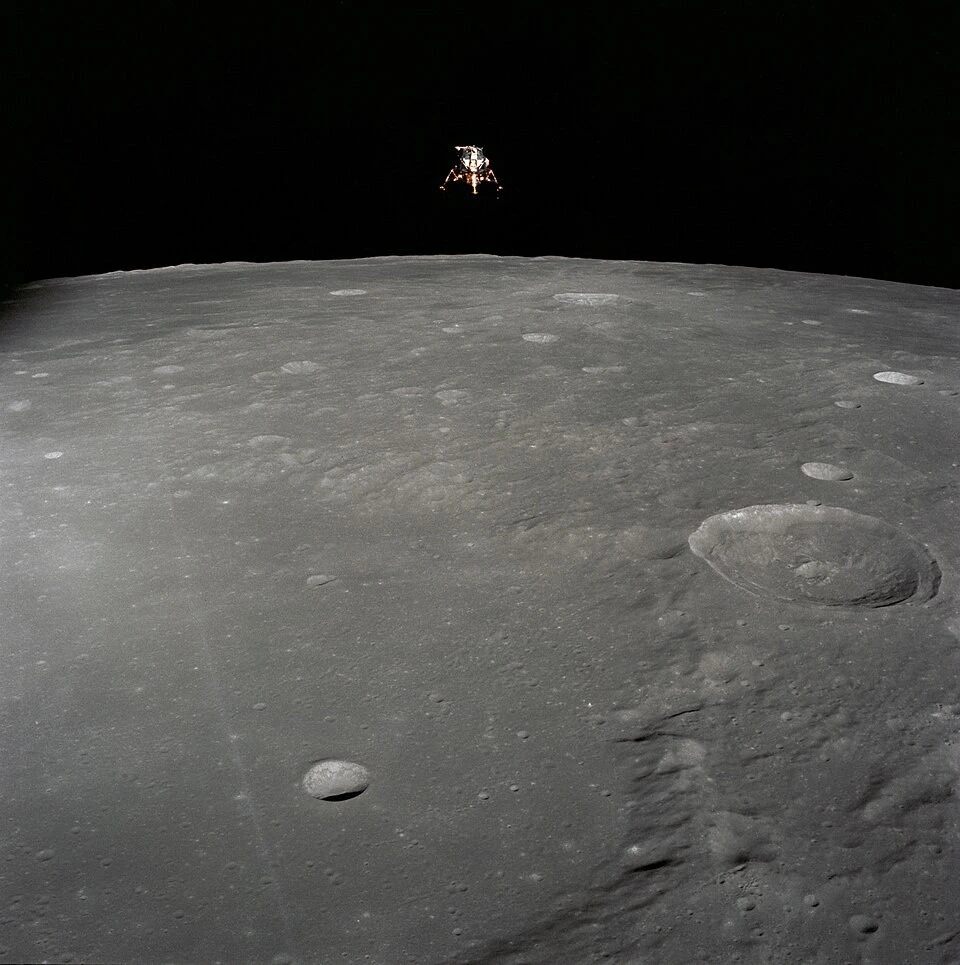
Apollo 12 lunar module begins its descent to the Moon's surface
Just to clear up any confusion: once the astronauts lifted off from the Moon, docked with the orbiter, and transferred to the command module, the ascent stage was no longer needed. NASA directed it back down, crashing it into the Moon at roughly 6,000 kilometers per hour. By that point, the astronauts were already on their way back to Earth.
Instruments recorded that after the impact, the Moon began to "ring"—with vibrations continuing for an astonishingly long time, nearly an hour.
Proponents of the hollow Moon theory interpreted this as proof of a void inside, arguing that only a hollow object could vibrate for so long, like a giant bell.
In reality, this prolonged "ringing" is due to the complete lack of water on the Moon. On Earth, moisture quickly dampens seismic waves. Lunar regolith, by contrast, is bone-dry and absorbs vibrations poorly, allowing shockwaves to dissipate far more slowly than on Earth. This effect doesn't contradict a dense, solid lunar structure in the slightest.
Argument #2: Low Average Density
A seemingly more compelling argument relies on actual numbers: the Moon's average density is roughly 3.34 g/cm³, which is indeed significantly lower than Earth's average density of about 5.51 g/cm³. Conspiracy theorists leap to a clever conclusion: if the density is lower, it must be empty inside. 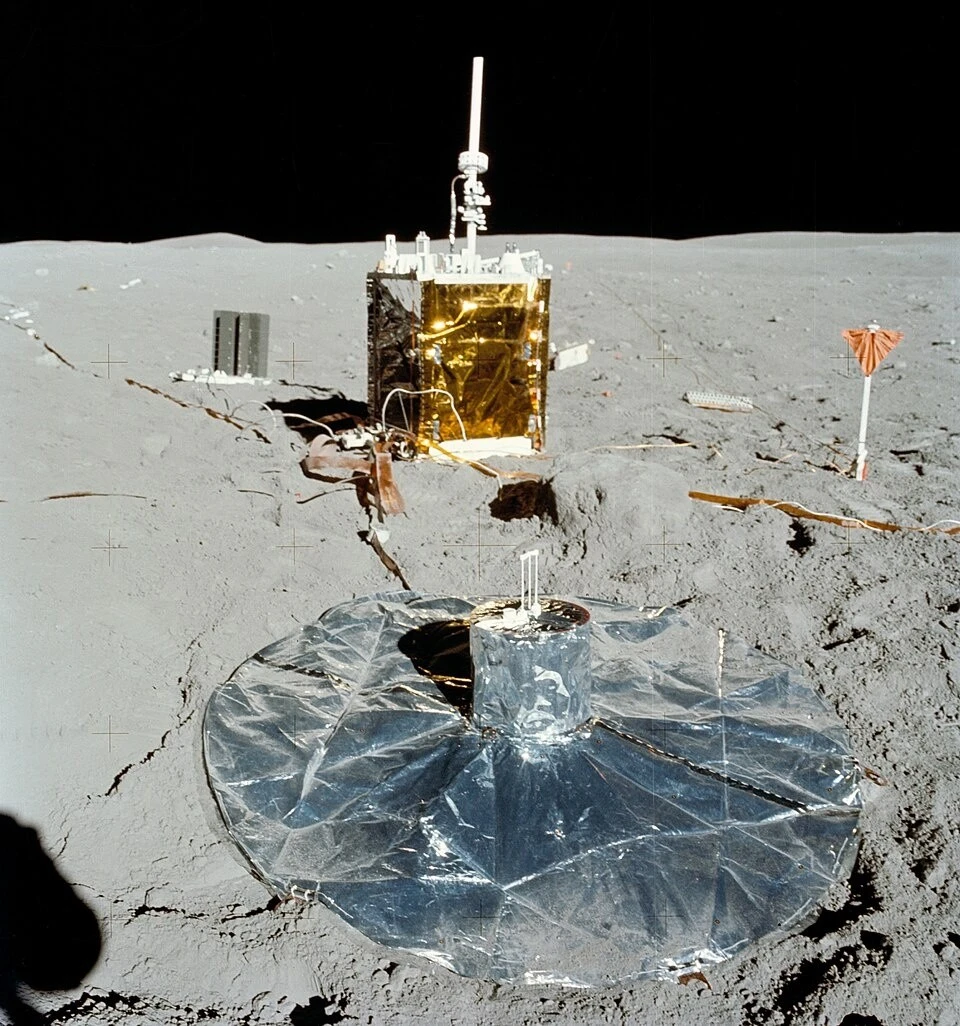
Apollo 16 lunar seismometer
As usual, the reality is far simpler. Earth's higher overall density is due to its large, ultra-dense iron-nickel core, which makes up a substantial portion of the planet's volume and mass. The Moon's core is much smaller relative to its overall size, even though its composition is roughly identical to Earth's.
For comparison, the Moon's solid inner core has a diameter of roughly 516 kilometers. Earth's inner core is vastly larger, spanning around 2,400 to 2,440 kilometers.
What Science Actually Knows About the Moon's Interior
The Moon's internal structure is far better understood than conspiracy theorists like to think—and that's thanks to those very seismometers installed by the Apollo astronauts. Operating until 1977, the instruments registered thousands of moonquakes caused both by the Moon's natural contraction as it continues to cool and by meteoroid impacts of various sizes.
This data laid the groundwork for seismic tomography—a method that allows scientists to peer inside a celestial body without cutting it open. Seismic waves travel differently through different materials, and by tracking how they refract and reflect, scientists can reconstruct what lies beneath the surface. 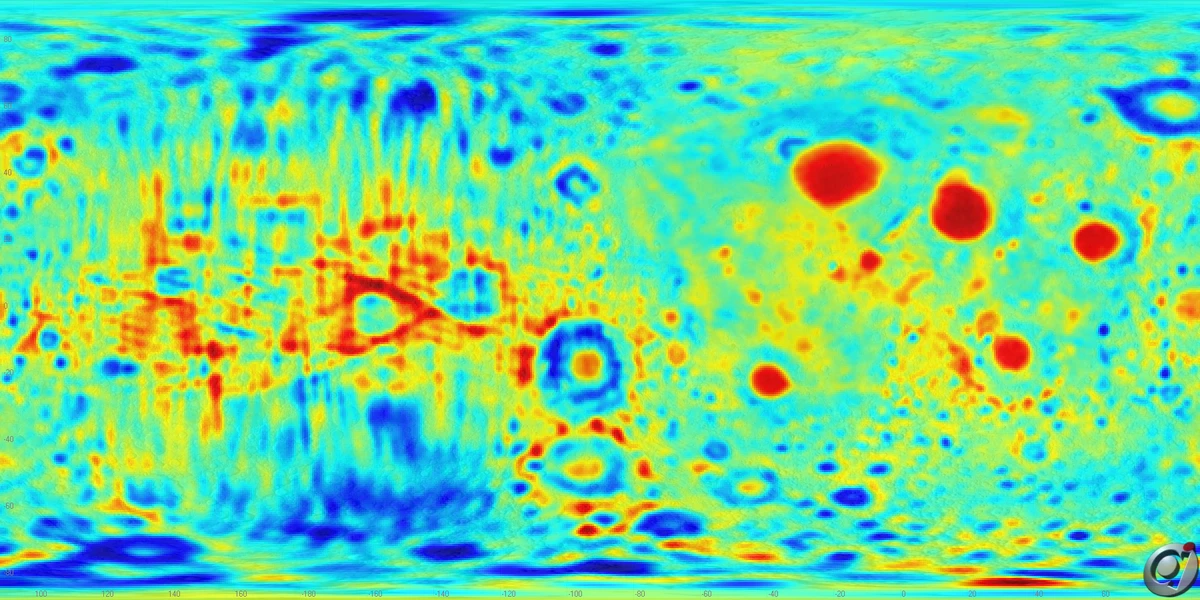
Visualization of the Moon's gravitational field based on data from the Lunar Prospector spacecraft, launched January 7, 1998
That is precisely how a detailed model of the Moon's interior was created.
Our current knowledge of the lunar interior was further refined by missions like NASA's Gravity Recovery and Interior Laboratory (GRAIL), launched in 2011 to map the Moon's gravitational field. All data points to a complex yet familiar layered structure: a relatively small, partially molten iron core at the center, surrounded by a mantle of dense silicate rock, and an outer crust. None of these studies have found any trace of large hollows or empty caverns.
Why the Myth Persists Anyway
For the exact same reason people still believe the Earth is flat, that no one ever went to space (because "they won't let us"), that a twin Earth is hiding behind the Sun, or that Mars survived a nuclear war.
Not because there isn't enough data, but because, first of all, global education systems have been in a state of permanent crisis for a long time. And second, many people simply don't like dry scientific explanations.
It's far more thrilling to believe in a global conspiracy, secret lore, and the mystical. An uneducated person reads a bunch of conspiracy nonsense, and something clicks: "Aha! I get it now! You can't fool me!" After that, they feel like they're part of something big—as if they've outsmarted the system, as if they're part of an elite that sees what others can't.
That very feeling—of being chosen, enlightened, and special—is the real reason the hollow Moon myth hasn't faded into history.
Add your comment
You might be interested in:












Toyota Baby Lunar Cruiser concept for the Moon and Mars (7
The success of the Sphere concert hall in Las Vegas gave

Cats helped create a difficult boss in a popular game

Soviet village in the 40s (26 photos)

Feel its pain

20 Times Reality Fell Cruelly Short of Expectations (21

New Glenn rocket explosion: a "disaster" that is

What happens if you go into outer space without a spacesuit

24 photos proving that time flies inexorably (25 photos)

A single gesture that made someone’s day: a man gives a

How Rowan Atkinson transforms into Mr. Bean

A clear demonstration of the difference between a $1, $5,

Top 10 Foods That Lower Blood Pressure (11 photos)

An American man reveals a bunker he spent 3 years preparing

Witches on roller skates—brooms included

An orchestra plays a prank on their conductor during his

A dad made a realistic WALL-E costume for his daughter

17 Photos of Famous People Goofing Off Like Kids (18 photos)
