The Last Mystery of Alexander the Great: Where Did 2,000 Macedonian Ships Disappear To? (16 photos)
By the age of 30, Alexander, son of King Philip of Macedon, ruled a vast empire stretching from Greece all the way to India. Even during his lifetime, his contemporaries hailed him as "the Great," while Egyptian priests declared him the living incarnation of the god Ammon. Alexander earned his title. Driven by unquenchable ambition, the king turned his eyes west, determined to conquer the western Mediterranean and unite the entire known world under his rule. 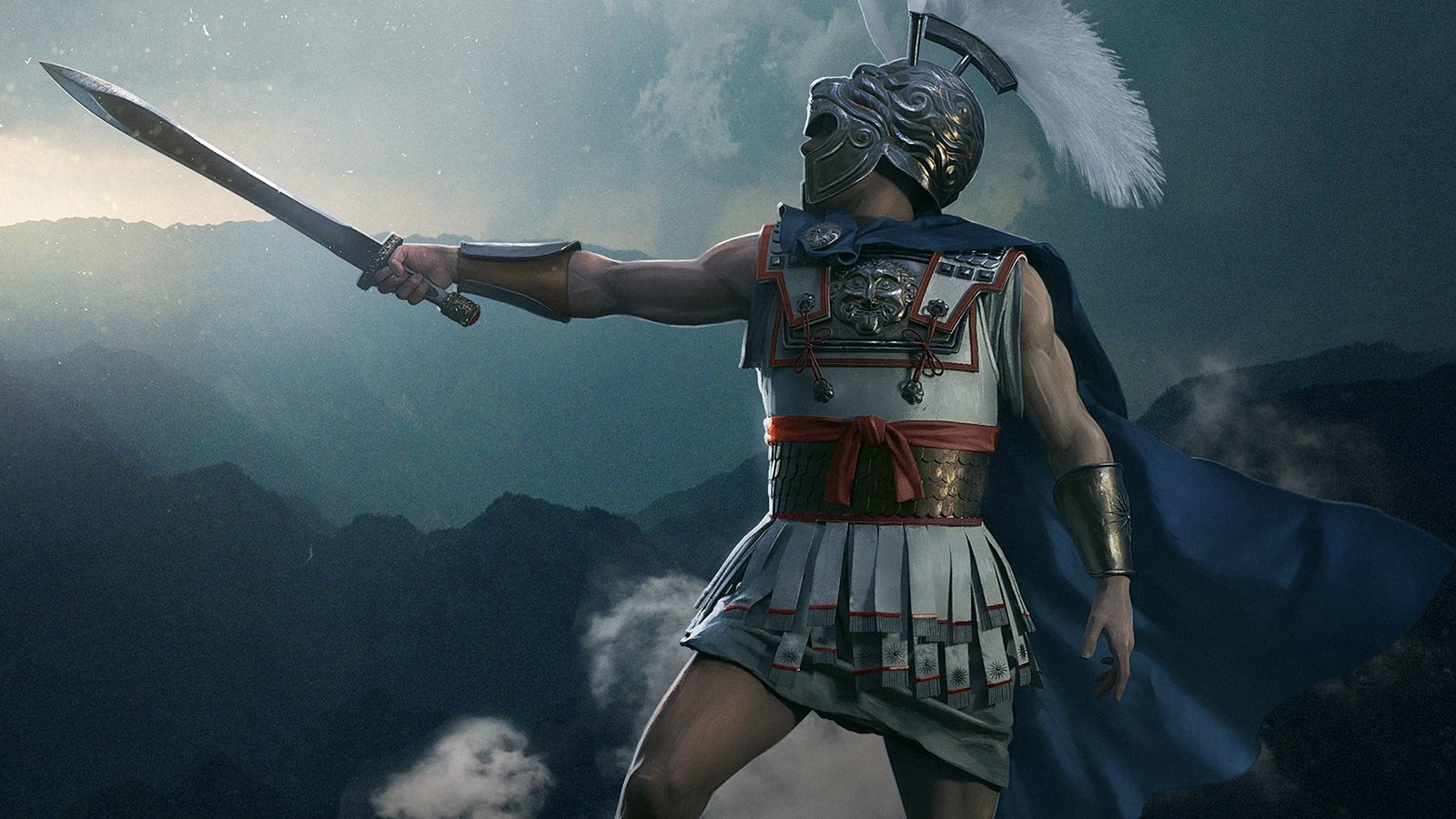
The Macedonian Armada
Macedon’s main rival in the West was set to be Carthage, and Alexander assembled a massive armada of 2,000 ships for the campaign. But the king’s grandiose plans were cut short. On June 13, 323 BC, Alexander died at just 32 years old. Centuries later, historians still debate the fate of the colossal fleet that set sail from the harbor of Babylon under his orders, only to vanish into thin air. 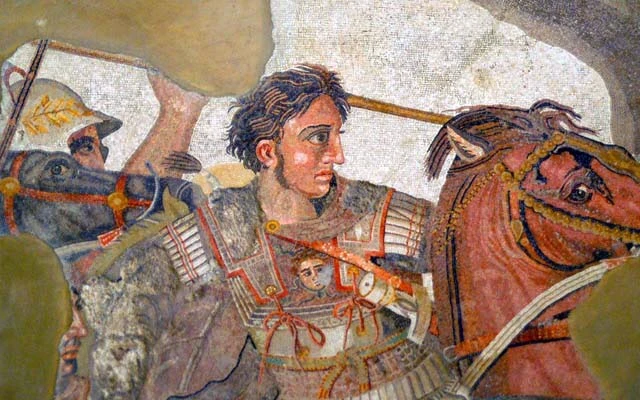
Portrait of Alexander the Great from a fresco dating to around 330 BC.
According to the ancient Greek historian Arrian, the king gave his fleet an audacious mission: circumnavigate the Arabian Peninsula and Numidia, pass through the Pillars of Hercules (the Strait of Gibraltar), enter the Mediterranean, and strike Carthage from the east while Alexander attacked from the west. Defeating such a powerful foe would have made Alexander the undisputed ruler of the known world. 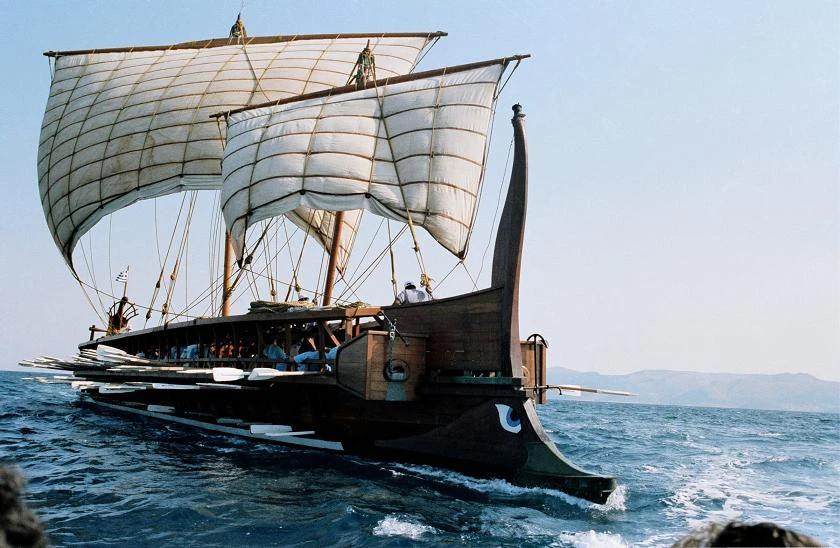
Modern reconstruction of a trireme from the era of Alexander the Great.
The fleet comprised 80 30-oared warships (triremes) and 1,900 supply ships carrying food, water, equipment, horses, and troops. Each trireme carried 170 rowers and 30 heavily armed hoplites. Alexander appointed Admiral Nearchus—his close companion and childhood friend—to command the armada. Nearchus was renowned for his extraordinary courage, composure, and seamanship. 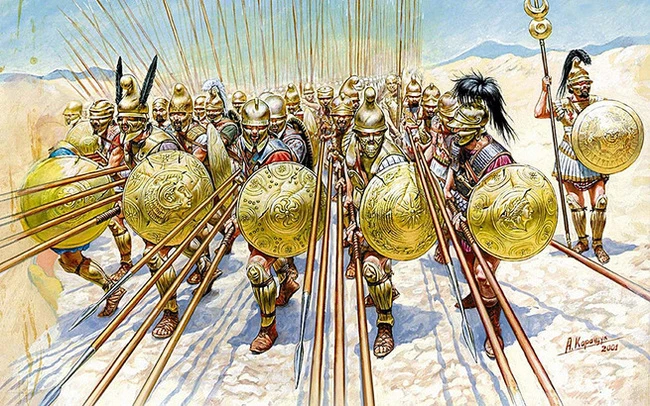
The Macedonian phalanx in battle.
Beyond sailors and soldiers, the fleet is believed to have carried craftsmen, young men and women meant to establish new colonies, and scholars tasked with documenting the expedition’s discoveries along the way.
A Navigational Trap or the Will of the Gods?
Researcher Andrei Dybovsky concluded that while sailing along the African coast, Nearchus and his fleet fell into one or more "navigational traps"—a convergence of natural factors that almost imperceptibly veers ships off course. Hugging an unfamiliar coastline, the Macedonians likely failed to account for local ocean currents that gradually dragged them away from their intended route. 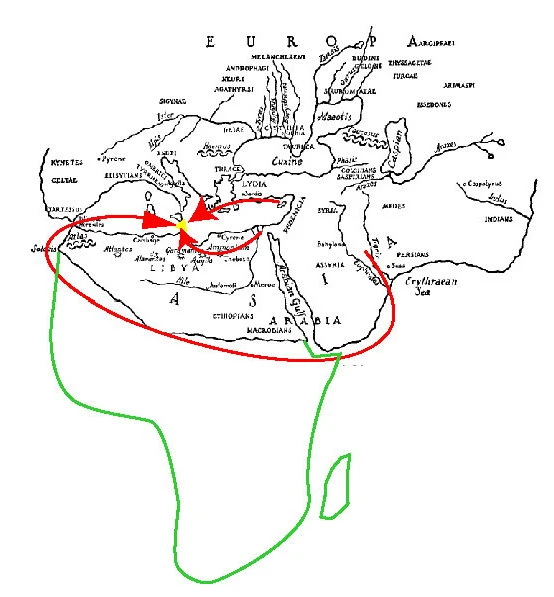
Ancient geographical worldview and the strategic plan for the attack on Carthage.
Their attempt to double Africa could have been foiled by navigational miscalculations, optical illusions, strong countercurrents, or massive freshwater discharges from major rivers knocking the fleet off course. For various reasons, the ships drifted further from the coast into the open ocean, where they either perished or eventually washed ashore on the coast of South America. 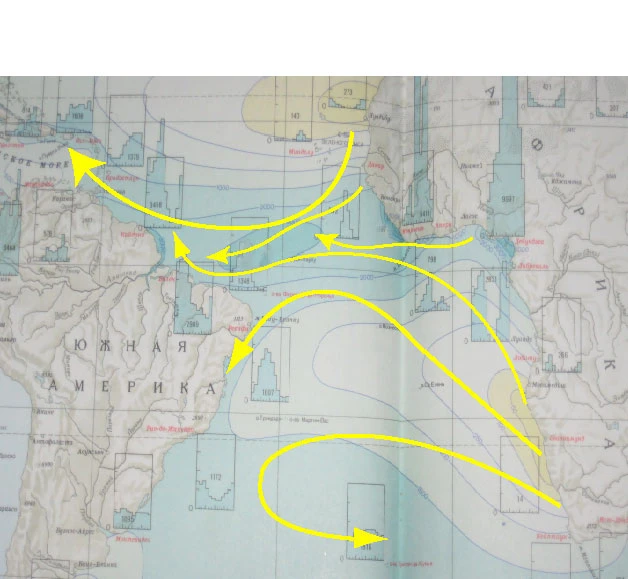
The hypothetical route of Nearchus's fleet in the event of a navigational error.
The fastest current in the Atlantic, flowing over the Romanche Trench, could have swept the ships toward the island of Fernando de Noronha, just 200 miles off the South American coast. Prevailing westerly winds could have pushed them further toward the unknown continent. Devoutly religious, the Macedonians may well have seen these winds pushing their sails as a divine sign, trusting in the will of the gods to guide their voyage.
Macedonians in South America
According to this theory, when the Macedonian fleet reached South America, the sailors and soldiers donned their helmets before setting foot on shore—helmets strikingly mirrored in the later attire of the Moche culture. Scholars of indigenous civilizations have noted that Moche warriors wore sturdy woven headgear with curved crests bearing an uncanny resemblance to the metal helmets of Alexander’s era. 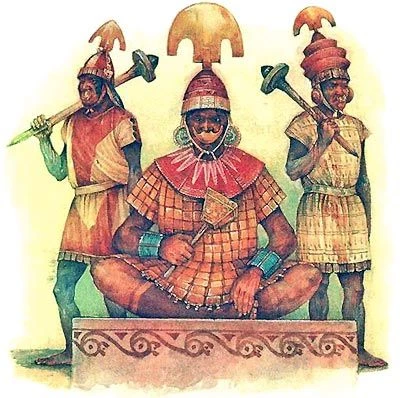
Moche warriors.
Researchers point to indirect evidence of contact between indigenous peoples and Hellenistic culture, such as striking similarities in ancient games found both in the Mediterranean and the Americas. 
South American bamboo panpipe.
Another piece of evidence is the panpipe, a favorite musical instrument of the ancient Greeks. Panpipes virtually identical to Greek designs have been unearthed in modern-day Colombia, Panama, and the Solomon Islands. 
Ancient Greek panpipe.
In Mexico, archaeologists uncovered a loom identical in design to ancient Greek models. Proponents of this theory claim to have documented over a hundred parallels between Hellenistic and Native American cultures.
The Long Journey
The boldest theory regarding the disappearance of the fleet and tens of thousands of men was proposed by two American archaeologists, Harold Gladwin and Constance Irwin. They suggested that June monsoons in the Arabian Sea forced Nearchus’s ships east toward India rather than west toward Africa. There, the sailors resupplied and picked up Macedonian soldiers left behind after Alexander’s Indian campaign. 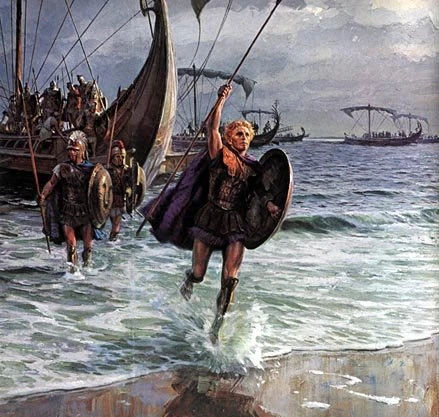
From India, the fleet sailed toward Burma and navigated south along the Malay Peninsula. Turning east while keeping the northern coast of Sumatra in sight, they reached the islands of Indonesia. The epic journey continued toward New Guinea and the Polynesian archipelagos. Eventually, the fleet crossed the Pacific Ocean, reaching the shores of South America. The voyage took 25 years; though many original sailors and soldiers perished along the way, their ranks were continuously replenished by locals from island tribes along the route.
Polynesian Macedonia
Historical discourse was long dominated by "isolationists" who believed ancient civilizations developed in total isolation from one another. However, recent discoveries and experiments have reshaped that view. The expeditions of Norwegian explorer Thor Heyerdahl aboard ancient-style vessels demonstrated that ancient mariners could traverse vast oceanic distances by riding deep-sea currents. 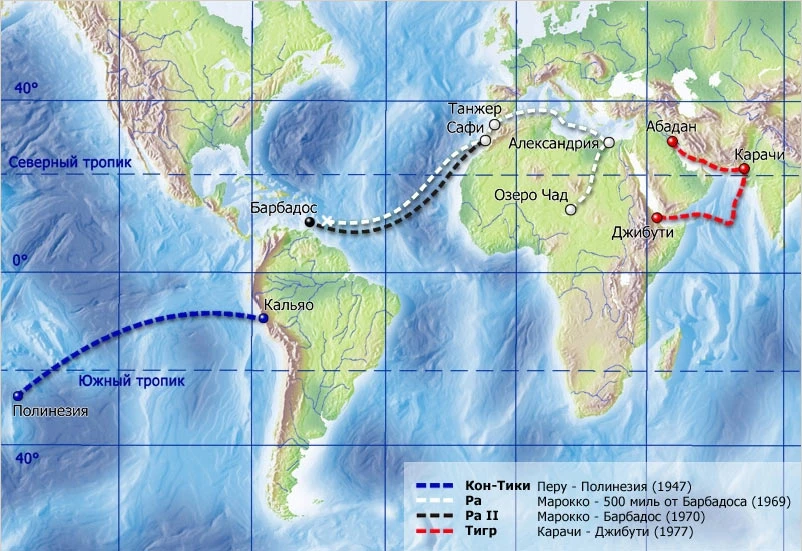
Map of Thor Heyerdahl’s expedition routes.
Early European explorers in Polynesia were astonished to find a significant blonde population among the native inhabitants. On Tonga, blonde individuals made up 10% of the population, while the neighboring island of Mo'orea was known locally as the "island of magical golden-haired people." Blonde traits were also remarkably prevalent on the New Zealand island of Tureho. Studying this phenomenon, Thor Heyerdahl posited that the islanders had interbred with ancient European mariners who introduced these genetic traits. 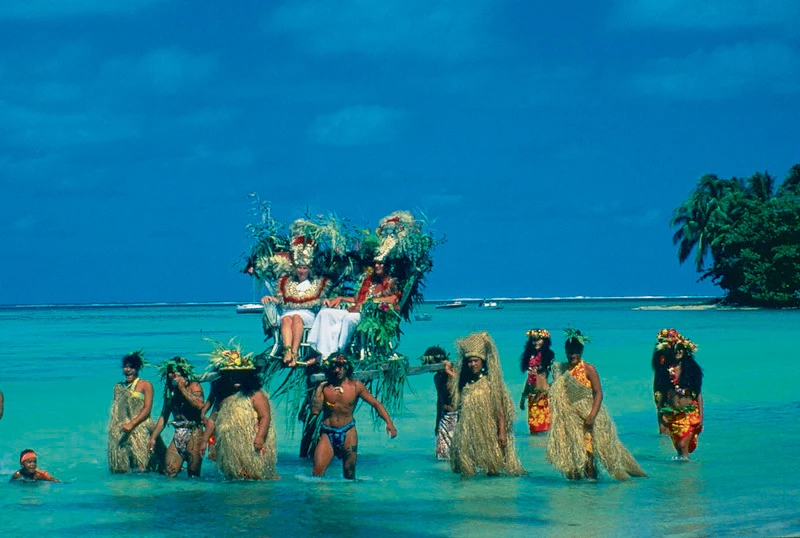
Mo'orea Island.
Another intriguing parallel lies in the central role of astronomy and celestial navigation in both ancient Greek and Polynesian cultures. Island navigators used strikingly similar methods to map stars and interpret their significance. Like the Greeks, Polynesians mastered celestial navigation, enabling them to traverse thousands of miles across open ocean and reliably locate tiny islands amidst vast aquatic expanses.
Macedonian Hawaiians
Renowned American scholar Joseph Campbell compared Polynesian oral traditions with Homer's
Iliad
and
Odyssey
, finding striking narrative parallels. But the biggest surprise came from Hawaii. When Captain Cook first set foot on the Hawaiian Islands, he was struck by the headgear of local warriors, which bore an uncanny resemblance to the crested helmets of Greek and Macedonian hoplites. 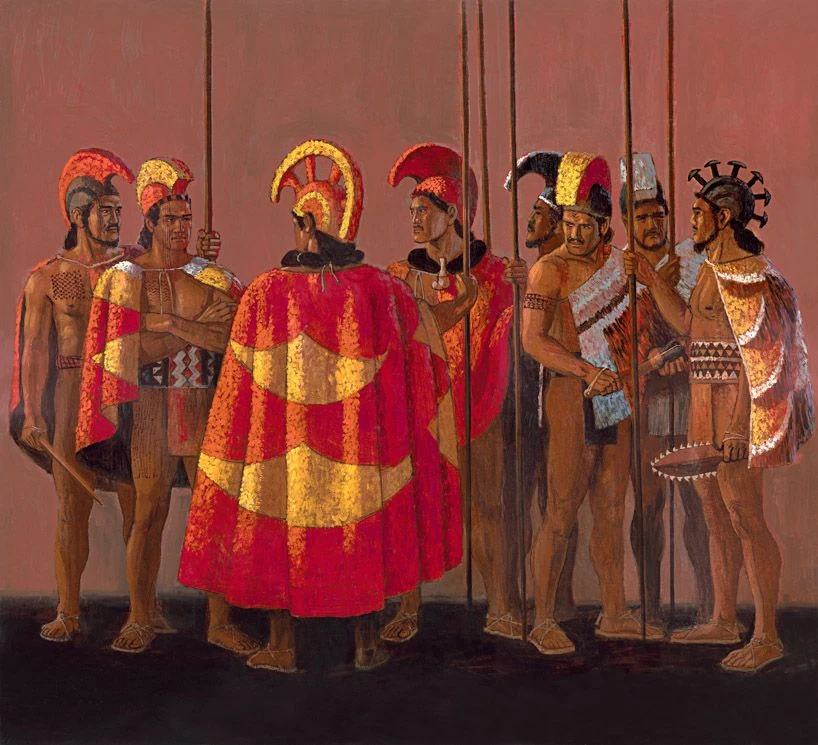
Warriors of the Hawaiian Koa tribe.
Known as
mahiole
, the feather-crested helmet was a symbol of the ruling nobility, reserved exclusively for those clad in ceremonial feathered cloaks. Intriguingly, Koa warriors fought in tight phalanx formations armed with long spears, just like Hellenic infantry. These uncanny parallels gave rise to the theory that Nearchus’s fleet—or a fragment of it—reached Polynesia and established dominion over the native population. 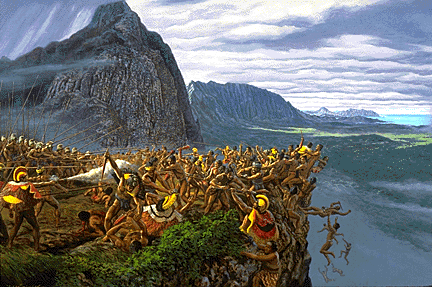
Hawaiian phalanx.
The small group of newcomers became the ruling elite, marrying local women. As generations passed, the Greeks, Macedonians, Phoenicians, and Egyptians merged into the island population. Their descendants eventually lost the memory of their ancestral homeland, yet retained their high status—symbolized by the hoplite helmet. Time eroded the original metal helmets, prompting descendants to carve wooden replicas and replace horsehair crests with vibrant bird feathers. 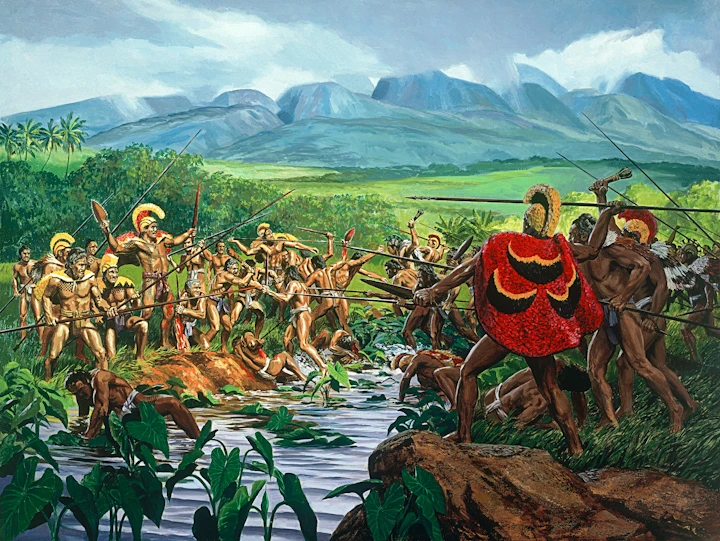
However, American archaeologist Stoddard Lothrop and historian Valery Gulyaev, a lifelong scholar of ancient civilizations, dismiss Gladwin's hypothesis as groundless. Citing Ptolemy, they maintain that Nearchus never vanished into oceanic oblivion; instead, he became satrap of Lycia and Pamphylia (along the southern coast of modern-day Turkey) and fought alongside General Antigonus Monophthalmus in the Wars of the Diadochi over Alexander’s empire. 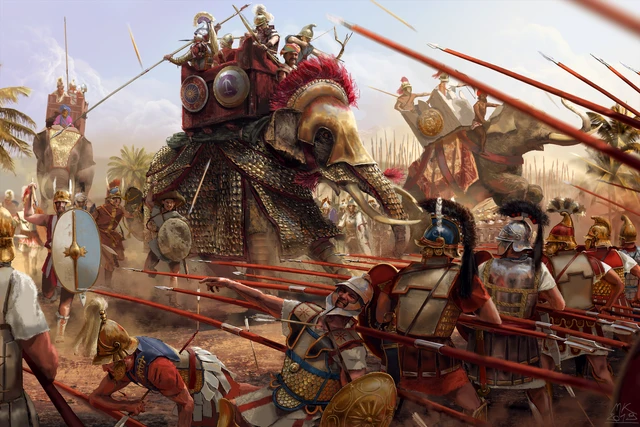
Every theory has its strengths and flaws. Proving or disproving them will require interdisciplinary collaboration among archaeologists, ethnographers, linguists, and seasoned mariners capable of practical nautical assessment rather than mere theoretical debate. History guards countless mysteries that still await resolution—much like recent findings suggesting the Great Sphinx of Giza was carved long before the pyramids it stands guard over.