Drying off the T-Rex: Behind the Scenes of ‘Jurassic Park’ (14 Photos)
On the set of 1993’s
Jurassic Park
, the actors had real creatures to react to, touch, and run from. Stan Winston’s team built full-scale animatronic dinosaurs. While CGI gave them freedom of movement, close-up shots called for heavy physical rigs complete with realistic skin, teeth, and hydraulics. 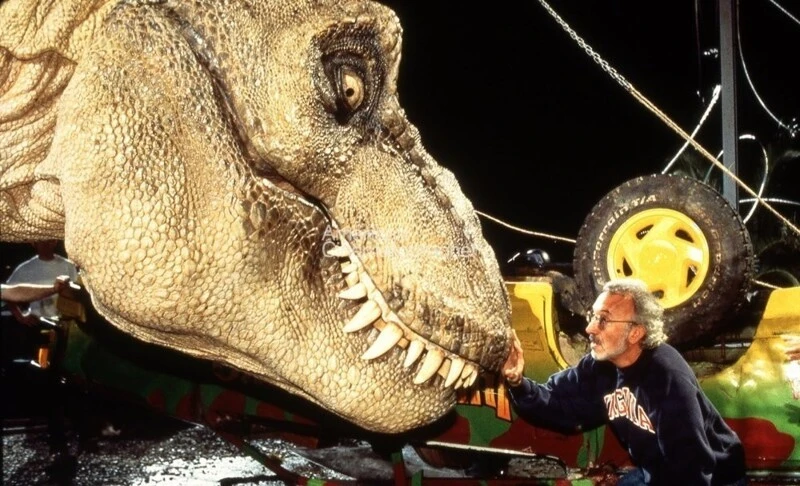
Stan Winston alongside the animatronic T-Rex. Photo by Murray Close/ American Cinematographer Archive.
Work began with small maquettes: the team first had to establish how each creature would look before deciding how it would move. In an interview with
American Cinematographer
, Winston explained that roughly a year and a half of their two-year timeline was spent purely on design and development. The full-scale form was assembled using scaled-up cross-sections of the small model, after which the sculpture was refined and a skin was crafted for the mechanical framework. 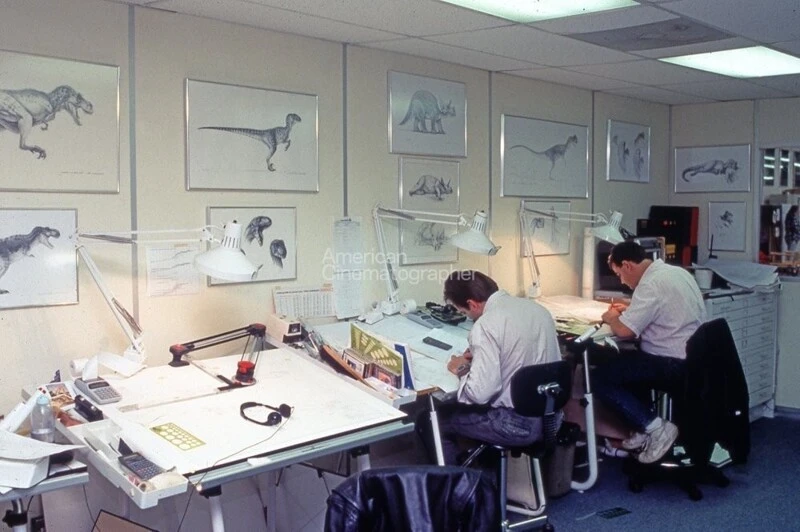
Artists designing the look of the dinosaurs. American Cinematographer Archive. 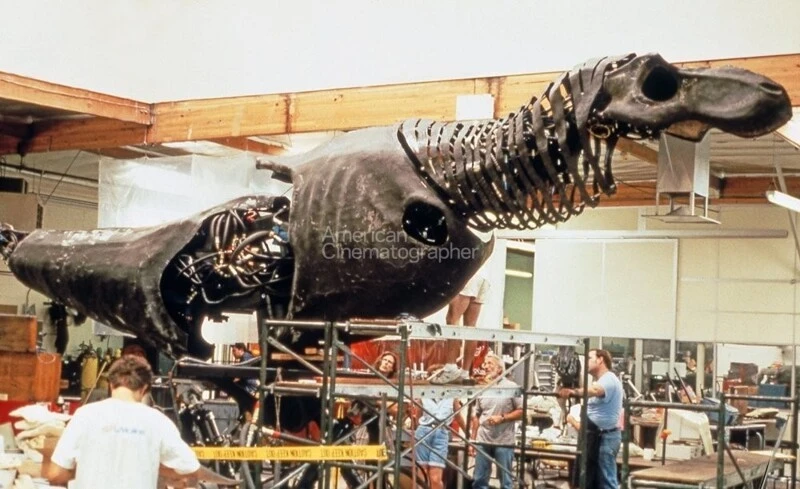
The T-Rex rig in the workshop. American Cinematographer Archive.
Different tasks required different raptors. Some were suits worn by performers, while others were animatronic puppets. Specific arms and legs were built separately for targeted close-ups. Consequently, a single creature on screen was actually a whole ensemble of rigs—a setup tailored for one motion wasn't necessarily suitable for another. 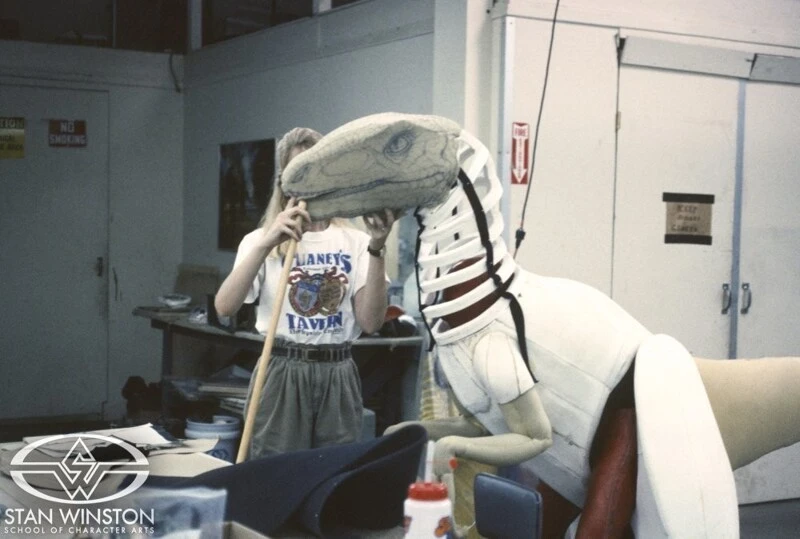
Marilyn Dozer-Chaney working on the raptor suit skin. Stan Winston Studio Archive.
The T-Rex presented its own unique challenge: its long, heavy neck needed to flex while the outer surface maintained its form over the internal mechanics. Alan Scott recalled replacing traditional individual rings with a continuous spring-like coil that compressed and expanded as the neck moved. They had first tested a similar solution on a raptor. 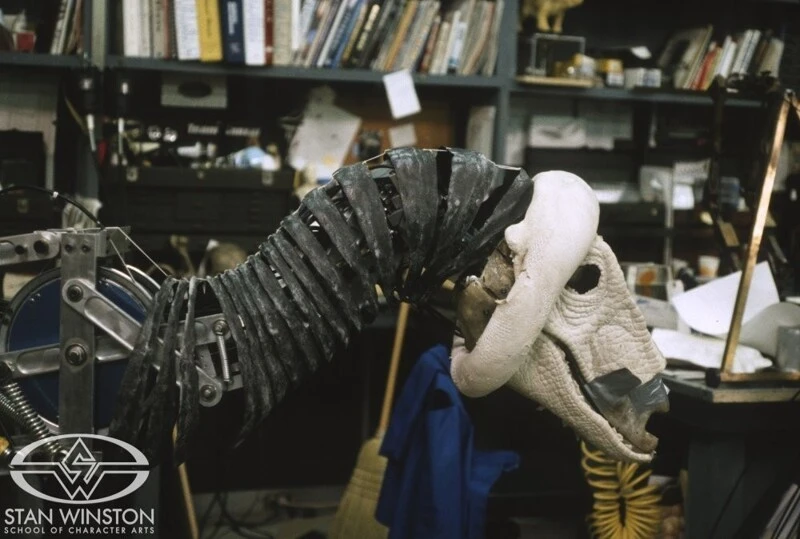
The coiled neck mechanism of the animatronic raptor. Stan Winston Studio Archive. 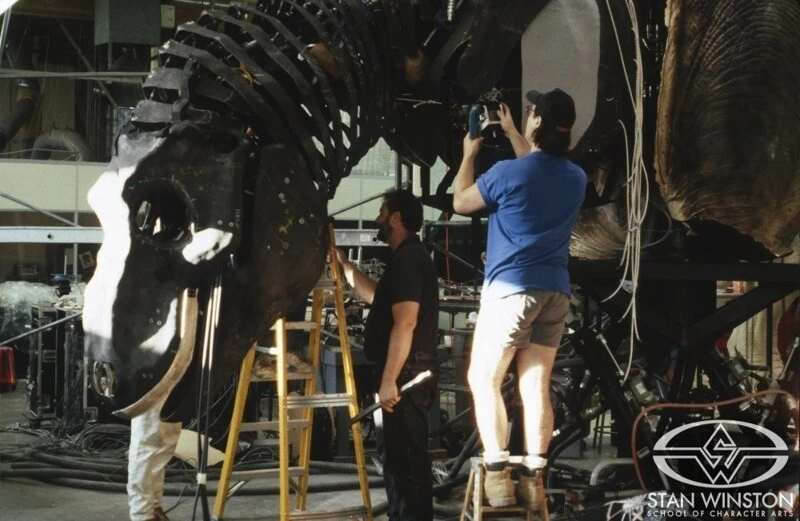
Tim Nordella and Mike Trcic working on the T-Rex neck. Stan Winston Studio Archive.
Next came fitting the skin. The large foam-latex pieces shrank during curing, leaving gaps that had to be filled with inserts and resculpted to match the folds. Archive photos capture this intermediate stage in detail. The corners of the mouth also demanded special attention: the webbing had to fold inward; otherwise, excess skin would bulge out when the jaws closed. 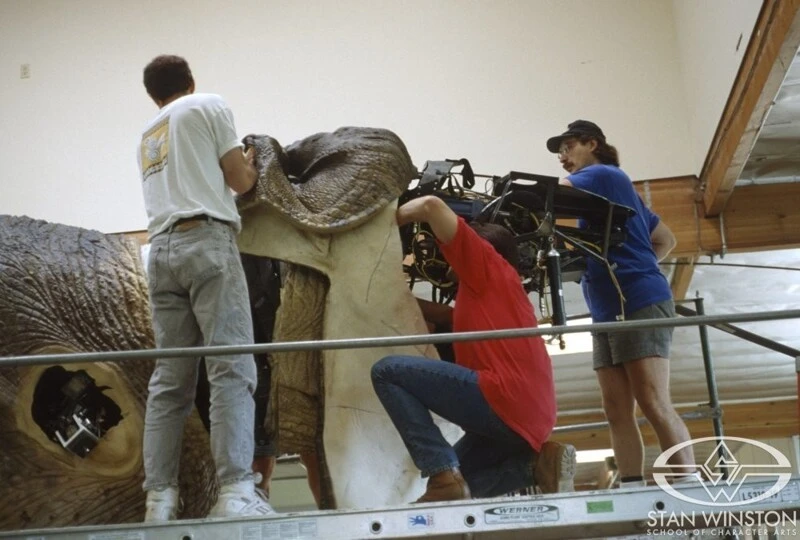
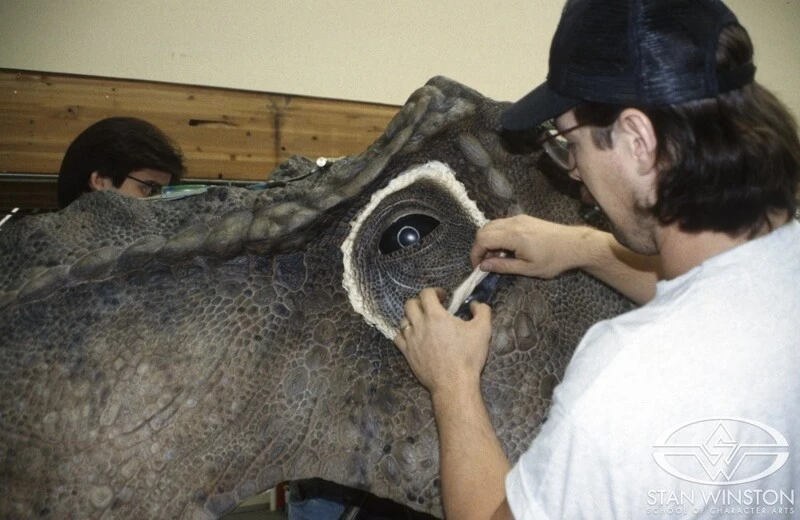
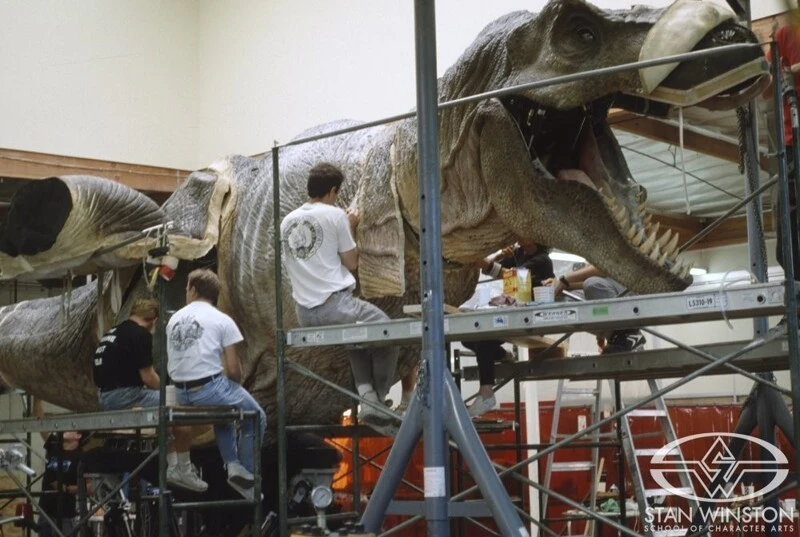
Inserts placed between large skin panels prior to final detailing. Stan Winston Studio Archive. 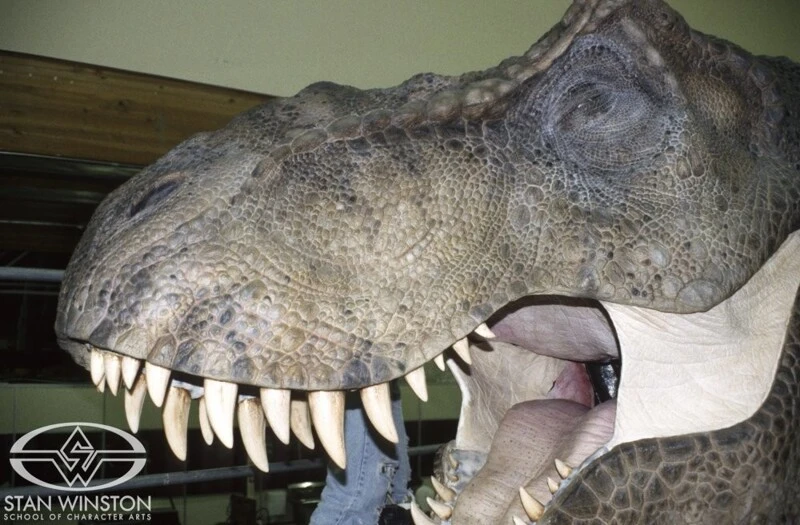
Fitting the flexible skin at the corner of the mouth. Stan Winston Studio Archive.
To achieve smooth motion, the massive hydraulic systems had to work in perfect sync. Winston devised a method to control the T-Rex using a 1:5 scale mechanical telemetry rig (a telemetry device or "Waldo"). Puppeteers manipulated the smaller model, and the full-sized dinosaur mirrored its every move. A successful sequence could be recorded and replayed for subsequent takes. 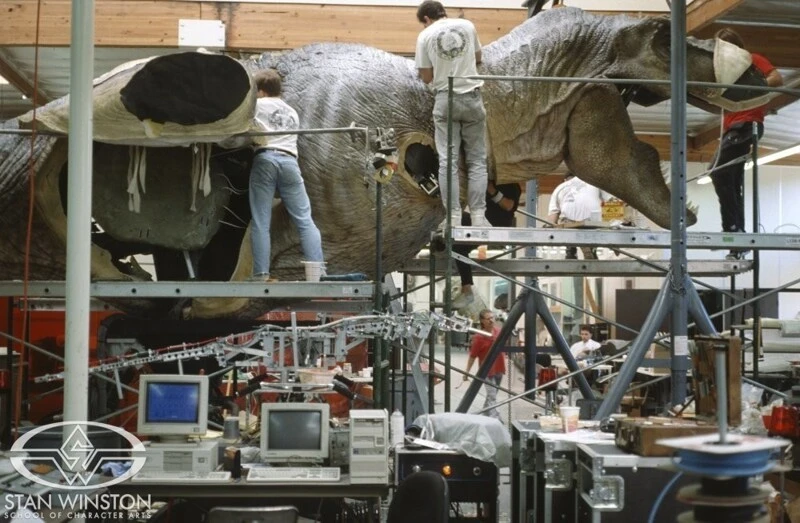
The smaller telemetry model used to control the full-size animatronic T-Rex. Stan Winston Studio Archive.
Gluing the skin on from the outside wasn't enough. In the book
The Winston Effect
, Scott recalled crawling inside the frame with a brush and adhesive because he couldn't reach the center from the outer openings. The rig had to stay powered on to hold its pose. Suddenly, the shop lost power: the massive head began to drop, and hydraulic parts shifted all around him. He recalled tucking in his arms and legs and waiting for the movement to stop, after which his crewmates pried open the jaws and pulled him out. 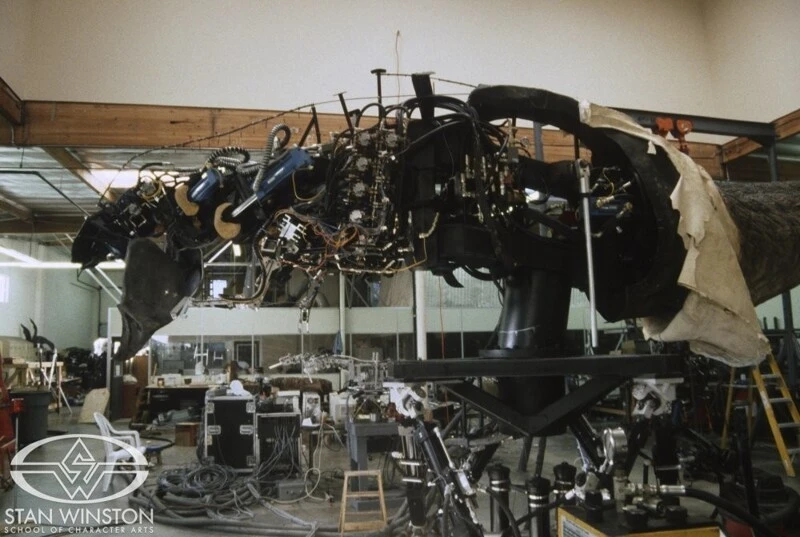
The simulated rain on set created new headaches for the completed dinosaur. Its foam skin soaked up water like a sponge. Christopher Rosengrant and Matt Winston recounted to ABC News how they used towels, hair dryers, and fans during overnight shifts just to dry the T-Rex in time for the next day's shoot. On screen, the T-Rex gets drenched in seconds; off camera, drying it out took hours of painstaking effort. 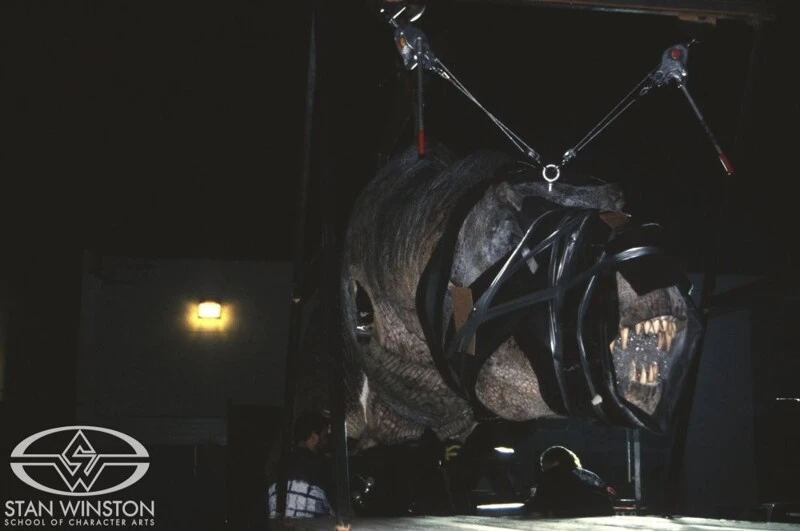
Transporting the T-Rex from the shop at night. Stan Winston Studio Archive.
The sick Triceratops alongside Ellie Sattler was another physical creation on set. According to the ACMI museum, operating the animatronic during the Hawaii shoot required a crew of eight. Some puppeteers hid in a pit beneath the creature, controlling its movements with cables, while the eyes were radio-controlled. Laura Dern later recalled how awe-inspiring it was to stand beside a life-sized creature lying right before her.
In the final photo of this gallery, the T-Rex is fully assembled on set. Hidden beneath its skin are the skeleton and actuators; standing just off camera are the operators with their control rigs. The finished film showed only a living, breathing creature. These archival photos bring back into frame the master craftspeople who designed and built that magic. 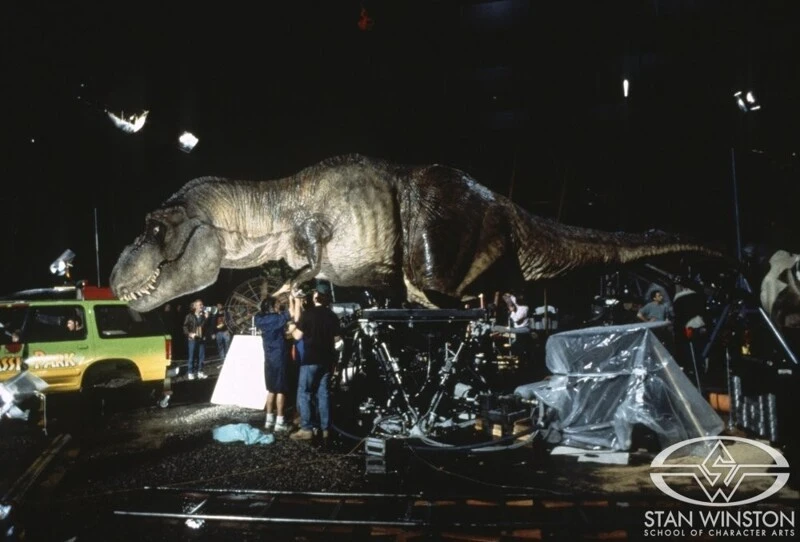
The fully assembled T-Rex on set. Stan Winston Studio Archive.