How to Cut Glass with Regular Scissors: The Secret Behind the Rehbinder Effect (4 Photos)
Hand anyone a pair of kitchen scissors and a sheet of window glass, and they'll likely struggle to make any headway. Glass is notoriously brittle: instead of a clean cut, you'll end up with a shower of sharp splinters and a nasty cut. 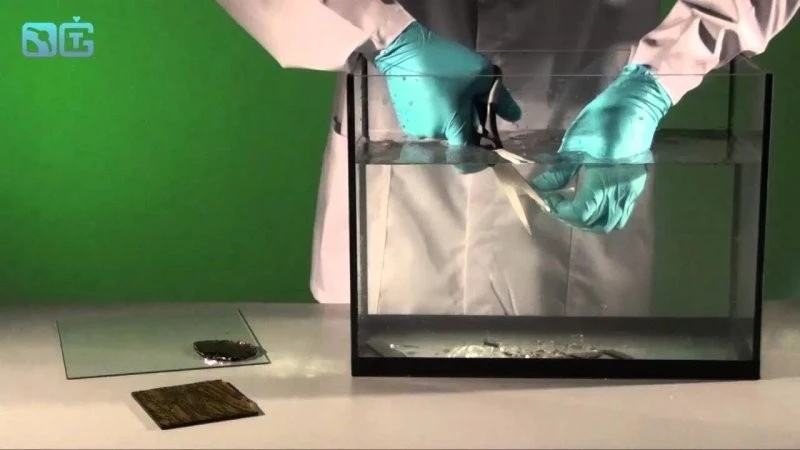
Submerge that same glass underwater, however, and the impossible suddenly becomes reality. Instead of shattering the pane, the scissors slice through it with surprising precision, allowing you to cut out ovals, circles, and intricate shapes. This trick had been floating around since the 19th century, remaining an unexplained curiosity—until Soviet scientist Pyotr Rehbinder decided to unravel the mystery.
The Mystery Solved by Rehbinder 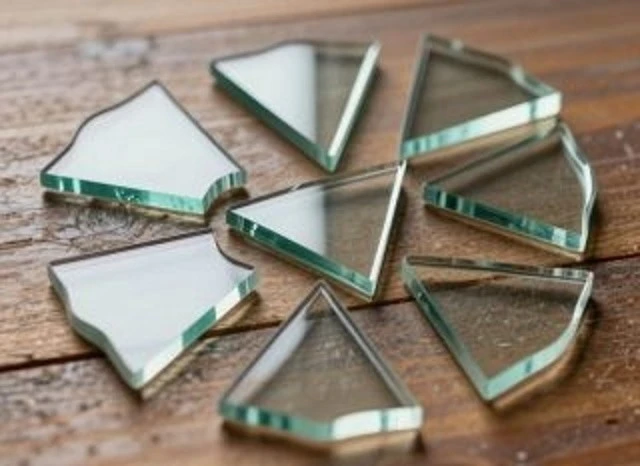
Glaziers had been cutting glass underwater long before anyone understood the science behind it. While craftsmen relied on the technique for generations, none could explain why it worked. That changed in 1928, when a young Soviet physicist named Pyotr Alexandrovich Rehbinder presented his discovery at an international physics congress. His breakthrough would go down in science history as the "Rehbinder effect"—the phenomenon of adsorption-induced reduction in the strength of solids.
The principle behind the discovery was surprisingly simple yet elegant. When a solid material—be it glass, metal, or ceramic—comes into contact with a liquid medium, its surface strength drops by 50 to 80 percent. This happens because liquid molecules seep into microscopic cracks and pores in the material, weakening the atomic bonds at the surface. When mechanical force is applied to this compromised structure—such as closing the blades of a pair of scissors—the material breaks along a clean, controlled line rather than shattering at random. Remarkably, once the liquid is removed, the material regains its original strength.
In this experiment, water doesn't act as a lubricant; it serves as an active agent of destruction. It penetrates the tiny fissures on the glass surface, compromising its structural integrity. As a result, the scissors don't actually cut the glass so much as chip away at it in microscopic fragments. That is why the process requires patience, moving millimeter by slow millimeter.
The Scientist Who Survived Denunciations and Prison 
Pyotr Rehbinder’s path to this breakthrough was anything but straightforward. Born in Saint Petersburg in 1898, he suffered from severe asthma as a young child, making the damp climate of the imperial capital dangerous to his health. When he was eight, his mother took him to Switzerland, where they lived until returning to Russia in 1916. A brilliant autodidact, Rehbinder passed his exams externally to graduate from the Faculty of Mechanics and Mathematics at Rostov University before earning a second degree from Moscow State University's Chemistry Department.
His 1928 discovery earned him international acclaim, yet recognition at home proved hard-fought. In 1932, the official Soviet newspaper Pravda published a scathing critique, dismissing Rehbinder's work as useless and even harmful. His institute was vilified, and Rehbinder himself was accused of offering practical advice that failed in real-world applications. Fortunately, thanks to the steadfast support of his peers, Rehbinder overcame the smear campaign and was elected a Corresponding Member of the USSR Academy of Sciences on February 1, 1933.
Yet the persecution did not stop there. In 1949, he was arrested on suspicion of scientific espionage. His salvation came down to his wartime contributions: authorities recalled that during World War II, Rehbinder had developed a self-igniting fuel formula for anti-tank weapons, created frost-resistant lubricants for armored vehicles, and invented anti-fogging compounds for gas mask visors. He was released, and in the post-war era, the Rehbinder effect laid the groundwork for an entirely new field of science: physicochemical mechanics.
How to Try It Yourself 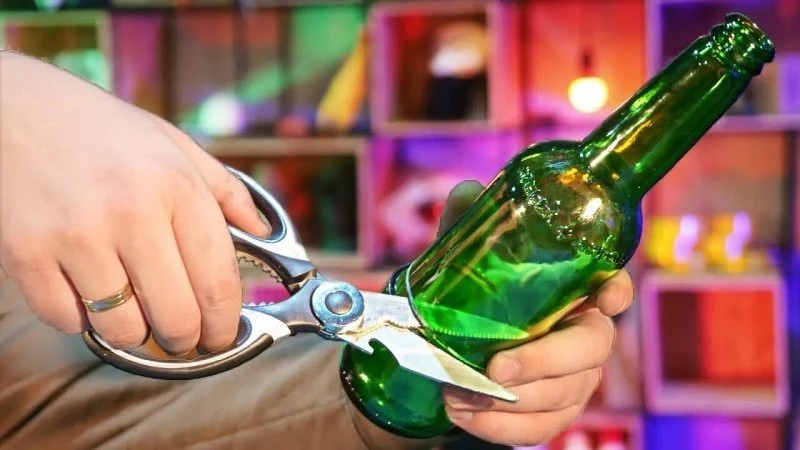
The technique of cutting glass underwater is so simple it borders on mind-boggling. All you need to do is submerge a piece of glass in water—the depth doesn't matter—and begin cutting it with standard scissors. The key is to cut slowly and smoothly, letting the water do the heavy lifting. The blades aren't doing the work through sharpness; it is the Rehbinder effect in action. Water weakens the structural bonds of the glass while the scissors guide the break. With a bit of practice, you can cut almost any shape out of a glass sheet.
When demonstrating his discovery, Rehbinder liked to say: "This remarkable trick—the ability to snip and cut glass with scissors—has been known for generations, but only now has it received a true scientific explanation."
Today, the Rehbinder effect is applied far beyond parlor tricks with glass. It plays a vital role in rock drilling, metalworking, and advanced ceramics manufacturing. Yet for most of us, it remains a captivating demonstration—a reminder that the everyday world is full of wonders waiting to be understood. And behind every such wonder stands someone who wasn't afraid to ask: "Why does this work?"