The Great Fire of London: How a Single Candle Transformed a Capital (12 photos)
By the summer of 1666, London had barely survived a devastating plague that claimed nearly 100,000 lives—and it seemed the worst was finally behind it. But on the night of September 2, a simple candle tipped over in a bakery on Pudding Lane. Over the next four days, the inferno consumed four-fifths of the city’s homes, cathedrals, and churches. Hesitant at first, the Lord Mayor refused to demolish neighboring buildings to stop the flames. After the dust settled, an innocent French watchmaker was scapegoated and hanged for a crime he never committed. Here is the story of how a tiny spark sparked the English capital’s greatest catastrophe—and what remained of old London in its wake. 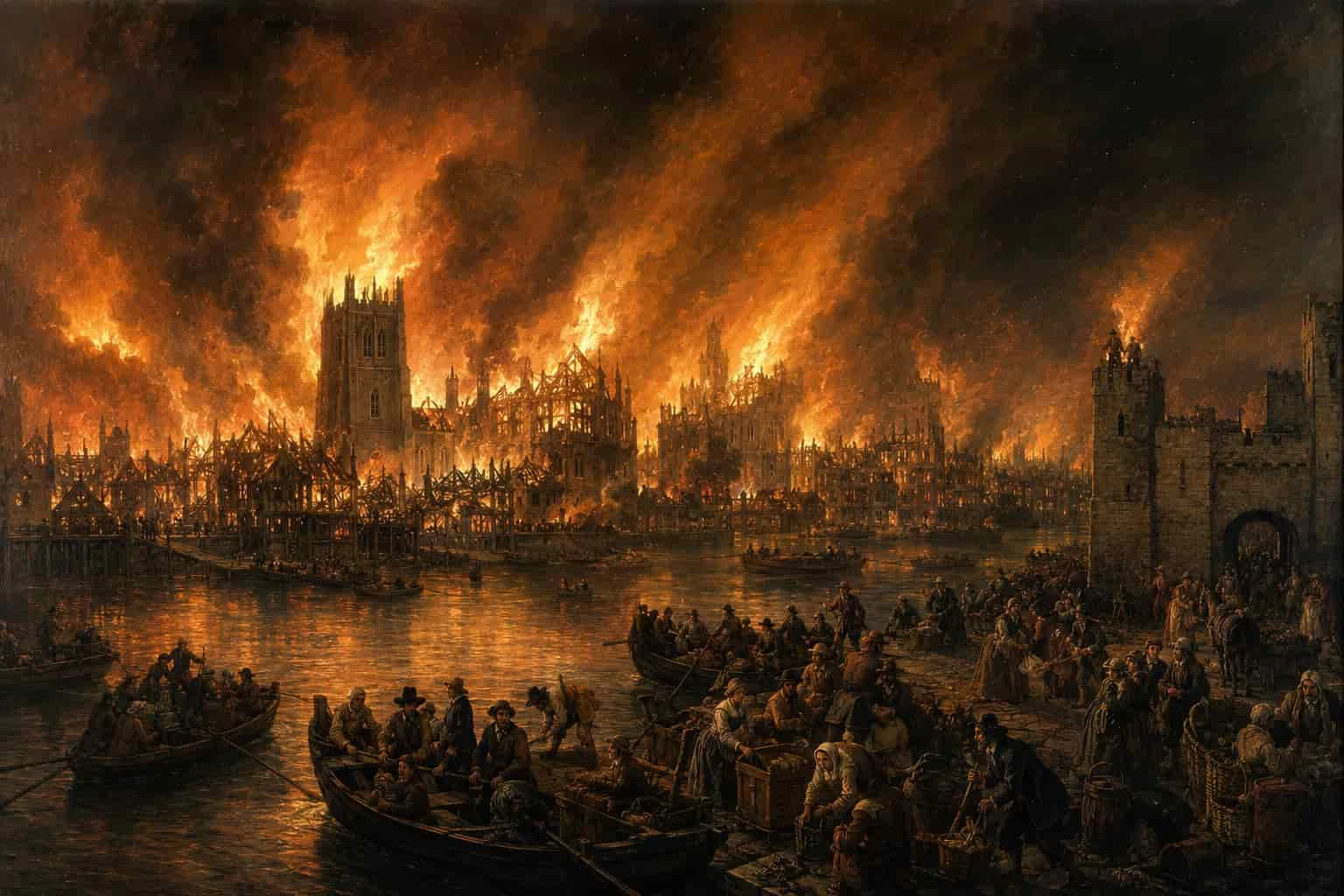
Devastating fires that reduced entire cities to ashes were a recurring nightmare in early modern Europe. In the aftermath of such disasters, cities were often rebuilt from the ground up, completely transforming their urban landscape.
The "Year of the Beast" and London’s Great Plague
Densely packed wooden buildings and the complete lack of an organized firefighting system made London a disaster waiting to happen. By the mid-17th century, the city was a maze of cramped alleys where timber-framed houses leaned so close together they nearly touched, topped with highly flammable thatched roofs.
The arrival of 1666 was met with widespread dread across Europe. Many saw the year's digits as an omen containing the apocalyptic "number of the beast," convincing locals that disaster was imminent. Yet superstition aside, there was already plenty of reason for panic: Londoners were dying in droves from a deadly outbreak that had erupted the previous year. 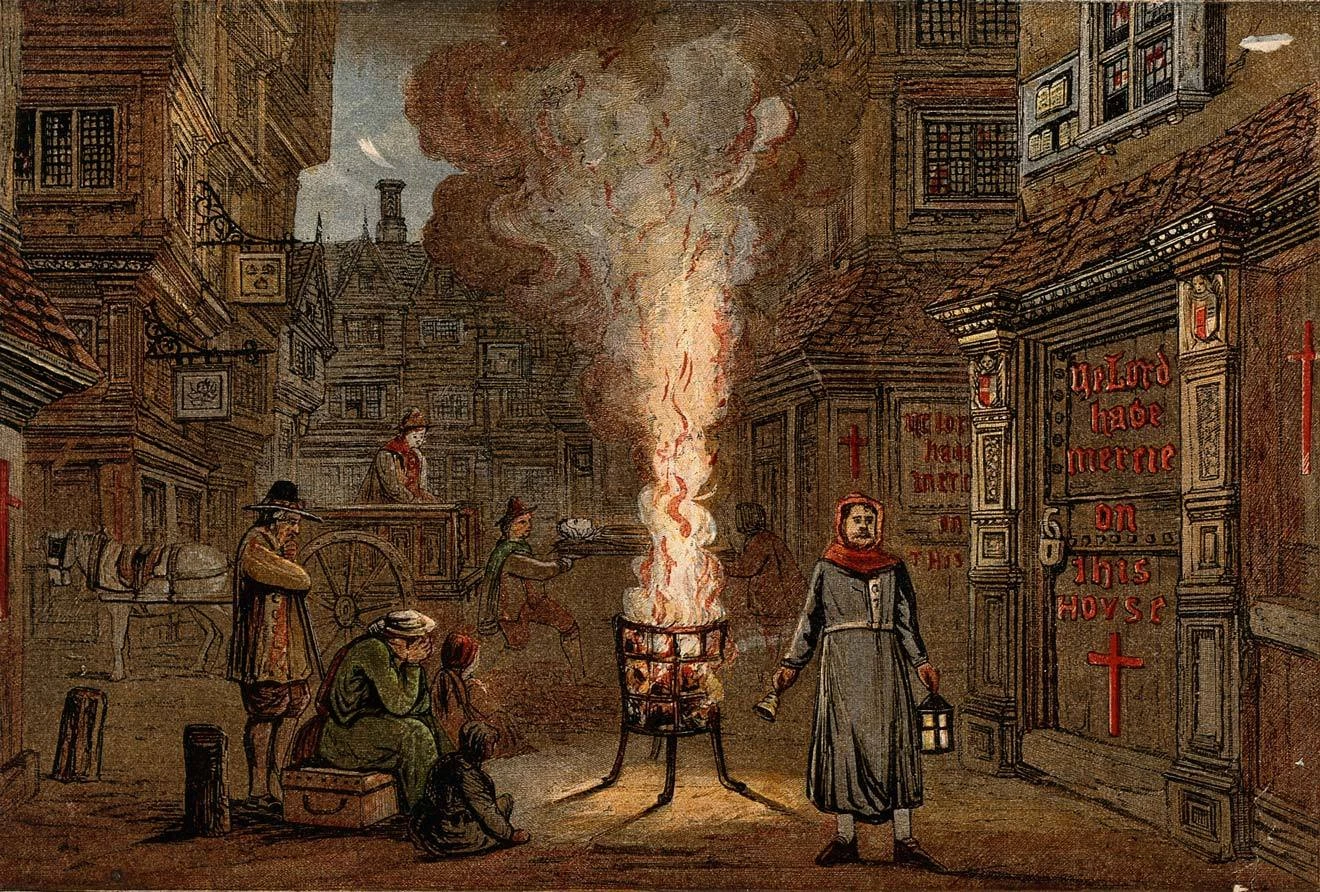
London streets during the Great Plague
The plague hit London in 1665, striking a city of nearly half a million people devoid of modern sanitation. The outbreak originated at the docks from ships arriving from the Netherlands. The previous year, the disease had wiped out 50,000 residents in Amsterdam; though Londoners tried to institute precautions, their efforts proved futile. The first victims were the destitute sleeping near the port, but the infection quickly tore through the impoverished outskirts of the City. King Charles II fled London with his family and court, seeking refuge far from the pestilence.
A City on the Brink of Despair
The death toll skyrocketed. By the autumn of 1665, London was losing up to 7,000 people a week, leaving grave-diggers struggling to dig mass trenches fast enough to handle the sheer volume of corpses.
In total, the epidemic claimed around 100,000 lives—roughly one in every five Londoners. The plague reached its peak between September 19 and 26, 1665, when 7,165 deaths were recorded in a single week. 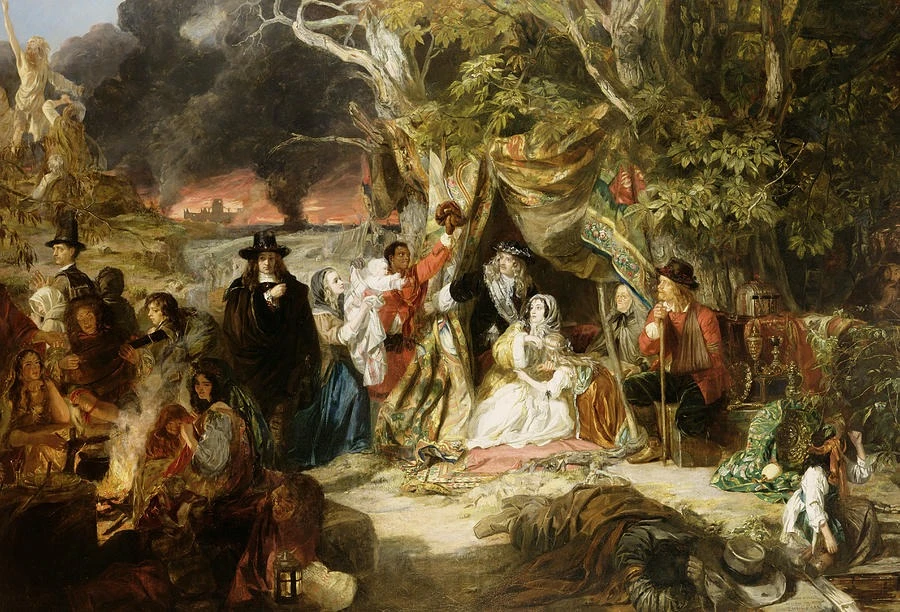
Highgate Fields during the Great Fire
The official record logged roughly 68,600 deaths—a vast underestimate, as the poor were often buried uncounted in unmarked pits. By the late summer of 1666, traumatized survivors felt numb to hardship; it seemed as though things could not possibly get any worse.
A Capital Overflowing with Filth and Fuel
The rampant overcrowding in poorer districts had fueled the plague's spread, and that same urban congestion soon unleashed a new disaster. London lacked any master urban plan: cheap timber houses were stacked haphazardly against one another, and statutory bans on thatched roofs were widely ignored because the poor could not afford brick or stone.
The poorest quarters crowded along the River Thames, where multi-story wooden tenements sat alongside shops and cellars packed with flammable goods. Warehouses along the wharves were stocked with oil and tallow—combustibles that would later feed the inferno—right alongside massive stockpiles of gunpowder. 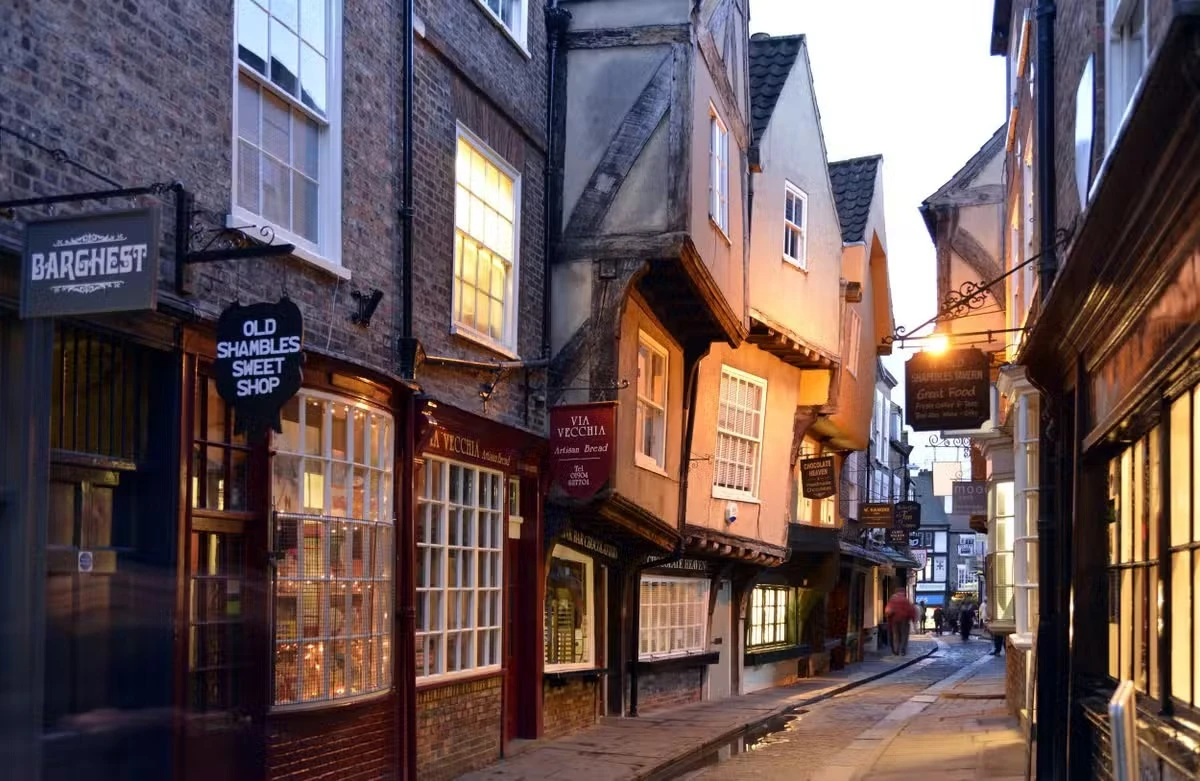
Old buildings in London overhung the streets, much like these surviving historic homes in York
The city had no professional fire brigade. When a blaze broke out, neighbors gathered at the sound of church bells to throw buckets of water on the flames. If that failed, the only alternative was to demolish intact buildings in the fire's path to create a firebreak. Ultimate success depended far more on the weather than on human effort.
A Candle on Pudding Lane
It all began in the early hours of September 2, 1666, at Thomas Farriner’s bakery on Pudding Lane. The bakers were working before dawn, using candles for light. A stray flame caught the wooden floorboards, and the fire quickly took hold. Though Farriner initially believed he had put it out, the building was engulfed in flames by one in the morning.
Farriner’s family managed to escape through an upper-story window by stepping onto an adjacent roof—a testament to how tightly packed London's buildings were. Tragically, his maid was paralyzed with fear, unable to move, and became the disaster's first victim. 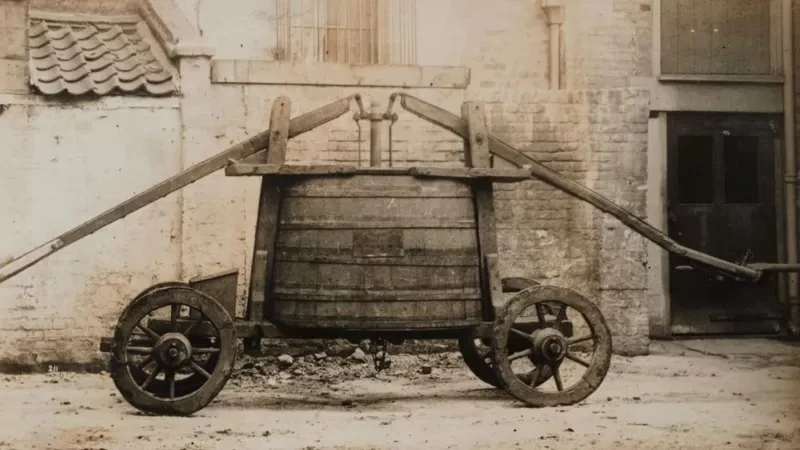
A 17th-century fire engine was a rather crude device
Neighbors and volunteers joined forces to fight the blaze, but their efforts were no match for the fire. Experienced locals urged the only proven tactic: pull down neighboring structures to stop the inferno from spreading.
Out of Control
Property owners fiercely resisted having their homes demolished, prompting officials to summon the Lord Mayor of London, Thomas Bloodworth. As the mayor dithered, the flames spread into adjacent outbuildings.
"Should we pull them down?" volunteers urged.
"We cannot," Bloodworth argued. "We haven't located all the property owners and tenants!"
Reluctant to take responsibility, the mayor seemed to hope the fire would burn itself out. But an unusually dry summer had turned London’s timber homes into tinder, and strong winds picked up, driving the fire relentlessly across the city. 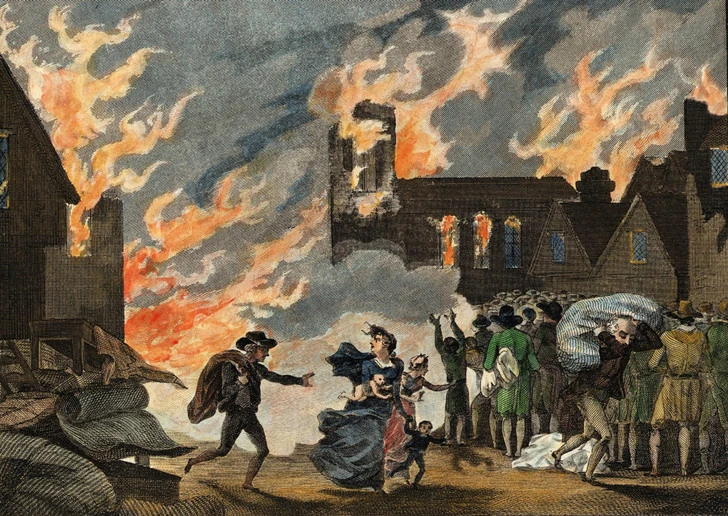
Artists captured the disaster shortly after the flames died down
By evening, the fire had swept into the riverside warehouses stored with oil and tallow, surging into an uncontrollable wall of flame. Fortunately, the south bank of the Thames was spared: a previous fire in 1633 had destroyed part of London Bridge, creating a natural gap that stopped the blaze from crossing.
Engulfed in Firestorms
Within hours, news reached the King. The inferno was moving so rapidly that affluent districts were now threatened. Charles II ordered immediate demolitions and deployed the Royal Guard, led by his brother, the Duke of York (the future King James II). According to the diary of eyewitness Samuel Pepys, the King himself rolled up his sleeves to clear rubble alongside ordinary citizens.
However, it was already too late. Firestorms began sweeping through the city. Severe updrafts merged scattered blazes into massive infernos reaching temperatures of up to 800 degrees Celsius, devouring everything in their path at breakneck speed. 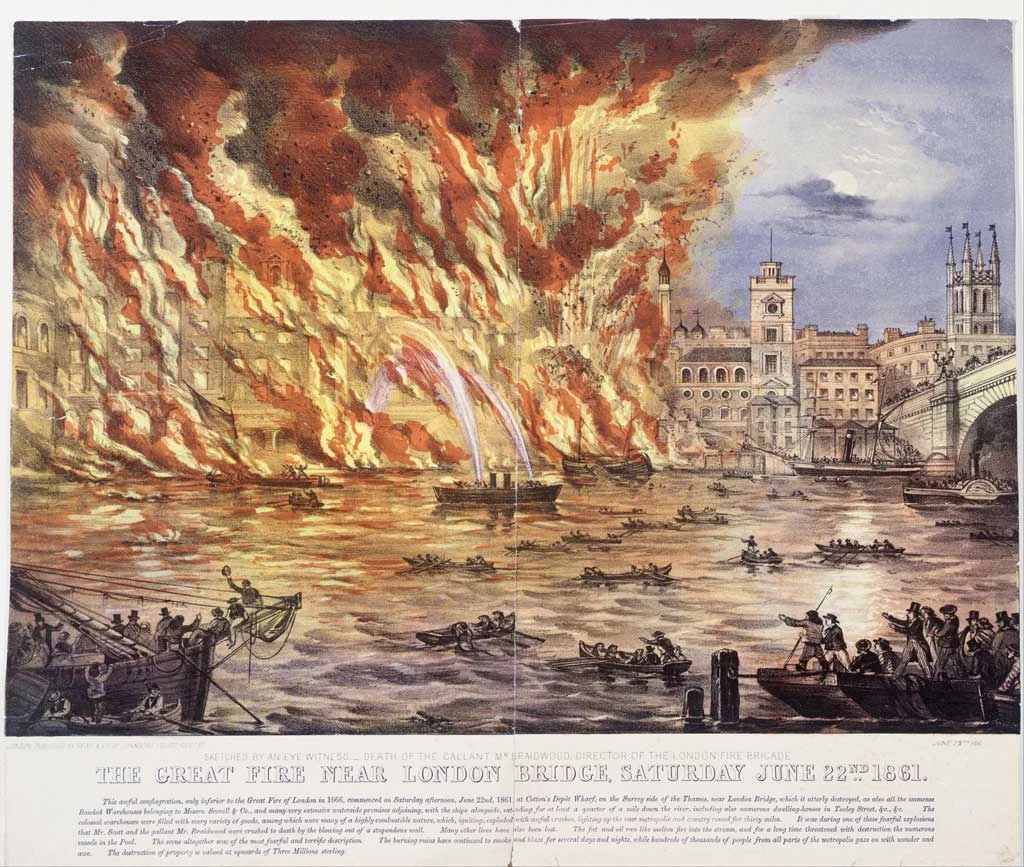
"The Great Fire at London Bridge," Museum of London, 1861
Witnesses recalled that by the morning of September 3, the fire was entirely unstoppable. Panic ensued as residents piled belongings onto carts, desperate to flee. Hopes that massive stone structures would hold back the flames were dashed when Baynard's Castle, a historic royal residence, collapsed into ruins.
The Destruction of St. Paul's Cathedral
St. Paul’s Cathedral fell next. Many had considered it a safe haven because of its thick stone walls, but wooden scaffolding erected for repairs proved its undoing. The scaffolding caught fire, spreading to the roof. When the roof collapsed, it ignited the vast stashes of household goods locals had moved inside for safekeeping. 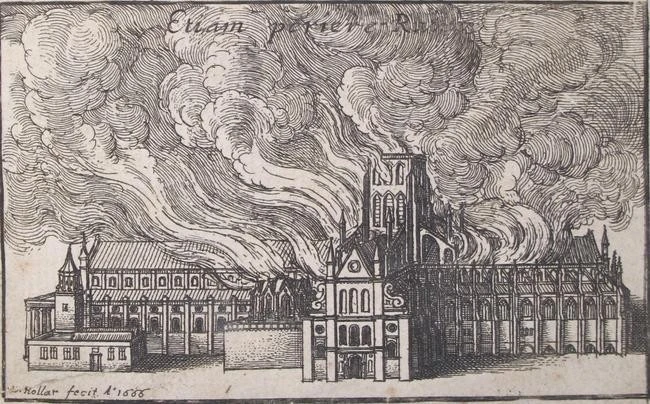
St. Paul's Cathedral engulfed in flames
English writer John Evelyn, an eyewitness to the catastrophe, recorded:
"The stones of St. Paul’s flew like grenades, a stream of melted lead ran down the streets, and the pavements glowed with a fiery red, so that no horse nor man was able to tread on them."
Not until September 5, as the winds finally died down, did the efforts of volunteers and the Royal Guard bear fruit. Firebreaks created by blowing up buildings halted the fire's advance, reducing the inferno to smoldering ruins.
A French Scapegoat
In total, the disaster destroyed 13,200 houses, 87 parish churches, 44 Livery Company halls, the Royal Exchange, St. Paul's Cathedral, several prisons, and three city gates. The fire laid waste to roughly 436 acres—nearly 176 hectares—wiping out four-fifths of the ancient City of London within its Roman walls. 
Fanned by strong winds, the fire swept from east to west
Despite the sheer scale of destruction, the official recorded death toll was just six. Historians believe the true casualty figure was far higher: many victims were poor residents whose deaths went unrecorded, and intense heat likely incinerated remains completely. 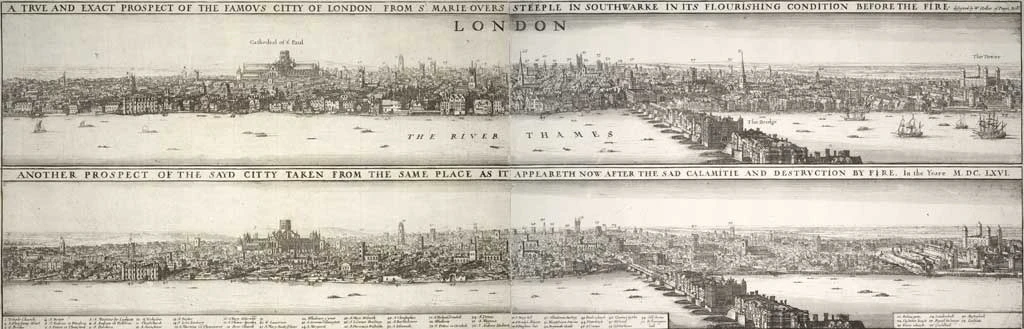
"Two views of London, before and after the fire," by Wenceslaus Hollar
Once the flames were doused, terrified citizens looked for someone to blame. Suspicions naturally fell on foreigners, suspected of seeking revenge over ongoing military conflicts. Mob violence against French and Dutch residents quickly erupted across the city.
A French watchmaker from Rouen named Robert Hubert was arrested and charged with arson. Following a long, confused interrogation—contemporaries suspected he was mentally unfit—Hubert confessed, despite offering contradictory testimony. He claimed to have thrown a firebomb through a bakery window that did not even exist. On October 27, 1666, Hubert was executed at Tyburn. It later emerged that the captain of the ship Hubert sailed on from Sweden confirmed he hadn't arrived in London until two days after the fire started. Even King Charles II doubted his guilt, yet the execution went ahead anyway.
Out of the Ashes: The Rise of Insurance
In 1667, the Royal Council officially concluded that the Great Fire was an accident caused by unfortunate circumstances and weather, rather than arson. 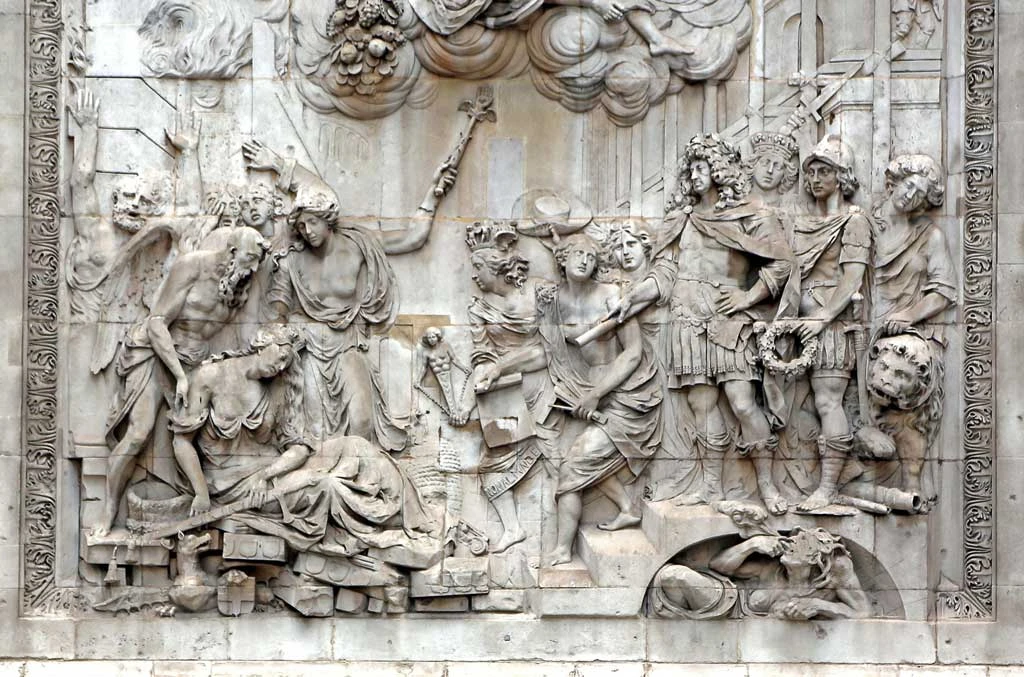
Bas-relief on the Monument to the Great Fire of London
The task of rebuilding fell to architect and mathematician Sir Christopher Wren. Although treasury shortages prevented his grand master plan from being fully realized, London was transformed nonetheless. Brick and stone replaced timber, streets were widened, and hazardous warehouses were relocated away from residential areas. Urban sanitation improved dramatically as a result. 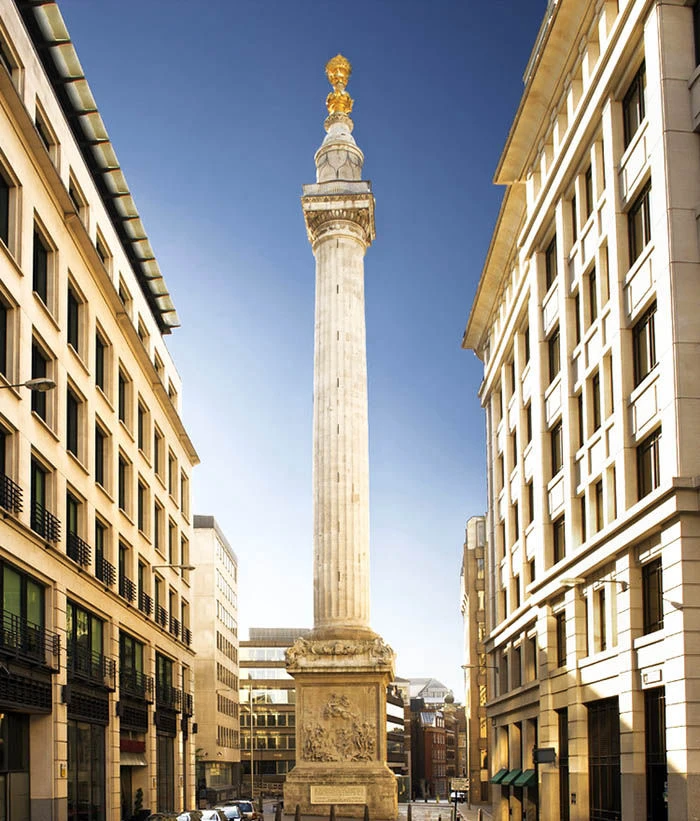
To commemorate the catastrophe, a 61.5-meter Roman Doric column—known today simply as The Monument—was erected
Designed by Wren alongside scientist Robert Hooke, the height of the column was deliberate: it stands exactly 61.5 meters from the site on Pudding Lane where the fire began.
The disaster gave birth to the modern property insurance industry in Britain; in the wake of such ruin, no one needed convincing of its value, and fire insurance businesses boomed. Legend also holds that the inferno helped eradicate the plague: with large swaths of filthy slums burnt to the ground, new cases plummeted.
Would you have rebuilt your home in the same spot, or would you have packed up and started fresh somewhere else?