Forget Crosses and Prayers: The Unconventional Way the Crawford Family Cast Out Spirits (9 Photos)
Model and actress Kaia Gerber, the 24-year-old daughter of supermodel Cindy Crawford, recently dropped a bombshell on *The Mitch Churi Chat Show* podcast. She revealed that as a child, after being told she was possessed, she underwent an exorcism using a traditional Australian wind instrument. What's more, when she landed a role in *American Horror Story*, her mother packed her off to set with holy water. While this might sound like a typical Hollywood quirk, it stems from a tradition thousands of years old that spans almost every major world religion. Here is a look at how exorcism works in Catholicism, Islam, Judaism, and shamanism—and what science has to say about it. 
What "Exorcism" Really Means
The word originates from the Greek *exorkizein*, meaning "to bind by oath." The core concept is straightforward: an evil spirit or demon has possessed a person, and it must be driven out. While methods vary—ranging from prayers and commands to sacred texts, sound, or touch—the objective is always the same: asserting authority over an invading entity. 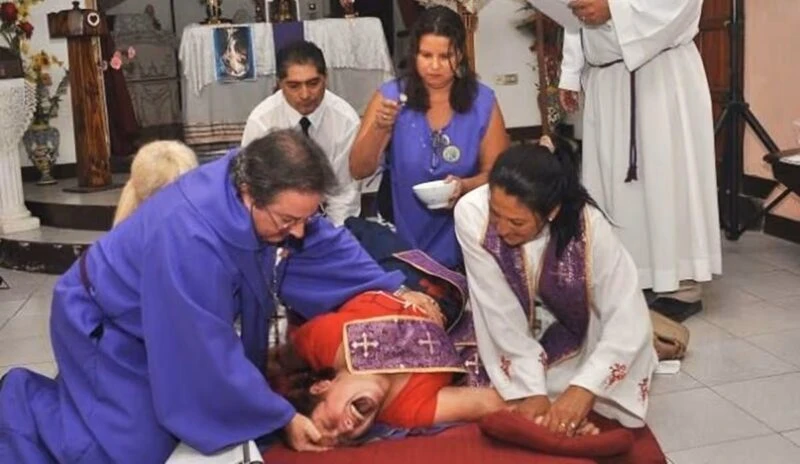
Catholic exorcism requires approval from a bishop as well as a prior psychiatric evaluation
Belief in demonic possession exists across virtually all cultures, making it far more than just a medieval superstition. According to the Vatican, the number of official Catholic exorcists actually grew throughout the 1990s and 2000s. Founded in 1994, the International Association of Exorcists unites clergy from five continents. Even well into the 21st century, demand for the ritual remains strong.
Different traditions use different names, but the core premise remains identical: an alien entity has taken hold of someone, and it must be expelled.
Catholicism: A 400-Year-Old Rite
In 1614, Pope Paul V authorized the Rituale Romanum—the official Catholic
liturgical book containing the rite of exorcism. This text remained virtually unchanged for three and a half centuries until an updated version was issued in 1999, though its foundation remained intact. 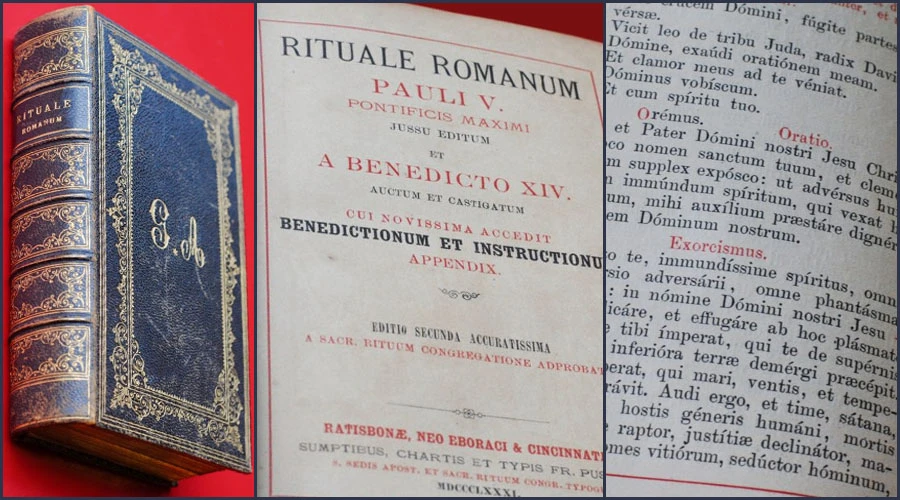
The Rituale Romanum was promulgated in 1614 under Pope Paul V and remained virtually unchanged until 1999
The Catholic Church allows only specifically designated priests to perform exorcisms, and strictly with a bishop's permission. Furthermore, a medical evaluation is required beforehand, as the Church has long acknowledged that many symptoms of "possession" have medical causes. During the rite, the priest recites prayers, invokes the saints, and directly commands the demon. He uses holy water, a crucifix, and holy relics while demanding that the spirit reveal its name—traditionally, knowing an entity's name grants authority over it.
The Vatican continues to train exorcists to this day. Since 2005, the Pontifical Athenaeum Regina Apostolorum in Rome has offered an exorcism course that welcomes priests from around the globe.
Islam and Judaism: Jinn and Dybbuks
In Islam, exorcism is known as *ruqyah*, which involves reciting Quranic verses over an afflicted person. Possession is linked to jinn—beings created from smokeless fire, according to the Quran, who are believed to be capable of possessing humans. A healer (*raqi*) recites protective verses, most notably *Al-Fatiha* and *Ayat al-Kursi*. However, Islamic scholars caution that most reported cases stem from medical or psychological conditions, and genuine jinn possession is exceedingly rare. 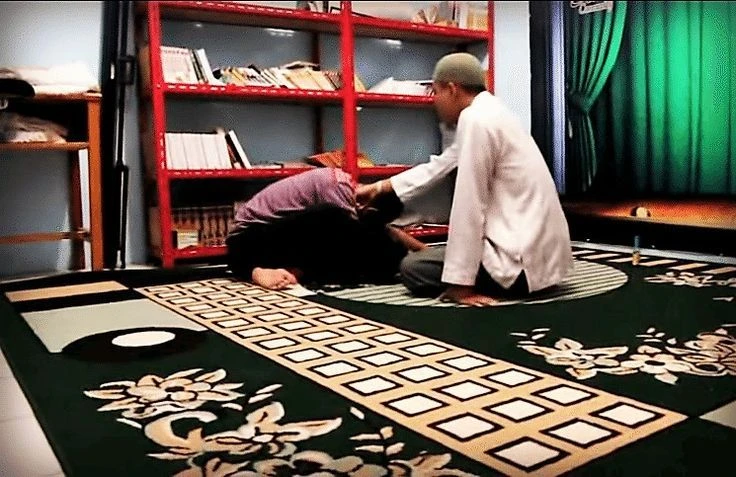
Ruqyah is the Islamic method of expelling jinn through the recitation of Quranic verses, which are believed to drive out harmful spirits
In Judaism, a possessing spirit is known as a *dybbuk*, from the Hebrew root meaning "to cling." A dybbuk is not a demon in the Christian sense, but rather the wandering soul of a deceased sinner that cannot find rest and attaches itself to a living person. This concept emerged in the 16th century within Kabbalistic circles in Safed, specifically from the school of Rabbi Isaac Luria. The first documented account of a dybbuk exorcism was published in Basel in 1602. The ritual is performed by a rabbi alongside ten Jewish adults. Shofars are blown, Psalm 91 is recited, and the rabbi negotiates directly with the spirit.
The Didgeridoo: Exorcism Without Demons
What Kaia Gerber described was neither a Catholic rite nor an Islamic ruqyah. Instead, it draws from Indigenous Australian traditions, where the didgeridoo (traditionally known as the yidaki) plays a central role. As one of the world's oldest wind instruments, it is crafted from eucalyptus trunks hollowed out by termites. The instrument produces a deep, pulsating drone rich in overtones, sustained through circular breathing—inhaling through the nose while maintaining sound output. 
The didgeridoo emits low-frequency vibrations between 40 and 120 Hz, which are widely utilized in modern sound therapy
In Indigenous Australian culture, the didgeridoo was traditionally played during healing ceremonies, based on the belief that its low resonance connects the physical and spirit realms. Modern research confirms that sound frequencies between 40 and 120 Hz have tangible physiological effects and can even aid in treating sleep apnea. Today, New Age practitioners frequently use the instrument for "space clearing"—which is likely what Gerber experienced. Ultimately, it is less a religious exorcism and more sound therapy wrapped in esoteric packaging.
What Science Says
Medical science attributes most cases of "possession" to dissociative disorders, epilepsy, or psychosis. Dissociative Identity Disorder is officially recognized in the DSM-5, which even includes a specific subcategory termed "trance possession disorder." 
Dissociative disorders often mimic the symptoms of possession, including memory loss, vocal changes, and the feeling of an alien presence inside the body
Symptoms historically attributed to demonic possession—such as convulsions, speaking in unfamiliar voices, and insensitivity to pain—have clear neurological roots. This distinction is critical: performing an exorcism on someone suffering from a medical condition is not just useless, but dangerous, as it replaces medical treatment with ritual. In 2005, a nun died during an exorcism at the Tanacu Monastery in Romania; she suffered from schizophrenia, which the priest mistook for possession. Those involved received prison sentences.
At the same time, researchers acknowledge that the ritual can act as a powerful placebo. If a person genuinely believes they will be healed, their condition often improves. This is not proof of spirits, but rather a testament to the power of belief.
"The Exorcist" and Hollywood's Shamanic Craze
On December 26, 1973, William Friedkin's *The Exorcist* hit theaters. The movie, which tells the story of a 12-year-old girl possessed by a demon, grossed over $232 million worldwide. Moviegoers reportedly fainted in theaters, and the film earned 10 Academy Award nominations—including Best Picture, making it the first horror film ever nominated in that category. 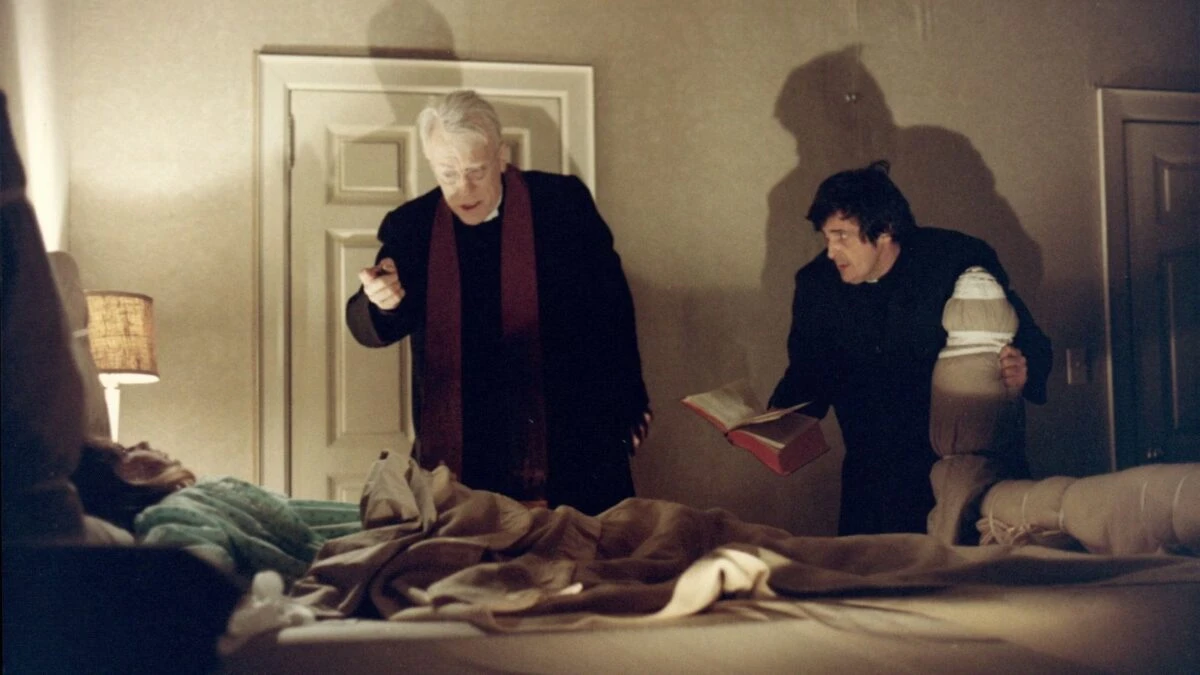
The Exorcist (1973) was the first horror movie nominated for the Best Picture Oscar, grossing over $232 million at the box office
While *The Exorcist* cemented the pop-culture image of possession, an alternative tradition was quietly taking root. New Age culture rebranded the language: replacing "demons" with "negative entities" and "possession" with "dark energy." Instruments like didgeridoos, singing bowls, sound, and chanting serve similar roles, but within a different framework. And this isn't just a fringe phenomenon—many highly educated people actively consult shamans and energy healers. 
New Age culture reframed possession in modern terms: substituting "dark energies" for demons and "cleansing" for exorcism
Kaia Gerber's experience is far from unusual in Hollywood. The entertainment industry has long harbored a fascination with alternative practices, though most celebrities simply keep quiet about it. 
Cindy Crawford gave her daughter holy water before filming American Horror Story—just in case of demonic possession on set
At the end of the interview, Gerber remarked that she now feels "completely healed." Whether her childhood experience was a religious rite, sound therapy, or simply a vivid memory remains open to debate. But it underscores an enduring human trait: the need for ritual—the drive to name our anxieties, give them form, and overcome them. Neither scientific progress nor common sense has erased that impulse.
Would you ever visit a didgeridoo healer, or would you stick strictly to a therapist?
What exorcism is from a religious and scientific perspective, and how dangerous it can be
13 real-life stories that inspired iconic horror movies
Exorcism rites in Colombia