It comes as no surprise that throughout history, hanging has been by far the most widespread method of capital punishment. It was swift, reliable, and above all accessible: a person could be hanged from virtually any elevated structure or sturdy branch capable of bearing human weight.
Yet in the Middle Ages, when executions were carried out en masse and with gruesome regularity for even petty offenses, authorities needed something far sturdier, larger, and more visible than a simple tree limb or wooden post. Enter the Gibbet of Montfaucon—the largest and most horrifying execution complex in human history. 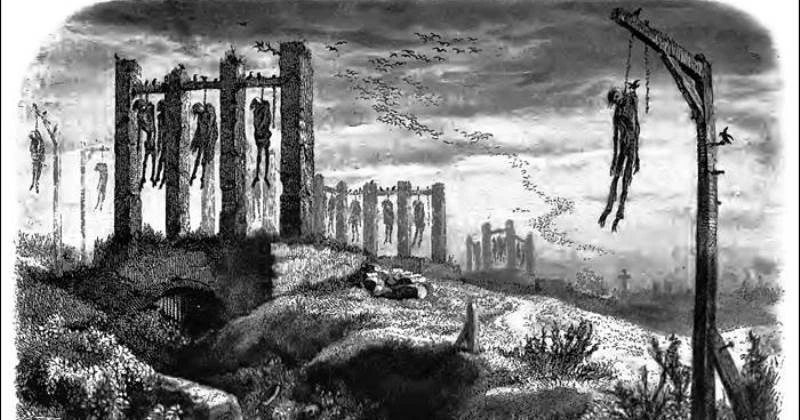
Montfaucon: Hell on the Outskirts of Paris
The full name of this grim landmark was the Gibet de Montfaucon. Built atop a prominent rise, its name is thought to derive from two elements:
mont
(mount or hill) and
faucon
(falcon). Another theory points to the landowner, Count Faucon, who reportedly ceded the property for the project. Regardless of its origin, Montfaucon became a colossal instrument of terror that served the French monarchy for nearly four centuries. 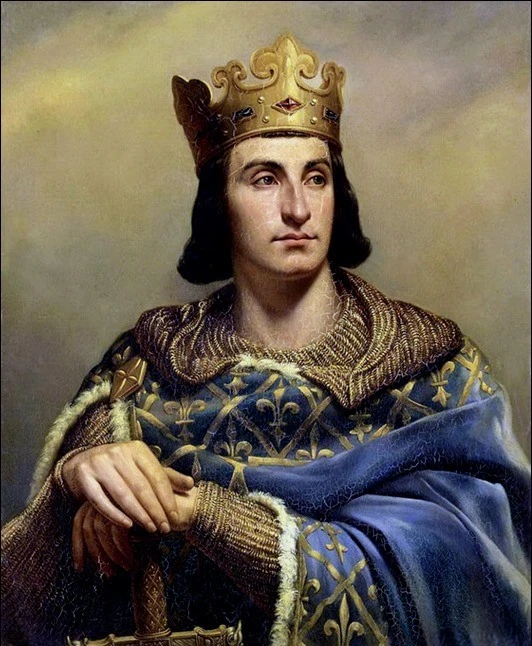
King Philip IV "the Fair" of France
No one knows the precise date when this nightmarish colonnade first rose northwest of Paris. Historical records indicate only that Montfaucon was erected in the 13th century on the orders of King Philip IV, also known as Philip the Fair—or behind his back, the "Iron King." A monarch of ruthless temperament, Philip ordered the hanging of political rivals, disgraced officials, convicted felons, and vagrants without a second thought.
Why Did Paris Need a Monumental Gibbet?
At the time, commoners were primarily executed on the Place de Grève, situated near the quays along the Seine. The square struggled to cope with the sheer volume of executions. Furthermore, because medieval authorities preferred to leave corpses dangling on public display, the stench of decay routinely drifted into nearby residential and commercial quarters. Montfaucon was designed to relieve the burden on the Place de Grève while solving the problem of body disposal: under contemporary law, executed criminals could neither be returned to their families nor given a Christian burial. 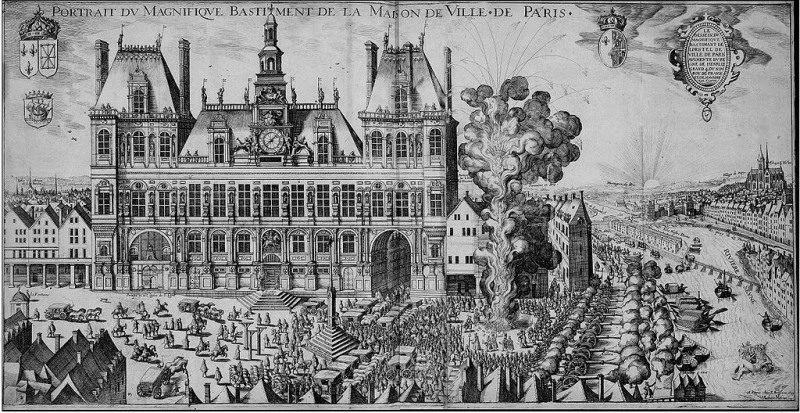
The Place de Grève in Paris, with gallows clearly visible in the center
Thus arose this industrial-scale machine of death, designed and supervised by royal advisor Enguerrand de Marigny. In a grim twist of historical irony, de Marigny himself fell from royal favor just a few years later and became an "inmate" of his own towering creation—much to the delight of the Parisian populace.
A Monstrous Engine of Execution
The gibbet was a nearly cubic stone monolith measuring roughly 12 meters in height and 14 meters on each side. Atop a raised stone foundation stood 16 massive pillars of roughly hewn masonry, arranged in a three-sided colonnade linked by three tiers of heavy beams. 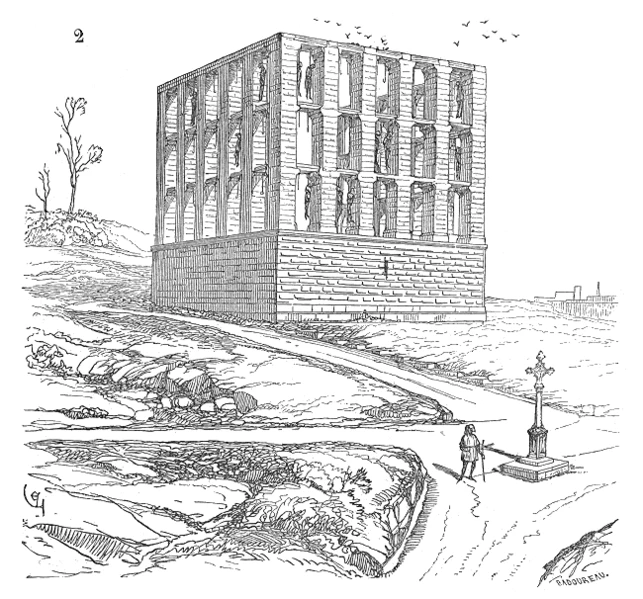
From a distance, Montfaucon looked like a three-story building stripped of floors and window panes, with the bodies of the condemned hanging from chains in each open bay. This architectural facade was completed by a door at the base opening into a walled staircase, which executioners used to access the upper tiers. This stairway occupied the fourth, pillarless side of the structure.
Inside the base of Montfaucon lay a deep ossuary pit intended for final disposal. Once a corpse had hung in chains for the designated time, the executioner's assistants cut it down and tossed it into the pit below, solving the burial dilemma once and for all. Whenever the pit grew full of human remains, it was cleaned out. There was only one key to the heavy entrance door of Montfaucon, and it was kept under lock and key by the royal executioner of Paris. 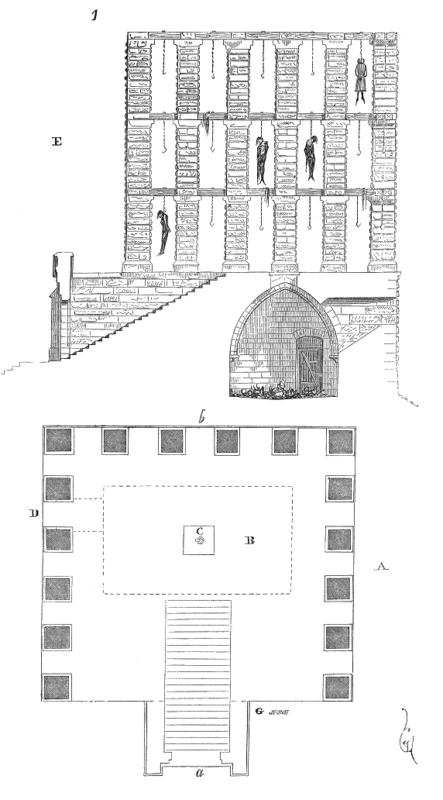
Montfaucon in Literature and Culture
It was this very ossuary that Victor Hugo immortalized as the final resting place of Quasimodo and Esmeralda:
"When, about two years or eighteen months after the events which close this story, people came to the vault of Montfaucon to search for the corpse of Olivier le Daim, who had been hanged two days before, and to whom Charles VIII had granted the favor of being buried at Saint-Laurent in better company, they found among all those hideous carcases two skeletons, one of which held the other in a singular embrace."
Montfaucon could suspend up to 50 corpses simultaneously, and as many as 90 when pushed to capacity. Space constraints were simply handled by stringing up two bodies per bay. During periods of war and civil rebellion, even this proved insufficient; within a few years, two additional standard gallows were erected nearby to handle the overflow. 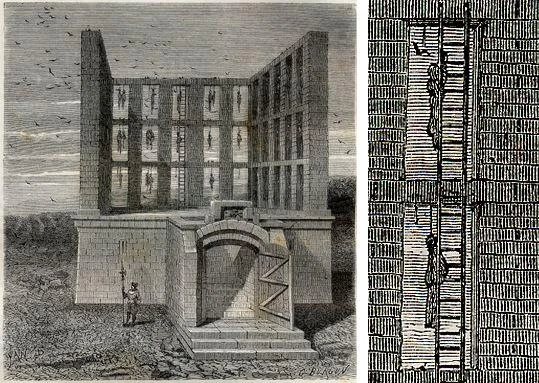
Standing atop a chalk ridge that loomed over the surrounding countryside, Montfaucon was never left empty. It operated not merely as an execution site, but as a chilling instrument of state propaganda, warning residents and visitors alike against defying royal authority. Flocks of ravens perpetually circled overhead, and even to medieval Parisians intimately acquainted with death, the sight inspired sheer dread. 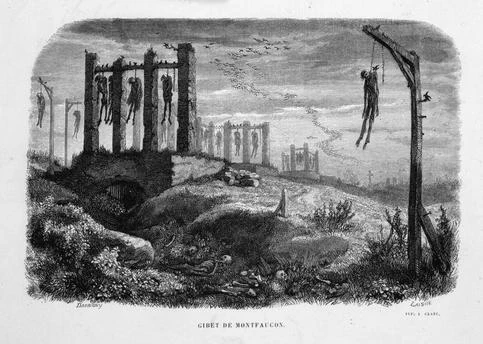
The End of an Era
Remarkably, the Gibet de Montfaucon remained in service for nearly four centuries. A 1527 engraving depicting the execution of the royal treasurer clearly shows that while the colossal structure had fallen into considerable disrepair by the 16th century, it was still actively used. The final execution on its crumbling stones took place in 1629. By then, the aged monument was so dilapidated that it posed a danger not only to rebels, thieves, and heretics, but to the executioners themselves. 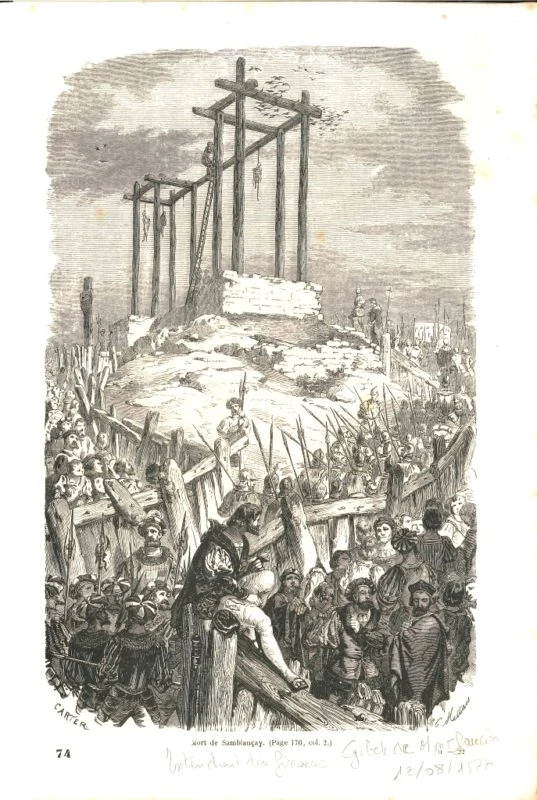
The execution of King Francis I's treasurer, Jacques de Beaune, Baron de Semblançay, on August 12, 1527
Over the tumultuous decades that followed, the rotting framework on the capital's perimeter was largely forgotten. Then came the invention of the guillotine, which dispatched the condemned in fractions of a second without requiring costly structural upkeep. As Paris expanded, Montfaucon's ruins were gradually absorbed into the city limits. Enlightenment-era citizens grew tired of looking out their windows at a crumbling, moss-covered colonnade dangling rusted chains, and the gibbet was finally dismantled in the late 18th century.
Today, the picturesque Parc des Buttes-Chaumont occupies the site in the 19th arrondissement of Paris. Yet beneath the manicured paths and lush greenery lies the memory of the terrifying spectacles staged here just a few centuries ago.
What do you think: is it right to demolish such grim relics of the past, or should they be preserved as stark reminders of history's brutality?
Add your comment
You might be interested in:















The Serial Killer Who Thought 'No Body, No Crime' Would

'Jaws': Behind the Scenes (10 Photos)

200 Watches Hurled from a Third-Floor Window (3 Photos)

Lucy Lawless Never Planned on Becoming Xena (9 Photos)
Executioners: How They Lived, What They Earned, and Why

Winona Ryder Turns 55: The Actress's Best Photos (11 Photos)

French Shopkeeper Turns into a Meme After Trying to Defend

Rescuing a Chubby Raccoon (3 Photos)

Turns Out Ostriches Love Bald People (7 Photos + Video)
