Unsinkability on paper. Was the Titanic's sinking predetermined? (8 photos)
On April 14, 1912, the largest passenger liner of its time was sailing through the ice fields of the North Atlantic. At 11:40 PM, its lookout spotted an iceberg directly ahead. Two hours and forty minutes later, the Titanic, declared unsinkable, sank, taking more than 1,500 lives with it. The official verdict was brief: a collision with a chunk of ice. However, this simple answer has never satisfied engineers, historians, or the general public. 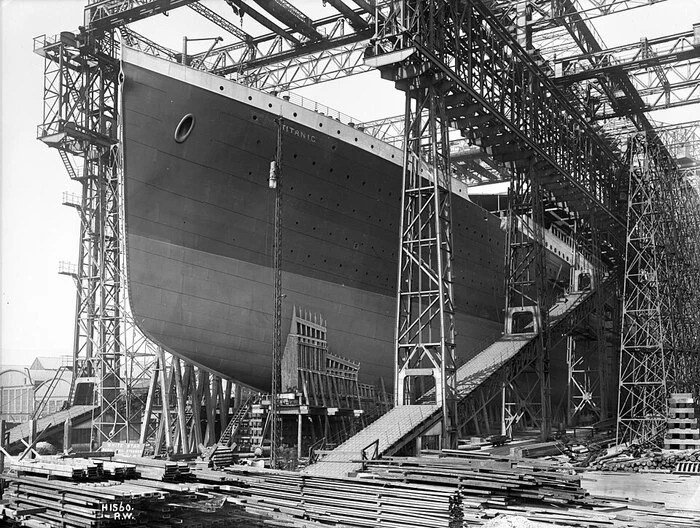
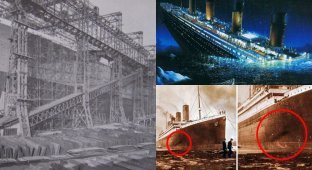
The Titanic on the slipway before launch, May 1911. The ship was built in Belfast Harbor. Today, the construction area is known as "Titanic Quarter."
Why did a liner longer than two football fields, built using the latest technology, sink so quickly? Modern research clearly indicates that the disaster was the result of a wide range of factors, among which design compromises and questionable engineering decisions were perhaps the decisive ones.
Rivets and Steel
Construction of the Titanic began at the Harland & Wolff shipyard in Belfast on March 31, 1909. The keel of the first ship in the series, the Olympic, had already been laid on the slipway. The design was monstrous: 269.1 meters long, 28.19 meters wide, and over 53 meters high from the keel to the tops of the funnels. The designed displacement was approximately 52,000 tons. The hull plating was assembled from approximately two thousand steel sheets, ranging in thickness from 25 to 38 mm. The largest plates reached 9.1 meters in length and weighed up to 4.5 tons each. In the lower part of the hull, closer to the bottom, the steel sheets were overlapped for strength, and above the chines, on the nearly flat side, they were joined end-to-end without overlapping edges—this ensured a smooth surface.
During the construction of the Titanic, more than three million rivets, weighing a total of approximately 1,200 tons, were used. In the central, most stressed part of the hull, they were securely and tightly driven by hydraulic machines. In the bow and stern, where the contours were more complex, hand riveting had to be relied upon. This small manufacturing detail would become a contributing factor to the disaster three years later.
When fragments of the hull planking and rivets were recovered from the seabed in the 1990s, metallographic analysis revealed an unexpected surprise for historians. The hull steel was not technically defective—it fully complied with 1912 standards. However, chemical analysis revealed elevated sulfur and phosphorus levels with extremely low manganese content. The steel for the Titanic was supplied by David Colville's Glasgow mills, where it was smelted in open-hearth furnaces with an acid lining. This lining did not absorb harmful impurities, and sulfur and phosphorus remained in the metal. Manganese was obviously required to bind the sulfur into harmless manganese sulfide, but its content was insufficient. As a result, the manganese-to-sulfur ratio was only 6.8:1. By comparison, in modern steels, this ratio reaches 39:1. Unbound sulfur formed brittle iron sulfide, which created a network of microscopic cracks and voids along the grain boundaries of the metal. This sharply increased the ductile-brittle transition temperature to +20…+40°C, making the steel extremely brittle in freezing water (-2°C), the same temperature the water reached on the night of the disaster. As a result, the hull plating cracked upon impact rather than crumpled, which also contributed to the size of the hole.
The curved sections of the hull used wrought iron rivets up to three centimeters in diameter, manufactured with an abnormally high slag content—a glassy byproduct of manufacturing. The norm for wrought iron of the time is considered to be 2-3% slag inclusions (less than 1% today), whereas in Titanic's rivets, this figure averaged 9.3%. The reason for this two-fold increase was the shipyard's production frenzy. The simultaneous construction of the Olympic and the competition with competitors from the Cunard Line created enormous pressure on production processes. Unsurprisingly, a shortage of skilled labor and high-quality materials arose. To meet the demand for three million rivets, the shipyard procured them from additional suppliers, often using lower-grade iron.
Interestingly, the Titanic's hull was not a single piece—though this isn't a unique feature of this particular liner, but a standard solution for large ships to this day. To prevent the giant vessel from breaking apart under the waves, engineers incorporated three expansion joints in the superstructure. This design gave the upper hull the necessary flexibility and allowed it to withstand the alternating loads of rolling. 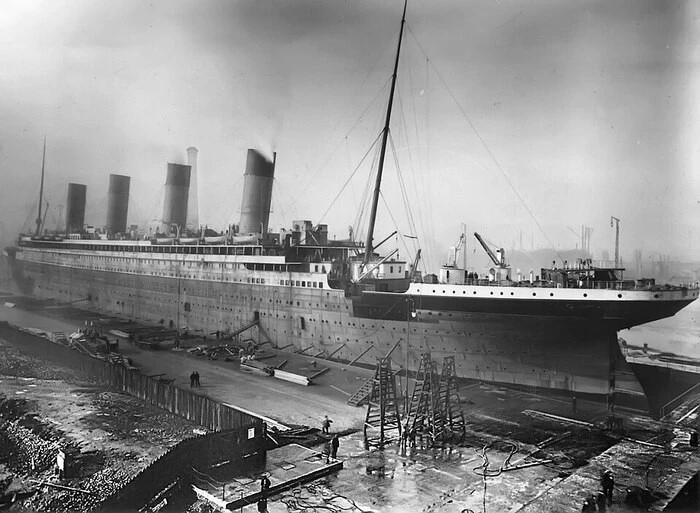
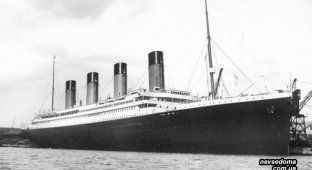
The Titanic in Thompson's drydock during the final stages of completion. Remarkably, the final stack was not connected to the boilers or used for smoke exhaust, but rather served as an exhaust vent for air and steam from the engine room and galleys.
A Victory for Convenience
Titanic's engineers spared no expense in design safety measures, at least in the drawings. The core of this protection was a double bottom—an internal "box" 1.6 to 1.98 meters high, divided into 46 separate compartments or tanks and running almost the entire length of the hull. This structure served as a barrier in the event of damage to the outer hull plating and simultaneously allowed for the storage of thousands of tons of ballast water to maintain stability. The double bottom flowed into the side keel beams and was supported by a system of frames spaced at intervals of 60 to 91 cm.
The honeycomb double bottom itself was a highly advanced solution for its time. However, its height proved insufficient when the ship was heavily bowed. Furthermore, above the double bottom, the hull was single-layered, meaning no second skin or internal longitudinal bulkhead was provided. The only watertight barriers within the hull were transverse ones. This meant that after a collision, water not only flooded compartment after compartment along the length of the ship, but also flowed freely sideways within each damaged compartment, creating additional list. 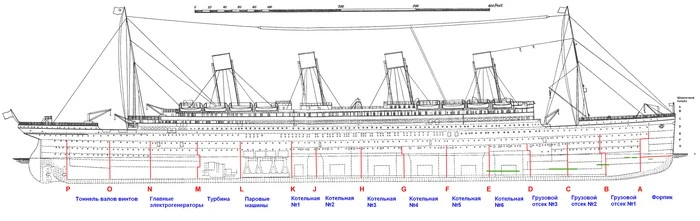
Longitudinal section diagram of the Titanic. Bulkheads are highlighted in red, and sections of the hull damaged in the collision are highlighted in green.
The design's crowning glory, and, as practice has shown, its most vulnerable point, was its watertight bulkhead system. Fifteen transverse steel bulkheads, designated by letters from A (the forwardmost) to P (the aftmost), omitting the letter "I" due to its resemblance to the number "1," divided the liner into sixteen compartments. Each bulkhead was constructed of steel sheets, reinforced with load-bearing ribs. Automatic, electromagnetically operated watertight doors were mounted at the bottom of twelve of them.
These doors deserve special attention. Each weighed approximately two and a half tons and was held in place by electromagnets. They could be closed in three ways: with a single push of a button from the bridge, with a lever in place, or they could slam shut automatically. As the water level in the compartment rose, a float mechanism was activated, releasing the latch. The door began to descend under its own weight, but not immediately, as a brake cylinder allowed it to move smoothly for most of the way. Only the last half meter, under the influence of gravity, did it move freely, locking firmly in its grooves. According to design calculations, the Titanic would remain buoyant even with any two adjacent compartments, or even four forward compartments, completely flooded. 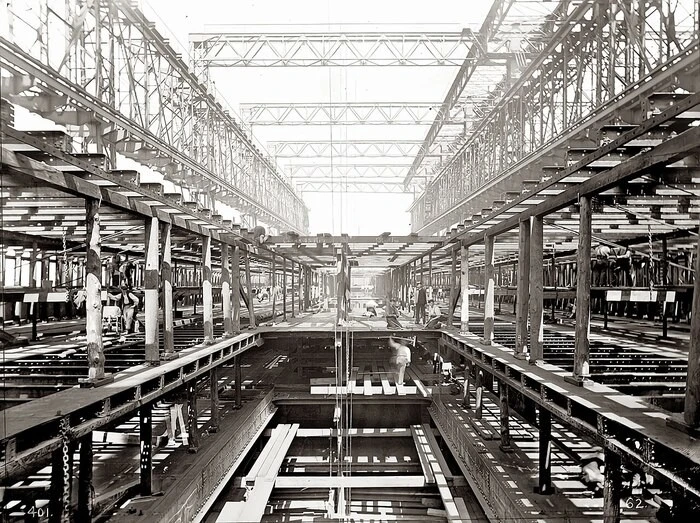
Titanic's C Deck during assembly. This level included first-class cabins and part of the promenade. Harland & Wolff shipyard, Belfast
However, this system had one serious flaw, which, under certain conditions, completely negated all the precautions taken by the designers. Of the fifteen bulkheads, eight (two forward and six aft) rose to the level of D Deck, which was approximately 6 meters above the waterline. The seven middle bulkheads reached only to E Deck, located one floor below, just 3.35 meters from the waterline. Above these elevations, there was no continuous, watertight "roof" at all. This seemingly flawed design was, in fact, a deliberate decision. The designers acted in the interests of passenger comfort. That's why they designed the open-plan cabins, allowing for easy communication between spaces, and the very spaciousness advertised. The bulkheads were essentially watertight only in the vertical plane. If the bow dropped just a few meters, water would inevitably spill over the edge, spilling into adjacent compartments. That's exactly what happened on the night of the disaster. Ice tore through the starboard side hull in five forward compartments at once. When Titanic's chief designer, Thomas Andrews, who was on board, learned of the nature of the holes, he immediately realized the liner was doomed.
Heart and Character
The Titanic's propulsion system consisted of twenty-nine boilers housed in six boiler rooms, two four-cylinder triple-expansion steam engines, and a low-pressure turbine. Each of the two steam engines turned its own outboard propeller, while a single turbine drove the central propeller.
The turbine had one design feature. It wasn't powered by its own boiler, but ran solely on waste steam from the two main steam engines, squeezing out every last bit of energy. This increased the overall efficiency of the plant, a highly intelligent solution for its time. However, the design had a fundamental drawback: the turbine couldn't reverse. Steam turbine blades have a fixed profile, allowing them to rotate only in one direction. To achieve reverse, a separate reversing turbine section would have been required, which the builders considered an unnecessary expense and added complexity to the design. Therefore, when the "full astern" command was given, steam was directed directly to the condenser, bypassing the turbine, since piston engines still needed to discharge their waste steam somewhere. 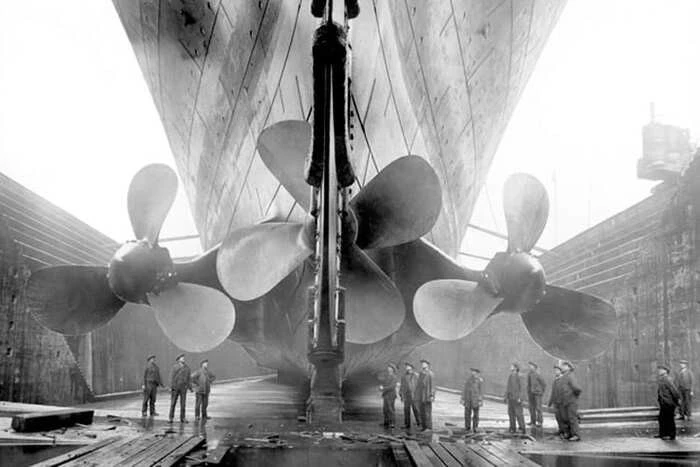
Olympic's propellers and rudder. Original photographs of the Titanic's propeller assembly likely have not survived. It is known that its central propeller had three blades, while the Olympic and Britannic had four-bladed central propellers.
The central propeller simply stopped. When the command "Full ahead" was given, this propeller was positioned directly in front of the rudder and created a powerful flow of water, improving turning ability. But when reversing, everything worked exactly the opposite. The central propeller stopped, the flow of water to the rudder disappeared, and maneuverability, already less than ideal, was further reduced. The liner lost a third of its propulsion system because only two outboard propellers were operating astern, and the full astern power was 30,000 horsepower (two propellers of 15,000 horsepower each). The total power of the system in normal operation exceeded 50,000 horsepower, allowing the liner to accelerate to speeds in excess of 23 knots—an extremely impressive figure for a vessel of its size. However, during emergency braking and maneuvering, this power disappeared, leaving the helmsmen with approximately half the capabilities expected by common sense. However, judging by the testimony of surviving crew members from the engine room, the "Full astern" command on the night of the disaster is a popular myth. Chief Fireman Frederick Barrett and Oiler Frederick Scott independently saw the "Stop" signal on the engine room telegraph. Fourth Mate Joseph Boxhall, on whose account the version of the "Full astern" command is based, arrived on the bridge after the collision. In this case, Officer William Murdoch, who was on watch that night, gave an order that maximally preserved the ship's steering during evasive action, given that the turbine continued to rotate by inertia, maintaining a steady flow of water. 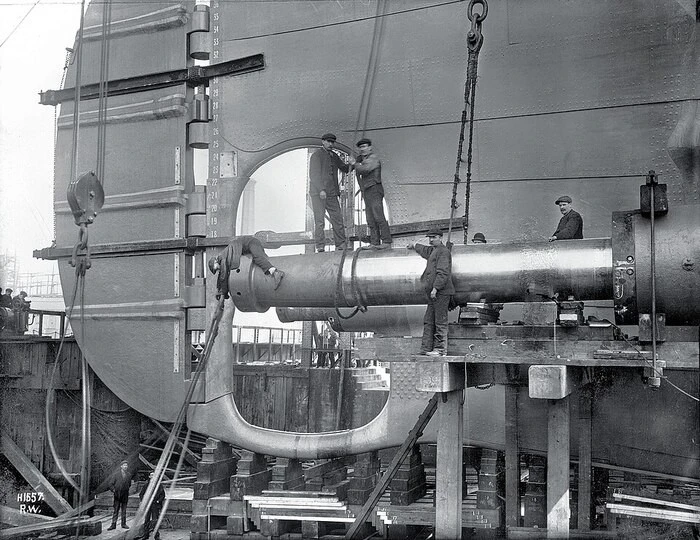
Installation of the Titanic's starboard shaft, May 1911. The design of the unbalanced rudder is clearly visible.
At the same time, the monstrous Titanic had a rudder weighing approximately 101 tons and measuring almost 24 meters high. Oddly enough, for a ship of such a size, such a rudder was comparatively small. There is debate about whether the rudder's area of 70 square meters was sufficient. The calculations are still ongoing. Calculations show that the rudder was only 5-10% short of its optimum, which likely wasn't crucial. Furthermore, there are reports of the sister ship Olympic, which had a similar rudder, whose performance was sufficient to turn the liner quickly enough to ram a German U-boat and prevent it from launching torpedoes. The rudder shift took approximately 37 seconds. At a speed of 22 knots, the liner traveled approximately 400 meters during this time. Therefore, the full turning circle was over 1,170 meters, or almost five hull lengths.
But the most telling fact confirming the Titanic's owners' overconfidence was the number of lifeboats. Exactly twenty of them were installed, exceeding the outdated British regulations in force at the time, which required a minimum of 16 lifeboats for vessels of that displacement. These, in turn, were calculated based on the vessel's tonnage, not the number of people on board. Furthermore, according to the logic of the time, lifeboats were not viewed as long-term rescue tools for crew and passengers, but rather as short-lived rafts for evacuating the shipwrecked to a quickly arriving rescue vessel. According to some sources, the designers had already planned for 48 lifeboats, which would have been sufficient. However, the company retained the minimum twenty, deciding to await new regulations that never came into effect. The designers chose not to spoil the aesthetics of the promenade decks or sacrifice space for safety. 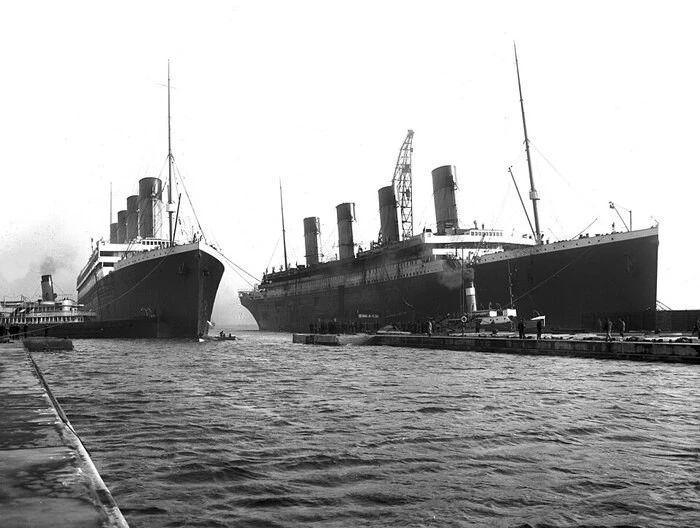
The Olympic (left) emerges from the drydock in Belfast after repairs. March 6, 1912. The Titanic (right) is moored at the fitting-out berth. This is the last photograph of the two liners together.
Ultimately, the Titanic didn't sink because of a single failure. It fell victim to a chain of decisions, each compromise individually seeming reasonable. Slightly more brittle steel, slightly lower-quality rivets, slightly lower bulkheads, slightly fewer lifeboats—the sum of these "little things" turned the flagship liner into a mass grave for 1,500 people. The disaster wasn't predetermined, but given all the design decisions, it was inevitable.