Where is Voyager going and what will happen to it in 40,000 years (7 photos)
Voyager 1 is a spacecraft that has traveled so far that it takes almost a day for a radio signal to reach it. It launched in 1977, outlived the disco craze, dozens of governments, and almost all consumer electronics, but still whispers to Earth from the interstellar darkness with a transmitter weaker than a light bulb. 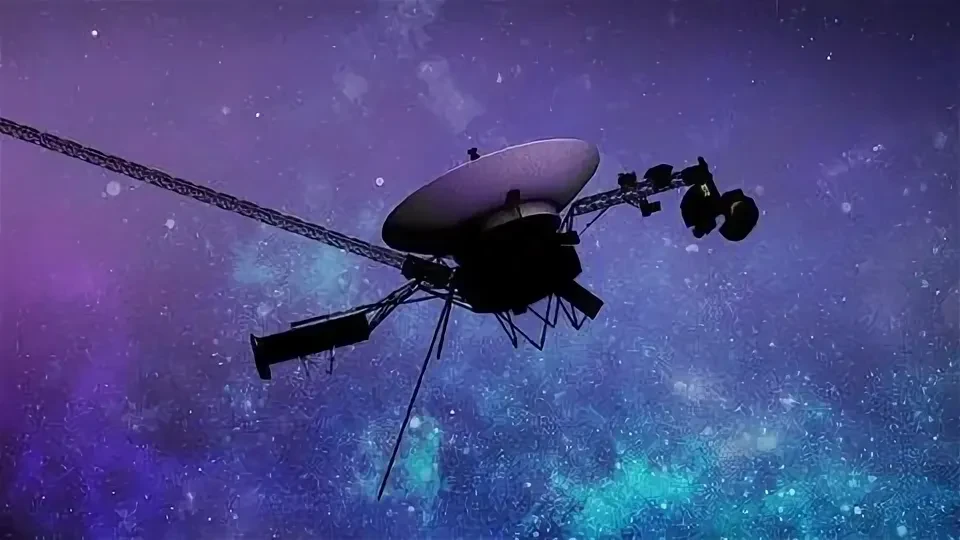
The next "encounter" in its future will only happen in 40,000 years. The probe will pass close to the star Gliese 445 and miss by a light-year and a half.
A light bulb is calling home
Voyager 1 launched in 1977 and hasn't stopped since. By the summer of 2026, it had traveled more than 25 billion kilometers from Earth.
The radio signal takes over 23 hours to reach it.
And on November 18, 2026, according to NASA calculations, the probe will be the first in history to reach us within a light-day: a command—a day there, a response—a day back.
This is Voyager's famous farewell photo, taken one last time before the probe left the Solar System. See the small white dot in the center? That's our Earth. The "Pale Blue Dot" is a frame in which the entire Earth fits into 0.12 pixels: a tiny blue spark lost in a beam of sunlight against a nearly black background. On February 14, 1990, Voyager 1 took this image from a distance of about 6 billion kilometers. 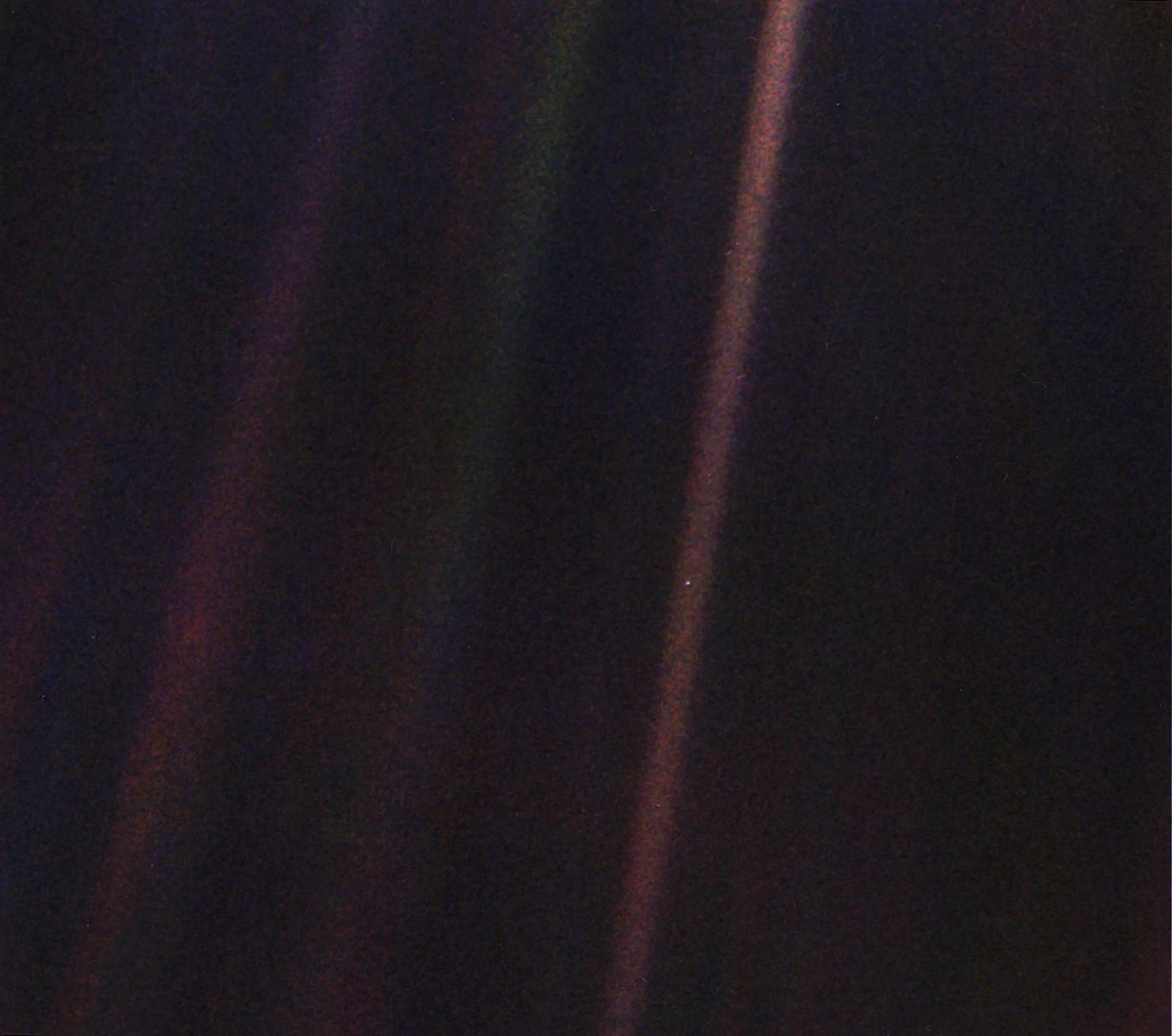
Its transmitter power is about 20 watts. Less than a refrigerator lightbulb. This whisper from the abyss is picked up by NASA's 70-meter deep space antennas.
Two scientific instruments are still breathing on board: a magnetometer and a plasma wave sensor. The engineers turned off the rest to save energy—the last particle detector was shut down in April 2026. No solar panels for you: back in 2012, the probe crossed the heliopause—the boundary of the solar wind bubble—and the Sun is now just a bright star among others.
Minus four watts per year
Power is provided by a plutonium-238 radioisotope generator, essentially a nuclear heater. 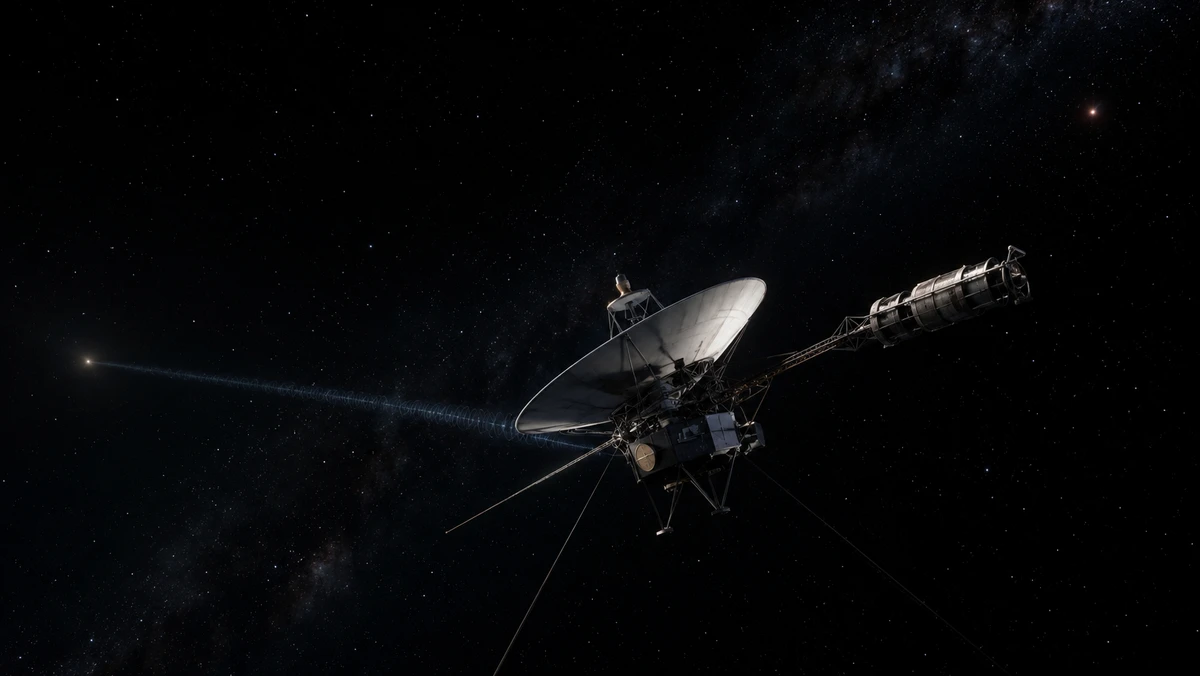
Plutonium decays, and the spacecraft loses about four watts of power each year. Engineers are haggling with the physicists over every instrument, gradually turning them off. But by the 2030s, there probably won't be enough energy even for science—and sometime after that, the probe will go silent forever.
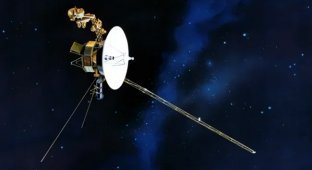
From there, Voyager will become what it always was: a hunk of metal weighing about 720 kilograms, flying at 17 kilometers per second. Just silent now.
It won't change its course: the remaining engines are needed not to fly to a new star, but to keep the antenna pointed toward Earth. The gravity of Jupiter and Saturn set its interstellar trajectory back in 1980, and it's flying roughly toward the constellation Ophiuchus—not because there's anything there, but because it was "thrown" there. 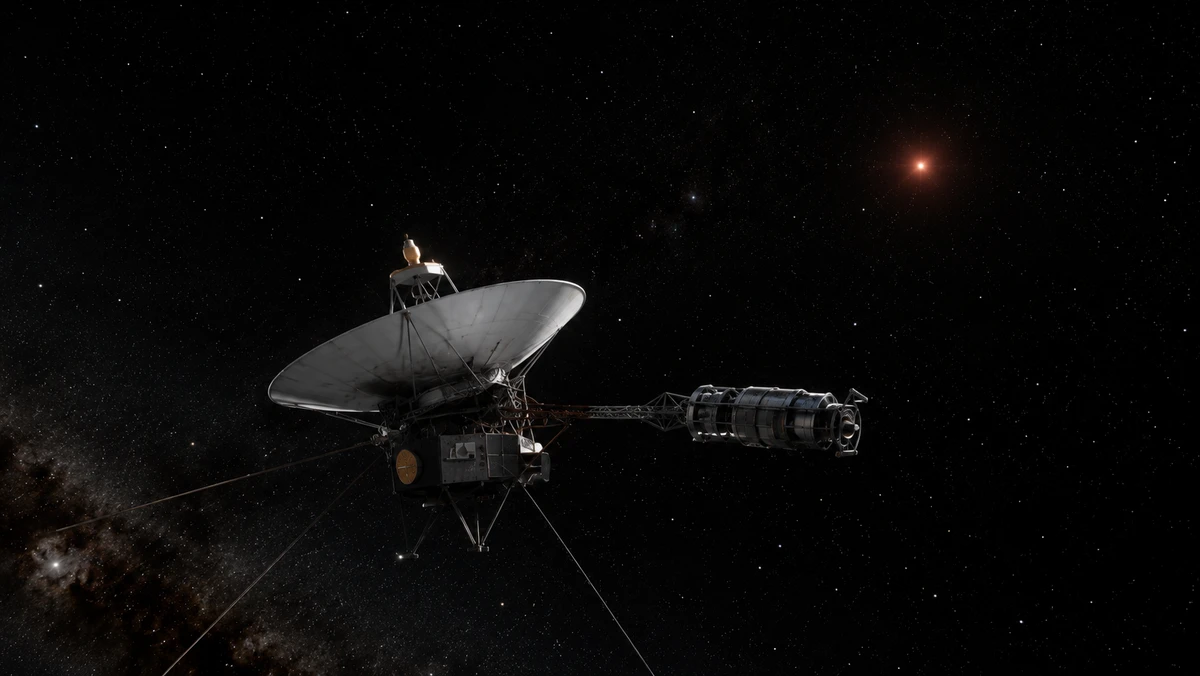
In 40,000 years, the probe will pass within 1.6 light-years of the red dwarf Gliese 445 in the constellation Camelopardalis—this is its closest known "date" on its schedule: it will then be closer to the alien star than to its home star. By Earth standards, 1.6 light-years is a monstrous miss, about 15 trillion kilometers. By galactic standards, it's very close.
Gliese 445 itself is flying through the Galaxy, and in 40,000 years, its path will simply pass close to the probe's route. No orbital capture, no landing—the speeds are different, the geometry is different. It will simply fly by and move on, a microscopic satellite of the Milky Way.
A gold record is attached to the probe: it contains recordings of Bach, laughter, a baby's cry, and greetings in 55 languages. 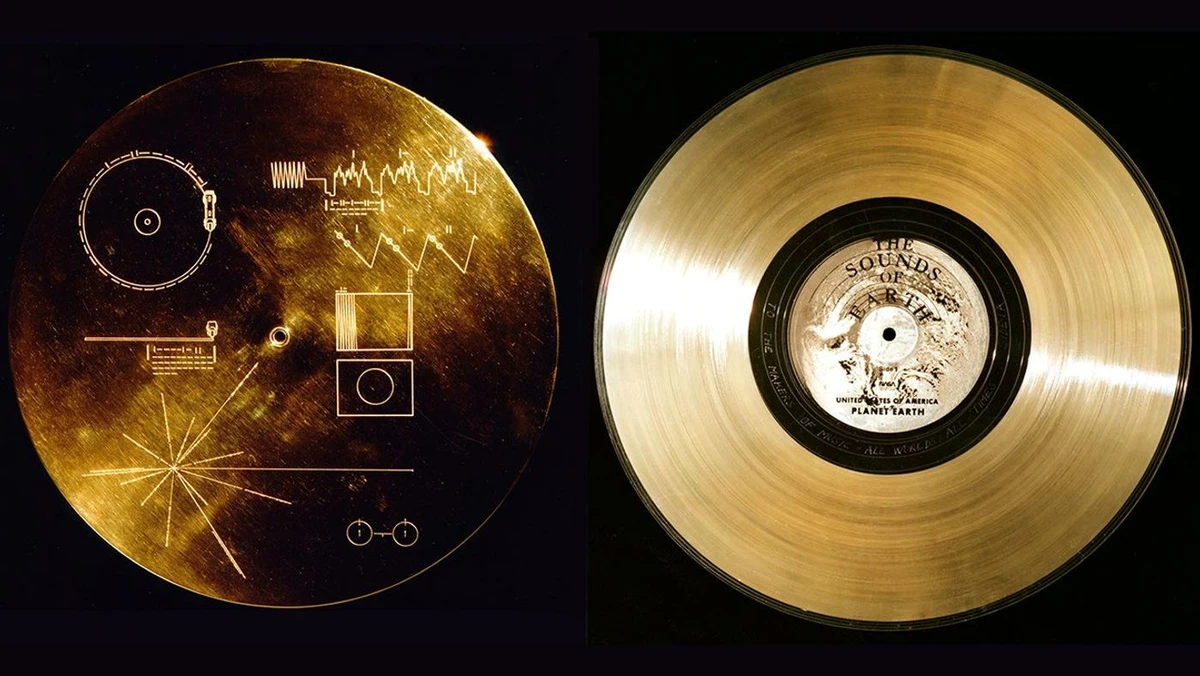
The creators designed it to last for about a billion years—if interstellar dust holds up, the recording will fly through the galaxy. And perhaps someone will listen to it.
What Voyager Discovered
The spacecraft is simultaneously making discoveries, adding to our knowledge of the Solar System. Here are the highlights of what the Voyager probes discovered.
Extraterrestrial Volcanoes
For the first time in history, humanity has seen active volcanoes on another world: giant jets of molten sulfur and gas on Jupiter's moon Io have proven that tidal forces can heat bodies to the point of full geological activity.
Jupiter's Rings and the Complexity of Giant Systems 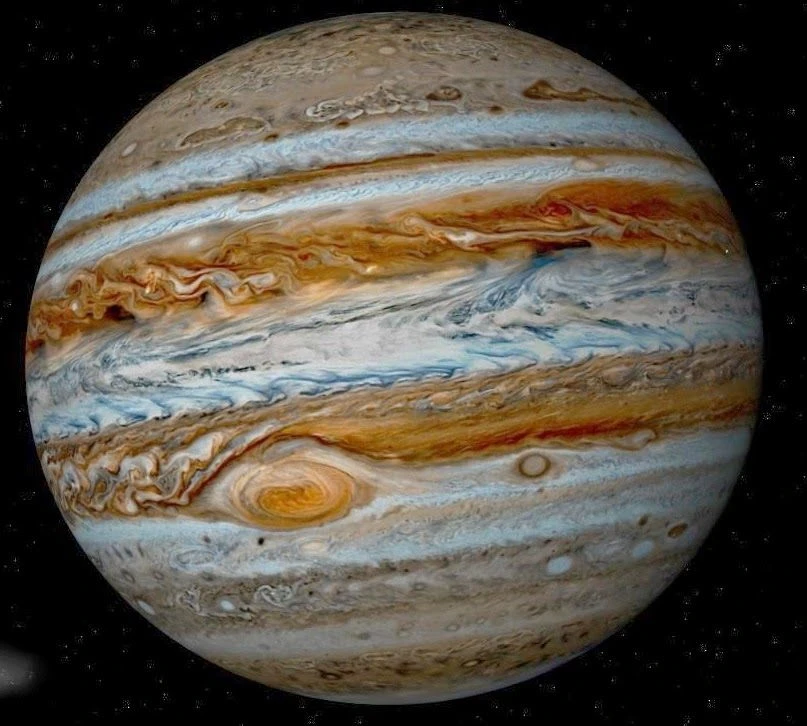
Voyager discovered Jupiter's thin, almost invisible rings, demonstrating that its complex ring structure is not unique to Saturn. Combined with the discovery of new small moons, this reveals the giants to be entire "mini-solar systems" rather than just isolated planets.
Icy Worlds with Signs of Internal Activity 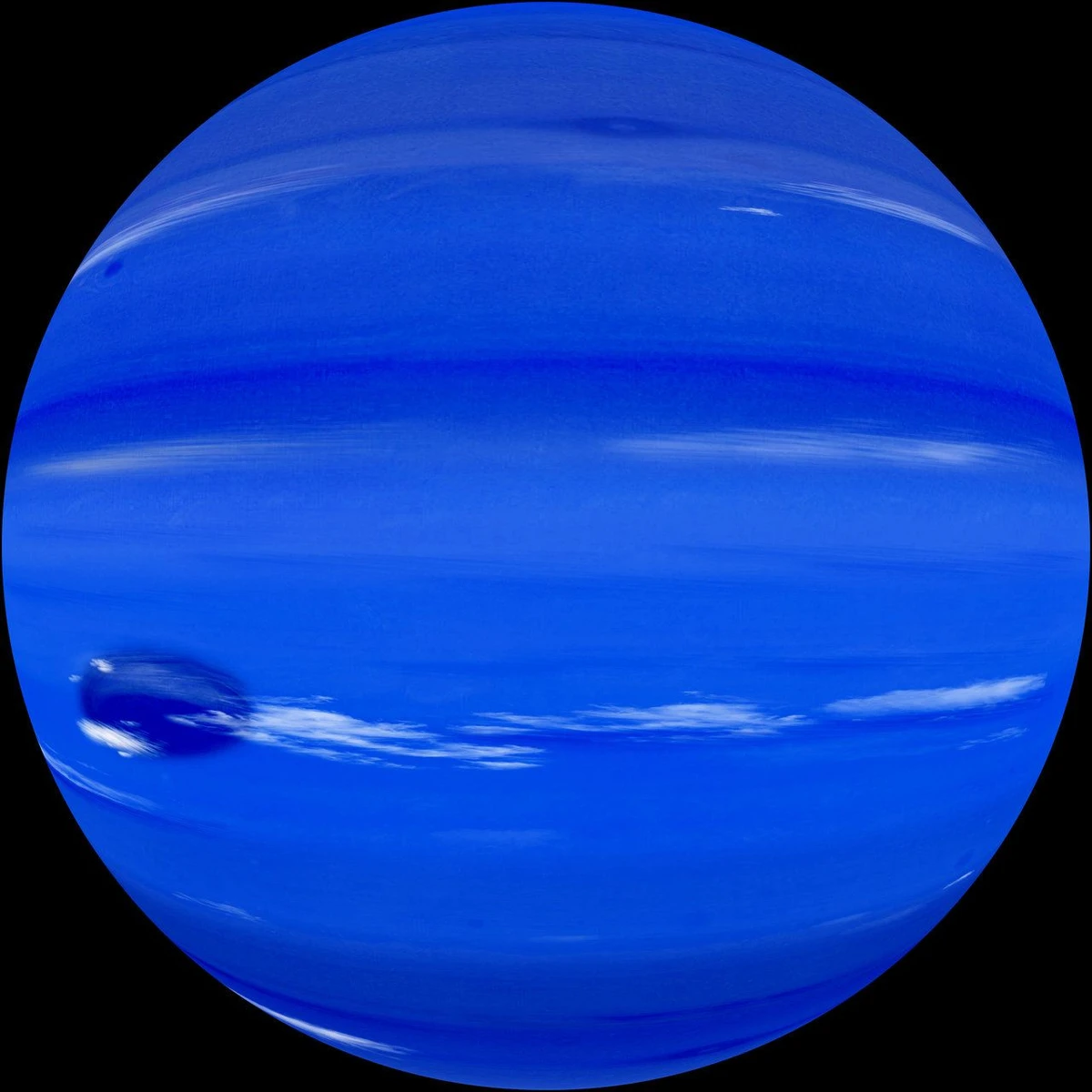
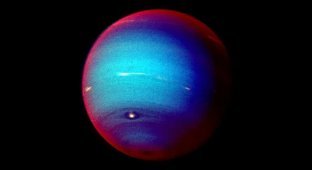
Neptune
Images of Europa, Ganymede, Enceladus, and other icy moons revealed cracks, young surfaces, and hints of subsurface oceans for the first time. It was this data that later inspired missions to oceanic worlds and made the idea of "life beneath the ice" a scientifically serious concept, rather than science fiction.
The Real Shape and Boundary of the Heliosphere
Flying to the edge of the Sun's influence, the Voyagers measured how the plasma velocity and density changed, how the solar wind flowed, and how it collided with interstellar gas. It turned out that our heliosphere is neither a perfect sphere nor a long "comet tail," but a complex bubble with a dense, hot edge where the Sun literally collides with the pressure of the galaxy.