NASA's Voyager 1 spacecraft is often called the first man-made object to reach interstellar space. It sounds epic. It seems as if a probe created by humans in the 20th century has left its home planetary system and is now flying among the stars... 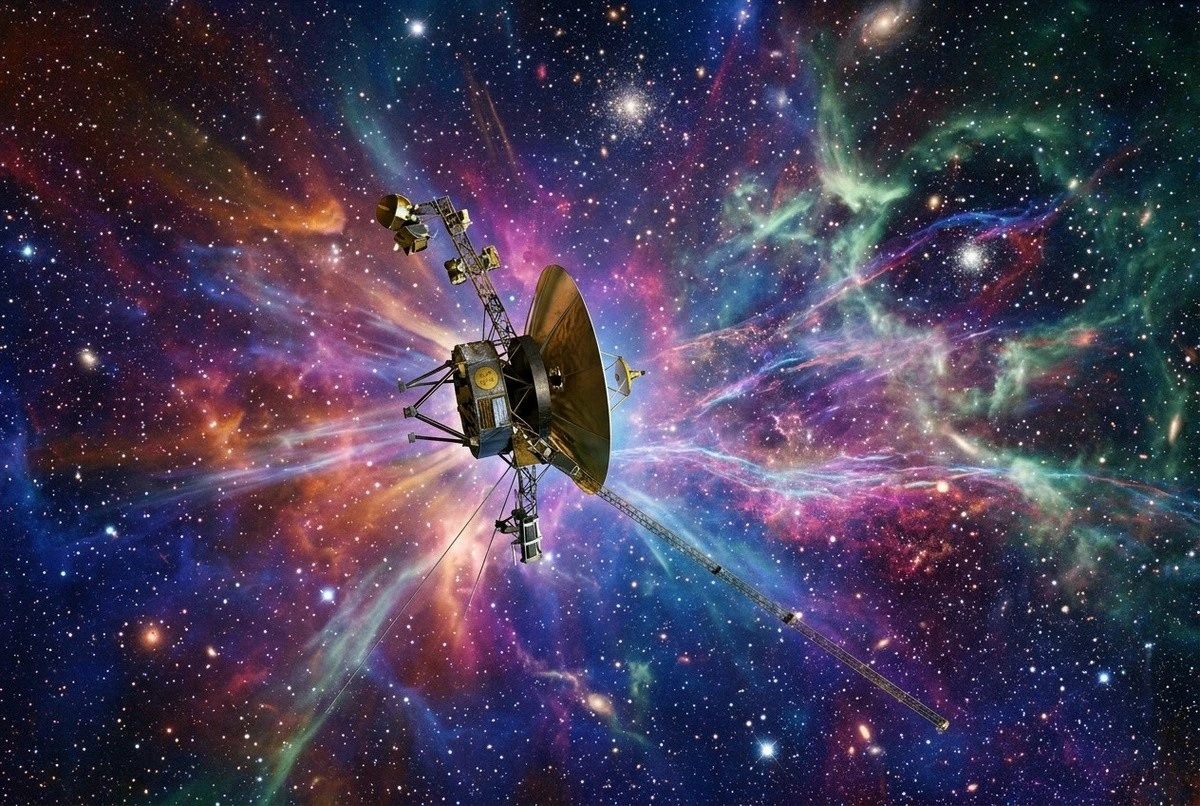
But there's an important nuance here. Voyager 1 did indeed reach interstellar space, but that doesn't mean it left the Solar System.
How so? Let's find out.
In 2012, Voyager 1 crossed the heliopause, the outer boundary of the heliosphere. The heliosphere is a giant "bubble" of near-solar space, filled with a stream of charged particles—the solar wind—and strongly influenced by the Sun's magnetic field. Within the heliosphere, the Sun dominates, but beyond the heliopause, the interstellar medium begins to play a major role.
This is why scientists say Voyager 1 has entered interstellar space: it is no longer within the protective bubble of the solar wind. But the Solar System is not only a region filled with solar wind. The Sun also exerts a gravitational influence that extends far beyond the heliopause.
The outer boundary of the Solar System is believed to be the Oort Cloud, a gigantic shell of mostly icy bodies bound by the Sun's gravity and located at a colossal distance from it. It is from the Oort Cloud that long-period comets originate.
And Voyager 1 hasn't even reached this region yet.
NASA calculations indicate that it will take the probe about 300 years to reach the inner edge of the Oort Cloud. Passing through the Oort Cloud will take another 30,000 years. Then we can say that humanity has escaped the Solar System and is heading for the stars. It's no secret that civilizations don't last that long, so there will likely be no one to be proud of this achievement. Or perhaps our distant descendants, inhabiting the remnants of our reality, will simply forget about it while solving the earthly problems we generously prepare for them.
This creates a strange, but physically accurate, picture: interstellar space begins before the Solar System ends. 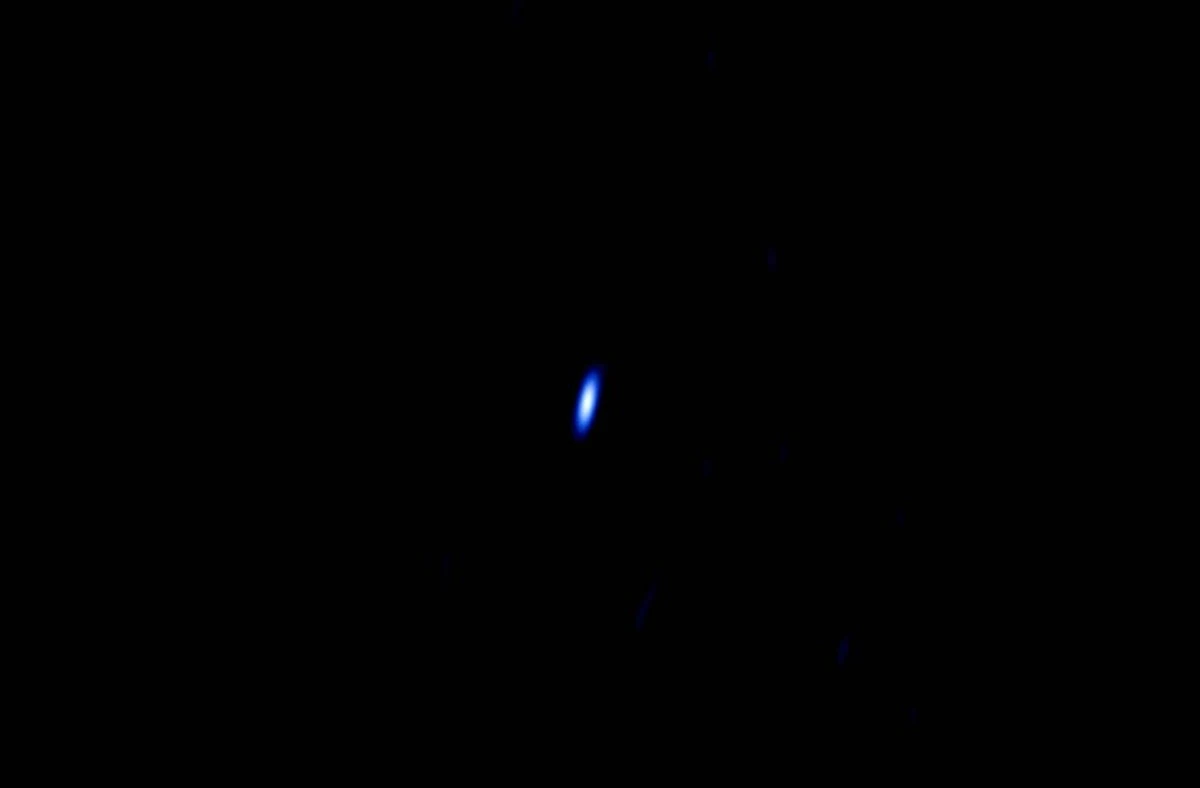
Voyager 1's radio signal, recorded on February 21, 2013, by the Very Long Baseline Array of the National Radio Astronomy Observatory. At that moment, the spacecraft was approximately 18.5 billion kilometers from Earth.
In fact, Voyager 1's journey is just beginning.
After its launch in 1977 and a series of gravity assists near Jupiter and Saturn, the probe reached a tremendous speed—approximately 61,200 kilometers per hour—and continues to move by inertia. In space, there's virtually no drag that could quickly slow it down, so the spacecraft doesn't need to constantly "burn fuel" to continue its journey, which has no final destination.
Voyager 1 is currently the most distant man-made object, heading toward the depths of interstellar space. But even such a tremendous speed by human standards seems insignificant on the scale of the universe.
Add your comment
You might be interested in:













Persistence in achieving a goal

A biker prevented a hit-and-run driver from escaping

Not everyone is having fun on the amusement ride

A dog sees itself on a phone screen

A visitor at a Bangkok zoo provoked a hippopotamus

A race for a parking spot

Young women, Dancing and George Michael: nothing superfluous

Ten seconds for a free haircut

A lock that didn’t give in after a few seconds
