Greenland Shark: Lives 500 Years, and Its Body Doesn't Degrade with Age (7 photos)
Today, the Greenland shark is considered the longest-living vertebrate on the planet. Radiocarbon dating of the shark's eye lens has shown that they can be over 500 years old! This is several times longer than the lifespan of other record-holders, such as giant turtles, bowhead whales, and humans. 
— What's the secret of your long life? — I watched absolutely every conspiracy theory video and discovered the truth.
Of course, the latter are extremely interested in this anomalous fish. And while some simply study it as a biological curiosity, others ask, "Can humans do the same?"
We previously believed that the abnormally long lifespan of Greenland sharks was a side effect of their adaptation to specific environmental conditions. For most of the year, the sharks inhabit the deep regions of northern waters, where resources and energy are catastrophically scarce. To survive here, they must feed on anything: shellfish, worms, carrion, any kind of fish. The largest sharks even attack seals sleeping on the ice, compensating for their slowness with surprise. 
Your face, before you've even woken up, but really, you don't need to.
However, it turns out it's not that simple. Research in recent years shows that shark metabolism isn't just slow, it's abnormal. In the vast majority of animals, metabolic processes gradually slow with age. Explosive growth and development in childhood are replaced first by stable maturity, and then by the fading of old age. But for Greenland sharks, it's different: the metabolism of newborns and elders twice Pushkin's age is practically identical. Their enzymes, protein production rates, and thousands of other processes proceed at the same speed and efficiency, regardless of age. 
— Grandpa, tell me about the war? — Well, listen. Peter the Great and the Kingdom of Sweden once had a fight over the Baltic Strait...
This small difference in metabolic rate is partly due to the fact that Greenland shark pups are exceptionally slow. They spend 8 to 18 years in their mother's womb (Greenland sharks don't lay eggs, but carry them internally), and after leaving their mother, they grow at a rate of only 1-2 centimeters per year, slower than trees! Even though they live in a kind of nursery—the relatively safe and food-rich shallows of Europe and the East Coast of North America—it's logical to expect that if their basal metabolic rate is so low, it would be very difficult to drop below that. 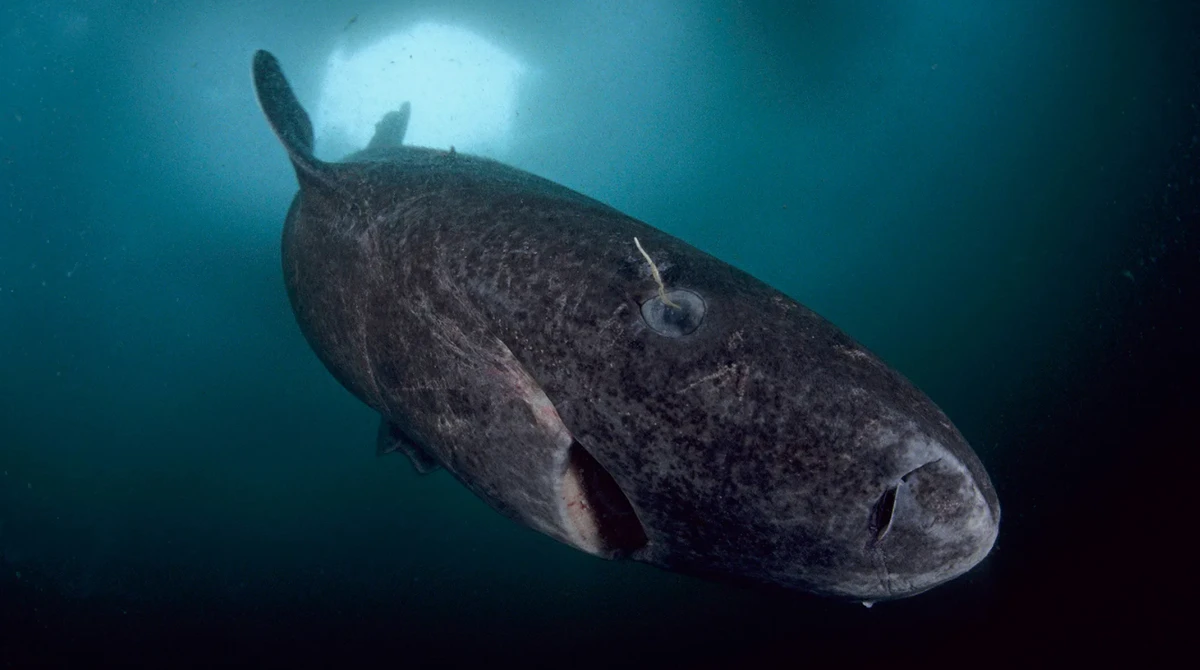
The shark may grow very slowly, but with its long lifespan, the fish can grow up to 5-6 meters in length and weigh up to a ton.
However, there's more to it. Greenland sharks have unique mechanisms for genome repair and restoration, as well as cellular regeneration, which complement the body's standard self-repair mechanisms. And they are so perfect that even their retinas—one of the most fragile tissues in the body—are perfectly fine after a couple of centuries of close contact with parasites. 
Your face, when your eyes have been constantly itching for three centuries...
The eyes of almost all adult Greenland sharks are infested with luminous copepods, which anchor themselves in the cornea with special hooks. In humans, such contact with the arthropod would surely lead to rapid vision degradation. That's why we long believed that decades of such close contact would inevitably lead to blindness. 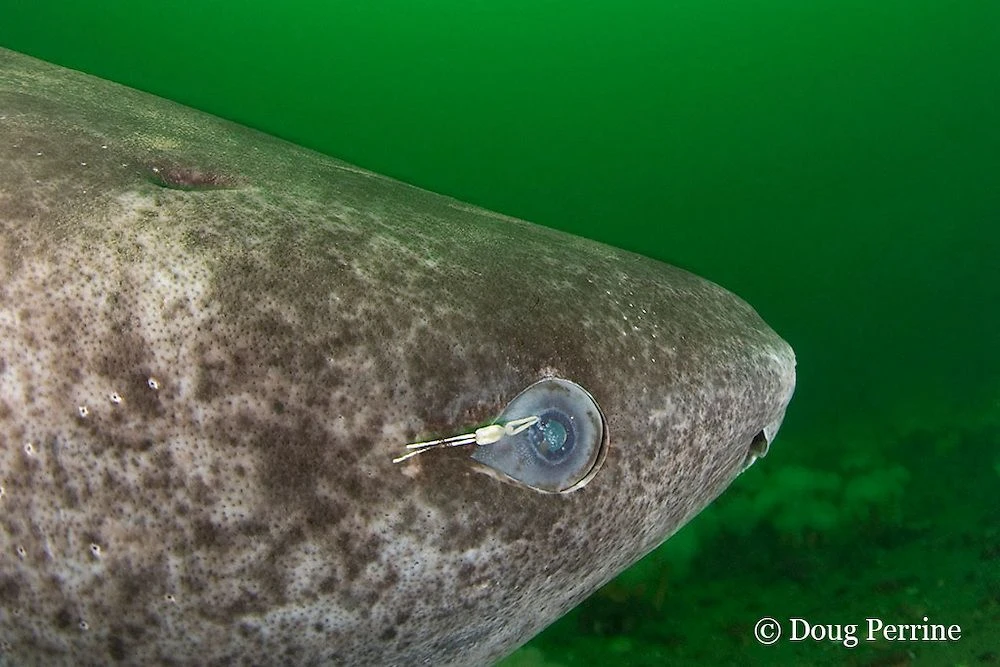
Slight discomfort. If you look closely, you'll find these cancers on the eyes of the sharks in almost all the photos in the article.
Well, no way. This winter, an international team of scientists was able to study parasite-infected sharks aged 130-150 years and found that their vision was as sharp as in their youth. They didn't even show age-related changes in the retina! 
Life has certainly taken its toll on you...
It's a shame that this knowledge is completely inapplicable to humans. The physiology and lifestyle of Greenland sharks are so different from ours that their methods for prolonging life and organ health simply wouldn't work for us, even theoretically. But they are extremely useful for a general understanding of how regenerative mechanisms work at the cellular level.