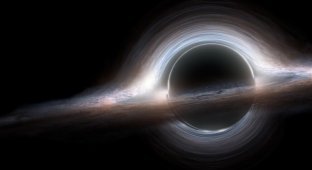
This world is filled with countless highly unconventional and even insane hypotheses, but one of the most ambitious deserves special attention. According to the idea discussed in this article, our Universe may be located inside a black hole. Not somewhere near it, not on its edge, but inside it—as a separate space-time born on the other side of the event horizon. 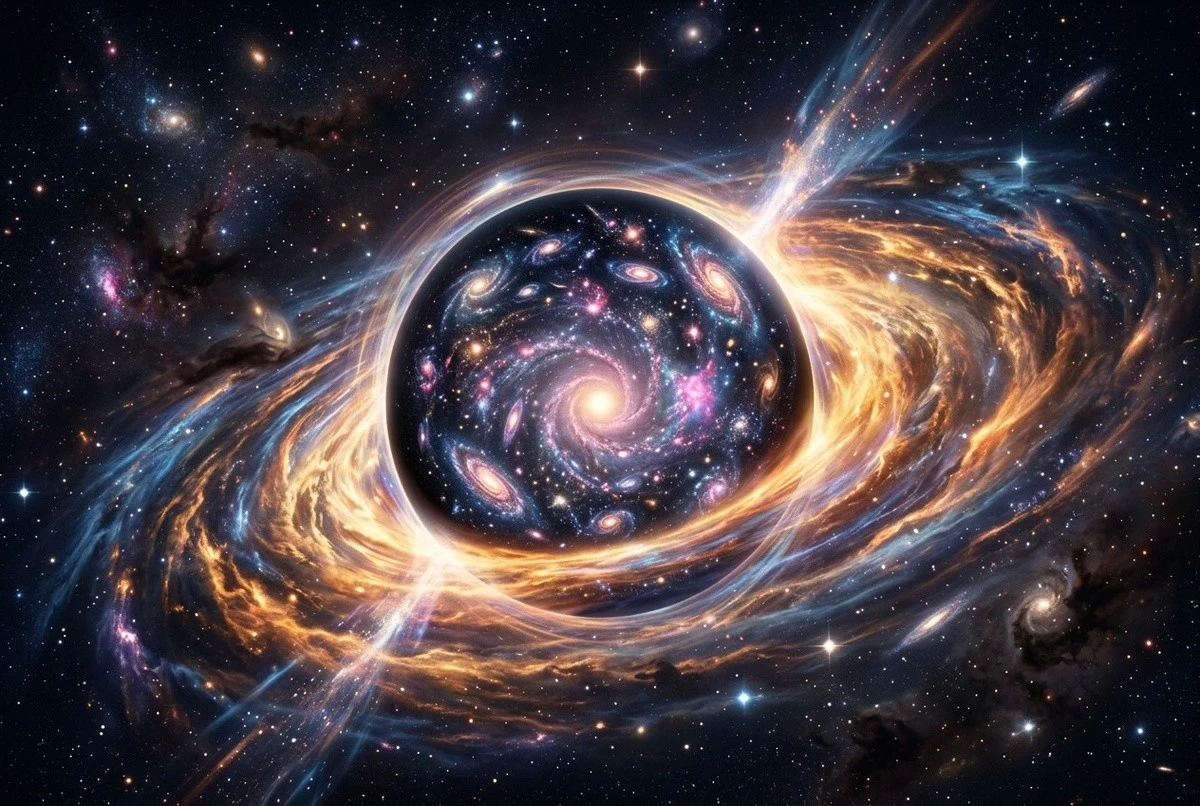
Why am I attaching so much importance to this concept? Because in modern theoretical physics, this hypothesis is far from just a free flight of fancy juggling pseudo-scientific terminology. This hypothesis has already accumulated several compelling arguments, forcing astrophysicists to return to it again and again.
The key here is not to imagine a black hole as a giant pit. According to general relativity, a black hole is a region of spacetime from which nothing can escape. For an external observer, the point of no return is the event horizon. But what happens "inside" a black hole, beyond the event horizon, is a much more complex question.
In the classical picture of the universe, everything that falls into a black hole irreversibly rushes toward a singularity—a state where the density and curvature of spacetime become infinite. It's important to clarify here that in physics, a singularity isn't a real thing, but rather, in fact, the limit of applicability of our theories. In other words, a singularity isn't a real point with infinite mass and density, but a place where our mathematics simply stops working.
And here comes the first strong argument in favor of the idea voiced at the beginning.
A cosmological singularity is a hypothetical initial state of the Universe, based on the classical extrapolation of its expansion back to the moment of the Big Bang. This means that what would appear to an external observer as a collapse into a black hole could, internally, lead not to the final annihilation of matter, but to the birth and rapid expansion of a new space.
In other words, a black hole in this model turns out to be not simply a "matter devourer," but a possible region where the collapse of matter transitions into the birth of a new Universe. 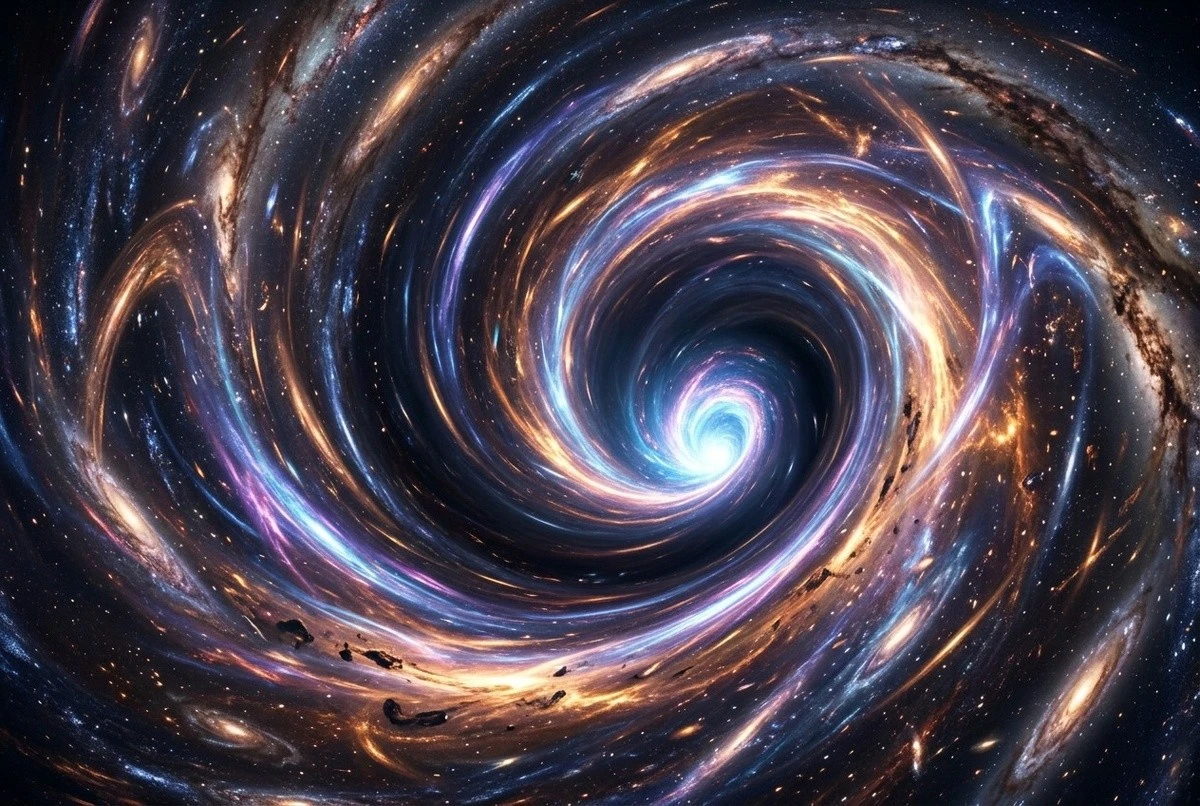
And here comes the second argument, based on the Einstein-Cartan theory. Unlike general relativity, it allows not only for the curvature of spacetime associated with mass and energy, but also for its twisting—torsion. The source of this torsion is the spin of matter, that is, the internal angular momentum of particles. Under conditions of extreme density, unattainable in any laboratory, a repulsive effect can occur, preventing matter from collapsing to a point. Instead, a rebound occurs: the collapse stops, and then the expansion begins.
Well, you understand, right?
A black hole is born, greedily absorbing matter, which compresses within it to a certain limit, and then, instead of disappearing into "impossible infinity," enters a phase of expansion. This is suspiciously reminiscent of what we call the birth and evolution of the Universe.
The third argument has to do with the event horizon. If our Universe truly began inside a black hole, then the "parent" region is inaccessible to us, no matter how sophisticated our instruments. Because nothing can escape the black hole or transmit information outward.
This resonates well with the nature of the cosmological horizon. If we were the center of the observable region of the Universe, its diameter would be approximately 93 billion light years. Anything beyond that is fundamentally inaccessible to direct observation due to the incessant expansion of the Universe and the limited speed of light.
That is, the hypothesis does not require that our observations at some point reveal the walls of a black hole. For inhabitants of such a universe, everything would appear as expanding space-time, the boundaries of which are impossible to sense or see.
The fourth argument is the direction of time. Once past the event horizon of a black hole, movement is only possible in one direction. That is, it is impossible to enter a black hole and then turn around and begin moving backwards. This creates a natural asymmetry: the past and future cease to be equal directions.
Our universe also has an arrow of time. We remember the past, but not the future. Entropy increases. Events unfold in one direction. And no one can simply return to the past because it is physically inaccessible to us.
The fifth argument concerns the rotation of black holes. This is a proven fact. But what about objects in our Universe? Everything in it is always rotating! Matter falls into black holes with angular momentum. This means that a black hole has a rotation axis. If a new Universe is born inside a rotating black hole, it should inherit some "memory" of this axis. Then there should be some weak, preferred direction in the structure of the cosmos.
This is precisely why the data from NASA's James Webb Space Telescope has caused such a stir. The JADES deep survey found that there are significantly more galaxies rotating in one direction relative to the Milky Way than in the other.
Of course, all of this can be explained by large-scale asymmetry. But on the other hand, it is also consistent with the birth of the Universe inside a rotating black hole.
The sixth argument is informational. Black holes have long inspired physicists to consider the connection between gravity, quantum mechanics, and information. Related to them are the ideas of black hole entropy and the holographic principle, according to which information about a three-dimensional region can be "recorded" on its two-dimensional boundary. 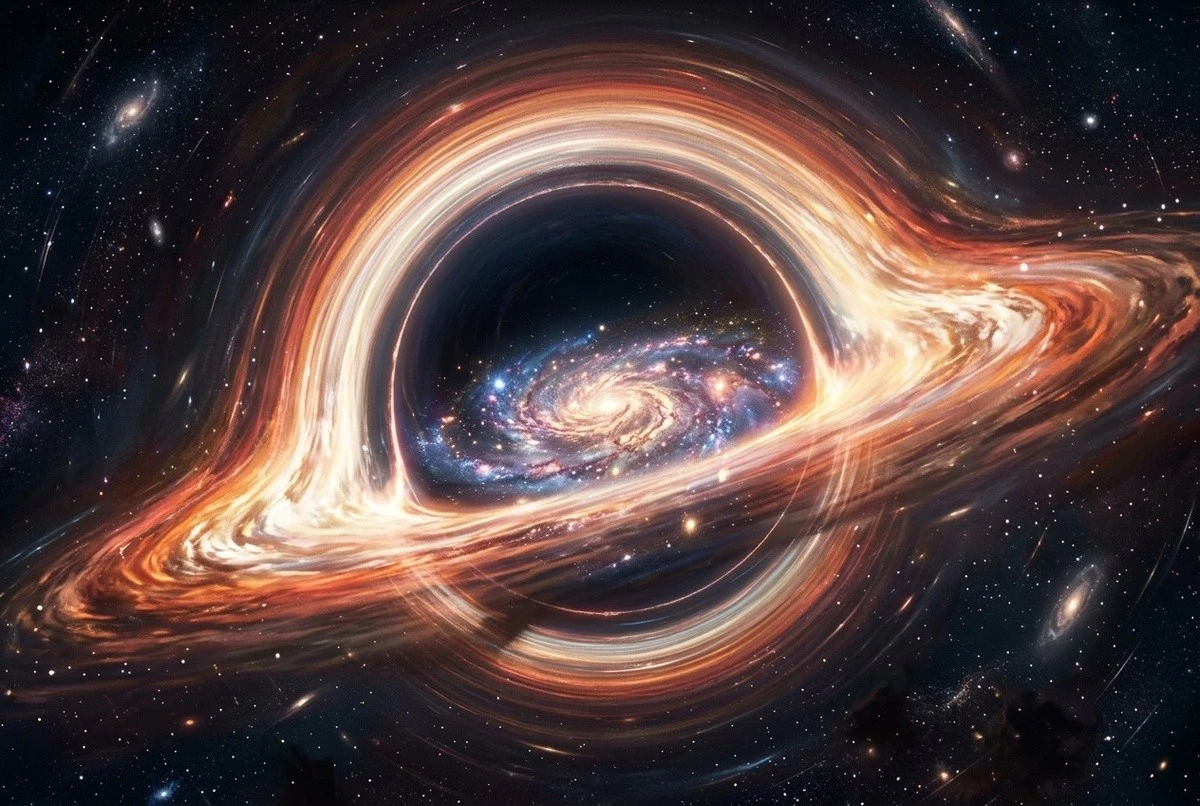
And this can naturally circumvent the singularity problem. Instead of an impossible point with infinite mass and density, a physical transition appears: collapse in one world becomes the beginning of expansion in another. Black holes in this scenario are not the end of history, but a mechanism for "cosmic reproduction."
It's like a Russian doll: black holes are born in one universe, new universes are born inside them, and within those, further black holes and new worlds are born.
So, the hypothesis that our universe is located inside a black hole is logical and can explain a number of profound questions: the nature of singularities, the arrow of time, possible large-scale asymmetries of the cosmos, and the fate of matter that falls beyond the event horizon.
However, this is not yet a proven picture of the world. But if the hypothesis is correct, then each black hole could be not only the end for infalling matter, but also the beginning of a whole new cosmos.
Read also:
Confirmed: An isolated black hole is wandering 5,000 light years away.
An extremely rare black hole has been discovered at the center of our galaxy.
The parasitic black hole "devoured" a star from the inside.
Add your comment
You might be interested in:













20 Personal Photos of Celebrities That Ooze Vintage

Global Sex Symbol: Rare Photos of Monica Bellucci (26

Animal Paws and Claws: 50 Photos That Will Surprise Even

America's Cheese Caves: How and Why the US Government

Fascinating Facts to Blow Your Mind (10 Photos)

How an Airline Pilot Was Sucked Out of the Cockpit

Thieves Stole NVIDIA Rigs Hunting for Scarce GPUs, But Got

This Korean Photo Studio Might Just Take the Best Family

Hilariously Awful Design Fails That Make Zero Sense (20
