The Story of Plasterer Eddie the Eagle—the Most Unusual Olympian in History (10 photos)
British ski jumper Michael Edwards never won a major sporting title or medal at his only Olympic appearance. Despite this, his name is familiar to millions, and in 2016, a film about his life, "Eddie the Eagle," was released. What made this shy guy with thick glasses, who never quite achieved stardom in professional sports, so famous? 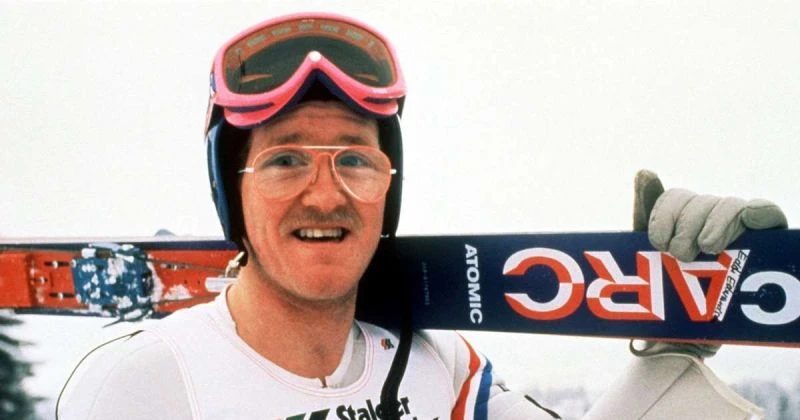
Michael Edwards, known to the world as Eddie the Eagle, was born in Cheltenham, England, on December 5, 1963, to a working-class family with no connection to sport. Eddie's father, from a line of plasterers, seriously expected his son to become the fourth generation of Edwards to dedicate themselves to the profession. 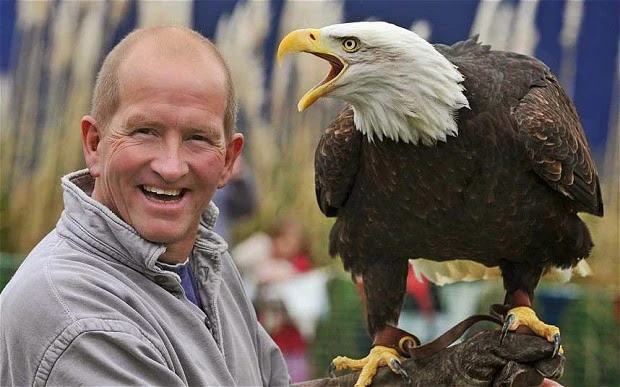
Eddie, nicknamed by his classmates after his last name, Edwards, was drawn to extreme sports from childhood. The boy had very poor eyesight, but this didn't stop him from participating in all the sporting activities of his peers. At age 10, while playing football with friends, Eddie suffered a complex leg fracture that required three years of treatment. Despite this, at age 13, barely out of crutches, young Edwards became interested in alpine skiing.
Having demonstrated enviable persistence in training, Eddie was noticed by sports coaches, and at 17, he was accepted into the British downhill team. The young plasterer made his choice – he abandoned his ancestors' profession, which he had barely begun to master, and devoted himself entirely to sport. It must be said that Eddie's parents weren't thrilled with this decision, but arguing with him was pointless.
Having barely shown his first decent results, Eddie became obsessed with the idea of competing in the 1984 Sarajevo Olympics. He trained day and night and showed good results in the trials, but missed out on just a few points. Despite being left out, Eddie didn't lose his desire to achieve his goal; instead, he became even more determined to work on his technique. 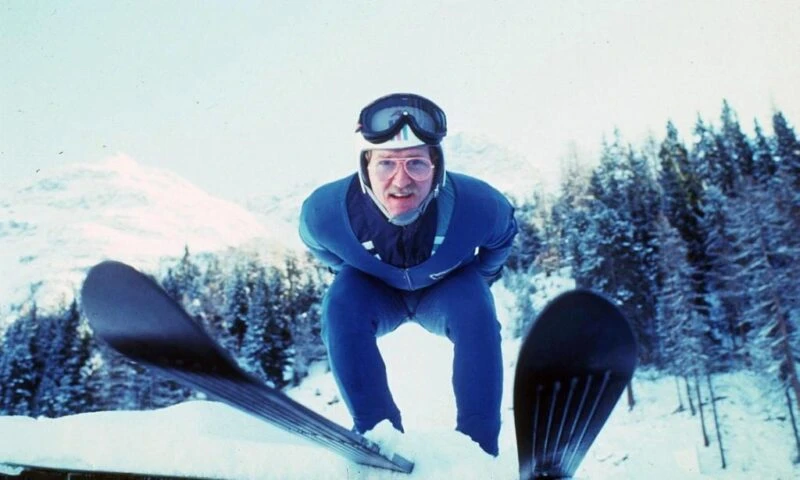
In 1986, Eddie left the British national team, and then his homeland, to train in the United States. For this purpose, he chose the best location – Lake Placid, where America's best skiers hone their skills. His next goal was the Calgary Olympics, which were just around the corner. But training abroad quickly emptied the British plasterer's meager wallet, and Eddie faced the prospect of an inglorious return to his homeland.
At this difficult moment, he suddenly saw ski jumpers training and realized that this was the sport he wanted to pursue. It was a wise decision, as Great Britain hadn't sent ski jumpers to the Games for 60 years, and Eddie had no competition. 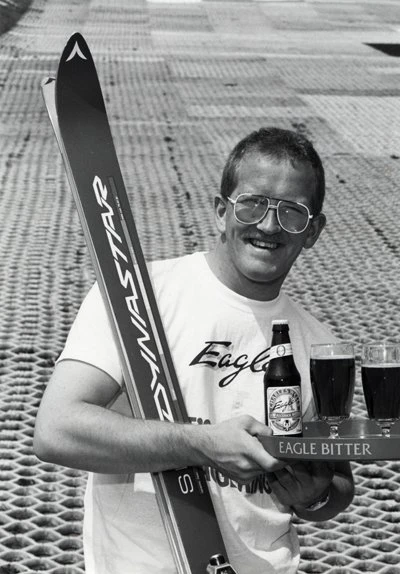
The Brit had never ski jumped before, but the 15-meter jump came easily to him. The very next day, Eddie moved up to the 40-meter jump, but then a series of failures befell him. The athlete fell repeatedly, and after a few days, he realized he couldn't cope without a mentor.
Local coach Chuck Berghorn agreed to help Eddie, helping him confidently master the 70-meter jump within six months. Bernhorn himself wasn't an Olympic champion, like Hugh Jackman's character in the biopic—he simply worked at a training center for 30 years, occasionally competing in amateur competitions. Chuck described his first impression of meeting Edwards this way:
"When Eddie came to sign the standard waivers in case he broke his neck under my supervision, I looked at him and couldn't believe I was going to coach him. Eddie was already an older man, wore the thickest glasses I'd ever seen, and was not at all the size of a ski jumper: he was stocky and clearly heavier than all his competitors." 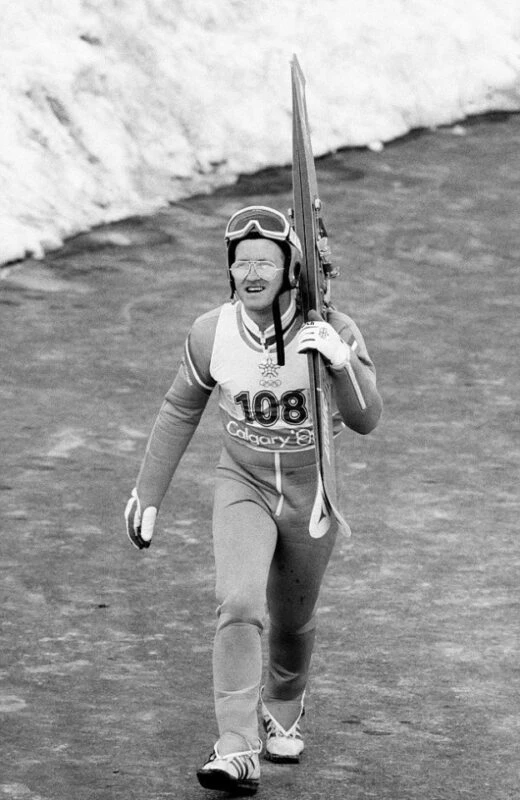
Eddie was a disaster for ski jumping. He weighed 82 kg, meaning he outweighed his heaviest Olympic competitor by 9 kg. He was farsighted, forcing him to wear prescription glasses under his ski goggles. Naturally, they fogged up mercilessly, and the Brit was practically jumping blind.
Eddie also suffered from a lack of money. He tied the old helmet Bernhorn had given him with rope, and his ski boots, which were several sizes too big, had to be worn over five pairs of socks. Unfortunately, just when Eddie was starting to get the hang of it, his money ran out and he was forced to return to Europe.
The boy showed up home in Cheltenham, but to his family's chagrin, he didn't act on his sanity. Instead, he borrowed his mother's car and set off to travel around Europe, honing his athletic skills. To earn a living, Eddie had to work as a loader, mow grass, cook in restaurants, and even change diapers for bedridden patients. But he was confident it was all worth it and had no intention of giving up. 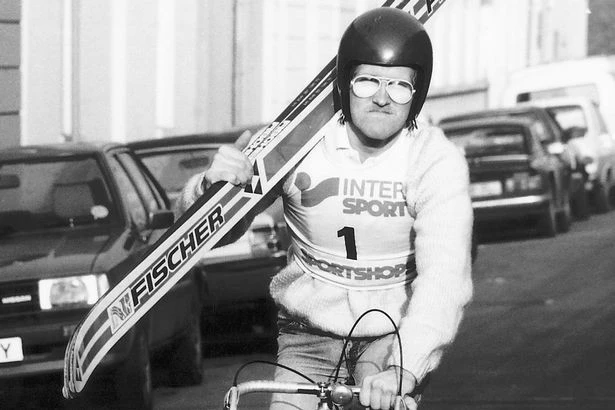
Money was always tight and often lacked the bare necessities. During one of his unsuccessful jumps, Eddie broke his jaw, but he had no money to pay the doctor. So the Brit simply strapped his chin with a pillowcase and continued training.
In 1986, Eddie achieved his first major success – at a competition in Kandersteg, Switzerland, he set a British national record of 68 meters. Some might say this was easy due to the lack of competition in his home country, but few could match what this brave, bespectacled young man accomplished, becoming a professional in an unfamiliar sport in just two years.
A year later, in 1987, Eddie was honored to represent Great Britain at the World Championships, where he placed last with a result of 69.5 meters. Nevertheless, it was a British record, as none of Edwards' compatriots ever competed in this sport again. 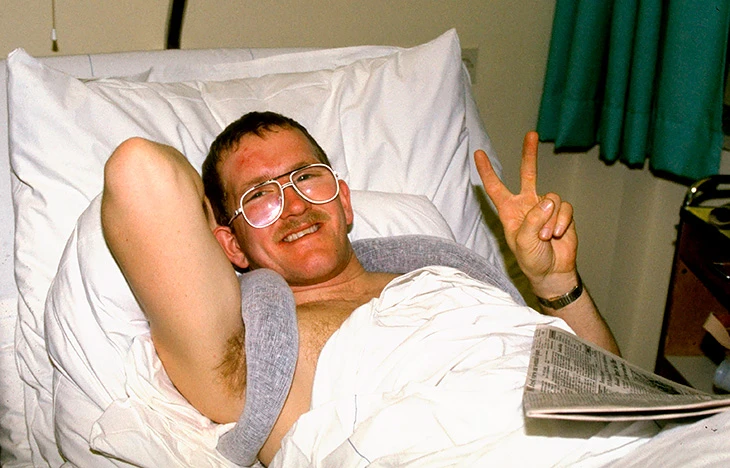
This success paved the way for Eddie to join his country's Olympic team. The news that his dream had come true reached the athlete in Finland, where he was training and living... in a psychiatric hospital. A room in a provincial mental hospital was the only accommodation the poor enthusiast could afford.
In 1988, Eddie arrived at the Calgary Olympics, where he got into several comical situations right at the airport and earned the proud nickname "The Eagle." Admirers of his athletic talent from Canada greeted Edwards with banners that read, "Welcome to Calgary, Eddie the Eagle!" Journalists were filming the meeting, and the new name stuck with Eddie.
At baggage claim, the athlete's suitcase suddenly burst open, and his shorts, socks, and T-shirts scattered across the conveyor belt. To the laughter of the crowd, Eddie calmly gathered his belongings and headed for the exit. Here, his poor eyesight played a cruel joke on him. Despite wearing glasses, the Olympian didn't notice the glass doors and slammed face-first into them at full speed, breaking his glasses and bloodying his nose. 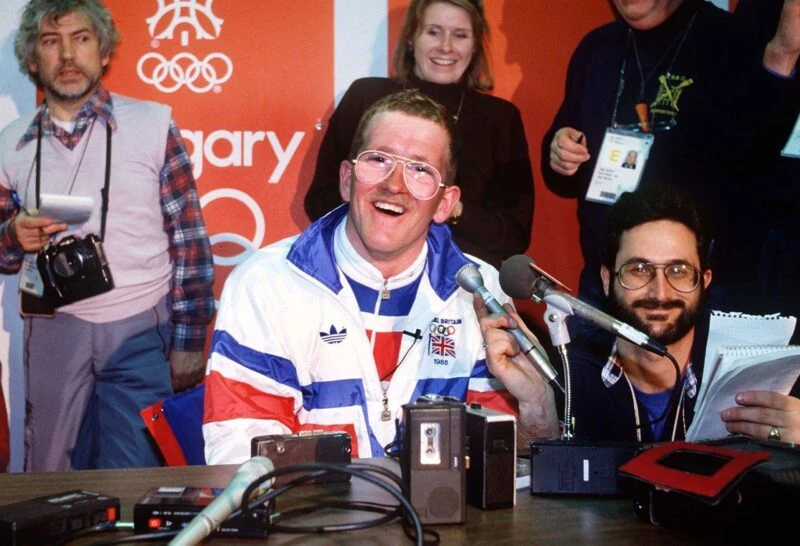
But Eddie the Eagle arrived in Calgary a crowd favorite. He was supported by many authoritative observers, who believed that he embodied the long-forgotten principle of the Olympics, articulated by its founder, Pierre Coubertin: "The most important thing is not winning, but taking part." At a press conference, Eddie declared, "Where is it written that the Olympics are only for winners?" This earned him a standing ovation.
The 70-meter ski jump competition took place on February 14. The first to compete was Olympic favorite Matti Nykänen, nicknamed the "Flying Finn." He leaped an incredible 118.5 meters, breaking his own world record. But many of the 46,000 spectators were more interested not in the Finn, but in the smiling redhead with large horn-rimmed glasses—Eddie the Eagle.
When he appeared on the ski jump, people chanted "Eddie! Eddie!" and even US President Ronald Reagan is said to have stopped working for a few minutes and watched the television. The Briton's two attempts didn't exceed 55 meters, and Eddie finished 58th, 16 meters behind his closest competitor! But this didn't disappoint anyone, and Eddie the Eagle himself looked happy and waved to his fans. 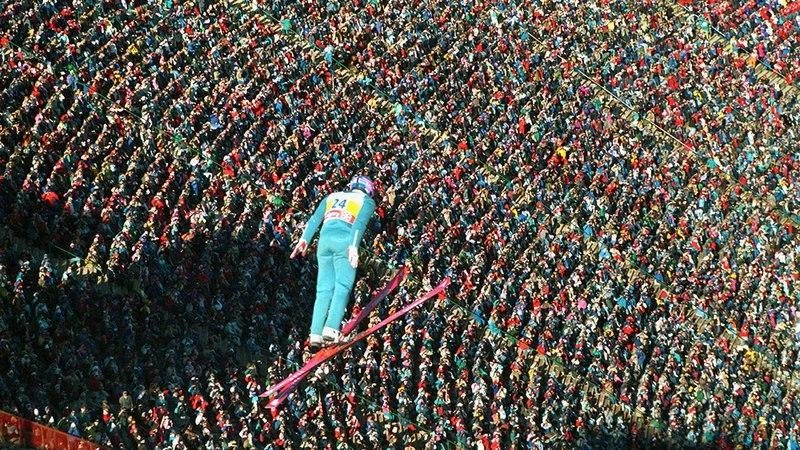
They tried to dissuade Eddie the Eagle from jumping from the 90-meter ski jump because there was a strong crosswind that day. But the stubborn Englishman jumped and set both a personal and British record, flying 71 meters. The final result was 55th place out of 55 possible, but the main goal was achieved – Eddie the Eagle made it to the Olympics and, despite his modest result, made sporting history for his country.
Eddie had hoped to compete at the 1992 Games in Albertville, but new Olympic rules ruled this out. Only athletes ranked in the top 50 in the overall standings were now eligible. The Eagle also failed to qualify for Lillehammer in 1994 and Nagano in 1998.
But these setbacks didn't stop Eddie the Eagle from becoming a worldwide celebrity. As a TV show star, he earned hundreds of thousands of pounds and finally left poverty behind. Eddie appeared in commercials and even recorded several songs in both his native language and Finnish! His English-language single "Fly, Eddie, Fly" even reached the top 50 of the UK charts. 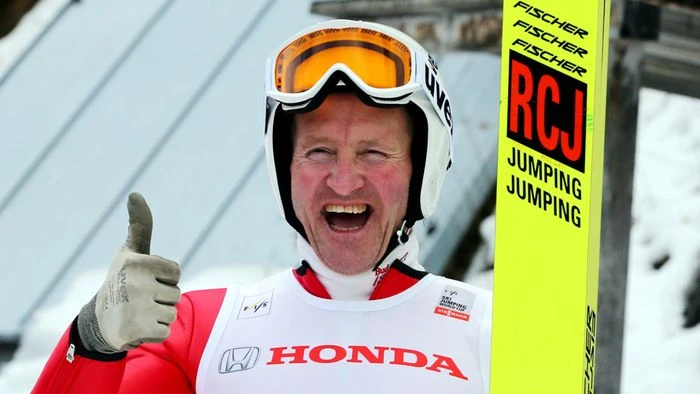
After achieving success, Eddie studied law at university, but he didn't settle for a boring office. He continued his involvement with sports and began coaching young athletes. In 1988, he wrote a book about his athletic career, and in 2015, he became a consultant on a biopic about himself. In 2010, Eddie the Eagle returned to the Olympics, carrying the Olympic torch in Vancouver, Canada.