A story about the German Pz.Sp.Wg.II Ausf.MAN Luchs reconnaissance tank from the collection of the Bovington Tank Museum 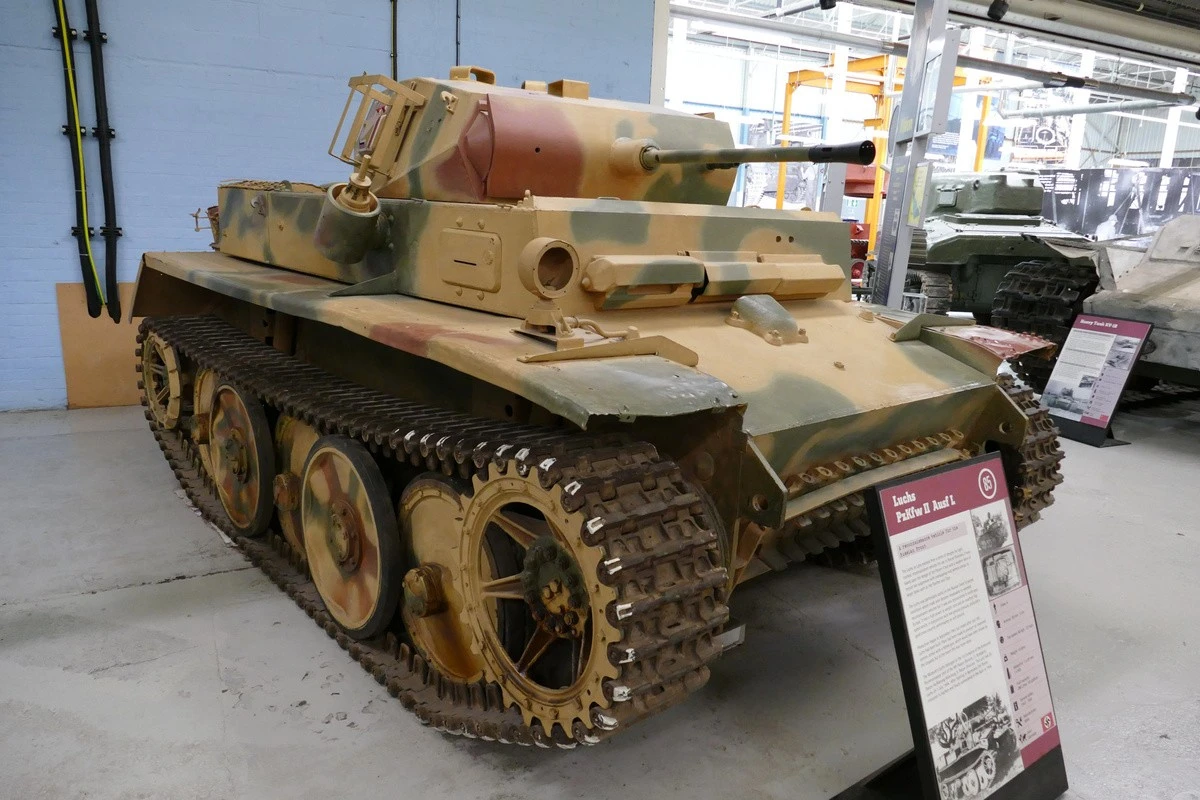
Pz.Sp.Wg.II Ausf.MAN at Bovington.
During the interwar period, light tanks became the mainstay of the armored forces of the vast majority of armies. They were cheaper, simpler, and more numerous. Given the limited budgets of the 1920s, as well as the need to saturate troops with tanks, light combat vehicles proved indispensable. However, by the beginning of World War II, it became clear that they would not remain the main battle tank for long. In 1942-43, most countries abandoned light tank production, concentrating on light self-propelled guns. But light tanks were not completely out of use.
Despite the fact that light tanks were rapidly becoming obsolete, they found their place on the battlefield. However, not quite in the role they are often assigned. As early as the early 1930s, reconnaissance tanks emerged, which, as it turned out, had more potential. In some countries, their development was given high priority, although this did not always translate into large-scale production. This is precisely what happened with the Pz.Sp.Wg.II Ausf.MAN Luchs reconnaissance tank; one of two surviving tanks of this type is now housed at Bovington. 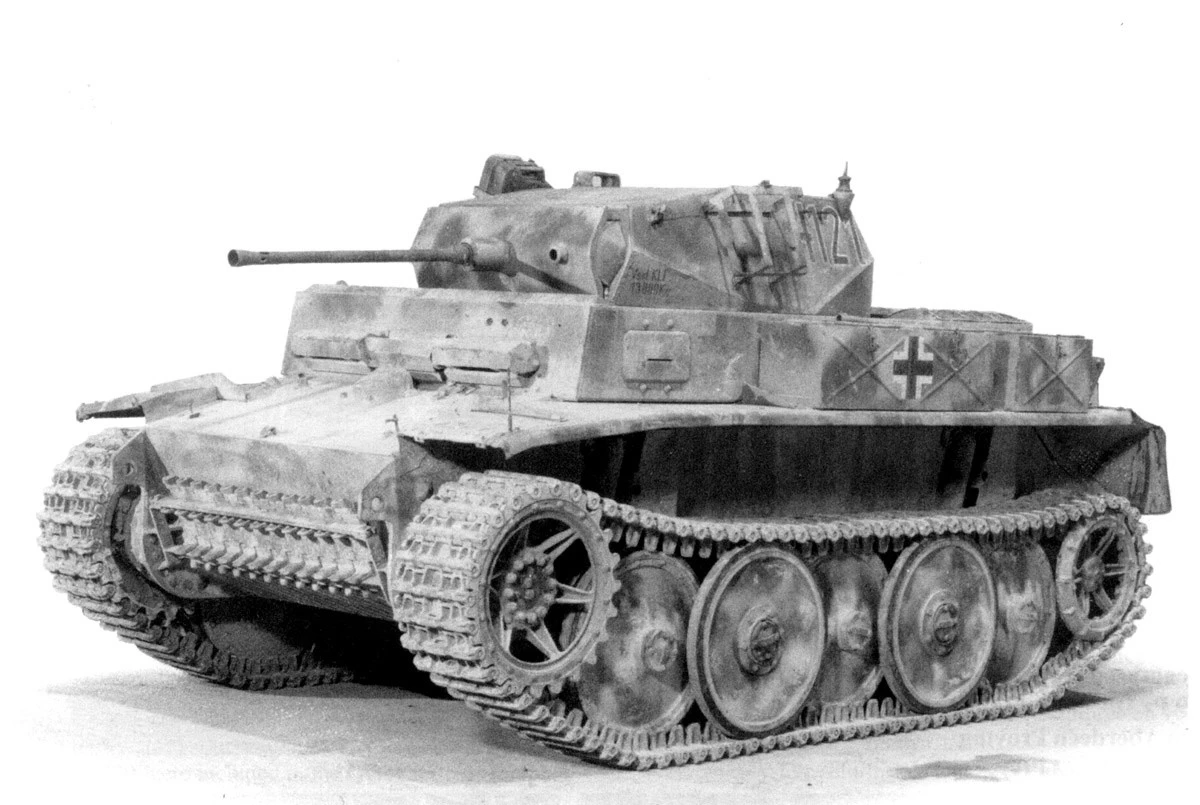
The same tank in 1944.
Reconnaissance for light tanks had been a function since the early 1930s, when tracked combat vehicles acquired more or less decent mobility. The French cavalry was the first to realize this. Generally, armored cars were the typical combat vehicle for cavalrymen, as they were faster than tanks. But in the early 1930s, the situation began to change. It turned out that the average speed of reconnaissance tanks and armored cars was very similar. Therefore, the French eventually adopted the AMR light tank under the designation "armored car."
The French weren't the only ones to call a tank an armored car. American and Japanese cavalry faced a very similar situation, though there it was usually a matter of classification (cavalry wasn't allowed tanks). However, a number of countries did enjoy high-speed reconnaissance tanks. The problem is that in most cases, these were more like light tanks for the poor. Especially in terms of their use. Either their mobility was insufficient, or their radio equipment was flawed, or both. 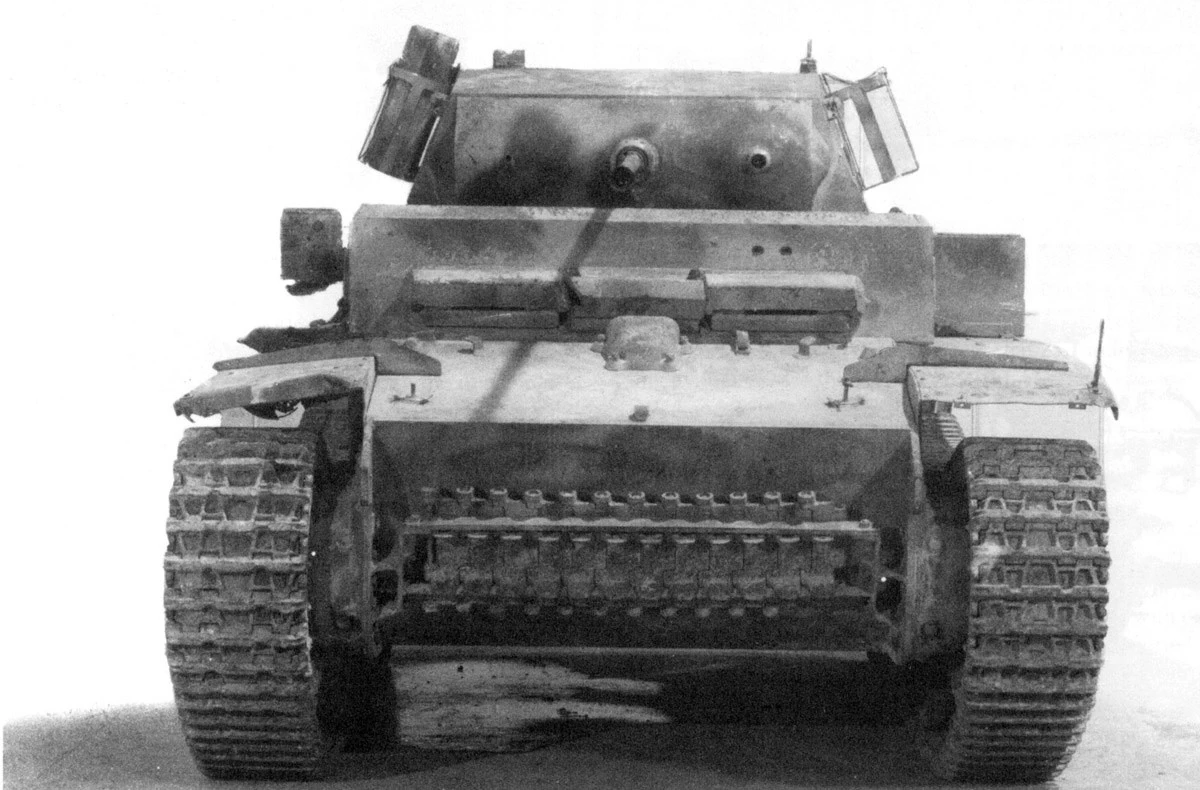
The distinctive fuel canister mounts are a hallmark of a tank from the 9th Reconnaissance Battalion.
The Germans strictly divided their tanks into tanks and armored cars, with the latter being used for reconnaissance units. Their light and heavy armored vehicles turned out quite well; at least on the highway, they had decent speeds. Potentially, the presence of all-wheel drive provided decent cross-country ability. But the first full-scale combat use of armored vehicles in September 1939 revealed that not all was well. Starting with the fact that the majority of German armored reconnaissance vehicles lacked radios and ending with their poor cross-country performance, on September 15, 1939, In 6 issued an order for a high-speed reconnaissance tank, designated Einheits-Aufklärungsfahrzeug (unified reconnaissance vehicle). It was intended to replace both light and heavy armored vehicles. According to the requirements, the reconnaissance tank's combat weight was estimated at 11 tons, and its maximum speed was at least 70 km/h. Moreover, such bold figures, in terms of dynamic performance, were not at all a fantasy. Speeds of around 70 km/h were quite realistic for tanks as early as the mid-1930s, and these were not at all wheeled and tracked tanks.
The German concept of a reconnaissance tank seemed quite interesting and, most importantly, potentially quickly implementable. The VK 13.01, as the new tank was named, was based on the promising VK 9.01 light tank. While the number typically denoted a weight class, the actual weight would have been 11 tons. The reconnaissance tank didn't replace the VK 9.01, but rather complemented it. The difference was the increased side thickness to 20 mm, as well as the installation of a two-man turret. This was necessary so that the commander/loader would become a separate crew member. The tank also received expanded radio equipment. The idea was good, but as usual, the Germans went off on a wild goose chase. For one thing, the very idea of loading a reconnaissance tank onto MAN was highly questionable. At that time, MAN had become one of the main manufacturers of the Pz.Kpfw.III. Loading it with light tanks would reduce the production of medium-class tanks. Apparently, the German command began to suspect this; it's no coincidence that on July 31, 1940, BMM and Škoda also received updated specifications for a reconnaissance tank. However, MAN was not relieved of its reconnaissance tank duties; in fact, it evolved into the VK 13.03, with a Maybach HL 66 P engine producing 200 horsepower. 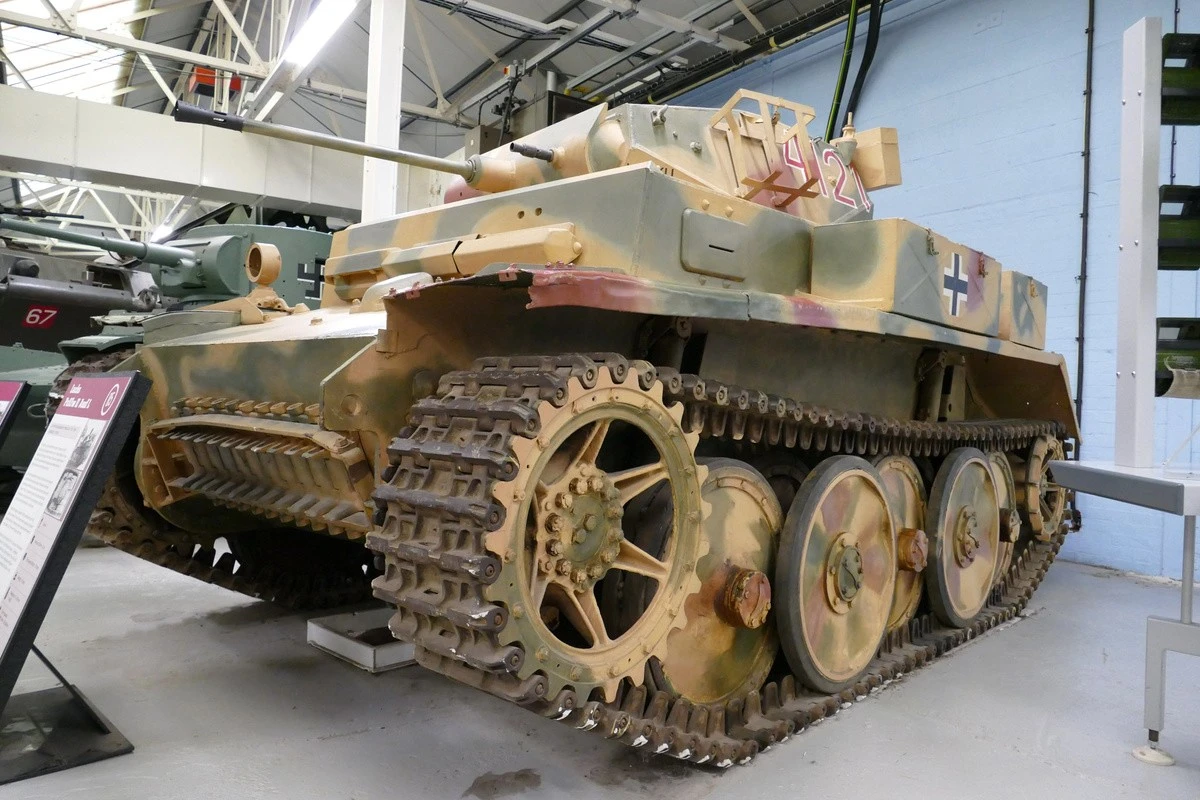
The bulk of the damage had been sustained 81 years earlier.
The result of all this was some unpleasant news. Firstly, the development of the reconnaissance tank dragged on, with the final decision being made in June 1942. Secondly, it was done out of touch with reality, meaning it failed to take into account the situation with production space. Thirdly, the two-man turret with a 20mm automatic cannon was no longer sufficient; the Pz.Sp.Wg.II Ausf.MAN, as the tank was then known, was to be equipped with the turret from the larger Gefechtsaufklärer Leopard reconnaissance tank. Therefore, the Luchs 2 cm, as the tank was also known, was to be produced in a run of only 100 units. Most importantly, these 100 units were stretched out over a year and a half – from September 1942 to January 1944. Could anything have been done differently? Of course it was. There was a Pz.Kpfw.38(t) n.A. reconnaissance tank, which was cancelled, most likely for political reasons. It was supposed to be equipped with German turrets (developed at Daimler-Benz). The ironic thing is that this isn't even an alternative history; the example of the Aufklärungspanzer 38(t) with a German turret is further proof of this.
This situation led to tanks of this type being available to only two units. These were the 1st Reconnaissance Tank Company of the 9th Reconnaissance Battalion of the 9th Panzer Division and the 2nd Reconnaissance Company of the 4th Reconnaissance Battalion of the 4th Panzer Division. Of these, the 1st Reconnaissance Tank Company of the 9th Reconnaissance Battalion was the most intensively used. Its first combat deployment was Operation Citadel, after which the unit was withdrawn for reformation. It was equipped with 29 tanks, meaning that in theory the production run would have been enough to form three reconnaissance companies. However, in reality, the remaining tanks were used to replace the losses of two companies.
The tank in Bovington (serial number 200117, produced in January 1943) belongs to the 9th Reconnaissance Battalion. In April 1944, it was sent to France, where it witnessed the Allied landings. As of July 1, 1944, the battalion had 26 Pz.Sp.Wg.II tanks, but by the end of August, it had lost them all. Considering that reconnaissance tanks, like armored cars, were largely expendable, this outcome is not surprising. Two tanks from the 9th Reconnaissance Battalion survive to this day, the second is in Saumur, France. This tank is in working order. 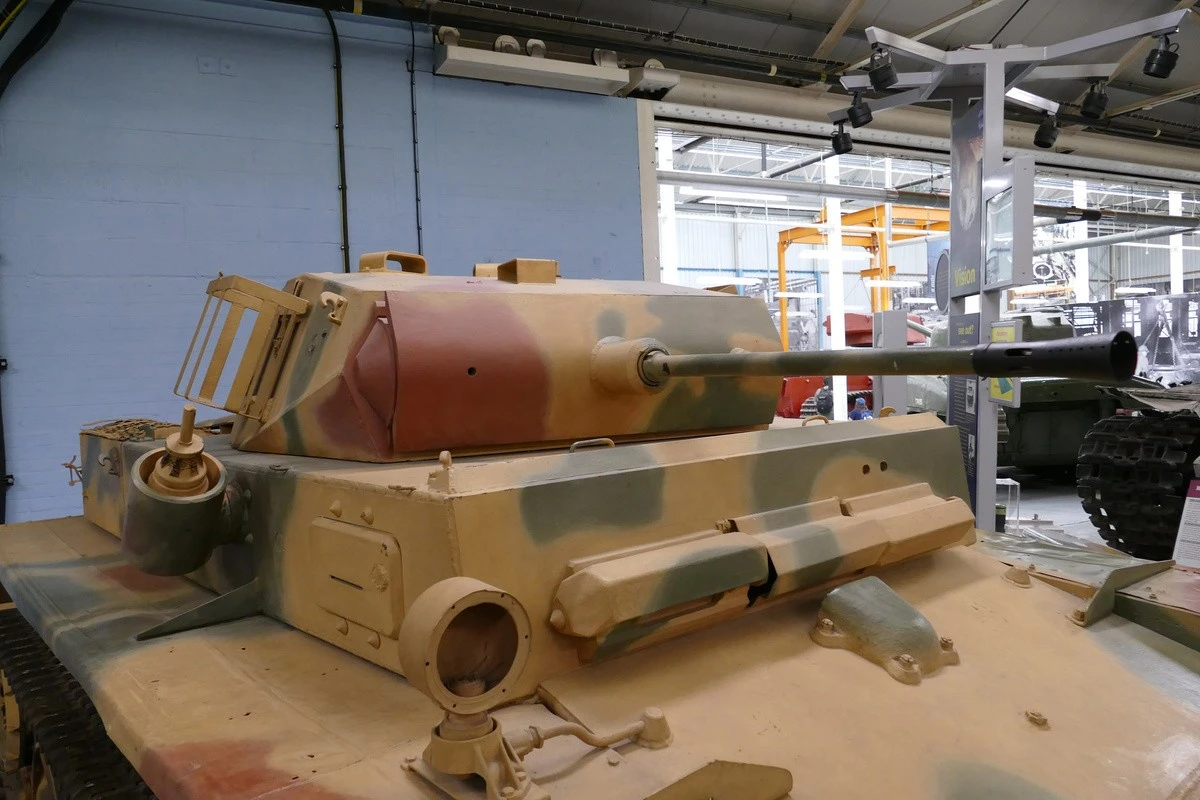
The Pz.Sp.Wg.II Ausf.MAN was the only mass-produced German light tank during World War II to feature a two-man turret.
This fate of the reconnaissance tanks doesn't necessarily mean they were inferior. Looking at the Pz.Sp.Wg.II from a purely technical perspective, there's no doubt about the adequacy of this combat vehicle. Of course, it didn't reach 11 tons, but 11.8 tons is still quite respectable. While the armor only provided protection against heavy machine guns, experience has shown that this is quite sufficient for a reconnaissance vehicle. The main factor was mobility, and the Pz.Sp.Wg.II had a very respectable power-to-weight ratio, just over 15 hp per ton.
The production Pz.Sp.Wg.II's speed was lower than the performance specification (60 km/h), but its average road speed reached 45 km/h. To put this into perspective, the Sd.Kfz.222 armored car had the same average speed, and it could only realize its advantage on roads. On dirt roads, the reconnaissance tank was faster than a wheeled vehicle, and even moderately difficult off-road conditions could be a trap for a wheeled armored vehicle. The tank, however, handled mud quite well. Also worth noting was the Pz.Sp.Wg.II's suspension, developed under the supervision of Heinrich Kniepkamp. It ensured a very smooth ride. In other words, the choice to develop a reconnaissance tank was entirely correct.
However, it wasn't just about speed. Besides the two-man turret, it featured excellent visibility solutions. Rarely did a German tank have rotating periscopes. Equally important, the tank boasted an impressive array of radio equipment. The radio operator had a Fu 12 SE 80 radio, which provided voice communications at a range of up to 25 kilometers. The commander also used a Fu.Spr.Ger.A radio with a voice range of 1 km. This equipment was equivalent to that of the Sd.Kfz.223 and Sd.Kfz.231 armored cars (8-radio).
Thus, from a general concept standpoint, the reconnaissance tank was truly equivalent to an armored car. Yes, it was significantly more expensive, but as a combat unit, it was more adequate. The German command's assessment of production capabilities proved inadequate. Moreover, as an analysis of combat experience showed, even a reconnaissance tank still needed a cannon armament. At least, that was the conclusion reached by the Americans, who were the most widespread users of reconnaissance tanks.
Add your comment
You might be interested in:











Persistence in achieving a goal

A biker prevented a hit-and-run driver from escaping

Not everyone is having fun on the amusement ride

A race for a parking spot
Changing a truck tire on the side of the road

An apology delivered with a running start
A steam locomotive for "big boys"

A dog sees itself on a phone screen

A visitor at a Bangkok zoo provoked a hippopotamus
